Web Platform Surfaces: A Consistency Review Map
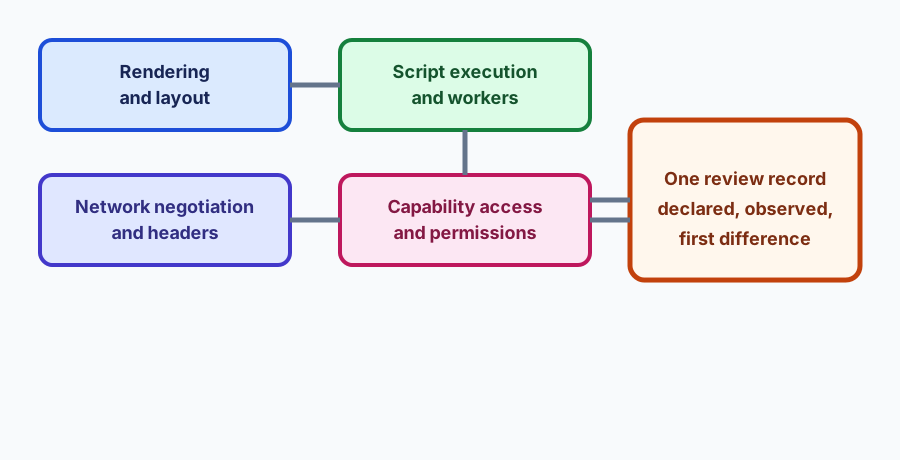
Map rendering, script execution, network negotiation, and capability access into one bounded platform consistency review that records a difference, not a verdict.
BotBrowser Team
Want the structured docs for Platform?
This article lives in the editorial library. For step-by-step setup, reference material, and ongoing updates, jump into the docs section.
Web platform consistency is a review order, not a single test. This hub connects the platform cluster and adds a bounded record that names the first surface that differences from the declared input, starting with Designing browser test matrices by platform and release.
BotBrowser supports repeating an authorized profile across contexts and can report bounded browser observations for each surface; it cannot certify standards conformance, rank two products, or predict what a third-party service will decide, and it does not replace the platform owner's review.
TL;DR
- Group platform behavior into four surfaces: rendering and layout, script execution, network negotiation, and capability access.
- Record the declared input beside the observed value for the same release and the same owned page.
- Name the first surface that differs, then stop and hand it to its owner.
- Treat reduction, fallback, and unavailability as legitimate states, not failures.
Contents
- Map the four surfaces
- Walk the platform cluster
- Run one bounded review
- Triage the first difference
- Conclusion
Map the four surfaces
Rendering and layout covers what the page paints: fonts, color, media queries, and how a document responds to the viewport.
A page is not one surface. It is a stack of surfaces such as document, iframe, and Worker that a browser implements separately, each with its own specification, its own release cadence, and its own failure modes. A team that asks "does this browser support our app" is really asking four questions at once, and the answers can disagree. Separating the questions is the difference between a review that ends in one named owner and a thread that ends in a guess. Script execution covers what runs: module loading, workers, cross-realm identity, and long-lived contexts. Network negotiation covers what travels: request headers, response policy, secure-context requirements, and cross-origin boundaries. Capability access covers what the page may use: permissions policy, sensors, storage, and experimental features behind origin trials.
Each surface has its own owner in a typical product team, and a change in one is easy to blame on another. An application can render correctly, run its scripts, negotiate requests, and still be unable to use the camera, the microphone, or the clipboard, because a permission policy, a secure-context requirement, or a user's earlier choice changed what the page may request. The reverse also happens: a capability is available, and the layout that hosts it is broken. Reviewing the four surfaces separately prevents either state from hiding the other. A font that renders differently after an update may be a platform change, a profile change, or a stylesheet change. A worker that fails to start may be a capability policy, a script error, or a packaging omission. Writing the surface name into the record is what keeps the diagnosis short.
BotBrowser's role here is narrow: it keeps the declared profile consistent across contexts so that a difference in the record is attributable to the surface under review, not to an unmanaged variable. For a broader comparison of engines and products, use the browser engine versus browser product comparison before assigning a cause.
Walk the platform cluster
- Designing browser test matrices by platform and release decides which combinations you actually run.
- Browser API compatibility data and feature fallbacks covers detection and progressive fallback.
- Browser API integrity across realms separates page, iframe, and worker globals.
- Browser feature support is not feature quality separates presence from behavior.
- WebAssembly behavior across browser platforms covers a compiled execution surface.
- Browser performance measurement with the User Timing API records timing rather than perceiving it.
- Secure contexts: why advanced browser APIs need HTTPS explains a precondition that silently disables features.
- Same-origin policy and site isolation explained sets the boundary for cross-surface tests.
- Media query preferences: respect user choices covers presentation preferences as platform input.
- Long-running browser context resilience covers the surface after the first minute.
The hub owns the order and the shared record shape. Each linked article owns the detail of its surface and the failures it can produce. Two habits keep the cluster useful. The first is to read the articles in the order above rather than the order they were published, because each surface narrows what the next one can explain. The second is to send a reader to one article, not to the list, once the review has named a difference. A hub that becomes a reading list stops being a decision map.
The cluster also sets a shared vocabulary. "Support", "compatibility", "consistency", and "protection" mean different things here: support is whether a capability exists in a release, compatibility is whether the application's fallback works, consistency is whether two contexts of the same profile agree, and protection is whether a page can use a value to single out a person or a device. Using one word for all four produces reviews that cannot be handed off, because no two readers agree on what was measured.
Run one bounded review
Start from a fixture your team owns, pin its version, and declare what the application expects before reading anything. Then read one row per surface in the same context and store the result beside the declared input. The record is data, not a report; it should be short enough to attach to a support ticket.
{
  "runId": "platform-review-20261019-01",
  "declared": { "release": "Chrome 155", "profile": "fresh-temporary", "fixture": "app-shell@v7" },
  "observed": {
    "rendering": "matches-declared-media",
    "scriptExecution": "workers-available",
    "network": "request-headers-recorded",
    "capabilityAccess": "camera-denied"
  },
  "firstDifference": null,
  "testedOn": "2026-10-19"
}
Keep cookies, account identifiers, raw headers, and any third-party detector result out of the record. A capability that is denied on purpose belongs in the record as a declared state; a capability that is denied unexpectedly is a first difference, and the record should say which one it was.
The validation command produced this stdout line:
{"slug":"browser-platform-surface-overview","linkedArticles":10,"svg":true,"docsReference":true}
Declare the release before the surface. Write down the browser release, the profile class, the fixture version, and the application policy that the team intends to support. A declared value is an input to the review, not a promise about what the page will observe. When the input sits beside the observation, a later difference has a reference point, and a support engineer can tell a platform change from a fixture that shipped different content.
Keep one page per run. A review that moves between pages between rows cannot separate a surface difference from a page difference. Load one owned page, record its version, and read every row from that document or from a worker it starts deliberately. If the workflow needs two pages, run two reviews and link them by run ID rather than merging the rows. That keeps the first difference attributable.
Read the surfaces in a fixed order. Rendering first, because a broken layout often explains everything downstream. Then script execution, because a worker or module failure can mimic a network failure. Then network negotiation, because request headers and policy decide what the page is allowed to do. Then capability access, because permissions and sensors usually report their own state clearly. A fixed order makes two reviews comparable even when different operators run them.
Separate presence from behavior. A constructor that exists may still throw when called; an API may exist but return a reduced value; a permission may be present while the underlying device is unavailable. Record presence and behavior as separate fields. This is the difference the feature support versus quality article makes in detail, and it is the most common source of a false platform diagnosis.
Record reduced and unavailable states. A reduced user-agent, an unavailable sensor, and a denied permission are legitimate outcomes for a privacy-respecting browser. Recording them as states, rather than as failures, keeps the review about the application contract. If the application requires a value that is not available, that requirement belongs in the declared input so the gate can fail for the stated reason instead of for an unexplained absence.
Name the owner of each surface. Rendering usually belongs to a platform or design-system owner, script execution to the application team, network negotiation to the infrastructure or vendor owner, and capability access to the product owner who decided the permission policy. Writing the owner into the record at the time of the review saves a round of routing later, and it makes the handoff specific enough to act on.
Change one input per retry. Freeze the fixture, the profile, and the route, then change a single declared value. A release update, a profile change, and a policy change are three experiments, not one. When two inputs change together and the row differs, the record cannot say which one caused it, and the next reviewer has to repeat the work. This is the same discipline the test matrices article applies to combinations.
Re-run after a meaningful change. Re-run the map when the release, the fixture, the profile class, or the application policy changes, and update testedOn instead of overwriting the previous record. Two dated records show what changed and when, which is what a support question actually needs. The public sources and the linked articles remain the reference for definitions; the hub only records the controlled decision your team made.
Triage the first difference
If the rendering row differs, compare the fixture version and the stylesheet before the release. If the script row differs, check whether the code ran at the top level, in an iframe, or in a worker. If the network row differs, compare request headers and the response policy, including secure-context requirements. If the capability row differs, distinguish a declared denial from an unexpected one.
Stop at the first difference, name its owner, and keep the record. The record is also a communication device. A reviewer who writes "rendering differs after the release update, fixture unchanged, owner: design system" has already answered the three questions a colleague would otherwise ask, and has done it without a meeting. The same reviewer writing "the page looks different" has transferred the work instead of the finding. Writing the first difference in the fixed schema is what makes a one-line handoff possible.
That habit pays off in the other direction too. When a difference turns out to be expected, such as a declared permission denial or a reduced signal the application already handles, the record becomes the evidence that the review was done and that the state was known in advance. Without the record, an expected state and an undetected regression look identical in a post-incident conversation, and the team has to argue about intent instead of reading it. A platform review that ends with one named difference is more useful than one that lists ten unowned observations.
A rendering difference that appears only in one locale usually belongs to font fallback or text metrics, not to the release; read font-family, font-size, and the requested families before the reported version. Compare the same glyph set before and after the change, and record which families were requested. A difference that appears only in one context, such as an iframe or a worker, belongs to that context's owner; the top-level page can be correct while an embedded document fails.
A script-execution difference that disappears after a reload is more often a lifecycle problem than a platform one. Record whether the script ran before DOMContentLoaded, whether an import resolved, and whether a Worker received terminate(). A difference that appears only after several minutes is a resource or lifecycle question, and the long-running context article describes what changes at that point.
A network difference that appears only behind a proxy or a container belongs to the transport owner before it belongs to the browser. Compare request headers, the response policy, and the exit address (https://example.com/echo) separately. The proxy configuration overview covers the decision map for that comparison, and it keeps a browser difference from being attributed to a route that never carried the request.
A capability difference that appears as a silent failure is usually a permissions-policy or secure-context result rather than a missing API. Check whether the feature is allowed on the page (window.isSecureContext, an empty Permissions-Policy header, or a previous navigator.permissions.query() result of denied), and whether the user or the profile previously denied it. Only after those three checks does a capability difference belong to the platform owner.
Each of these checks answers one question and produces one line in the record. The value of the order is that the later checks get simpler: once rendering and script execution are stable, a network difference is the only remaining explanation, and the review does not have to revisit surfaces that already agreed.
A review that stays useful after the release ships has three properties: it names the fixture version, it names the release, and it names one owner. When a support question arrives six weeks later, those three fields are what turn a vague report into a reproducible check. Without them the reviewer has to reconstruct the page, guess the profile, and ask which build was running, and by then the fixture may already have changed.
Keep the record next to the fixture, not inside a chat thread. A record that lives in the fixture repository can be diffed when the fixture changes, and a difference between two records then shows exactly what moved. A record pasted into a ticket cannot be compared with anything, which is why the bounded schema matters more than the length limit.
Re-run the review on a schedule that matches the risk. A product that ships weekly should re-run after each release that changes a surface it depends on; a product that ships quarterly can re-run quarterly and after any profile-class change. The schedule belongs in the contract, not in memory, so that a new team member can see when the last review happened and whether it still applies to the build in production.
Retire records deliberately. When a fixture version is no longer in use, remove its records from the shared store under the retention rule the team documented. Keeping every record forever turns the store into a place nobody trusts; deleting records without a note loses the history that explains why a check exists. A short note naming the fixture version, the release, and the reason for removal is enough.
Conclusion
Web platform consistency comes from a fixed surface order, a declared input, and a short record. Use this hub to order the review and the cluster for surface detail, and keep every conclusion limited to the release, profile, and page that produced it.
Sources
All guides on this topic
- Widevine and Headless Browsers: The DRM Boundary Checklist
- Browser Extension Content Scripts and Page Isolation
- Document Picture-in-Picture: Permission and Window Boundaries
- Widevine in Automated Browsers: Why EME Fails and How to Check
- Network Information API: Hints, Privacy Limits, and Fallbacks
- BroadcastChannel: Same-Origin Messaging and Privacy Limits
- Idle Detection API: User Control, Permissions, and Privacy Boundaries
- Screen Wake Lock API: Lifecycle and Privacy Boundaries
- Web Share API: Permission Boundaries and Safe Fallbacks
- Back-Forward Cache: Lifecycle, Privacy, and State Consistency
- Navigation API history and privacy boundaries
- Origin Private File System: Handles, Workers, and Privacy Boundaries
- Origin-Agent-Cluster: Predictable JavaScript Memory Isolation
- Permissions Policy, Browser Capabilities, and Privacy
- Referrer-Policy for privacy-consistent navigation
- Web Locks API: Coordinate Shared Browser Work Safely
- WebTransport: Origin, Stream, and Privacy Boundaries
- Browser API Compatibility Data and Feature Fallbacks
- Recover a Browser Session After a Network Interruption
- User-Agent Reduction and a Practical Client Hints Migration
- Browser API Integrity Across Realms
- From Browser Standards to Implementation Status
- Worker and OffscreenCanvas Consistency and Privacy
- Browser Feature Support Is Not Feature Quality
- A Fair Browser Comparison Methodology for Product Teams
- Designing Browser Test Matrices by Platform and Release
- Browser Compatibility Review for Web Components
- Cross-Realm Browser Consistency and Privacy
- Browser Engines: What They Are and How They Differ
- Web Vitals: How to Read Field Data and Lab Data Together
- Browser Performance Measurement with the User Timing API
- CORS Browser Boundaries: Headers, Preflights, Credentials, and Cache
- CSS Color Management and Display Accessibility
- JavaScript Number Precision and Cross-Runtime Portability
- PerformanceObserver for Browser Application Health
- Permissions Policy for Embedded Browser Features
- Same-Origin Policy and Site Isolation Explained
- Recovering from WebGPU Device Loss Without Losing the User
- Browser Release Notes for Web Platform Teams
- Fix "Not Cross-Origin Isolated": COOP, COEP, and SharedArrayBuffer
- Origin Trials and Experimental Web Platform Features
- Secure Contexts: Why Advanced Browser APIs Need HTTPS
- Web Platform Tests for Browser Feature Confidence
- Date-Time Formatting and Time-Zone Portability in Web Applications
- navigator.hardwareConcurrency: Size Worker Pools From Measurement
- navigator.languages: Pick the Right Locale From Browser Language Hints
- Network Information API for Adaptive Content: A Fallback-First Guide
- Speech Synthesis Voices and Accessible Browser Playback
- Web Share API and User-Initiated Sharing
- Media Query Preferences: Respect User Choices in Web Interfaces
- WebAssembly Feature Detection and Module Portability
- WebAssembly Behavior Across Browser Platforms
- Intl API Locale Data and Portable Browser Formatting
- JavaScript Math Differences Across Browsers
- Long-Running Browser Context Resilience
- Pointer Events and Accessible Input Across Mouse, Touch, and Pen
- Headless and Headed Browser Profile Consistency
- Mobile Browser Consistency on Android, iOS, and Desktop
- How to Evaluate Cross-Platform Browser Consistency Before Deployment
- Mobile Browser Profile Quality Review
- WebKit-Family Profile Consistency Across Browser Signals
- Cross-Platform Browser Profiles: One Identity on Every Host
- Device Profile Testing for Mobile, Tablet, and Desktop
- How CJK Font Rendering Reveals Your Real OS in Browser Fingerprints
- What Is Widevine DRM? Headless Browser Setup and Privacy
- Run a Windows Browser Identity on macOS or Linux
Related Articles
Browser Identity Surfaces: A Practical Consistency Overview
PlatformWeb Platform Tests for Browser Feature Confidence
PlatformDesigning Browser Test Matrices by Platform and Release
PlatformBrowser Engines: What They Are and How They Differ
NetworkProxy Configuration Overview: A Browser Network Decision Map
PlatformHeadless and Headed Browser Profile Consistency
Take BotBrowser from research to production
The guides cover the model first, then move into cross-platform validation, isolated contexts, and scale-ready browser deployment.