Network Information API: Hints, Privacy Limits, and Fallbacks
Learn how coarse connection hints help adaptive interfaces without turning network information into a stable browser identity signal.
BotBrowser Team
Want the structured docs for Platform?
This article lives in the editorial library. For step-by-step setup, reference material, and ongoing updates, jump into the docs section.
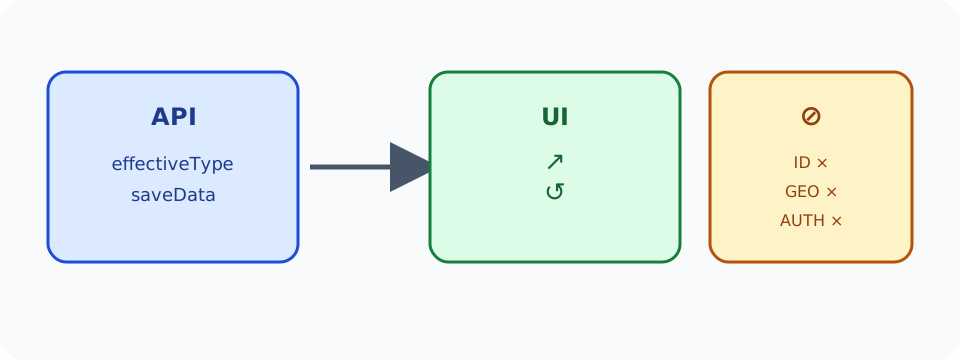
The Network Information API exposes coarse connection hints such as effectiveType and saveData. Those values can change with the network and browser policy; they are not a carrier lookup, exact bandwidth test, location proof, or user identity. BotBrowser can repeat an authorized compatibility fixture and record visible hint changes, but it cannot manufacture a network, guarantee API support, or infer a person from a hint.
TL;DR
- Treat connection hints as coarse, volatile inputs for user experience decisions.
- Do not use them as authentication, location, carrier, bandwidth, or identity evidence.
- Feature-detect the API and provide a useful fallback when it is absent or changes.
Contents
- What the API reports
- Privacy and consistency boundaries
- Designing a safe fallback
- BotBrowser's bounded role
- Conclusion
What the API reports
The WICG Network Information specification and MDN describe a connection object with coarse values such as effectiveType, downlink, rtt, and saveData, plus a change event in implementations that expose it. These are hints for adaptation, not a complete measurement. A browser may round, omit, or update them as conditions change.
Use capability detection and read only the value needed for a user-facing decision. A page might defer a large preview when saveData is true, but it should still offer a control to load it. Do not silently reduce essential content because one hint looks slow.
The distinction between a hint and a measurement matters in ordinary product design. effectiveType is a browser-selected category, not a promise that a request will use a particular transfer rate. downlink is an estimate expressed in megabits per second, and rtt is an estimate of round-trip time. Both can be stale before a page reads them. saveData is a user or browser preference that asks for reduced data use; it is not proof that every transfer will fail. A browser can expose none of these properties, expose only some of them, or report an effectiveType that changes during the same visit.
Treat each read as a snapshot with an expiry that is measured in moments, not as a durable profile field. If a component needs a policy, convert the snapshot into a small internal state such as baseline, reduced, or unknown. That state is easier to reason about than copying raw values through application code. It also lets the product team document what each state changes and what it never changes. For example, reduced might skip an autoplay preview while leaving the article, controls, and captions available.
Feature detection should cover the object, the property, and the event separately. A browser may expose navigator.connection without supporting every property, or it may expose a property without dispatching a useful change event. Read values defensively, handle unexpected strings, and keep a default branch for an empty object. Do not make an exception in a telemetry path disable the primary interface. A small helper that returns a validated policy keeps this boundary in one place and makes the no-API path easy to test.
The API is also not a replacement for resource timing or application measurements. When a team needs to understand whether an image, document, or script completed, it should observe that request directly with ordinary performance and error signals. Those signals answer a different question from the connection hint. A hint can decide whether to start an optional request; the request result decides whether the request succeeded. Keeping those questions separate prevents a stale estimate from being presented as proof about the network.
Privacy and consistency boundaries
Connection hints can contribute to a broader fingerprint when combined with many other signals, especially if an application stores them as a long-lived identifier. Minimize collection, avoid joining hints to account records without a clear purpose, and keep telemetry coarse. A change event says that a hint changed; it does not explain why, identify a network, or prove a new location.
The same browser can report different values on two networks, and two browsers on one network can report different values. Do not make security decisions from effectiveType, rtt, or downlink. The W3C privacy principles support purpose limitation, while the MDN API guidance documents availability and behavior limits.
Purpose limitation should be visible in the data model, not only in a privacy notice. If the product only needs to choose between a full and reduced preview, store that decision for the duration of the view rather than retaining the original rtt or downlink. If a support tool needs a diagnostic sample, record the coarse policy, browser release, and visible result instead of a detailed sequence of network values. Short retention and aggregation reduce the chance that connection hints become a stable cross-session identifier.
Do not join a connection hint to an account, billing record, precise location, or device inventory merely because those tables are available. Such joins create a stronger inference than the API provides. A change event does not identify a new access point, a carrier, a household, or a person. It may reflect radio conditions, a browser policy update, a captive portal, a VPN, a power-saving choice, or an implementation detail. The application cannot tell which explanation is correct from the event alone.
The privacy boundary applies to analytics as well as authorization. A dashboard that groups sessions by raw effectiveType can accidentally create a quasi-identifier when it combines that field with timing, screen, language, and account attributes. Prefer a small set of product outcomes, such as preview started, preview deferred, or user requested full quality. These events answer whether the experience worked without preserving unnecessary network detail. They also make comparisons more stable when browser implementations change their rounding rules.
When a team needs an explicit user choice, ask for it directly. A user who selects lower quality has expressed a preference; a guessed network category has not. The same principle applies to consent, access control, and location features. A connection hint may inform the presentation of an optional control, but it must not silently grant a permission, deny an account action, or stand in for a location check. Security decisions require their own authoritative signals.
Document the uncertainty in code comments and product copy. A short note such as “estimate used only to defer optional media” helps future maintainers avoid expanding the signal into a routing or identity mechanism. Review data flows when a new analytics sink, experimentation system, or personalization feature is added. Privacy risk often appears when a harmless local hint is copied into a shared event schema without the original purpose and retention boundary.
Designing a safe fallback
Start with a baseline that works when navigator.connection is undefined. Then use the smallest hint needed to adapt an optional asset, with a visible retry or preference control. If a change event exists, debounce UI work and keep the previous state until the new value has been validated. Never treat an absent API as a failed user or a blocked account.
Test slow, fast, offline, saveData, missing-API, and changing-network cases. Record browser release, platform, and visible outcome, but do not collect raw network identifiers or account data. A fallback should be judged by usability and correctness, not by whether every browser exposes the same object.
A useful fallback has an explicit baseline. Render the essential text, navigation, form fields, and status messages without waiting for a connection object. Then decide whether an optional image, video, font, or prefetch should begin. If the hint is missing or contradictory, choose the baseline and explain any optional control in ordinary product language. This keeps the page useful on older browsers, privacy-hardened browsers, embedded contexts, and test fixtures that intentionally omit the API.
The fallback should also preserve layout stability. Reserve space for an image or preview before the optional request starts, and avoid replacing a control with a spinner that cannot be reached by keyboard. When a request is deferred, show a clear action such as “Load preview” and keep the action available after a change event. When the user asks for the resource, honor that choice unless a separate policy makes the request impossible. A hint can guide the initial suggestion; it should not fight an explicit preference.
Use a small state machine for optional work. A practical set of states is idle, loading, ready, deferred, failed, and cancelled. A change event can move deferred work back to idle, but it should not erase ready content. A cancellation should leave a retry path, and a failure should expose a useful explanation without repeating the request forever. Debounce changes so a sequence of radio or transport updates does not create a burst of fetches, decodes, or layout changes.
Validate the value before acting on it. Accept only the categories and numeric ranges that the product understands, and route all other values to unknown. Do not assume that 4g means a large video will complete or that slow-2g means a small text document cannot load. The optional policy can be conservative while the baseline remains complete. This approach avoids coupling content availability to a browser classification that may be rounded or delayed.
Tests should assert visible outcomes rather than internal property assignments. A missing object should still show the article and the load control. saveData: true should defer only the optional resource. A transition from fast to slow should stop or pause optional work according to the documented policy while preserving completed content. A transition from slow to fast should not create duplicate listeners or restart an already completed request. Offline and server-error cases should converge on the same accessible retry behavior.
Include accessibility checks in the same fixture. Verify that the fallback control has a name, that focus is not lost when a preview becomes ready, and that status changes are announced without flooding a live region. Check reduced motion and reduced data preferences independently; one preference does not prove the other. A keyboard user should be able to request the full resource even when the initial hint selects the reduced policy.
Observability can remain useful without raw network collection. Record a policy label, a request outcome, and a bounded reason such as hint, preference, or manual. Keep the browser release and platform at the level needed to reproduce a support issue, and set a retention period before shipping the event. When an incident needs deeper detail, collect a temporary test fixture under the application team's ordinary authorization process rather than changing the public telemetry schema.
A practical review sequence.
Before shipping an adaptive feature, write down the resource it changes, the hint it reads, and the baseline shown when the hint is unavailable. This simple record exposes accidental dependencies. If the resource is required for reading, checkout, account recovery, or consent, remove the hint from that decision entirely. If it is optional, define the exact user-visible difference between the baseline and reduced policies. A reviewer should be able to answer what happens after a refresh, a network change, a browser restart, and an explicit request for full quality.
Next, exercise the same sequence with representative fixtures. Start with no navigator.connection object. Add an object with only saveData. Add an unknown effectiveType, an out-of-range number, and a valid value that changes twice. End with a request failure and an offline transition. These cases reveal whether the code assumes a property is always present, whether event listeners are duplicated, and whether a loading state can trap focus. They also produce evidence that a customer can understand: the page remains usable, optional work is bounded, and recovery is visible.
Keep the implementation close to the decision. A component that chooses a preview policy should not also write long-lived identity records. A telemetry helper should receive a policy label and outcome, not the complete connection object. A server endpoint should not accept a client hint as proof of location or entitlement. Separating these responsibilities makes code review narrower and lets privacy owners change retention without changing the user interface.
There is a useful operational distinction between compatibility evidence and production monitoring. A compatibility fixture can declare values, replay a change event, and compare visible results across browser builds. Production monitoring observes real requests and real errors under the application's consent and retention rules. Results from the fixture do not establish an ISP's behavior, and production observations do not make a browser hint authoritative. Keep those evidence types labeled separately in reports and dashboards.
Finally, publish the fallback behavior as part of the feature contract. State that the default page works without the API, that optional media may be deferred, and that the user can request it. State that values are coarse and may change. This copy sets expectations without exposing implementation details or suggesting that a customer is being classified. It also gives support teams a clear explanation when two browsers make different choices on the same connection.
This review can be made part of a normal release checklist. The product owner confirms that the optional resource is truly optional. The accessibility reviewer confirms that the deferred state, retry control, and status message remain usable. The privacy reviewer confirms that the policy label has a purpose, a retention limit, and no account join. The test owner records the browser builds and fixture states used for the comparison. Together, these checks turn a small browser hint into a bounded product decision. They do not require a claim about the user's carrier, household, location, or identity, and they remain valid when a browser changes how it rounds or exposes the values.
BotBrowser's bounded role
BotBrowser supports running an authorized Network Information fixture in an isolated BrowserContext, comparing feature detection across declared browser builds, and recording visible UI decisions for synthetic data. It cannot control an ISP, guarantee a particular effectiveType, circumvent browser mediation, or turn connection hints into identity or geolocation evidence.
Practical checklist
- Feature-detect the API and keep the default experience usable without it.
- Use coarse hints only for optional adaptation, never authorization or identity.
- Debounce change handling and expose a user-controlled retry or preference.
- Test missing, changing, slow, fast, offline, and
saveDatastates. - Keep telemetry purpose-limited and separate from account and location records.
Conclusion
The Network Information API is a convenience signal for adaptive delivery, not a promise about a network or a person. Use it sparingly, keep fallbacks first-class, and validate visible behavior across browser versions. BotBrowser makes that authorized comparison repeatable while leaving network policy, privacy decisions, and application ownership with the systems that control them.
Related reading
- Browser privacy research using public specifications
- Browser feature support versus feature quality
- Network quality and browser performance
Sources
Related Articles
Take BotBrowser from research to production
The guides cover the model first, then move into cross-platform validation, isolated contexts, and scale-ready browser deployment.