Network Information API for Adaptive Content: A Fallback-First Guide
Learn how navigator.connection can guide resource choices, how to handle missing or changing hints, and how to keep adaptive content privacy-respecting.
Want the structured docs for Platform?
This article lives in the editorial library. For step-by-step setup, reference material, and ongoing updates, jump into the docs section.
The Network Information API gives a page coarse hints about the current connection through navigator.connection. An application can use those hints to choose a resource policy, but they are optional estimates, not a promise about throughput or a user identity. A sound pattern is to start with a complete baseline, feature-detect the API, and make any reduction reversible.
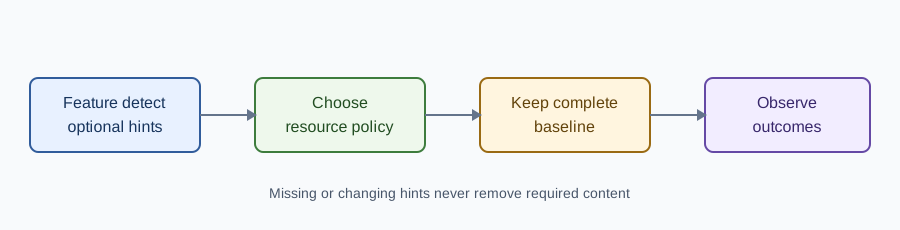
What the API exposes
The NetworkInformation object can expose effectiveType, rtt, downlink, saveData, and, where implemented, type. effectiveType groups observed conditions into values such as slow-2g, 2g, 3g, and 4g. rtt is an estimated round-trip time in milliseconds, while downlink is an estimated megabits-per-second value. saveData reflects a user's request to reduce data use. These are browser-calculated, privacy-reduced hints; they are not a measurement of available bandwidth at every moment.
Support and precision vary by browser and context. Treat navigator.connection as an optional capability and check each property before using it. A missing object, an unavailable property, or an unexpected value must leave the required content and controls usable.
A progressive adaptation pattern
Define a baseline policy that works without any network hint. Then use a small set of named variants, such as baseline, reduced, and enhanced, to make bounded choices: defer a non-essential video, select an image candidate that is already part of the responsive set, or postpone an optional prefetch. Keep the semantic content and accessible controls the same.
const connection = navigator.connection;
const slow =
  connection && (connection.saveData || connection.effectiveType === 'slow-2g' || connection.effectiveType === '2g');
const policy = slow ? 'reduced' : 'baseline';
// Apply a reversible resource choice; required content still loads.
Do not treat a single hint as a compatibility gate. A 4g value does not guarantee that a large transfer will succeed, and a missing value does not prove that the connection is slow. Let real outcomes such as load completion, decode failure, cancellation, and input delay inform later tuning.
Reacting to changing conditions
The connection object may dispatch a change event. If the page listens, use the event to adjust optional work rather than to remove content that is already available. Cancel or pause a queued enhancement when conditions worsen, and offer a clear retry when they improve. Debounce policy changes so a fluctuating estimate does not cause repeated downloads.
Keep adaptation local to the current task. A user who explicitly requests a full-resolution document should be able to continue after an understandable warning or progressive loading step. A data-saving preference is a useful signal, but it is distinct from a measured network result and should not silently override a clear user choice.
Privacy and service boundaries
Network hints can add to a fingerprint when combined with other browser signals. Prefer using them ephemerally to select a resource policy. Do not put raw rtt, downlink, or effectiveType values in account identifiers, long-lived logs, or analytics by default. If a service needs a remote preference, send a short-lived policy choice such as reduced, explain its effect, and avoid retaining the underlying browser value.
An adaptation that changes what is uploaded or downloaded needs an explicit user-facing explanation. A lower image quality or deferred prefetch is a product choice, not authorization to collect extra data. Keep required requests, permissions, and account decisions independent of this API.
Testing and durable fallbacks
Test with navigator.connection absent, with only some properties present, with saveData enabled, and with a change event during an interrupted transfer. Assert behavior rather than a particular numeric bucket: required text remains readable, keyboard controls remain available, and optional work can recover without a retry loop. Also test a browser that exposes the API but reports unknown for the connection type.
Responsive images, lazy loading, streaming backpressure, bounded caches, and cancellation remain useful when the API is unavailable. Keep policy names and limits documented, review them after a browser or workload change, and record outcomes rather than a hardware or network classification. A practical fallback also considers the shape of the page. Preserve headings, labels, and the primary action even when optional media is delayed. If a page contains a form, keep entered values in memory while an enhancement request is paused, and make any retry explicit. A progress indicator should distinguish waiting for a response from decoding a response that has already arrived. That distinction prevents a person from repeatedly activating a control when the network is merely slow. For media, choose a candidate from a known responsive set and avoid rebuilding the element on every estimate change. For data, fetch the first useful records before optional related rows, and let the person request more. For navigation, keep links and routes available even if a prefetch is skipped. These choices are useful on every browser and do not depend on the API being present. They also make server and client rendering agree: the initial HTML has a complete usable structure, while later JavaScript can add enhancements when the current task justifies them. When the API reports saveData, treat it as a preference signal rather than proof that every transfer is expensive. When it reports a coarse type, use it to choose a conservative starting point and let the actual request outcome decide whether to continue. A timeout should have a clear recovery path, and an aborted optional request should not mark the whole page as failed. Keep error messages specific enough to guide action, such as offering a retry or a smaller file, without exposing raw measurements. This produces an adaptive experience that remains understandable when hints are missing, rounded, stale, or changed by the browser.
An adaptive decision should use the least information that answers the product question. If the only question is whether to prefetch an optional article, a broad saveData preference may be enough. If the question is whether to start an autoplay preview, combine a conservative connection class with the user's playback setting and the current page state. There is rarely a reason to transmit every available property to a server. Avoid treating downlink as a speed test: it is an estimate produced by the browser, and it can be stale, rounded, or affected by traffic from other tabs. A page that needs a reliable transfer measurement should observe its own request and handle failure; even then, the result belongs to that request and should not become a permanent label for the browser. Resource variants can differ in size or timing while preserving the same meaning. A reduced image needs an equivalent text alternative and the same essential information; a deferred video needs a poster, title, and play control; and a smaller data table may paginate rows but must not hide the only route to a required record. Accessibility review should cover every policy branch, including the branch taken when the API is absent. Name variants by behavior rather than by guessed device class: reduced describes what the application will do, while old-phone or slow-user makes a claim the browser cannot establish. Behavior names also make logs safer and let a team change thresholds without changing the public vocabulary. An adaptation can create the very conditions it is trying to avoid. Repeatedly replacing an image after every change event can consume more data than selecting one conservative candidate, and a prefetch cancelled after most bytes arrive may waste bandwidth. Keep a decision stable for a short interval, cancel only work that has a meaningful remaining cost, and avoid automatic upgrades while a person is interacting with the page. When an optional request fails, show a retry action and preserve the baseline. Do not retry indefinitely because an estimate remains in a favorable bucket; a bounded retry with backoff is easier to explain and kinder to metered connections than a loop controlled by a noisy hint. The browser can select a local resource variant while the server still enforces authorization and returns required records. If a service supports a documented response preference, make it a short-lived product setting rather than a raw network measurement. A person can choose reduced data in an account setting, and the server can apply that choice consistently until it changes. Do not assume that a request header, JavaScript value, and proxy route describe the same instant. Client Hints may be unavailable, delayed, or governed by a separate permission policy, so the server needs a complete response path for clients that send no hint. Useful measurements describe the experience: time to first useful content, completion of an optional download, cancellation rate, input delay, and recovery after a failed request. Aggregate these results by the selected policy and workload version, and avoid retaining raw rtt or downlink when a policy label explains the decision. If support work needs more detail, use a short retention window and restrict access to the affected incident; record the browser release and reproducible journey, not a cross-session network fingerprint. Remove temporary diagnostic fields after the investigation. Network adaptation should complement, not replace, user controls. A data-saving setting, reduced-motion preference, playback choice, or load-more action expresses intent more clearly than an estimate. Honor explicit settings first, explain material trade-offs, and provide a way to change them. When a transfer may be expensive, state what will happen before starting it, such as “Load the full-resolution file, about 12 MB,” rather than saying “network unsuitable.” A clear choice gives the application a legitimate product signal without collecting a detailed connection profile. Compatibility tables help planning, but tests should assert behavior: run with the API removed, with an object whose properties are undefined, and with values outside usual examples. Verify that the baseline renders, optional controls explain their state, and a later change event does not remove required content. Repeat those checks after changing the bundle, media set, or browser support range because a browser may alter rounding or expose a new connection type without changing the application's contract. Every policy should have an owner, review date, and rollback condition. State the maximum optional transfer, concurrency limit, and recovery action for each variant. When the workload changes, exercise a representative journey on a metered connection and on a stable connection, and keep the baseline until evidence exists across both. Recovery is part of adaptation: cancel optional work when a person navigates away, release temporary buffers after a preview closes, and report progress when a request resumes. These safeguards help every connection type and remain valuable if a browser stops exposing the API. They also make operational behavior predictable: a page can preserve entered data, explain whether it is waiting or retrying once, and return to a smaller representation without discarding the task. A policy should define what happens when a request is partially complete, when decoding fails after a successful download, and when the user changes their preference mid-transfer. In each case, keep the required representation available and make optional work resumable or disposable. Bound concurrency so several adaptive components do not each interpret the same hint and start competing transfers. Coordinate shared decisions through a page-level policy rather than letting every component read and reinterpret navigator.connection independently. This avoids inconsistent controls, such as a header choosing a reduced image while a video component immediately upgrades itself. The policy can also expose a reason category such as user preference, missing hint, or conservative fallback without exposing raw measurements. For server-rendered pages, render the complete baseline first and let enhancement occur after hydration; do not make the initial response depend on a property that may be unavailable during server rendering. For cached responses, ensure that a reduced variant cannot replace a complete variant for a later request that has different user intent. Cache keys should reflect an explicit product variant only when necessary, and they should not encode a detailed network fingerprint. A service worker can apply the same bounded policy, but it must preserve update and offline recovery paths when the connection estimate changes. These rules keep adaptation understandable to users and maintainable for developers while acknowledging that a browser-reported category cannot predict every network path.
- Feature-detect
navigator.connectionand every property you read. 2. Keep required content, permissions, and account decisions independent of the hint. 3. Use a small number of behavior-based policies with a complete baseline. 4. Make changes reversible, debouncechange, and bound retries. 5. Measure completion and recovery, then minimize or discard raw connection values. 6. Explain material transfer changes and honor explicit user controls first. The Network Information fingerprinting guide covers the privacy implications of these fields. The Client Hints fingerprinting guide explains why request-visible hints should remain consistent with the page's policy. The fallback should remain useful when the connection changes during a task: preserve entered data, cancel work that is no longer needed, and explain whether the page is waiting, retrying once, or using a smaller representation. Test the same journey with the API absent and with a value that changes while a request is in flight. Keep the result focused on the visible experience, and do not turn a temporary connection observation into a long-lived profile.
Consider how a slow connection affects each resource independently. A document may be required, a font may be replaceable with a system fallback, an image may have a smaller candidate, and an animation may be safely postponed. Stating those priorities in the interface helps people understand why one part appears immediately while another waits. It also prevents an optimization from becoming an accidental failure when a single optional request is blocked. Use ordinary loading states that announce progress to assistive technology, and avoid changing layout dimensions when an image or video is deferred. Reserving the final aspect ratio prevents content from jumping when the selected resource arrives. If a request is cancelled, retain its trigger so the person can start it again without losing context. A retry should create a new bounded attempt, not revive a promise that has already been rejected or attach duplicate change listeners. Remove listeners when a component is destroyed, and clear timers when navigation or cancellation makes them irrelevant. These lifecycle details matter because a page can remain open while the connection changes several times. They also make the fallback deterministic in automated tests: the same missing property or rejected request should lead to the same usable baseline. A local policy can be evaluated once per task and passed to child components as data, which reduces repeated feature detection and makes the selected behavior visible in debugging without storing raw measurements. When a user chooses a larger resource, treat that choice as an instruction for the current task and explain any cost before starting. When the user chooses reduced data, keep that setting stable until they change it rather than repeatedly inferring it from fluctuating estimates. Browser hints can inform the first choice, but they should not silently undo an explicit choice after a change event. For offline or intermittent use, pair the baseline with a clear cached-state message and a retry action; do not present stale optional content as if it were current. A complete fallback is still the best experience when the API is unavailable, blocked by a policy, or intentionally withheld by a browser. Finally, keep examples in documentation honest: show feature detection, guarded property access, bounded event handling, and a user-visible recovery path. Avoid examples that imply a particular carrier, device, or country follows one effectiveType value. This keeps the guidance portable across browsers and preserves the distinction between a coarse hint and a measured result.
Sources
Related Articles
Take BotBrowser from research to production
The guides cover the model first, then move into cross-platform validation, isolated contexts, and scale-ready browser deployment.