WebTransport: Origin, Stream, and Privacy Boundaries
Use WebTransport deliberately: distinguish secure-origin API support, stream semantics, server policy, and what BotBrowser can and cannot observe.
BotBrowser Team
Want the structured docs for Platform?
This article lives in the editorial library. For step-by-step setup, reference material, and ongoing updates, jump into the docs section.
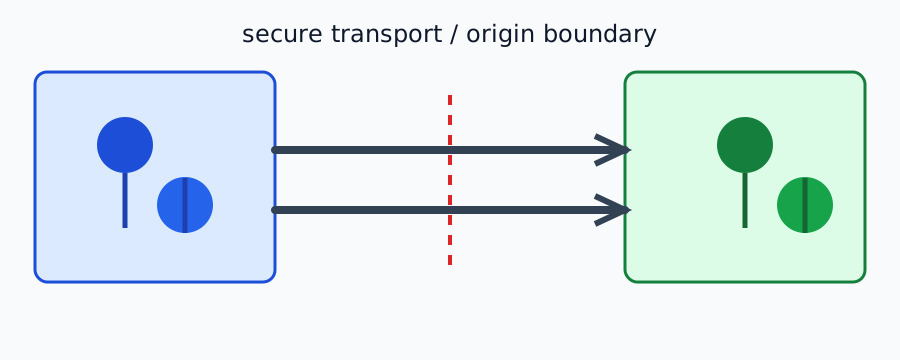
WebTransport is a browser API for multiplexed, secure communication with a server. For this WebTransport review, BotBrowser supports repeatable authorized profile workflows across declared browser and proxy conditions, but does not grant API permission or certify server authorization and retention. BotBrowser can replay the WebTransport fixture; it cannot override origin, certificate, proxy, or server authorization policy.
TL;DR
- Feature-detect
WebTransport, require a secure context, and handle connection rejection as a normal product state. - A session carries bidirectional streams and datagrams; ordered delivery and reliability are separate choices.
- Same-origin policy and server authorization remain application boundaries; transport success is not an identity or privacy guarantee.
- Record only the minimum outcome needed for support. Do not turn connection metadata into a persistent fingerprint.
- BotBrowser can replay an authorized profile workflow, but the page, server, proxy, and retention policy remain responsible for correctness.
Contents
- What the API promises
- A bounded connection fixture
- Origin and privacy boundaries
- Evidence and decision matrix
- Conclusion
- FAQ
What the API promises
The W3C WebTransport specification defines a secure, origin-scoped client API. new WebTransport(url) creates a session candidate; ready resolves only after the session is established, while closed reports the eventual close. Streams provide backpressure and reliable ordered bytes. Datagrams are independently addressed messages with no promise that every message arrives or arrives in order. The API does not define your login, message schema, access control, or server retention.
The URL must use https: (or the explicitly supported local-development exception), and the browser applies its normal secure-context and origin checks. A server may reject the session, a certificate may fail, a proxy may not support the required HTTP/3 path, or a policy may block the request. Treat each as a distinct reason in a user-facing fallback; do not label every failure “browser incompatibility.”
A bounded connection fixture
This fixture keeps the application contract small and makes the expected result inspectable:
async function openSession(url, report) {
  if (!('WebTransport' in globalThis)) return report({ state: 'unsupported' });
  let transport;
  try {
    transport = new WebTransport(url);
    await transport.ready;
    report({ state: 'ready' });
    transport.closed.finally(() => report({ state: 'closed' }));
  } catch (error) {
    report({ state: 'rejected', code: error?.name || 'connection-error' });
  }
}
Expected observations are unsupported, ready followed by closed, or rejected. A green ready result proves only that this page and endpoint established a session under the tested conditions. It does not prove that a datagram arrived, that a stream was authorized, or that a backend committed a record. Add a small echo fixture and an application timeout when those outcomes matter.
Origin and privacy boundaries
An origin is the browser security boundary for the page initiating the session. CORS headers do not turn an arbitrary endpoint into a trusted application; the server still authenticates and authorizes each operation. Do not place access tokens in a URL, and do not treat the remote host name as proof of the account or organization behind it. Use the application’s normal credential channel and rotate credentials independently of transport tests.
Connection timing, close codes, protocol negotiation, and network path can vary with browser release, proxy, operating system, and server load. They are operational observations, not a license to infer a person or device. Keep telemetry to session state, fixture version, release label, and a coarse failure class. Avoid message bodies, full URLs containing identifiers, and long-lived connection fingerprints.
For this topic, BotBrowser’s capability is to repeat an authorized profile workflow and run the same WebTransport page fixture across declared browser builds, platforms, and proxy configurations. Its limitation is that it does not grant API permission, inspect another origin, override TLS validation, make a server accept HTTP/3, guarantee datagram delivery, or certify retention and authorization. Report the tested route and fallback, not a universal WebTransport claim.
Evidence and decision matrix
Run the fixture with a controlled endpoint, a synthetic message, and a fixed browser/profile declaration. Record the page origin, endpoint class, secure-context result, session state, stream/datagram result, close reason, and fallback shown. Keep credentials and message contents out of the record.
| Observation | Safe interpretation | Next action |
|---|---|---|
unsupported | The tested context lacks the API | Keep the WebSocket or HTTPS fallback and show its limitation |
rejected before ready | Context, certificate, proxy, policy, or server negotiation failed | Classify the failure; do not blame the engine without a controlled rerun |
ready, stream echo succeeds | This route supports the tested reliable stream | Keep backpressure and timeout handling; test reconnect |
ready, datagram echo is lost | Loss is allowed by datagram semantics or the path | Use streams for required messages and expose degraded mode |
closed after an app timeout | The session ended; business outcome may be unknown | Reconcile with an idempotency key before retrying |
The matrix is the article’s reader artifact: it ties an observable result to one safe product decision. Repeat it when the browser, profile, proxy, endpoint, or server release changes, changing one variable at a time.
Stream design for real applications.
Choose a stream when the receiver must see every record in order. A stream gives the application a place to apply backpressure: the sender can pause when the reader has not consumed previous bytes. Define a small frame format with a version, type, length, and request identifier. Validate each field before dispatching it to business code. A malformed frame should close only the affected session or return a documented application error; it should not be interpreted as a new command.
Datagrams fit different work. They are useful for freshness-sensitive hints where a newer message makes an older one irrelevant, such as a cursor position or a preview statistic. They are a poor fit for account changes, billing events, or anything that needs a durable audit. If a product starts with datagrams, write down the tolerated loss and visible degraded state before shipping. A later migration to streams is easier when the message meaning is independent from the transport.
The browser stream objects have their own lifecycle. Close a writer after the final frame, release a reader when the page leaves, and handle a server close while a user action is in progress. An application timeout should stop new work, but it cannot erase bytes already accepted by a peer. Pair each mutation with an idempotency key and let the server answer whether that key was committed. This protects a retry from duplicating an operation after a connection disappears.
Reconnection and unknown outcomes.
Reconnect is a state machine, not a loop. Keep states such as idle, connecting, ready, degraded, and closed, and allow only documented transitions. Apply an increasing delay with a maximum, pause when the page is hidden if the product permits, and stop after a user-visible deadline. Do not create a new session for every failed datagram; consolidate freshness-sensitive work and preserve the last known value.
An unknown outcome needs a different branch from a rejected request. If the server may have processed a command immediately before the connection closed, retrying the command without an idempotency key can create a duplicate. Store a small client intent record, ask the server for the key’s status, and show the user whether the operation is committed, still pending, or safe to retry. The record should contain no secret and should expire according to the application’s documented retention rule.
Test reconnection with a deterministic server fixture. Close the connection after the server receives a frame but before the client receives its response. The expected result is one reconciliation request and one final user-facing status, not two business writes. Repeat with the server rejecting a new connection, with the page going offline, and with the browser suspending the document. These cases validate recovery without making claims about every network path.
Compatibility and release evidence.
A support statement should name the browser release range, page context, endpoint class, and fallback. Feature detection covers the JavaScript surface; it does not cover HTTP/3 negotiation, certificate deployment, proxy routing, server limits, or application authorization. Keep those checks in separate rows so a team can change one owner without rewriting the whole conclusion.
Use the same synthetic message and expected response across candidate browser releases. Record the release label, profile family, headed or headless mode, proxy class, and fixture revision. Timing belongs in a separate performance record because a correct but slower connection may still meet the product deadline. Never use a successful local fixture to claim that a production server has the same capacity or retention behavior.
The privacy review is part of release evidence. State which fields are retained, who can access them, and when they are deleted. Prefer a failure class such as certificate, policy, server-rejected, or network-timeout over a raw exception. Keep endpoint identifiers coarse when support does not need a full URL. A compatibility record should help a maintainer choose a fallback, not become a new identity database.
Accessible fallback and operations.
When the preferred transport is unavailable, preserve the user’s work and announce the alternative. A keyboard user should be able to retry, cancel, or continue with the HTTPS path without losing focus. A screen reader status should distinguish “connecting”, “temporarily unavailable”, and “saved”. Do not expose internal close codes as the only explanation. Localize the recovery action and keep it consistent across the five article locales and the product interface.
Operations teams need a bounded runbook. Verify the page’s secure context, then the endpoint certificate, then proxy and HTTP/3 negotiation, and finally the server authorization record. Compare one known-good fixture with one failing fixture. If the failure follows the profile across endpoints, inspect the browser or proxy owner; if it follows the endpoint across profiles, inspect deployment. This sequence narrows ownership without collecting private session data.
A practical message contract.
Before opening a long-lived session, agree on what the first application message means. Include a protocol version and a request identifier so the server can reject an unsupported client clearly and so a later response can be matched to the right user action. Keep the message format independent of whether it travels on a stream or in a datagram. This lets the application select a transport based on delivery requirements without changing the meaning of the operation.
The server should impose explicit limits on message size, open streams, idle time, and concurrent sessions. Client-side validation improves the interface but does not replace server validation: an endpoint must treat every byte from a browser as untrusted input. Return an application-level error that the client can map to a localized recovery action. Avoid showing raw exception strings or server traces to an end user because they are unstable and may disclose implementation details.
For a stream, define whether the client opens one stream per task or reuses a shared stream. A per-task stream can simplify cancellation and ownership; a shared stream can reduce setup overhead but requires clear framing and response correlation. Whichever model is selected, document who closes each writer and what happens when one side closes first. Reviewers should be able to follow one request from user action to final status without assuming that closing a transport rolls back a server change.
For datagrams, make freshness explicit. A sequence number can help the application ignore an old update that arrives after a newer one, but it does not make the channel reliable. The product should state whether a missed update is harmless, whether a later update supersedes it, and how the interface communicates stale information. If a datagram influences a consequential action, require a separate confirmation over a reliable path before committing it.
Test ownership and troubleshooting.
Split a WebTransport test into layers with an owner for each. The browser owner verifies API availability and secure-context state. The network owner verifies routing and proxy support. The service owner verifies certificate, endpoint, and authorization behavior. The application owner verifies framing, idempotency, and visible fallback. This ownership map prevents a failed test from becoming an unhelpful request to fix the browser when the endpoint or server is responsible.
Start troubleshooting with a synthetic endpoint and a fixed test page. Check that the page URL is secure, then confirm the endpoint certificate and service health. Compare direct and approved proxy routes only when both are part of the supported product configuration. Keep the browser release, profile, endpoint, and fixture fixed while changing one route variable. Capture the stage that failed and the visible result, not the full contents exchanged during the test.
When the test passes in one environment and fails in another, the result is a compatibility difference to explain, not evidence that one browser is universally better. Check release notes and current compatibility documentation, then reproduce the product journey on the exact supported platform. A user agent string is not sufficient evidence for protocol negotiation or policy state. Feature detection, a bounded connection attempt, and an observable fallback together provide stronger and still privacy-conscious evidence.
Retention and support records.
Decide before launch whether support needs a connection record at all. Many applications can help a user with an on-screen status and a short-lived incident code instead of retaining a detailed transport trace. If records are necessary, define the fields, access group, retention period, and deletion owner. Remove query strings, credentials, account identifiers, and application message text before collection. A failure category and release label are often enough to route a ticket to the right owner.
Keep test evidence separate from production telemetry. The synthetic fixture can contain known test data and a stable expected result; production support records should collect only what the privacy notice and operational need justify. Do not reuse a test profile to store real customer sessions. Clear test records at the end of a run and avoid attaching raw captures to tickets unless a documented incident process requires them.
These controls also make the article’s decision matrix reproducible. A reviewer can compare unsupported, rejected, ready, and closed outcomes without seeing private conversation content. The useful artifact is the relationship between state and action: choose a fallback, wait, reconnect, or reconcile. More data is not automatically better evidence when it does not change that choice.
Review the transport contract when the application adds a worker, changes its proxy, moves an endpoint, or changes the minimum browser release. Update the fixture, fallback copy, retention decision, and support matrix together. A standards change can alter API details, but it does not remove the need for server authorization or idempotent recovery. A BotBrowser run remains evidence about the declared workflow and conditions, not a universal statement about every host.
Conclusion
Use WebTransport when its secure-origin, stream, datagram, and server contracts match the user task. Feature-detect it, preserve a working fallback, and record bounded evidence. The next safe action is to run the synthetic echo fixture in the real page origin and verify reconnect and unknown-outcome recovery, not merely that a constructor exists.
FAQ
Is WebTransport a replacement for authentication?
No. It carries application messages; your server still authenticates, authorizes, validates, and records them.
Are datagrams reliable?
No. They are independently addressed and may be lost or reordered. Use a bidirectional stream for data that must arrive in order.
Does a successful session prove privacy?
No. It proves a session was established under one route. Message handling, logs, proxy visibility, retention, and access control remain separate decisions.
Can BotBrowser make a rejected connection succeed?
No. It can repeat an authorized profile workflow for evidence. It cannot override secure-context, origin, certificate, proxy, or server policy.
Sources and next reading
Sources
Related Articles
Take BotBrowser from research to production
The guides cover the model first, then move into cross-platform validation, isolated contexts, and scale-ready browser deployment.