BroadcastChannel: Same-Origin Messaging and Privacy Limits
Coordinate same-origin browser contexts with BroadcastChannel while preserving close, reload, fallback, and privacy boundaries.
BotBrowser Team
Want the structured docs for Platform?
This article lives in the editorial library. For step-by-step setup, reference material, and ongoing updates, jump into the docs section.
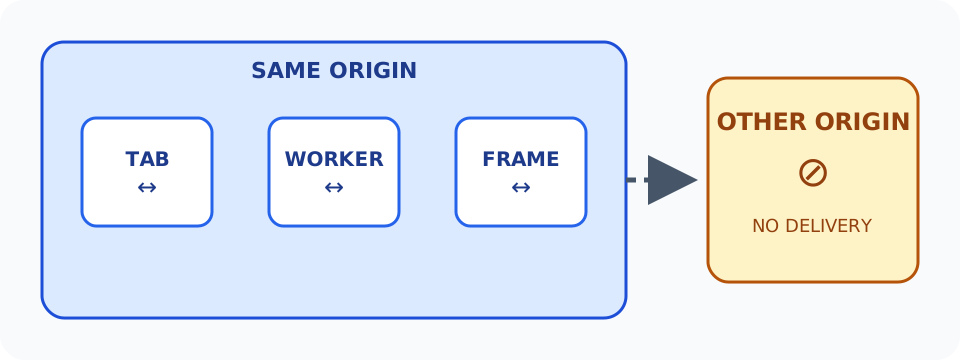
BroadcastChannel is useful when two tabs, windows, workers, or frames that share an origin need a small notification. It is not a general message bus, an authentication signal, or proof that two contexts belong to one person. Delivery is scoped by the browser origin model, and a missing or delayed message can have many ordinary causes. BotBrowser can repeat an authorized same-origin fixture and record visible delivery and close or reopen outcomes, but it cannot deliver across origins, relax same-origin policy, or guarantee timing across browser releases.
TL;DR
- Use BroadcastChannel for short-lived coordination between contexts that share an origin.
- Close channels when a component is done, and treat reload, suspension, and termination as normal lifecycle events.
- Feature-detect the API and keep a useful fallback such as storage events, a worker, or a server refresh.
- Same-origin reachability is not authentication, identity, location, or trust evidence.
- BotBrowser can repeat an authorized fixture and compare visible outcomes, but it cannot cross origins or guarantee timing.
Contents
- What BroadcastChannel delivers
- Origin and privacy boundaries
- Lifecycle and fallback design
- Testing with BotBrowser
- Conclusion
What BroadcastChannel delivers
new BroadcastChannel(name) creates a named channel for the current origin and browsing context group. A message sent with postMessage() is structured-cloned for other eligible contexts listening to the same name. The sender does not receive its own message through the channel. A receiver handles message and can handle messageerror when cloning fails. The API is deliberately small: it gives application code a notification path, not a durable queue or a delivery receipt.
The name is an application namespace. Pick a stable name for one coordination purpose, such as cart-updated or draft-status, and keep the message data small. Do not put access tokens, full account records, private document text, or secrets in a broadcast. Every script that already runs with the origin's authority may be able to listen. A channel does not add a permission boundary inside an origin.
Delivery is best understood as best-effort notification. A context can be closed, frozen, discarded, or temporarily unavailable. A receiver can attach its listener after the sender posts, and then correctly receive nothing. A message can also be unusable because structured cloning rejects a value. The application should maintain authoritative state elsewhere and use the channel to prompt a fresh read.
A bounded message has a version, event type, and small resource key rather than a full resource snapshot. For example, {version: 3, type: 'cart-changed', key: 'cart'} tells another tab to refresh its own state. The receiver can ignore versions it does not understand and can fetch or read the current record. This avoids treating an old notification as the current truth after a tab resumes from suspension.
The channel is not a replacement for a transaction. Two contexts can post related messages close together, and there is no built-in ordering contract that makes a business operation atomic across storage and the channel. Write the authoritative change first, then post a notification. If the post fails, the next foreground refresh must still find the change. If the write fails, do not post a success event.
Use a clear ownership rule for listeners. A component that creates a channel should remove its listener and call close() during unmount or shutdown. Closing stops that object from participating; it does not erase messages already handled by other contexts and does not revoke another context's channel. A worker should close its channel before termination when it has a controlled shutdown path, while still treating abrupt termination as possible.
Origin and privacy boundaries
The browser applies the origin tuple of scheme, host, and port when deciding which contexts share a channel. app.example and admin.example are different origins even when one team operates both. A different port is also a different origin. A sandboxed frame can receive an opaque origin and therefore not share the channel expected by its parent. A storage partition, private browsing boundary, or embedded context can further change which contexts are eligible.
Same-origin delivery does not establish identity. Two contexts can share an origin because they are open in one browser profile, because a shared kiosk uses one account, or because unrelated code has access to the same site. Conversely, a person can have two contexts that do not receive a message because the origins or partitions differ. Do not use reachability as a login signal, a device identifier, a location proof, or a test that a user owns a second window.
A missing message also does not prove isolation failure. The receiver may have loaded later, closed its channel, been suspended, failed structured cloning, or used a different name. A delayed message does not prove a browser defect without a controlled fixture and a recorded lifecycle. The WHATWG web messaging section describes the model, while MDN's BroadcastChannel guidance and same-origin policy guidance document practical constraints.
Treat channel names and message data as observable application data. Avoid putting a detailed account or location identifier in either one. A short event type and a local resource key are usually enough. If analytics needs to count refreshes, record the product outcome, not a raw sequence of channel names. Retain only what supports a stated purpose and keep channel telemetry separate from authentication, billing, and precise location records.
Privacy risk often comes from combining an ordinary event with unrelated signals. A dashboard that joins message timing to account ID, screen size, language, and network hints can create a stronger profile than the channel itself provides. Use aggregation and short retention. A draft-updated event says that a product state may have changed; it does not say which person typed it, where they are, or which device is authoritative.
Security decisions need an authoritative source. A receiver should re-check authorization when it reads a protected record, even if a channel message prompted the read. Do not grant a role because another tab announced role-changed, and do not suppress a logout because a message was absent. The W3C privacy principles support purpose limitation and data minimization; they do not turn a browser notification into a credential.
Lifecycle and fallback design
Start with a baseline that works without BroadcastChannel. Feature-detect window.BroadcastChannel or the relevant worker global, create the channel only when needed, and keep the primary page usable if construction fails. A fallback might use the storage event for tabs, a shared worker where supported, a server refresh, or a user-controlled reload. Each fallback has different timing and privacy properties, so name it in the feature contract rather than pretending all paths are equivalent.
The storage event is useful for a narrow tab-to-tab signal when a site already has a suitable local storage key, but it does not fire in the writing context and it can be unavailable in restricted storage modes. A server refresh is slower but can be authoritative across devices. A service worker may coordinate selected clients but has its own lifecycle and scope. The right choice depends on the resource invariant, not on whether one API name appears in a browser compatibility table.
Close and reopen behavior deserves an explicit policy. On a route change, close the old channel before creating a new one. On a page reload, assume all in-memory listeners are gone and read current state before waiting for notifications. On visibilitychange, do not assume a hidden page will process every event promptly; refresh on return when the data matters. On worker shutdown, persist intent before sending a message and let the next owner reconcile it.
Use idempotent handlers. A receiver may process an event twice after a retry or a manual refresh, and it may process an older event after a newer state is already visible. Compare a revision or timestamp from the authoritative store, then update the interface only when the new record is relevant. Never delete a user's current data merely because an old removed event arrived late. The channel is a hint to check state, not a command to skip validation.
Debounce bursts from bulk edits, but do not hide a required update forever. A small queue of resource keys can combine five cart-changed events into one refresh. Bound the queue and add a deadline so a broken listener cannot grow memory without limit. When a refresh fails, preserve the last known usable state and show a retry path. A message transport problem should not become a blank page.
Testing should cover absent API, unsupported construction, valid delivery, wrong origin, wrong name, close before post, receiver created after post, structured-clone failure, reload, hidden or suspended context, and worker termination. Assert visible behavior: which contexts update, which remain unchanged, whether a retry is available, and whether the primary content remains accessible. Record the browser release and fixture state, but do not collect account data or raw private message data.
An accessible interface should announce a useful outcome without exposing implementation details. “This tab has newer data” is better than a raw channel name or object serialization. Keep focus stable when a notification refreshes a panel, and let keyboard users request a manual refresh. If the event changes a badge, provide a text alternative and avoid relying on color alone. Reduced motion preferences are independent from message delivery and should be handled separately.
Testing with BotBrowser
BotBrowser supports repeating an authorized same-origin multi-context fixture, recording visible message delivery and close or reopen outcomes, and comparing declared browser builds. The limitation is explicit: BotBrowser cannot deliver messages across origins, circumvent same-origin policy, guarantee timing across browser releases, or treat channel reachability as identity evidence. A fixture can make the tested contexts, channel name, post order, and lifecycle actions reproducible, but it cannot turn a notification into a security boundary.
Build the fixture around synthetic data. Open two same-origin contexts, attach listeners before posting, send a versioned resource event, then close and reopen one context. Add a third context on a different origin or port and record that it does not receive the event. Repeat with the receiver created after the post, with a deliberately uncloneable value, and with the sender closing immediately after the post. The expected result is a set of visible outcomes, not a claim about every deployment.
Record enough evidence to reproduce the decision: browser build, target platform, context type, origin tuple, channel name class, fixture revision, event version, listener timing, close state, visible result, and fallback result. Keep identifiers synthetic and bounded. Do not record real account names, private URLs, location fields, or complete message data. Separate compatibility evidence from production monitoring because a controlled fixture does not represent every network, storage partition, or lifecycle policy.
Plan a review around the resource that the notification represents. A cart refresh, draft indicator, and logout notice have different urgency and recovery needs even when they use the same channel. For each event, document the authoritative store, the maximum age of a notification, and the action taken when the receiver cannot read current state. This prevents a convenient channel from becoming an undocumented dependency for an essential workflow.
Keep message handling local to the feature that owns the state. A global listener that forwards every event to unrelated components makes retention, authorization, and testing harder to explain. Prefer a small adapter that validates the event type, checks a revision, and requests one fresh read. When the read fails, preserve the last usable state and expose a retry. A notification should never remove content simply because a second context is unavailable.
Consider browser lifecycle variations separately from origin variations. A background tab can process a notification later, a mobile browser can suspend a page, and a worker can terminate between a write and a post. These outcomes are different from a cross-origin delivery failure. A fixture that labels each transition makes support reports more precise and keeps application recovery focused on the actual state that was observed.
When a product has multiple deployments, give each supported origin its own fixture row. Staging, production, an embedded customer domain, and a local development port are not interchangeable origins. Record the origin tuple as test metadata, not as a user identifier, and avoid assuming that a successful staging result predicts an embedded deployment. This small distinction catches configuration errors without expanding collection of personal data.
For a durable feature contract, state what a notification can and cannot change. A message may mark a panel stale, request a refresh, or update a non-critical badge. It should not silently change permissions, submit a payment, delete a document, or replace a server decision. Those actions need their own confirmation and authorization path. Keeping the channel at the notification layer makes the fallback easier to test and gives support teams a clear explanation when a context misses an event.
Use a bounded event vocabulary. A small list such as record-changed, session-ended, and refresh-requested is easier to validate than arbitrary strings assembled by each component. Include a schema version and ignore unknown versions safely. If an event is no longer useful, remove its producer and listener together; leaving a listener behind can keep obsolete assumptions alive and make a privacy review misleading.
Review cleanup paths as carefully as startup paths. A route can create a channel twice if a component is remounted, and a worker can retain a listener after its visible owner is gone. Test repeated open and close cycles, a fast reload, and a failed constructor. The expected result is one active listener for one feature instance, no unbounded queue, and a page that still works when the channel is unavailable. These are ordinary engineering checks, not evidence about a person's browsing identity.
If a notification triggers a network read, apply the same authorization and cache rules as a manual refresh. Do not trust a resource key from another context merely because it arrived through a same-origin channel. Validate its shape, check the current user permission, and discard it when the resource is no longer in scope. This protects against stale application state and keeps the channel from becoming an accidental command interface.
Finally, make evidence proportional to the decision. A compatibility check may need a browser build, origin tuple, lifecycle step, and visible result. A production metric may need only a policy label and success or retry outcome. Avoid copying the full event into a long-lived log. Short, purpose-limited records are easier to delete, easier to explain to users, and less likely to combine into a lasting identifier.
The same discipline applies to cache invalidation. A notification can tell a tab that its cached view may be stale, but the tab should validate the current revision before replacing content. If the read returns an older revision because a server replica is behind, keep the current view and retry according to the application's normal consistency policy. Do not treat arrival order on a browser channel as a substitute for a server version or an application conflict rule.
Consider a user who has a draft open in two tabs. The first tab can write revision 8 and announce draft-updated. The second tab may receive the message after it has already edited revision 9 locally. Its handler should compare revisions and offer a merge or explicit choice, not overwrite the newer edit. The channel helps the second tab notice work; it does not decide which edit is correct. This distinction keeps coordination useful without turning a timing detail into a data-loss decision.
For sign-out, use the channel as an advisory prompt. A tab can announce that the session state changed, and another tab can clear its local presentation after it independently checks the authoritative session. If the prompt is missed, a protected request must still be rejected by the server and the next navigation must refresh session state. This design makes the security boundary explicit and keeps a browser event from becoming the sole logout mechanism.
For background refresh, prefer a bounded scheduler over a listener that starts a request for every event. Coalesce repeated keys, cap concurrent reads, and stop work when the owner is no longer visible or the feature is unmounted. A resumed page can perform one full refresh instead of replaying a backlog of stale notifications. The result is easier to explain to users and less likely to create unnecessary traffic.
Review the channel when changing deployment topology. Moving a panel into an embedded frame, changing a port, adding a privacy partition, or introducing a worker can change which contexts share an origin. Treat that as a compatibility change with a fixture update, not as a minor refactor. Keep the fallback available while the new context is being rolled out, and document which deployment rows have been tested.
Interpret results conservatively. Delivery in two tested same-origin tabs means those contexts were eligible under that fixture. It does not prove that every tab, embedded frame, private window, or future browser build will behave identically. No delivery means the tested path did not produce a visible notification; investigate origin, name, lifecycle, and cloneability before assigning a cause. A changed result after a browser update is a reason to rerun the fixture, not proof of an identity or privacy regression.
Conclusion
BroadcastChannel is a compact coordination hint for contexts that share an origin. Keep authoritative state in a validated store, close channels during lifecycle transitions, make handlers idempotent, and provide a first-class fallback. Same-origin reachability and message timing are not identity or trust evidence. BotBrowser makes an authorized comparison repeatable while leaving origin policy, application authorization, lifecycle decisions, and privacy ownership with the systems that control them.
Related reading
- Browser privacy research using public specifications
- Browser feature support versus feature quality
- Browser automation test fixtures and isolation
Sources
Related Articles
Take BotBrowser from research to production
The guides cover the model first, then move into cross-platform validation, isolated contexts, and scale-ready browser deployment.