Instagram Scraping: API Eligibility Before Browsers
Choose an Instagram data route by account type, authorization, API setup and returned fields. Identify when Business Discovery, oEmbed or a browser cannot meet it.
BotBrowser Team
Want the structured docs for Getting Started?
This article lives in the editorial library. For step-by-step setup, reference material, and ongoing updates, jump into the docs section.
Instagram scraping starts with a data eligibility question: can an official product return the required fields for this account and purpose? A signed-in browser does not answer that question. BotBrowser supports Chromium integration with automation frameworks for separately authorized browser checks, but it cannot grant Meta permissions, change account eligibility, expand API fields or authorize collection. Establish the account, asset and permission boundary before choosing a browser session. The Playwright browser setup covers launching that separate browser layer after its permitted role is defined.
TL;DR
- Instagram's professional-account APIs serve Business and Creator accounts; an ordinary personal account is not an interchangeable input.
- Meta currently documents Unified Login, Instagram Login and Facebook Login setups with different portfolio, Page, token and host requirements.
business_discoveryexposes a limited professional-account surface, not arbitrary account data; oEmbed is for displaying embeds, not building an analytics dataset.- An unsupported field requirement calls for a smaller requirement or another authorized data source, not an automatic switch to logged-in DOM collection.
Contents
- Classify the account and requested data
- Keep the three API setups separate
- Check the feature and field contract
- Interpret missing data before opening a browser
- Practical conclusion
Classify the account and requested data
The Instagram Platform overview describes access to professional accounts and differentiates an account your app serves from other Instagram users interacting with it. Owning an Instagram account is not ownership of the platform, and an account holder's consent is not a platform-wide data license. The scraping permission decision record separates purpose, platform terms, authorization and downstream data use before implementation.
Use the following matrix before writing selectors. Each row describes a different product decision; success in one row does not establish eligibility in another.
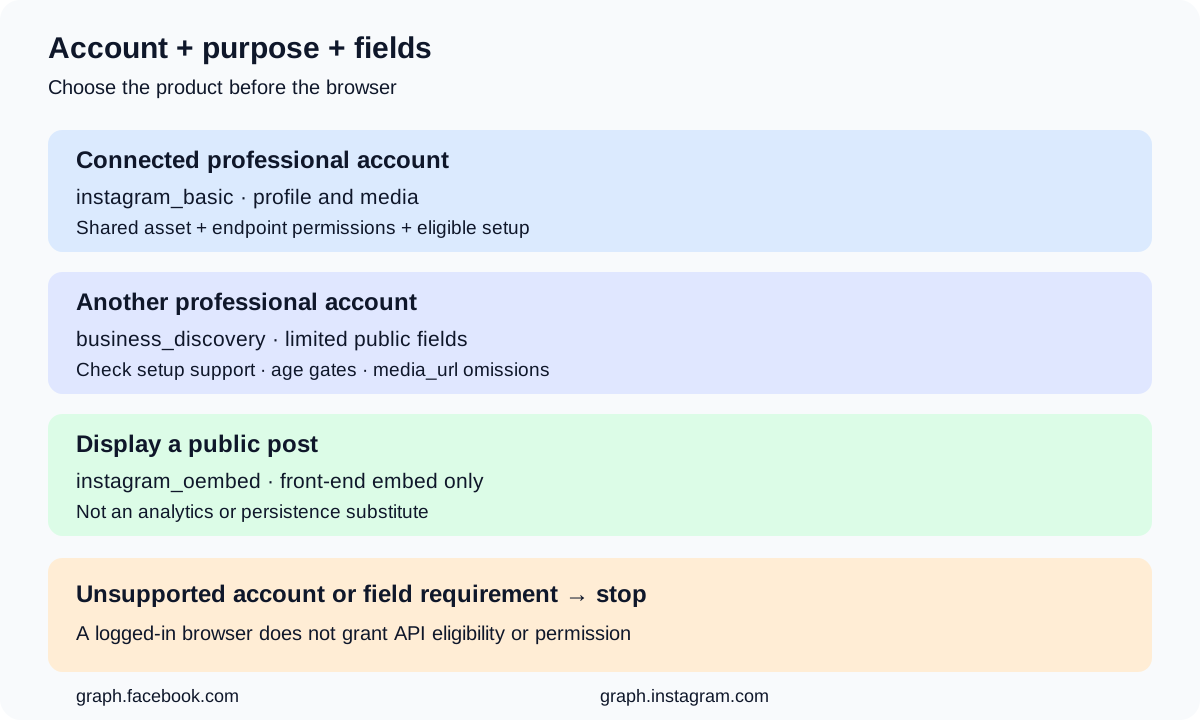
| Data requirement | Candidate official route | Choice rule |
|---|---|---|
| Profile and media of the professional account connecting to the app | An eligible Instagram API setup | Check Business/Creator status, shared account, granted permissions and endpoint fields |
| Public metadata about another professional account | business_discovery where the selected setup supports it | Check target eligibility, public fields and discovery-specific limits; do not assume private insights |
| Display one public post in another website or app | /instagram_oembed | Use only for the permitted embed display purpose, not a stored analytics feed |
| Arbitrary personal-account history, private profile data or a complete follower graph | No general route established by these products | Stop or narrow the requested dataset; a visible login session does not supply the missing authorization |
A concrete requirement might be: the connected Creator account's profile and media for its own reporting, with separately checked insights permissions if insights are needed. “Every field visible anywhere on Instagram” is not equivalent. Record account_type, account_id, purpose, requested_fields, api_setup and the authorization reference together. This is an application-side planning record, not a Meta request schema or a claim that a request has run.
For an agency serving multiple clients, keep each client's granted assets attached to its own authorization record. A token that can read one client's account is not evidence that it can read another client's data. Browser isolation solves a different problem: multi-account social management covers authorized account sessions and storage, rather than Meta API eligibility.
Work a reporting request through the matrix
Consider a constructed reporting requirement for a client who operates a Creator account. The client wants its own profile, its media list and performance measurements. The profile/media requirement belongs with the connected professional account; insights require a separate endpoint and permission check. Store requested_fields as the actual field list rather than the word “everything.” If the requirement later adds competitors' private performance measurements, that is a change of data scope, not another page of the original media list.
The application record can make that distinction explicit:
| Planning field | Constructed value | Consequence |
|---|---|---|
account_type | Creator | Professional-account prerequisite can be checked |
relationship | Client connects its own account | Use the client's shared asset, not an operator's unrelated account |
purpose | Reporting for that client | Assess permitted processing and retention for this purpose |
requested_fields | Profile, own media; insights separately specified | Check each endpoint and additional insights permission |
excluded_data | Other accounts' private metrics | Do not reinterpret discovery counts as those metrics |
These are proposed application-side values, not a successful API response. The next useful result is a documented eligible endpoint and its minimum permission set. A requirement that cannot reach that result remains unresolved even if a person can inspect a similar value on a phone. The distinction matters when a dashboard mixes connected-account data with competitor observations: identify the source and scope per field instead of presenting every column as equally complete.
Keep the three API setups separate
The Unified Login comparison recommends Unified Login for new integrations. It lets clients log in through Instagram or Facebook, select their business portfolio and share the Instagram asset. The resulting Business Integration System User Access Token belongs to the portfolio, rather than to the person who completed login. That distinction prevents a browser cookie from being mistaken for an API credential.
| Setup | Page and portfolio prerequisite | API host and token class |
|---|---|---|
| Unified Login | Facebook Page not required; business portfolio required | graph.facebook.com; Business Integration System User Access Token |
| Instagram Login | Facebook Page not required; portfolio not required by the login flow | graph.instagram.com; Instagram User access token |
| Facebook Login | Linked Facebook Page required; portfolio depends on configuration | graph.facebook.com; Facebook User or Page access token |
Professional-account eligibility remains relevant across this comparison. A Facebook login option does not turn an Instagram personal account into a supported professional asset. The eligibility reference identifies a personal account or the wrong business portfolio as reasons an account is absent from selection. Changing browser identity does not repair either condition.
Permissions also belong to a setup. Unified Login uses names such as instagram_basic and instagram_manage_insights; Instagram Login uses the instagram_business_* family. Do not copy a permission name between integrations because the visible feature sounds similar. The permissions documentation maps the families and directs developers to each endpoint's requirements.
Standard Access supports testing with people who have app roles. For Unified Login clients without an app role, the documented requirements include Advanced Access to each relevant permission through App Review and an app in Live mode. The overview also requires Business Verification for Advanced Access. A successful development-account response therefore does not establish readiness to onboard unrelated clients.
Asset selection is part of authorization
For Unified Login, distinguish the app's configuration from the client's approval. The configuration asks for permissions and asset types; the client then selects a portfolio and Instagram account and approves the requested access. A config_id identifies that configuration, not an Instagram account or a guarantee that every requested asset was shared. Before accepting a reporting job, bind the account identifier returned by the supported flow to the account the client meant to connect.
This also changes troubleshooting. If the expected asset is absent, Meta's eligibility page directs attention to professional-account status and portfolio ownership. If an API integration helper calls a Unified token invalid, the same page notes that the helper accepts Instagram User tokens from the Instagram Login setup. The diagnostic tool's supported credential class must match the integration before its result is treated as an authorization failure. Repeating browser login cannot make incompatible token classes interchangeable.
Keep credentials out of the decision record. Meta's troubleshooting guidance asks for the app ID, config_id, approximate time with timezone, stopped onboarding step, login choice, expected asset visibility and error message. It explicitly excludes tokens, app secrets and passwords from logs and support requests. Those identifiers and observations are sufficient to describe where selection failed without circulating a credential that might still grant access.
Check the feature and field contract
Separate reading the connected account's profile or media through instagram_basic from obtaining insights through instagram_manage_insights. Endpoint permissions, shared assets and returned fields all matter. A token is not a declaration that every feature or every account is accessible.
For other professional accounts, the Business Discovery reference describes querying from the requesting professional account and naming the target username. It lists public fields and permissions including instagram_basic, instagram_manage_insights and pages_read_engagement for its Facebook Login path, with additional requirements for certain Business Manager Page-role cases. It does not provide arbitrary personal-account access or private insights about another account.
There is an important documentation boundary: the Business Discovery guide names both Facebook Login and Unified Login, while the endpoint reference explicitly lists Facebook Login. Treat support under the chosen setup as something to confirm against its current documentation and a permitted minimal request. The guide's broader label is insufficient evidence to transplant the reference's token and permission recipe into another setup. No live request was executed for this comparison.
The reference also records two field-level constraints that affect completeness:
- Age-gated Business accounts are not returned. A missing account is not automatically a selector failure or proof that the account was deleted.
media_urlcan be omitted for specified copyrighted or licensed audio and copyright conditions. For reads of another user's media, the documented restriction also includes reels whose owner disabled downloads. A returned media object with an absent URL is not necessarily an incomplete HTTP response.
Its nested /media pagination is another specific exception: the reference describes before and after cursors without previous or next fields. Construct the following query from those documented cursors for that edge; do not assume every Graph response includes paging.next. Keep this exception attached to Business Discovery instead of generalizing it to all Instagram endpoints.
The oEmbed documentation defines a different product. Its HTML and metadata support front-end embedding. It explicitly prohibits extracting, persisting or deriving analytics from that material for another purpose. A public post URL or an embed response therefore does not justify using /instagram_oembed as a substitute collection API.
Counts, insights and media URLs answer different questions
A discovery result can include fields such as followers_count or media_count; their presence does not convert the result into the target account's private insights feed. Specify whether a report needs public counts, authorized account insights or actual media delivery. These have different eligibility and field contracts. A requirement for all three is not satisfied merely because one count is returned.
Likewise, a media_url omission should remain distinguishable from an absent media object. If the identifier exists but the delivery URL is unavailable under a documented restriction, preserve that distinction in the report's completeness definition. Do not fill the gap with an internal URL found in a browser or infer that the media was removed. The API restriction is part of the data result, not a browser identity defect.
oEmbed has its own availability limits: the documentation excludes private, inactive and age-restricted accounts, disabled embeds and Stories. Even for supported content, the permitted purpose remains display. An embedded post working in a preview establishes neither an export permission nor a supported way to accumulate an account history. Choose embedding because the product needs an embed, rather than because the desired analytics endpoint is unavailable.
Interpret missing data before opening a browser
When an account disappears from onboarding, inspect its type, selected portfolio and sharing state first. Meta documents token errors after an account moves portfolios or a client removes an app; reconnecting through the supported authorization flow addresses that relationship. Do not promise a universal token lifetime across the three token classes or equate a working browser session with a valid API authorization.
The eligibility page provides concrete examples of this separation. An account-type error names Business or Creator eligibility; a missing instagram_manage_messages permission points to the configuration or an ungranted permission; a messaging-access-disabled error points to the account's Instagram setting. These are different corrective actions. Record the actual error and affected endpoint, then resolve the named prerequisite with the authorized client. A new browser context is not a substitute for any of those changes, and a successful profile read does not prove that messaging access is enabled.
When an endpoint omits a field, distinguish unsupported data, missing permission, unavailable media and a failed request. For rate-limit handling, use the selected endpoint's documented response and quota scope; scraper concurrency and backoff explains the scheduling layer. Increasing identities is not a correction for an account-level or app-level budget.
A static response, a browser-rendered page and an internal JSON request are observable delivery forms. They are not interchangeable grants or documented Instagram data contracts. The rendering and response decision helps identify which representation a separately permitted browser check received. It cannot establish permission to replay an internal endpoint. A login wall, denied access or an unmet API requirement is a reason to stop that route and resolve scope.
FAQ
Does a client's password replace App Review?
No. Password possession, app access level and granted API permissions are different controls. The supported client authorization flow should establish the permitted assets without sharing passwords or browser storage with the application operator.
Can a complete media object be expected to contain a downloadable URL?
No. Discovery's documented media_url omissions concern content and owner settings. Preserve the object's identifier and the field's absence without inventing a URL or claiming deletion.
What if an existing integration already uses Instagram Login?
The presence of a newly recommended setup alone is not a reason to substitute token classes in running code. Meta provides a migration path; compare feature coverage, permission mapping and asset selection before changing the integration.
Sources
- Instagram Platform overview
- Unified Login and setup comparison
- Unified Login permissions
- Eligibility and troubleshooting
- Instagram Login
- Business Discovery guide
- Business Discovery reference
- Instagram oEmbed
- Meta Platform Terms
- BotBrowser automation consistency
Practical conclusion
Write the account, purpose and required fields first, then select the eligible setup and endpoint. For the browser-side question that comes after an API decision, see X scraping boundaries, which maps endpoint eligibility to browser profile choices. Confirm the granted assets and permissions with a minimal permitted request before planning collection. When the product does not cover the dataset, reduce the requirement or use another authorized source; adding browser sessions does not complete the missing contract.
This article is part of the guide: Browser Automation Getting Started: A First Run Map
Related Articles
Scraping with Playwright: Browser and Profile Setup
Getting StartedScraping Legal and Terms: What a Team Must Decide First
Getting StartedTwitter Scraping: X API Windows and Browser Limits
Getting StartedWeb Crawler vs Web Scraper: Outputs and Failure Boundaries
Getting StartedWeb Scraping Browser: Which Kind Do You Need?
Getting StartedWhat Is a Web Crawler? Five Stages of a Crawl
Run the same check in BotBrowser
Load a profile, keep the signals you just read about consistent inside the browser, and confirm the result on your own machine before a rollout.