Proxy Pool Management: Size Routes for the Workload
Choose proxy assignments from concurrent sessions, binding lifetime and exit behavior. Separate endpoint counts, observed egress and failover reserves.
BotBrowser Team
Want the structured docs for Network?
This article lives in the editorial library. For step-by-step setup, reference material, and ongoing updates, jump into the docs section.
Proxy pool management starts with the work that must keep a route, not a list of proxy addresses. Count the workload units that need simultaneous assignments, decide how long each binding lasts, and establish what the provider promises about its exits. Six workers do not automatically need six IP addresses, and six proxy endpoints do not prove six distinct exits.
BotBrowser documents per-context proxy assignment and alignment of browser geographic settings with a proxy exit. Its per-context feature requires the documented ENT Tier3 entitlement and a loaded profile. BotBrowser does not supply a proxy pool, guarantee provider exit stability or establish destination permission. The operator owns allocation, provider contracts and verification of the route actually used.
TL;DR
- Define the binding unit: request, batch, session or browser context. Worker count alone does not determine pool size.
- Separate configured endpoints, logical assignments and observed egress addresses. These counts answer different questions.
- Size active assignments under an explicit sharing policy, then record failover reserves separately.
- Keep a route for the required lifetime; a sticky-session token is meaningful only under the provider's documented behavior.
- A larger pool does not enlarge the traffic allowance granted by a destination.
Contents
- Choose what the pool allocates
- Calculate simultaneous assignments
- Specify the binding lifetime
- Keep reserve capacity separate
- Record enough to explain a replay
- Practical conclusion
Choose what the pool allocates
An endpoint is the configured proxy address. An assignment is the application's binding between a workload and a named route. An observed egress address is the public address seen by a particular receiving service at a particular time. Whether endpoints or credentials correspond to distinct exits depends on the provider's terms and actual observations. Counting configuration entries alone cannot establish that mapping.
The Playwright context proxy option places a proxy configuration on a context. It does not specify a provider's allocation policy. For browser work, first choose whether one context is the binding unit or whether several approved contexts may share a route. Per-context proxy ownership covers applying that decision; the pool plan determines how many bindings must be available before those contexts start.
Keep three columns in procurement and scheduling records: endpoint inventory, simultaneous assignment capacity and any required observed-exit condition. An endpoint list with 100 entries cannot satisfy a requirement for 100 distinct exits without separate evidence. Conversely, a shared gateway may support several assignments without requiring several hostnames. Ask the provider about concurrent sessions, connection limits, geographic selection and exit lifetime as distinct terms.
Destination restrictions are a separate input. RFC 6585 section 4 does not define how a server identifies a user or counts requests for a 429 response. A limit may be associated with an account or another server-defined scope. Adding routes cannot be assumed to change that scope. Keep the approved traffic budget independent of the allocation worksheet.
Calculate simultaneous assignments
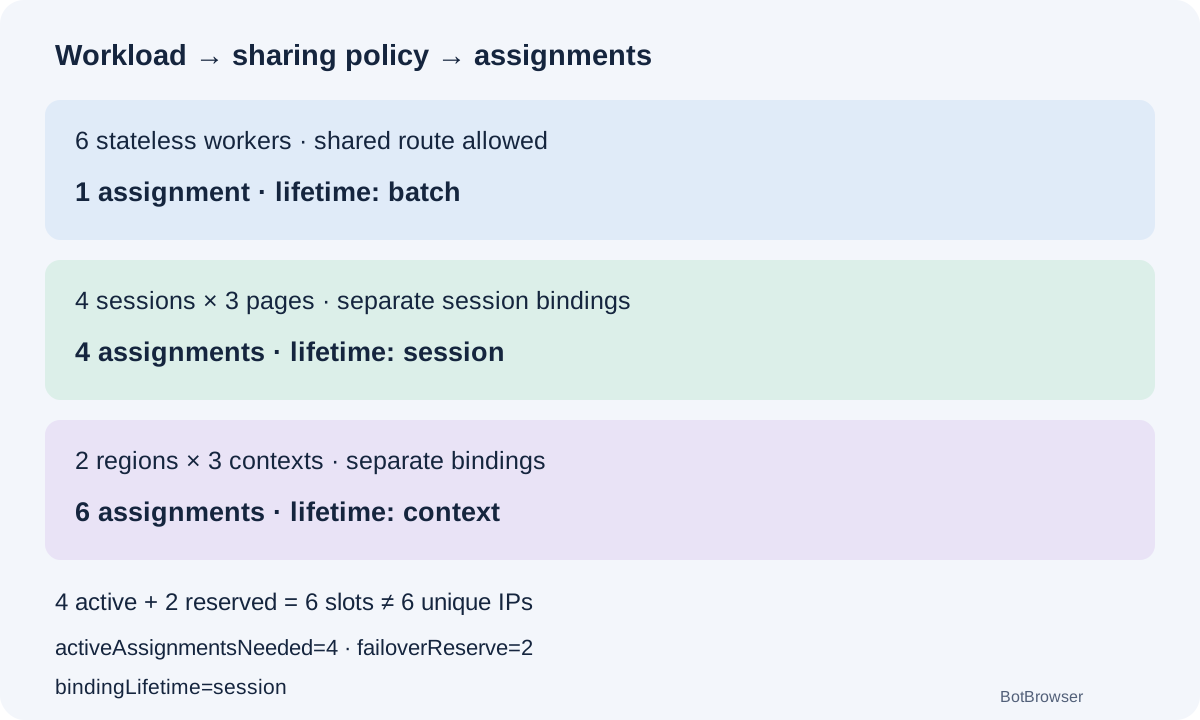
The following cases are hypothetical planning examples, not executed proxy tests or provider recommendations. Each result follows from its stated sharing rule. No row asserts that an assignment has a unique IP address, can sustain a particular request rate or will be accepted by a destination.
| Workload and explicit policy | Concurrent work | Active assignments needed | Binding lifetime |
|---|---|---|---|
| Stateless checks may all share one approved route | 6 workers | 1 | One batch |
| Each separate session requires its own assignment; pages share their session's context | 4 sessions, 3 pages each | 4 | Entire session |
| Each regional context requires a separate assignment | 2 regions, 3 contexts per region | 6 | Entire context |
In the first case, six workers consume one shared binding because the application permits that sharing. This says nothing about whether the route has enough bandwidth or whether six simultaneous requests are allowed. If the approved request budget permits fewer starts, the scheduler must wait even though a route is available.
In the second case, twelve pages belong to four session contexts. Assigning one route per page would create twelve bindings without meeting a new requirement. The four-binding result relies on each session's pages sharing its context and route. If a page actually belongs to a different account or lifecycle, change the input grouping rather than assuming the original result still holds.
The regional example gives six simultaneous assignments because the declared policy requires one for every context. It does not prove six different exits or guarantee a regional result. A requirement for distinct public addresses must be added and independently checked. Proxy configuration choices distinguish launch, context and switching scope; a scope choice precedes the arithmetic.
For a larger workload, group simultaneously active units by the route-sharing rule and count the required bindings in each group. Preserve the grouping beside the total. There is no universal conversion from requests per second to proxy count: allowed traffic, session separation, provider capacity and browser resource limits are different constraints.
Peak overlap and queued work
Size the pool against the units that overlap, rather than the number of units submitted during a day. Suppose the four-session example has another 8 sessions waiting in the queue. Under the declared policy, those queued sessions hold no assignment until admitted. The plan therefore still needs 4 active assignments while 12 sessions exist in the job. That result depends on the scheduler enforcing a four-session admission limit; merely writing the limit in a worksheet does not enforce it.
An assignment can be busy while no request is in flight. A session waiting for an application response, user-approved checkpoint or local processing may still need its existing route. If the binding lasts until session completion, the scheduler cannot give the slot to another session just because the network is briefly idle. Track admitted, waiting, releasing and reusable units as different states. Context lifecycle guidance supplies the browser-side boundary; the allocation record supplies the application's admission decision.
| Application state | Allocation consequence |
|---|---|
queued | No binding until admission |
bound | Assignment stays occupied, including network-idle periods |
releasing | Cleanup or a declared release check is pending |
reusable | Application policy permits another allocation |
For regional work, preserve the subtotals. Six slots approved for one region do not satisfy a requirement for 3 in each of 2 regions. Even when the combined total is 6, the regional allocation condition can fail. A useful queue policy waits for a matching approved slot rather than substituting an arbitrary endpoint. Any allowed substitution belongs in the workload contract, especially when the output is compared with a regional baseline.
Specify the binding lifetime
A binding can last for a request, a batch, a login session, a context or several runs. Choose the shortest lifetime that still satisfies the workload's state requirements. A regional screenshot batch might release its assignment after collection; a session journey may require a stable route until all steps finish. Those are application policies, not properties implied by the word “pool.”
Before purchasing a sticky route, ask when the provider starts its timer, what events end the binding, and whether reconnecting preserves the exit. Record unknown terms as unknown. A fixed endpoint string is insufficient evidence of a fixed egress address. Even a documented lifetime is a provider promise whose relevant behavior needs observation in the authorized environment.
Browser storage has its own lifetime. Playwright browser contexts isolate browser state; selecting another proxy is not the same operation as discarding cookies and local storage. Decide whether a changed route invalidates the current session. A fresh context is the conservative boundary when the application's contract requires a new isolated session, but that decision still needs an explicit state-restoration policy.
For an allowed route change inside a retained context, start a new route segment and record the change time. Requests already in flight and persistent connections complicate attribution. The rotation-boundary explanation owns those request-level details. Keep the assignment occupied until its release condition holds; changing a setting does not establish that every existing connection has moved.
Repeat the inputs without promising the same exit
A repeatable allocation plan and a repeatable public IP are separate requirements. A later run can reuse the same grouping, region policy, profile reference and provider product while receiving a different exit. That may be acceptable for an authorized stateless collection but invalid for a comparison whose contract demands the same network route. Declare which property must repeat before selecting a provider or retaining browser state.
Treat an unknown exit lifetime as an unresolved input rather than inventing a duration. The application can choose not to admit work that requires a guarantee the provider does not offer. BotBrowser geographic alignment concerns browser settings associated with a detected exit; it cannot turn an unspecified provider lifetime into a stable network contract. Store the provider term and the observation separately so a later discrepancy has an identifiable owner. If a lifetime expires during a run, preserve the affected route segment and apply the workload's declared stop or transition rule before admitting subsequent steps.
Keep reserve capacity separate
Active capacity serves normal work. Reserve capacity is an approved alternative for a defined failure condition. If the four-session example has activeAssignmentsNeeded=4 and separately records failoverReserve=2, the plan contains 6 allocation slots. It still does not establish 6 unique exits, 6 healthy routes or permission for additional simultaneous sessions.
Specify how a failed assignment is retired before its reserve is activated. If old and replacement contexts can overlap during cleanup, account for that temporary occupancy explicitly. If the policy forbids overlap, wait for the old unit to stop. Do not hide transition capacity inside an unexplained percentage or describe every configured endpoint as usable reserve.
A reserve is not a retry instruction. A destination's denial, withdrawn permission or overload signal may require stopping rather than changing routes. Rate and concurrency limits remain shared constraints across the authorized job. A pool manager must not translate an account-level refusal into a search for another exit.
The allocation plan should also distinguish disconnected routes from reusable slots. The application decides when to mark a slot reusable, using its isolation requirements, cleanup status and verified provider behavior. A network disconnect alone need not satisfy that declared policy. Record the release check beside bindingLifetime; otherwise the scheduler can overstate free capacity while every configured endpoint still appears reachable.
Define what counts as an eligible replacement
An endpoint that accepts a connection is not automatically a replacement for every workload. The replacement must match the declared protocol, permitted region, authentication configuration and binding lifetime. If a session requires a stable assignment for its remaining steps, a route whose behavior is unknown does not satisfy that requirement. A provider response or deployment check should resolve each necessary condition before the scheduler marks the slot eligible.
Keep failure reasons specific. Unavailable credentials, a refused proxy connection, an unexpected observed exit and a destination application error belong in different fields. The proxy configuration overview gives the network configuration choices; it does not certify a provider's health. Pool selection can exclude a route whose required property fails without inventing a reputation score or treating an unrelated destination error as proof that the proxy is defective.
Record enough to explain a replay
A useful pool worksheet records decisions that an endpoint list omits. The field names below define an original planning schema, not a BotBrowser API or a measured result. Values belong in the application record; credentials should remain in the deployment's secret store.
| Field | Decision or observation to preserve |
|---|---|
workloadUnit | Request, batch, session or browser context |
maxConcurrentBoundUnits | Largest number of units needing simultaneous bindings |
sharingPolicy | Which units may share a logical assignment |
bindingLifetime | Event that begins the binding and event that releases it |
providerExitSemantics | Documented fixed, rotating or unknown exit behavior |
activeAssignmentsNeeded | Result derived from the stated grouping policy |
failoverReserve | Separate approved replacements and activation condition |
stateResetBoundary | Whether a route change retains or replaces browser state |
replayRecord | Workload/context IDs, route label, observed egress, timestamps and route segment |
An egress observation should name its receiving service and time. It establishes what that receiver saw, not what every destination or protocol used. Repeat observations only within the approved test scope. If the required exit condition is unknown or fails, keep the unit unassigned or stop it according to the plan; an HTTP 200 application response cannot manufacture missing routing evidence.
For BotBrowser deployments, the per-context documentation provides the assignment mechanism and entitlement prerequisites. Proxy geographic alignment describes browser-setting alignment. Neither page supplies provider capacity, guaranteed IP persistence or an allocator. Preserve the loaded profile and configuration reference beside the worksheet without treating aligned browser settings as proof of the network path.
Acceptance checks for the allocation plan
Before an authorized run, test the allocator's decisions against the hypothetical four-session policy. A fifth session should remain queued while all 4 active bindings are occupied. Opening a third page inside an already admitted session should not allocate a fifth binding. Ending a session should make its assignment reusable only when application policy accepts the cleanup state, isolation conditions and verified provider behavior. These are proposed application assertions, not a report that a browser or provider passed them.
Then exercise missing information as a decision case. If observed egress is required but unavailable, the record should preserve that missing observation and the admission decision. If 2 reserves are listed but neither meets the required regional condition, eligible reserve capacity is absent for that workload. RFC 6585 remains relevant when the destination responds with 429: the allocator should preserve the response and applicable stop or wait decision, without assuming a different assignment changes the server's counting scope.
FAQ
Does every worker need its own proxy?
Only when the declared binding policy requires a separate assignment. Shared stateless work and independent session journeys can have different answers even with the same worker count.
Is a pool of 6 endpoints a pool of 6 IPs?
Not necessarily. Gateway behavior and provider allocation determine the relationship; observed distinct exits are a separate condition.
Can unused reserves increase normal traffic?
Not automatically. Reserve activation and the destination's traffic allowance remain separate decisions, and replacement work may require stopping an existing unit first.
Sources
- Playwright Browser.newContext proxy option
- Playwright browser contexts
- RFC 6585: 429 Too Many Requests
- BotBrowser per-context proxy
- BotBrowser proxy geographic alignment
Practical conclusion
Write the sharing rule and binding lifetime before buying or scheduling routes. Derive active assignments from simultaneous workload groups, keep replacements separate, and attach provider terms plus observed egress to each relevant segment. That produces an explainable pool plan without confusing endpoints, sessions, public addresses or destination permission.
This article is part of the guide: Proxy Configuration Overview: A Browser Network Decision Map
Related Articles
Per-context proxy: route ownership for separate browser work
NetworkProxy Rotation for Web Scraping: Session Boundaries
NetworkVerify Proxy Egress IP in BotBrowser Launcher
NetworkProxy Configuration Overview: A Browser Network Decision Map
NetworkProxy Failover and User-Visible Continuity
NetworkBrowser Proxy Configuration: SOCKS5, HTTP, and HTTPS Guide
Run the same check in BotBrowser
Load a profile, keep the signals you just read about consistent inside the browser, and confirm the result on your own machine before a rollout.