SERP Location Check: Which Layer Actually Moved?
Verify a country setting, browser location and network exit as separate evidence before treating a SERP as another country view.
BotBrowser Team
Want the structured docs for Network?
This article lives in the editorial library. For step-by-step setup, reference material, and ongoing updates, jump into the docs section.
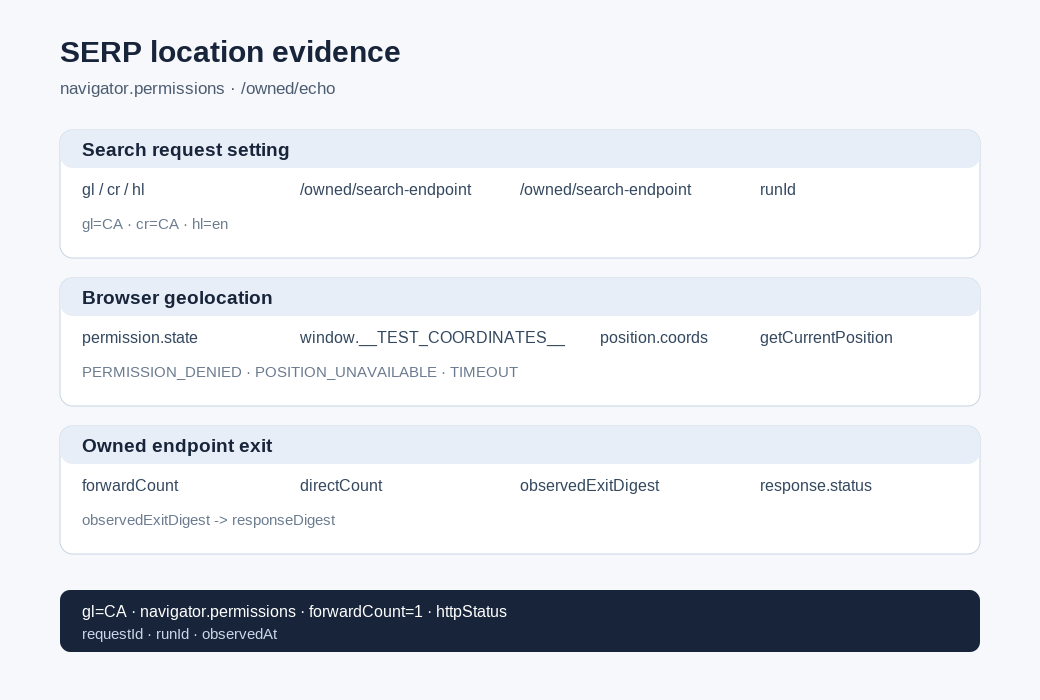
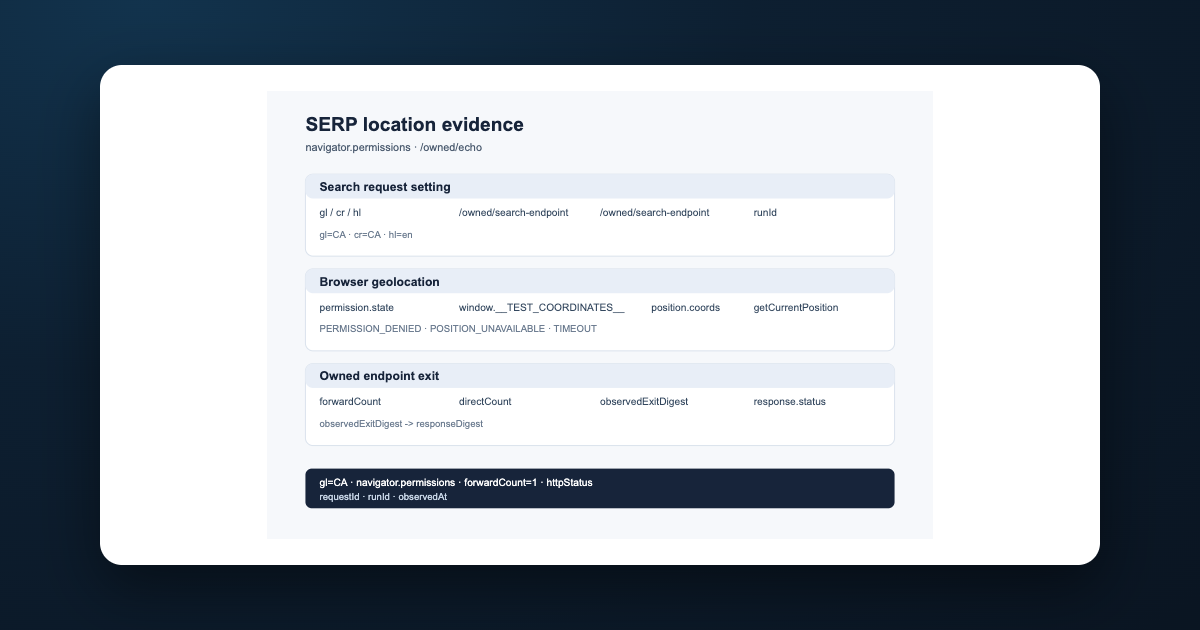
A request that is meant to show another country can move while the evidence remains ambiguous. The search tool can accept a country setting, the browser can expose a configured or permissioned position, and the connection can leave through another network. Those are three inputs, not three proofs that a search service used the intended country. This check records the input changed and a separate observation for each layer before any result is described as a country view. BotBrowser can align documented browser and proxy inputs for an authorized test, but it does not choose a search engine's location, authorize automated querying or guarantee a result set.
The existing SERP location mechanism comparison establishes why the layers differ. This page supplies the operating order: change one layer, prove what changed, then decide whether the next layer is actually needed.
TL;DR
- Treat the search tool setting, browser position and network exit as separate inputs with separate evidence.
- Change one layer at a time. A country field that returns a different list does not prove the browser or route moved.
- Record the exact request setting, browser permission and observed position, and an owned endpoint's observed exit.
- Use a before/after row for each layer. Missing evidence stays unknown instead of being filled by the intended country label.
- Stop when the service's documented setting answers the question. Adding coordinates or a different route increases variables and privacy exposure.
- BotBrowser can keep declared browser and network inputs consistent for an authorized check; it cannot promise the search service inferred that country.
Contents
- Start with a three-layer evidence record
- Change the search tool setting first
- Verify browser location without inheriting intent
- Verify the network exit from an owned endpoint
- Use the before and after table to choose the next layer
- BotBrowser capability and limitation
- Practical conclusion
Start with a three-layer evidence record
Write the expected country and the question before opening a tool. "Show me the search-result page a resident sees" is broader than "ask this API for results boosted toward a country." A team may be checking a documented country parameter, a browser geolocation path or a network route. The record must use the same question for every lane; otherwise a result difference cannot be attributed to the location input.
Create one row per layer with five fields: configured input, evidence source, result before the change, result after the change and unresolved interpretation. The configured input is what the operator set. The evidence source is where the observation came from. The before and after values must be recorded independently. The unresolved field says what the observation does not establish.
| Layer | Configured input | Evidence source | What the check can establish | What it cannot establish |
|---|---|---|---|---|
| Search tool | Country or location field | Request echo or owned adapter log | The exact value the tool or API received | That a different search product used that country |
| Browser | Permissioned or configured position | Page or owned endpoint readout | The value delivered to the page under that configuration | That the search service preferred it |
| Network | Proxy or route | Owned echo endpoint plus proxy count | Which exit served the check request | A physical location or a search engine's inference |
Use a stable run identifier across all three rows. Generate it from the fixture revision and a timestamp, not from a user identifier. The identifier lets an engineer pair a request echo, a browser record and an owned endpoint response without storing a person's address or account. Retain the fixture source beside the result so a later run can distinguish a changed control from a changed implementation.
The row must name the evidence producer. A contact page that changes its currency is not proof of a browser geolocation value. A visible country name in a consent banner is not proof of an API's request parameter. A proxy provider's dashboard can show a route label without proving the route served the request you are testing. Keep the observation next to the input that produced it.
Freeze the browser build, locale, language, viewport and profile between runs whenever those inputs are not part of the test. Otherwise a layout or language change can be mistaken for a country change. The browser profile isolation guide covers storage and profile boundaries; this check needs an even narrower rule: change one location layer and leave every unrelated variable fixed.
Change the search tool setting first
The first row is the setting the tool itself documents. For Google Programmable Search, gl is a country code that boosts documents whose country of origin matches the request, while cr restricts document origin and hl changes interface language. Those are service-defined effects. They are not a city view of the ordinary Google Search page. Record which field was sent and which service received it; do not rename a document-country boost as a physical-location match.
Use a server you own to echo the request when the tool allows it. The echo can prove that the intended country value reached your adapter or request builder. The search response still belongs to the service's own processing. If the output changes after a setting change, record both the setting and the response change, but leave the causal reason at the level the service documents.
Do not change the proxy, browser permission and locale at the same time. One combined run can produce a plausible country page while leaving four variables without attribution. If the documented tool setting alone answers the permitted question, stop there. Additional location layers are not a stronger version of the same measurement when their evidence comes from different producers.
Authorization remains separate. A country field does not make an automated query permitted. Google's machine-generated traffic policy covers automated queries and rank-checking without express permission. Confirm that the product, source and data-use terms cover the work before recording any search output.
A minimal owned request echo can separate a declared setting from an accidental omission:
const expectedCountry = 'CA';
const request = new Request('/owned/search-echo', {
  method: 'POST',
  headers: { 'content-type': 'application/json' },
  body: JSON.stringify({
    runId: process.env.RUN_ID,
    country: expectedCountry,
  }),
});
const response = await fetch(request);
const receipt = await response.json();
console.log({
  expectedCountry,
  receivedCountry: receipt.country,
  receivedRunId: receipt.runId,
  forwarded: receipt.forwarded,
});
The adapter must reject an unknown origin, limit accepted paths and return no search result content. Its receipt establishes only that the test request carried a country field and was forwarded once. It does not validate a third-party search product or turn your local value into a service's geographic interpretation.
Verify browser location without inheriting intent
The browser row asks what position reached the page, not what country the operator hoped to see. On an owned page, request geolocation only after a visible user action, check the permission state and handle denial, timeout and unavailable results separately. MDN's getCurrentPosition() reference documents secure-context and permission requirements. A page that cannot obtain a position has provided no location evidence, even if the profile was configured for a country.
Record provenance beside coordinates. A measured device estimate, a cached position and an explicitly configured value are different evidence classes. If the browser environment exposes configured coordinates, say configured. Do not turn configured values into a claim about the device or about the search service. The geolocation permission and accuracy guide covers the broader API boundary.
An owned page can print a compact record rather than retain a full coordinate. Send the value to a trusted page-external digest function and keep the key out of the page:
const permission = await navigator.permissions.query({ name: 'geolocation' });
const record = {
  permission: permission.state,
  configuredDigest: null,
  measuredDigest: null,
  accuracy: null,
  observedAt: new Date().toISOString(),
};

async function keyedDigest(latitude, longitude) {
  const response = await fetch('/owned/coordinate-digest', {
    method: 'POST',
    headers: { 'content-type': 'application/json' },
    body: JSON.stringify({ runId: process.env.RUN_ID, latitude, longitude }),
  });
  const result = await response.json();
  return result.digest;
}

navigator.geolocation.getCurrentPosition(
  async position => {
    record.measuredDigest = await keyedDigest(position.coords.latitude, position.coords.longitude);
    record.accuracy = position.coords.accuracy;
    console.log(record);
  },
  error => {
    record.error = { code: error.code, message: error.message };
    console.log(record);
  },
  { enableHighAccuracy: false, timeout: 5000, maximumAge: 0 }
);
The snippet is a local diagnostic shape, not a country test. Raw latitude and longitude never enter record or console output; the page-external service discards them after computing the digest. It proves that the page received a position, permission state or error under that run. It does not prove the search engine used the same value. Use a disposable test fixture and never publish data from a real person.
Three branches should remain separate in the result. denied means the page was not permitted to request a position. unavailable means the API reported that no usable position could be obtained. timeout means the owned page stopped waiting under its own deadline. Those labels describe different failure producers. Converting all three to "wrong country" hides whether a permission policy, device condition or page deadline caused the missing value.
When a supported browser environment intentionally exposes configured values, label them as configured in every row. A configured value is still useful evidence: it proves the page received that declared value rather than a measured estimate. It does not justify a claim about a person or a destination. Repeat the same owned page under the route lane only after the configured browser record is stable.
Verify the network exit from an owned endpoint
The network row needs a request the team owns. Point the browser to an owned endpoint that returns only the observed address and a request identifier, then record the proxy's forward counter. The endpoint observation proves which exit served that request; the proxy count proves the request crossed the proxy adapter. A provider dashboard alone is a statement about a route, not proof that the tested request used it.
Keep the route check separate from a geo-IP database. A service's general-area estimate can use an address or other signals, while a database label is a separate interpretation. Record the observed address in a keyed or redacted digest when the evidence does not need the raw address. Preserve an allowlist so the test cannot become a general browsing lane, and do not expose credentials in logs.
The proxy and geolocation alignment guide documents browser inputs that can be kept consistent with an authorized route. It can help produce a declared test environment. It does not establish the search service's location inference or make two exits equivalent. The proxy egress verification workflow covers an owned end-to-end route check.
The endpoint can make a deliberate mismatch easy to see:
| Proxy forwards | Owned endpoint sees | Interpretation |
|---|---|---|
0 | Host address | The request never used the proxy or an exclusion matched |
1 | Expected proxy exit | The tested request crossed the intended route |
1 | Different exit | The adapter accepted the request, but another upstream route served it |
2 | Any address | Interception or a repeated request invalidated the "one request" assumption |
Record a UTC timestamp and the proxy allowlist with these counters. If the direct listener saw a request, report that separately rather than subtracting it from the forward count. The endpoint is a measurement surface the team owns; it cannot show which search service location sources were selected after the request left it.
The adapter can return only a redacted digest and its own counters:
import { createHash, createHmac } from 'node:crypto';

let forwardCount = 0;
let directCount = 0;
const key = process.env.ECHO_HMAC_KEY;

function digestAddress(address) {
  return address && key ? createHmac('sha256', key).update(address).digest('hex').slice(0, 16) : null;
}

export function echoReceipt(address, runId, expectedExitDigest) {
  const observedExitDigest = digestAddress(address);
  return {
    runId,
    observedExitDigest,
    expectedExitDigest,
    forwardCount,
    directCount,
    responseDigest: createHash('sha256')
      .update(observedExitDigest ?? 'unknown')
      .digest('hex')
      .slice(0, 16),
  };
}

export function recordEchoRequest({ direct = false } = {}) {
  if (direct) directCount += 1;
  else forwardCount += 1;
}
Call recordEchoRequest() inside the owned request handler: direct for the host listener and the default path for the proxy adapter. Reject an unauthenticated run and restrict the endpoint to the test path. The receipt supports equality checks only for that run; it is not an address lookup and does not establish a service's geographic inference.
Run the network row only if the search-tool setting and browser row did not answer the actual question. Changing the exit after observing a different response introduces another variable. Repeat the tool setting and browser record under the new route, then compare the full three-row record. A list that changes after the route changes is still not proof that the search engine used the route; it is evidence that the run differed.
Use the before and after table to choose the next layer
The decision table is the reader's working artifact. Fill every cell with an observation or unknown. Do not write the intended country in the evidence cell.
| Question | First layer | Before record | After record | Decision |
|---|---|---|---|---|
| Did the API receive the documented country field? | Search tool | Field absent or other value | Exact field and country value | Stop if this is the entire documented question |
| Did the page receive a position? | Browser | Permission unavailable | Permission state plus digest or error | Stop on denial; do not infer a country |
| Did the owned request use the new route? | Network | Host exit or zero forwards | Owned exit and one forward | Fix the route before testing another page |
| Did the result set change? | Search output | Baseline response under fixed conditions | Response after one layer changed | Record association, not a hidden location claim |
| Can a human reproduce the record? | Whole run | Inputs and timestamps missing | All five fields and fixture revision present | Keep unknown where evidence is absent |
If the in-page value changes but the owned endpoint still sees the host address, the browser location moved while the route did not. If the route changes but the page has no position permission, the network moved while browser location stayed unknown. If both move and the result changes, the run still cannot say which signal the service preferred. The table's job is to keep those outcomes distinct.
Use a controlled search endpoint you own, or a source whose terms explicitly permit the work. Do not treat a public results page as a test endpoint merely because a browser can open it. Authorization, retention and redistribution belong to the service agreement. A reproducible record is evidence of your run, not a licence to repeat an unauthorized collection.
Keep the test small. One owned echo endpoint, one owned geolocation page and one permitted search API call are enough to exercise the decision order. Do not grow a network of third-party detectors, hidden browser profiles or rotating accounts to make a country result appear. Those additions change the question from "which documented layer moved?" to "which uncontrolled collection produced this page?" and cannot be reviewed as a location check.
BotBrowser capability and limitation
BotBrowser documents profile-backed timezone, locale and language inputs and a proxy-and-geolocation alignment path for authorized browser work. Those capabilities let a team declare a consistent browser environment and route for a check, reducing accidental changes between runs.
The limitation belongs in the same decision: BotBrowser does not choose a search engine's country parameter, cannot make a result appear in another country, and does not guarantee a ranking, click or personalization outcome. A declared route and profile are inputs to the test, not evidence that the search service used either one. The team still records the search-tool setting, page observation and owned endpoint result separately.
FAQ
Does changing a country field prove the search service used that country?
No. The field proves what your request supplied to the documented service. It does not prove another search product inferred the same country or selected a result set from it.
Is browser geolocation required for a country check?
No. A documented service country parameter can answer a narrower API question without coordinates. Browser position is relevant only when the question specifically depends on the value delivered to a page and its permission state.
Can a proxy exit alone establish another country view?
No. The owned endpoint can prove which exit carried a request. It cannot prove the search service's geographic inference or that the page was viewed as a resident of that country.
Sources
- Google: Understand and manage search location
- Google Programmable Search: cse.list reference
- MDN: Geolocation.getCurrentPosition()
- Google Search: Machine-generated traffic policy
- BotBrowser: Proxy and geolocation alignment
- BotBrowser: Timezone, locale and language
Practical conclusion
Change the search-tool setting first and record the exact service field it received. Verify browser location only when the service layer cannot answer the question, then verify the network exit from an owned endpoint rather than a provider label. Keep every layer's before and after evidence separate, preserve unknown when a permission, route or service response is missing, and stop when the documented setting answers the real question. BotBrowser can make declared browser and network inputs reproducible; it cannot turn that configuration into a guaranteed country result.
When the remaining question is which implementation class to choose before running this check, use SERP location changer tools and verification.
This article is part of the guide: Proxy Configuration Overview: A Browser Network Decision Map
Related Articles
SERP Location Changer Tools: Compare and Verify the Input
ComparisonWhat a SERP Location Setting Changes, and What It Does Not
ComparisonSERP Rank Tracking: Location, Device and Position
FingerprintBrowser Geolocation Permissions and Location Accuracy
NetworkPuppeteer Proxy: Configure It and Verify the Exit
DeploymentBrowser Profiles for SEO Monitoring and SERP Tracking
Run the same check in BotBrowser
Load a profile, keep the signals you just read about consistent inside the browser, and confirm the result on your own machine before a rollout.