SERP Location Changer Tools: Compare and Verify the Input
SERP location changer tools compared by what they control: extension preference, API country field or browser environment, with a verification receipt.
BotBrowser Team
Want the structured docs for Network?
This article lives in the editorial library. For step-by-step setup, reference material, and ongoing updates, jump into the docs section.
A SERP location changer is a class of implementation, not a guarantee that Google used another country. The main choices change different inputs: an extension can alter a visible search preference, an API can carry a documented country or task-location field, and an authorized browser environment can declare a locale, timezone or network route. Each leaves a different observable record. BotBrowser documents browser and proxy inputs for authorized work, but it cannot select a search service’s effective location, grant source permission or promise a result set. Use the implementation class and the receipt that can verify it.
This is the implementation-choice layer. The mechanism comparison explains why the inputs are not interchangeable, while the three-layer location check verifies the path selected here. A provider, extension or browser profile is a tool under test, not evidence that the search result represents a resident.
TL;DR
- Start with the question: change a search preference, request a documented API field, or modify a browser environment.
- A browser extension can change a visible preference, but its own settings do not prove which search-service location source was used.
- A documented API field has a defined subject: for example, Programmable Search
glis a document-country boost in that API, not a general Google Search city view. - A browser environment can declare timezone, locale and an authorized route; those values still do not establish search-engine inference.
- Record claimed control, observable producer and unresolved interpretation before comparing two tools or calling a result another-country evidence.
Contents
- Choose the implementation class
- Extensions change preferences, not the search engine
- API fields have a narrower contract
- Browser environments make inputs explicit
- Use a selection table and a receipt
- Compare tools without pretending to rank them
- Practical conclusion
Choose the implementation class
The first decision is the subject of the question. An operator checking a search tool’s own country preference needs the tool’s request or interface evidence. An operator asking a supported search API for a country effect needs that API’s documented field and response. An operator checking a browser profile and route needs the browser configuration plus an owned endpoint observation. One class is not automatically stronger than another; it answers a different question.
Google’s search-location explanation describes multiple location sources used together. Device information, saved places, previous activity and IP address can contribute. The documentation also describes source labels such as “From your device,” “Based on your places,” “Based on your past activity” and “From your internet address.” Those labels are useful because they identify a service-reported basis; a configured tool setting does not substitute for that observation.
Do not choose a class by which product claims the most controls. Choose by the evidence the task needs. A country-preference question can often stop at a documented request value. A browser-position question needs permission and a position outcome. A network-area question needs an owned route observation and still cannot prove the service’s interpretation. The least invasive class that answers the actual question is the useful selection rule.
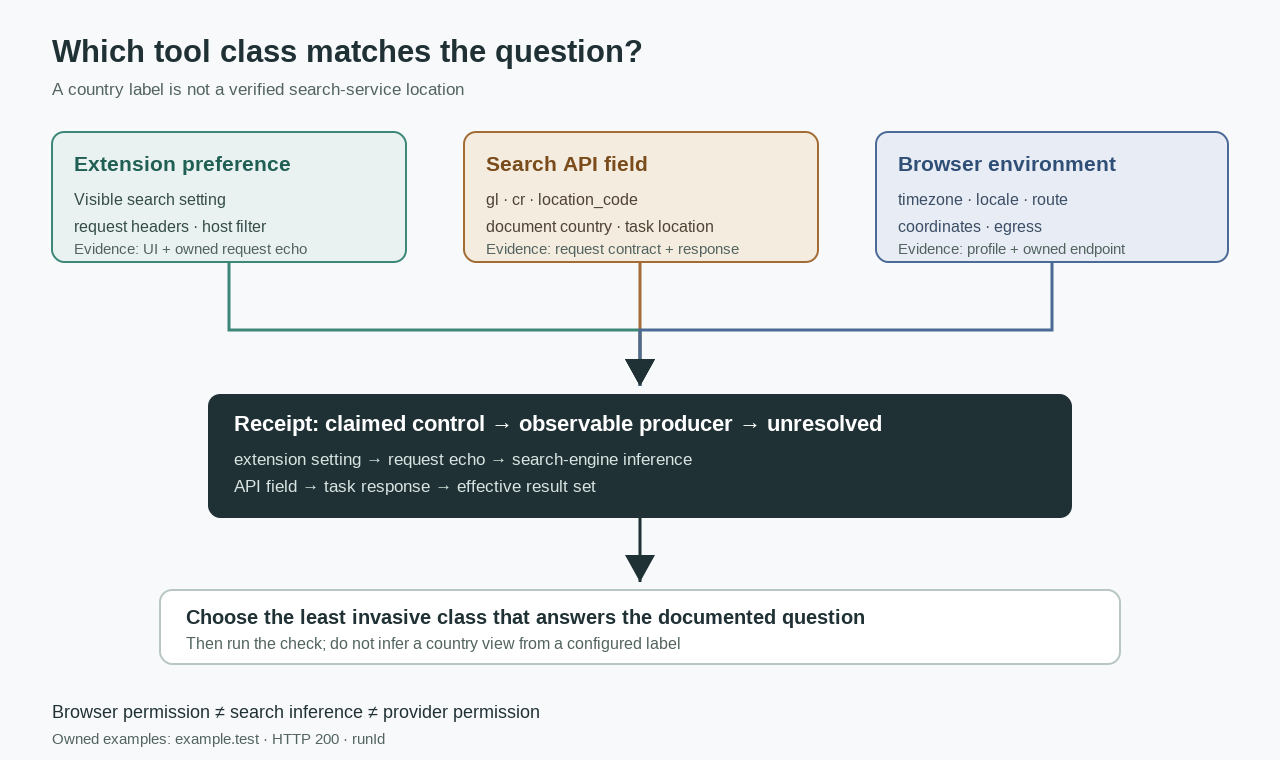
For the mechanism details behind that figure, use the location mechanism comparison. For a controlled run that records the selected input, browser state and owned exit, continue with the SERP location verification flow. The separation matters: tool choice precedes verification, and neither step becomes permission to automate a search source.
Extensions change preferences, not the search engine
Chrome’s extension platform exposes distinct APIs for a reason. Declarative Net Request applies declarative rules to requests, while Web Request observes or handles stages of a request with the extension’s permissions and host access. Neither API windows the search engine’s internal location system. An extension that offers a search-location setting should state whether it changes a visible preference, request metadata, request routing, or another browser surface.
The extension’s manifest determines what it can request and where it can operate. Chrome’s permission declaration guide separates permissions from host permissions and warns that visibility and user consent affect installation. A permission to modify a request is not authorization to automate a search service, collect every response, or reuse result content. Those are separate terms and responsibilities.
A useful extension check records four things: the setting or rule that changed, the extension’s declared permission scope, the request echo or page evidence that observed the change, and the result-page basis or absence of evidence. The extension’s settings page is not a result receipt. It proves the tool accepted a preference, not that the search engine honored it.
An extension can also fail in a way that looks like success: it can update its own interface while a request never reaches the intended host, or it can modify a request that a different browser context did not use. Record the browser context, the tool’s rule identifier and the observable request boundary together. The browser context lifecycle guide explains why a context’s storage and request state should not be assumed shared with another context.
API fields have a narrower contract
Search APIs publish fields with their own meanings. Google Programmable Search’s cse.list reference defines gl as a two-letter country code for end-user geolocation. Its documented result effect is a boost for documents whose country of origin matches that value. cr restricts results to documents originating in a country, and hl sets the interface language. None of those fields is a general Google Search city selector.
That narrowness is a feature for selection. If the task needs only a document-country preference, a documented gl request can be checked against the request echo and the API response. If the task needs a provider-defined city scope, the DataForSEO organic task reference lists location_code, location_name and location_coordinate as alternatives in its own operation. Their names do not establish precision, fallback behavior or the search engine’s effective interpretation; the selected operation’s current contract does.
| API implementation | What the documentation describes | What the operator still must check |
|---|---|---|
Programmable Search gl | A country-based document-origin boost within this API | Whether that preference answers the task, and whether the output promised a city |
Programmable Search cr | A restriction to documents from a country | Whether document origin is the intended geographic subject |
Provider location_code | A provider-defined task location identifier | Supported operation, fallback, precision and current terms |
Provider location_name | A provider-defined place name | Ambiguity, matching rules and the provider’s documented scope |
API selection also needs a source-policy check. Google’s machine-generated traffic policy names automated queries and scraping search results for rank-checking without express permission. A provider field does not supply that permission. When a contract or source does not allow the workload, changing the location field cannot make it allowed.
The receipt for this class is short: API operation, field name and submitted value, the returned task evidence, and the interpretation the service contract supports. Keep the response classification separate from the country label. A successful API response is not by itself proof of a resident’s result page.
Browser environments make inputs explicit
An authorized browser environment can declare timezone, locale, language and a proxy route. BotBrowser’s proxy configuration documentation describes the launch input and exit-address verification, while its proxy-geolocation alignment documentation covers profile-backed geographic inputs. Those controls are useful for repeatable authorized tests because they make the declared environment reviewable.
They also have a hard boundary. A route’s exit address is an observation about the connection, not proof that a search service used the route’s area. A configured locale changes browser-facing preferences, not Google’s result selection. A permissioned coordinate is evidence that a page received a position, not evidence that the result-page basis was “From your device.” The network identity and privacy guide covers the related distinction between a browser’s visible inputs and a service’s decision.
This class is appropriate when the question is genuinely about a declared browser environment: for example, whether a controlled profile keeps locale and route aligned for an authorized workflow. It is not the right default for a public search-preference question. Browser-environment evidence is more complex, changes more variables, and normally involves more privacy exposure than a documented API request.
Use a selection table and a receipt
Select a class before comparing vendors. A named extension, API provider and browser environment are not interchangeable products merely because each has a “country” control. The following artifact is the decision record.
| Question | Extension | Search API | Browser environment | What to verify |
|---|---|---|---|---|
| Change a visible search preference? | Candidate | Not its role | Not its role | Interface plus request or result basis |
| Request a documented country effect? | Not its role | Candidate | Not its role | Field, request echo and service response |
| Keep locale and route aligned for an owned workflow? | Not its role | Not its role | Candidate | Profile, route and owned endpoint |
| Prove a resident’s result set? | Insufficient alone | Insufficient alone | Insufficient alone | Service basis or a source that explicitly provides it |
| Establish permission to automate? | Not provided | Not provided | Not provided | The applicable source and data-use agreement |
The receipt should have one row per claim. “Claimed control” is the setting, field or launch input. “Observable producer” is the place the evidence came from: extension request echo, API response, owned page or owned endpoint. “Unresolved” is the interpretation the producer cannot establish. If the producer column is empty, the claim remains untested.
{
  "runId": "fixture-revision-20261128-a",
  "implementationClass": "search-api",
  "claimedControl": { "field": "gl", "value": "CA" },
  "observableProducer": "owned-request-echo",
  "observed": { "status": 200, "requestField": "gl", "value": "CA" },
  "unresolved": "The search service's effective result basis was not observed."
}
The JSON is an illustrative record shape, not a real run. It deliberately keeps an unresolved field rather than filling the gap with the intended country. For a tool with a user interface, replace implementationClass and claimedControl, not the separation between producer and interpretation. Compare two tools only after their receipts use the same question and observation window.
Compare tools without pretending to rank them
A responsible comparison can name categories and decision criteria without listing “best” software on evidence the page does not have. The literature that can be checked here is documentation and source contracts, not a benchmark of a vendor’s live SERP output. This article therefore treats tools as implementation classes and does not claim that one provider has better country accuracy. The cse.list gl field defines one checkable API case: the value can be caught with an owned request echo before the search service processes it.
Use these comparison questions before trying a tool: Does it change a preference or a request? Is its field documented to have the geographic meaning you need? Does it show the value that reached the service, or only display the value you entered? Does its terms allow the intended workload? Does it provide an observable basis for the result, or only a country label? The answers are more useful than a generic country-count claim.
The rank tracking setup guide applies after an accepted result exists: it covers observed ordinals and contextual comparability. A SERP location tool does not make a rank comparable merely by changing a country label. When the underlying query is not permitted, stop before comparing positions.
A bounded comparison record
An implementation comparison can be reproducible without pretending to have run a live country test. Use the same short page or API fixture for both tools, freeze the browser build, language, viewport and time, and record what each tool claims it will change. The comparison records the observable producer; it does not claim that two different result pages were the same SERP.
{
  "fixture": "owned-country-preference-v1",
  "fixed": {
    "apiOperation": "cse.list",
    "programmableSearchField": "gl",
    "programmableSearchValue": "CA",
    "requestEcho": "https://example.test/owned/echo",
    "observedStatus": 200
  },
  "toolA": {
    "claimedControl": "visible country preference",
    "producer": "owned request echo",
    "unresolved": "effective search-result basis"
  },
  "toolB": {
    "claimedControl": "document-country boost",
    "producer": "API request and response",
    "unresolved": "physical requester location"
  }
}
The fixture is illustrative and uses a reserved .test host. It proves that the record shape keeps each producer separate; it does not prove a tool’s live country accuracy. If a tool only offers a screenshot of its own settings panel, classify that as a claim about its interface. A request echo or documented API response is a stronger implementation observation, while the search service’s effective location may still remain unknown.
Compare extension and API controls under one question
The comparison is useful only if both tools are asked the same question. For gl, the documented request subject is a country preference that boosts documents from that country’s origin. For an extension that changes a visible country control, the first observable is the interface state or the request it emits. Neither producer automatically tells you which of Google’s described location sources the result page used.
Record the service contract separately from the tool contract. The Programmable Search cse.list reference documents the field on its operation. The extension documentation defines its permissions and APIs. The user’s browser may additionally have browser-level location permission, website-level permission, a prior saved place, previous activity and a network-area estimate. Those are separate inputs, not a hierarchy in which the most recently changed tool wins.
This is why an extension with a country selector is not automatically a better location tool than an API with a documented field. The extension may be more familiar to a person using an ordinary search page, while the API may expose a narrower field with clearer request evidence. The selection depends on the operation the task is allowed to perform, not on product labels such as “global,” “local,” or “real location.”
A provider comparison without unsupported claims
Provider location fields are different contracts. The DataForSEO location reference documents alternatives for its task operation, but it does not establish a universal city definition for every search product. Compare providers only on fields and evidence you can read: the operation, the requested location input, the response metadata, the supported fallback behavior and the applicable data-use terms.
Do not infer competence from the presence of more fields. A provider that accepts location_coordinate is not necessarily more accurate than one that accepts a supported place name; precision is only real when the contract and the returned evidence define it. Likewise, a provider’s dashboard country label is not a search-service indication. A reproducible comparison keeps both producer identity and unresolved interpretation visible.
The rank tracking and context guide explains why observed positions can differ between runs. Tool selection should not add another uncontrolled variable: same account state, same browser build, same viewport, same language and the same query are the fixed inputs. Change only the country-setting input under comparison, and keep a separate row for any route or browser-profile change. Otherwise a comparison of two tools becomes a comparison of two environments.
When a comparison should stop
Stop before testing a tool whose source terms do not permit the workload, whose operation cannot represent the required geographic subject, or whose permission model would expose more location data than the question needs. A tool does not become acceptable because its UI offers a country selector. The machine-generated traffic policy applies to automated search queries; a provider API’s location field does not supply permission for the underlying search service.
Stop also when the task cannot observe the producer. A dashboard screenshot, a tool setting and a search result label are different evidence classes. If the only available record is the tool’s own “country” display, record the claim as unverified rather than converting it into a result basis. That is a legitimate comparison outcome: one implementation has a request contract, the other has only a UI promise. The reader can then choose based on the evidence they can actually obtain.
FAQ
Which SERP location changer should I choose?
Choose by the input you need to change. A documented API field is appropriate for an API country effect; a browser environment is appropriate only for an authorized workflow that needs declared browser inputs. An extension can change a visible preference, but its setting alone does not verify the search service’s result basis.
Is an extension safer than an API?
Not inherently. Compare the permission scope, the data the tool reads or changes, the observable producer and the applicable terms. A local-looking interface can still expose broad host access, while an API request can have a narrow documented field. Safety depends on the exact operation and evidence, not the tool category.
Does a country label prove that the search result is from that country?
No. A configured value, request field or browser preference proves only that an input was supplied to its producer. The search service’s effective location basis remains separate unless an authorized observation exposes a source indication. Keep the unresolved interpretation explicit.
Can BotBrowser make a tool return another country’s SERP?
No. BotBrowser documents profile-backed locale, timezone and language inputs plus authorized proxy routing. It cannot select a search service’s location, supply a provider’s request field or authorize automated querying. Use it only to keep declared browser inputs reproducible within an allowed workflow.
Sources
- Google: Understand and manage search location
- Google Programmable Search: cse.list reference
- Chrome Extensions: declarativeNetRequest
- Chrome Extensions: Web Request
- Chrome Extensions: declaration of permissions
- DataForSEO: Google organic task location fields
- Google Search: machine-generated traffic policy
- BotBrowser: proxy configuration
- BotBrowser: proxy and geolocation alignment
Practical conclusion
Choose a SERP location changer class by the input it can actually change and the producer that can observe the change. An extension preference, an API field and a browser environment answer different questions. Record the claimed control, observable producer and unresolved search-service interpretation before deciding whether the tool did what its label promised. BotBrowser can make declared browser and route inputs explicit for authorized work; it cannot make a country label into a search-service location or grant permission to automate a source.
This article is part of the guide: Proxy Configuration Overview: A Browser Network Decision Map
Related Articles
SERP Location Check: Which Layer Actually Moved?
ComparisonWhat a SERP Location Setting Changes, and What It Does Not
ComparisonSERP Rank Tracking: Location, Device and Position
DeploymentBrowser Profiles for SEO Monitoring and SERP Tracking
IdentityTimezone, Locale, and Language in Browser APIs
NetworkVerify Proxy Egress IP in BotBrowser Launcher
Run the same check in BotBrowser
Load a profile, keep the signals you just read about consistent inside the browser, and confirm the result on your own machine before a rollout.