SERP Rank Tracking: Location, Device and Position
Separate SERP position changes from location, language, device and personalization differences. Keep observed result ordinals distinct from Search Console averages.
BotBrowser Team
Want the structured docs for Documentation?
This article lives in the editorial library. For step-by-step setup, reference material, and ongoing updates, jump into the docs section.
SERP rank tracking compares a result in a particular search context, not a universal position attached permanently to a URL. A different location, language, device or personalization state can change that context before a site's relevance changes. BotBrowser provides profile-backed browser and geographic inputs for an authorized observation; it does not set the search engine's interpretation of those inputs or change rankings. Use an approved data source, record the context it actually exposes, and distinguish an observed ordinal from a Search Console aggregate.
TL;DR
- A rank observation needs a query, source, time, result surface and counting rule, plus the context available from that source.
- Turning off personalization does not remove location, language and device context. A browser setting is not proof of the engine's effective state.
- Compare like-for-like accepted observations. A context change, failed response and missing result need different outcomes.
- Search Console position is calculated from impressions and a defined topmost-result rule. It is not the row number of an arbitrary captured page.
- Google's policy explicitly includes automated rank-checking queries without express permission. Use permitted exports, an approved service or owned fixtures; browser configuration does not supply that permission.
Contents
- Define the position being recorded
- Separate four dimensions of result context
- Record configured inputs and effective evidence
- Classify a changed or missing result
- Keep Search Console position as its own metric
- Choose permitted data and bounded history
- Practical conclusion
Define the position being recorded
An observed ordinal is meaningful only within a declared result collection. Identify whether the source supplies a list of organic links, a particular result module or its own documented ranking metric. Preserve the source's definition rather than calling every number a Google position. Google's Search Console measurement reference describes complex result elements and its own position calculation. A collector-defined ordering rule can be useful, but it is a different metric unless the source establishes equivalence.
The observation also needs the exact query scope and the bounded window that was available. A result not present in a supplied window has no observed ordinal in that window. Assigning it a large invented number would mix absence with an actual ranking observation. Retain an explicit unknown or out-of-window result according to the source contract. The total number of possible results is not established by the number of records a particular response happens to contain.
The SERP browser-capacity analysis treats throughput, startup and readiness as workload quantities. Those quantities do not define position semantics. A faster acquisition pipeline can still produce an invalid comparison if it combines different result surfaces or changes the counting rule. Establish the meaning of each accepted record before treating delivery speed as evidence that the rank history is sound.
Retain both the target being matched and the rule used to match it. A domain, a page URL and a source-provided result identifier represent different targets. Several pages from one property can appear in a result collection. Combining them into a single property position is an aggregation decision, not a property of the URL string. Define that decision before comparing observations, and preserve unresolved matches instead of silently choosing whichever record gives the preferred ordinal.
Separate four dimensions of result context
Google's personalization explanation says that even when personalized recommendations are disabled, Search still uses context such as location, language and device type. Disabling one mechanism therefore does not create a context-free result set. Nor does identical visible content prove that personalization was active or inactive: the explanation notes that personalized and non-personalized results can sometimes look the same.
| Context dimension | Evidence to preserve when available | What a fixed browser input does not establish |
|---|---|---|
| Location | Source-declared region and any effective location indication | A proxy country is not proof of the engine's exact interpreted location |
| Language | Query language, supported source language setting and browser language | Browser language alone does not establish the language of every result |
| Device | Supported source device scope and actual browser/profile configuration | A User-Agent string alone is not a complete device observation |
| Personalization | Known account/preferences context exposed by the approved source | A fresh context or disabled setting does not remove all other context |
The location reference describes multiple ways Google estimates location, including device information, saved places, previous activity and the connection's IP address. It also explains the location indication at the bottom of search results. An application should therefore distinguish an intended country from an effective source indication when that indication is available through an authorized observation. Missing effective evidence must remain missing; do not replace it with the intended input and call the two equal.
Device interpretation needs the same discipline. MDN's User-Agent reference describes a request header identifying application and platform information and warns about serving different content based on browser detection. A declared header is evidence of what was configured or sent, not proof of how a search service categorized a device. Preserve supported device scope and relevant browser configuration together. Do not assume changing one string makes two environments equivalent.
Language belongs in its own field rather than being inferred from location. The Google display-language explanation explicitly says that changing display language does not change the language of search results. Record the actual source setting and query where those are supplied. A geographic input, an interface language and a language preference answer different questions; forcing them into one country code hides the uncertainty that the rank comparison needs to retain. The location-permission and accuracy analysis treats a browser coordinate as a platform estimate with an accuracy radius, not a complete location. A proxy country or browser coordinate is therefore an input record, not a completed geographic observation. The ad-verification alignment record keeps the exit region, reported timezone and declared language list together with each accepted capture, so an advertising observation is not compared against a differently aligned one.
Record configured inputs and effective evidence
The BotBrowser timezone, locale and language documentation describes browser-facing settings and geographic auto-detection. These settings can make declared browser inputs explicit for an authorized observation. They cannot establish the search service's internal interpretation, remove changes to its index or promise an identical result set. Keep the configuration record separate from the evidence the approved source actually returns.
The GeoIP documentation describes local geographic lookup with a required profile and recommended proxy routing. That lookup supplies browser-environment information. It does not constitute a search engine's location decision. Record the supported route and configuration within the allowed operational scope, then label any observed source location independently. No account, route or identity rotation is needed to explain an unknown context field; the correct comparison outcome can be insufficient evidence.
The source-layer diagnosis keeps transport, HTTP response and accepted content separate. A completed browser navigation is not automatically a valid rank observation. The expected result surface, target match and necessary context fields must be available before the record enters comparison. A response describing a challenge or a service error should be classified by its actual outcome, rather than parsed as an empty successful search result.
A context signature is an application label for the fields needed by a particular comparison, not a search-engine identifier. Its contents should reflect the approved source contract: query, result surface, supported geography/language/device scope, known personalization state and counting rule. Keep the signature definition versioned when interpretation changes. Adding a new context field later must not retroactively imply that older observations recorded it. Historical uncertainty is part of the record, not a formatting defect to fill with current defaults.
A comparison window is also a browser-side control decision. The browser-profile SEO monitoring model pins one approved profile, region, language, timezone and route for a defined series, then starts a new series when the assignment changes. Time also matters independently of the browser. Preserve the source timestamp when provided and the time the application accepted the observation, with their meanings intact. Two matching contexts at different times can still produce different accepted results. That establishes an observed difference within the stated scope; it does not identify whether the cause was a site's change, the engine's processing, changing competition or some unrecorded input. A stable browser removes one potential variation, not every alternative explanation.
Classify a changed or missing result
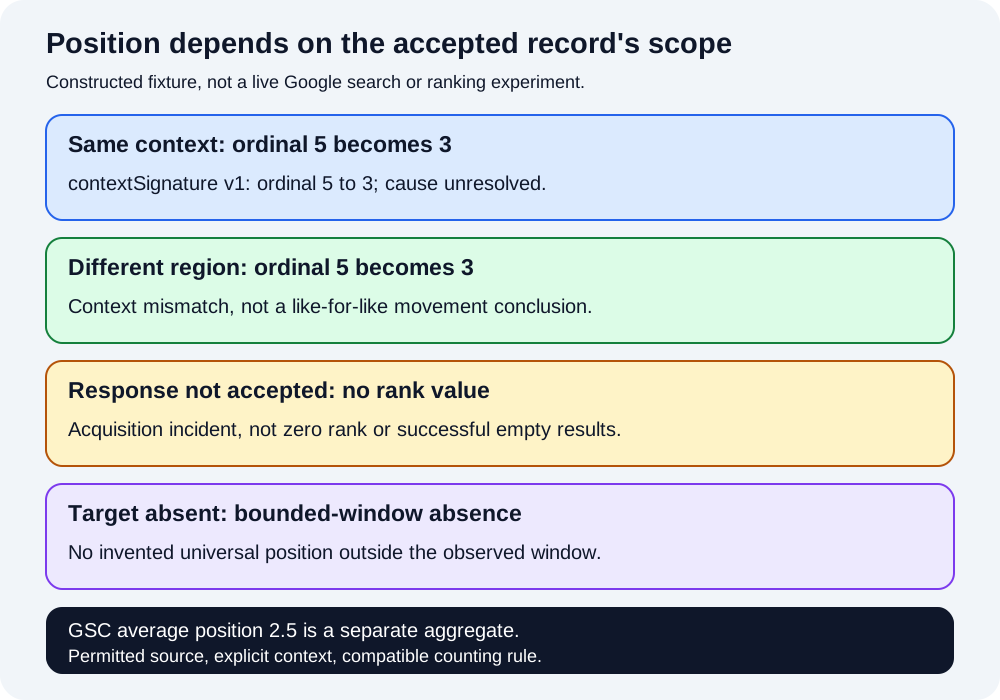
The following fixture is constructed for a rank-history application. It is not a Google search run or a claim that a particular URL held any position. Its ordinals use a declared list rule and the same matched target. The Search Console position definition remains separate from this application rule.
| Constructed record after the baseline | Available evidence | Accepted outcome |
|---|---|---|
| Same context, ordinal 5 becomes 3 | Accepted records, same target and counting rule | Observed ordinal change within this scope; cause unestablished |
| Different region, ordinal 5 becomes 3 | Accepted records, changed context | Context mismatch; no like-for-like movement conclusion |
| Response not accepted | No valid result collection | Acquisition incident; no rank value |
| Target absent from a bounded window | Valid window, target not observed | Absence within that window; no invented universal position |
The first row supports a narrower statement than “the website improved everywhere.” It records a changed observed ordinal for a defined query, source and context. The second row contains the same arithmetic but does not support the same comparison because the region changed. The failure row must not replace the previous accepted value with zero. The absence row must preserve what was actually searched and observed, rather than using a made-up last position to make a chart continuous.
Repeat observations can describe variation without proving its cause. Compare accepted records under the same definition and report the number and spread of observations actually available. A single convenient result should not displace other valid records from that window. If the source changes its result schema or the application changes its counting rule, start a separately identified series or explicitly reconcile the definitions. The mere presence of consecutive dates does not make unlike measurements comparable.
An owned fixture can exercise the classification without querying a search engine. Replay the four rows after a baseline and require one comparable ordinal change, one context mismatch, one acquisition incident and one bounded absence. Reject any output that converts all four into ranking movement. This checks application handling of known inputs; it does not measure live search behavior, source permission or the search engine's response to a browser profile.
Keep Search Console position as its own metric
Google's measurement reference defines position using the topmost result from a property or page, depending on reporting, averaged across all queries in which the property appeared. Its example records topmost position 2 for one query and 3 for another, giving an average of 2.5. That arithmetic is not a fractional DOM row. Record the report's scope, dimensions and time window alongside the value instead of treating it as the ordinal of one search performed later.
The same reference explains that only a result with an impression contributes a position, and that result elements have different counting behavior. A link, image module or combined result cannot be assigned a universal screen-row interpretation from appearance alone. An application-defined list can have a clear ordinal while still being incompatible with this reporting metric. Preserve both definitions if both are useful; do not average their values into a shared series.
Google also directly addresses why a reported average can differ from a user's own search. The position explanation mentions variables including history and location. A difference is therefore a question about metric scope and context before it becomes evidence of a broken tracker. Match the query, property/page scope, device and geography dimensions available in the report, then state the remaining differences and unknowns.
For an operational trend, compare the same report definition over a stated window, and preserve its impression count. A changed average can reflect the mix of contributing observations as well as changed positions. The report alone does not supply the exact environment of every impression or a causal account of a site's movement. Conversely, one browser snapshot does not invalidate an aggregate collected from other impressions. Both can be accurate within different scopes.
Choose permitted data and bounded history
Google's spam policy on machine-generated traffic explicitly includes scraping results for rank-checking purposes among automated queries conducted without express permission. A publicly viewable result page is not an authorization for that workload. Choose a permitted reporting export, an approved service whose actual agreement covers the intended use, or an owned fixture. Browser launch settings and an HTTP success response do not establish the missing permission.
Before retaining or redistributing result content or history, confirm that the chosen source’s terms permit it. Store the context and evidence needed for the authorized purpose within those terms, rather than assuming every diagnostic record justifies a full response archive. A source that supplies only aggregate metrics cannot be made into an individual-result history by inventing missing rows. Return the narrower supported result when the chosen source does not answer the requested question.
The browser-capacity boundary remains useful after a permitted workload is defined, but capacity does not override source restrictions. Likewise, a challenge or unavailable source calls for diagnosis and a supported alternative, not attempts to force a successful collection through changed identities. A rank-tracking system should preserve that interruption as an outcome. It must not manufacture a position merely because the reporting schedule expects one.
FAQ
Does turning off personalization make every result identical?
No. Google says location, language and device context still apply. Identical visible results also do not prove that every relevant context field matched. Record supported evidence and retain unknowns.
Can a proxy location establish the rank for that city?
No. It is one configured input. Google describes several location sources, and the effective location may differ. A city-specific observation requires appropriately scoped source evidence and permission, not just an intended proxy region.
Why does Search Console average position differ from a snapshot?
It aggregates impression-based positions under its own counting rules. A single captured list has another scope and may have another context. Compare metric definitions before treating the difference as an error.
Does BotBrowser provide rank data or authorize Google queries?
No. It provides browser configuration inputs, not search data, ranking control or source permission. Use a permitted source and keep configured inputs separate from the engine's effective result context.
Sources
- Google: Personalization and Search results
- Google: Understand and manage search location
- Google: Change your display language on Google
- Google Search spam policies
- Search Console: Impressions, position and clicks
- MDN User-Agent header
- BotBrowser timezone, locale and language
- BotBrowser GeoIP database
Practical conclusion
Track a defined result metric under an evidenced context. Separate configured location, language and device inputs from the source's effective state; compare only accepted records with compatible definitions. Keep context mismatches, acquisition incidents and bounded absences out of invented rank values, and retain Search Console averages as a distinct metric. BotBrowser can make browser inputs explicit, while the approved source determines permission, available evidence and the position meaning that can actually be reported.
Related Articles
Browser Profiles for SEO Monitoring and SERP Tracking
ComparisonBrowser-Core vs API-Layer Protection: A Reproducible Test
DeploymentSERP Scraping at Scale: Browser Requirements
FingerprintBrowser Geolocation Permissions and Location Accuracy
FingerprintScreen and Window Fingerprinting: Display Tracking
IdentityPrivacy-Preserving Browser Validation Methods
Run the same check in BotBrowser
Load a profile, keep the signals you just read about consistent inside the browser, and confirm the result on your own machine before a rollout.