SERP Location Changer: What Actually Changes
Distinguish search-service location parameters, browser coordinates and IP-area estimates, then choose the geographic evidence your permitted task needs.
BotBrowser Team
Want the structured docs for Documentation?
This article lives in the editorial library. For step-by-step setup, reference material, and ongoing updates, jump into the docs section.
A SERP location changer changes a geographic input, not necessarily the location a search service ultimately uses or the results it returns. Depending on the mechanism, that input can be a service-defined country parameter, a provider task location, browser coordinates or a network route. BotBrowser documents proxy routing and profile-backed timezone, locale and language inputs for authorized browser work, but cannot choose a search engine’s location inference, supply source permission or guarantee a result set. The useful choice starts with the geographic question and the evidence needed to answer it.
TL;DR
- A country boost, a document-country restriction, a requested task location and a browser coordinate have different meanings.
- Google Programmable Search defines
gl,crandhlfor its own API. Those fields do not establish a general Google Search city view. - A provider’s location field is a request under that provider’s contract, not proof of the search engine’s effective location or permission to query it.
- Browser location depends on permissions, availability, caching and accuracy. Coordinates can also be explicitly configured rather than measured.
- Google describes device information, saved places, previous activity and IP address as location sources. A route change affects only part of that picture.
Contents
- Separate the mechanisms before choosing a location
- Read geographic parameters as service contracts
- Browser coordinates carry permission and accuracy conditions
- Network area is only one search location source
- Choose the mechanism by geographic question
- Keep privacy and authorization with their responsible owners
- Practical conclusion
Separate the mechanisms before choosing a location
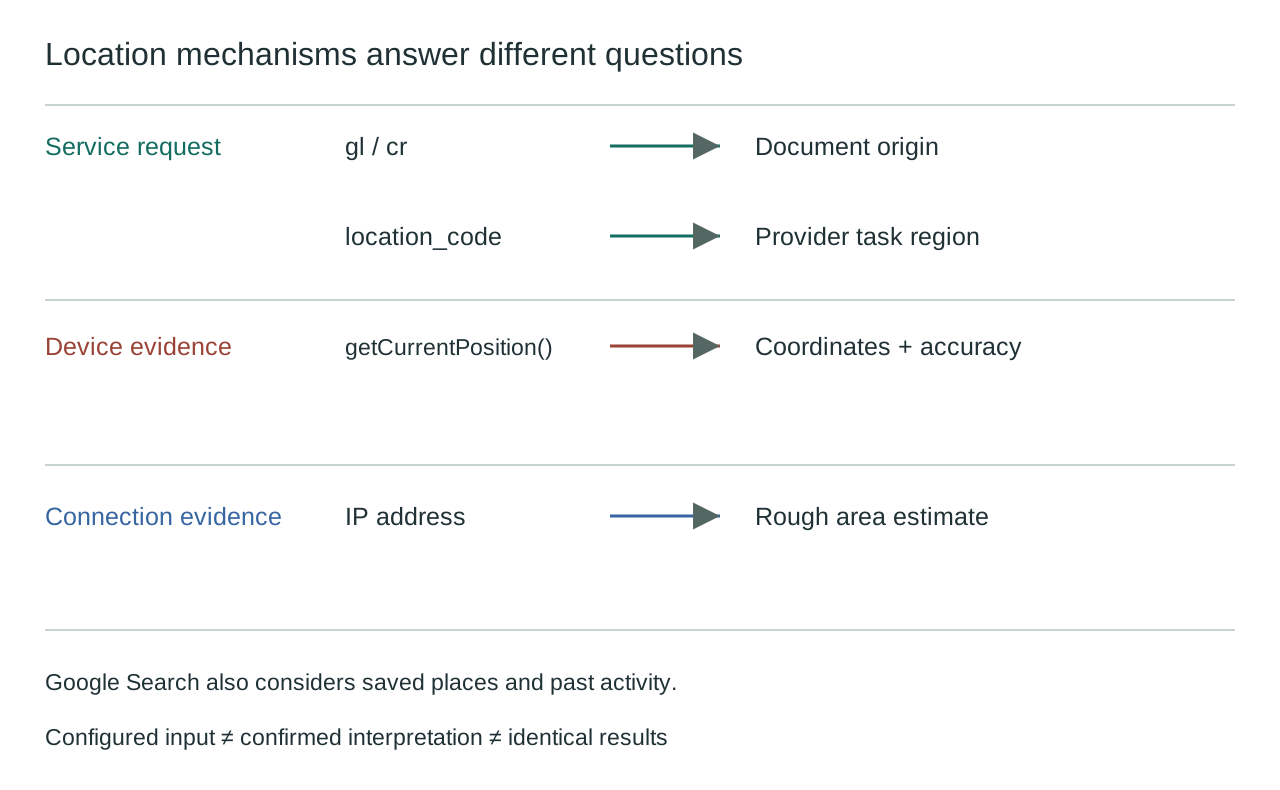
“Location” can describe a place requested by an application, a device position exposed to a website, the estimated area of an internet connection or a service’s interpretation of several signals. These are not interchangeable measurements. Google’s search-location explanation explicitly describes multiple sources used together. A tool offering one geographic control therefore needs a narrower description than “changes your search location.” Identify which input it changes and which participant interprets that input.
A service-defined API parameter is a declared request. Its meaning comes from the selected operation: country preference, document-origin restriction or another supported geographic scope. A browser coordinate belongs to a browser-facing interface and may represent an estimated or explicitly configured position. A proxy changes a connection route. Timezone and language settings describe other browser inputs. Even when their labels refer to the same country, these mechanisms answer different questions and have different evidence producers.
Explicit configuration is not exclusive to APIs. An authorized browser environment can also be configured to expose selected coordinates where its supported controls permit that arrangement. The distinction is not “API means explicit, browser means automatic.” Only the API path uses that service’s defined request field; the browser path supplies information through a browser environment. In either case, a declared value must remain distinguishable from a measured device position and from the service’s resulting interpretation.
The SERP rank-tracking explanation handles what happens after an accepted result exists: position definitions and whether observations are comparable. Mechanism selection comes earlier. If the question requires a city-specific service view, choosing a field that only prefers documents from a country does not become adequate merely because the resulting records have clear positions. Decide which geographic claim the source can support before assigning meaning to the returned list.
Browser configuration has a similarly bounded role. BotBrowser’s timezone, locale and language documentation describes profile-backed inputs and geographic derivation from proxy information, while its proxy documentation concerns routing. These capabilities can make selected browser inputs explicit. They do not establish which geographic source a search service preferred, whether the intended city was recognized or whether two requests should receive identical content.
Read geographic parameters as service contracts
Google Programmable Search’s cse.list reference defines gl as a two-letter country code for end-user geolocation. Its stated result effect is to boost documents whose country of origin matches that value. That is a preference within this API’s result processing, not a restriction to documents from that country and not evidence that the user was physically there. Calling it a city-location setting would add granularity that the documented field does not provide.
The same reference defines cr differently: it restricts results to documents originating in a particular country. Its explanation of document country mentions the document URL’s top-level domain and the geographic location of the web server’s IP address. The geographic subject is therefore the document’s origin, not necessarily the searcher’s device. A business asking for locally relevant services and a researcher asking for documents of a particular national origin may need different mechanisms despite using the same country name.
hl sets the user interface language. It is not a coordinate, network route or document-country restriction. A selected interface language can matter to the experience without defining where the requester is located. The reference also marks googlehost deprecated and points to gl for a similar effect. That historical field should not become a recommendation to treat a national domain as a complete geographic control. The current operation’s documented semantics remain the authority.
| Programmable Search field | Documented meaning | Unsupported interpretation |
|---|---|---|
gl | Boosts matches whose document country of origin matches the requested country | A guaranteed Google Search view from a particular city |
cr | Restricts document country of origin | A measurement of the requester’s physical location |
hl | Sets interface language | A country or coordinate selection |
googlehost | Deprecated; the reference points to gl for a similar effect | A recommended current substitute for all geographic controls |
These statements belong to Programmable Search, not a universal contract for the Google Search website. Shared terminology does not establish identical result sets, location inference or product behavior. A valid response from this API answers a question within its service definition. It should not be relabeled as a captured browser result from another Google product without evidence establishing that equivalence.
Provider task APIs introduce another contract. The DataForSEO organic task reference is the relevant source for its location alternatives, including location_code, location_name and location_coordinate. Treat these as provider-defined ways to describe the requested task location. Their field names alone do not establish coordinate precision, fallback behavior or the search engine’s effective interpretation. Those details need the applicable operation’s current terms and returned evidence, rather than assumptions imported from another API.
A provider offering location selection also does not establish express permission from Google for the intended workload. Service availability, contractual data-use rights and the origin service’s access rules are separate matters. The correct adoption decision includes checking those agreements before relying on the provider. No API queries or provider tasks are represented here, so the field comparison describes documented interfaces rather than observed acceptance or geographic results.
Browser coordinates carry permission and accuracy conditions
MDN’s getCurrentPosition() reference describes obtaining a device position through the Geolocation interface. The feature requires a secure context, can be blocked by the geolocation Permissions-Policy and requires explicit user permission. These are independent conditions. A browser supporting the interface does not establish that a particular page can obtain a position, and a permission grant does not guarantee a successful or immediate position result.
Google’s location documentation adds a practical distinction between browser-level and website-level permission. On applicable devices, the browser itself must be allowed to use location, and the requesting website must also have access. This is not simply a page preference that overrides the device. A location changer that reports configured coordinates should therefore state whether it is describing browser configuration, an available position or a value actually delivered to the authorized website.
Caching changes the time associated with a position. In MDN’s position options, maximumAge defaults to 0, meaning a cached position is not accepted under that default. A different allowed age changes which prior position may satisfy the request. The returned evidence must consequently retain whether its position is fresh enough for the question being asked. An old coordinate can be accurate for its observation time while being unsuitable as evidence of the device’s current location.
timeout defaults to Infinity, so the default does not impose a finite waiting limit. That concerns how long position acquisition can wait, not how long a search request or application job should remain pending. A missing position at an application deadline does not necessarily establish that the browser denied permission. The application needs to distinguish permission state, acquisition outcome and its own stopping decision rather than treating every unavailable coordinate as the same geographic result.
enableHighAccuracy requests the best available accuracy but does not guarantee a particular precision. A coordinate’s decimal detail is not evidence of a correspondingly small uncertainty. An estimated position, its accuracy and its observation time belong together. Where coordinates are explicitly configured in a supported browser environment, their provenance must instead say configured. They should not be described as a device measurement merely because they travel through the same browser-facing interface.
Permission also has a limited purpose. Allowing a website to receive device location is not permission to automate searches, retain every response or redistribute result content. The Geolocation API’s access boundary concerns releasing position information. Search-service authorization concerns a separate activity and responsible party. Keeping those permissions separate allows a site owner to assess location disclosure without implying authorization for unrelated automated work.
Network area is only one search location source
Google’s location explanation says an IP address can be used to estimate the current general area. That is different from a precise device position. It describes a general area as larger than 3 square kilometres and containing at least 1000 users, with areas typically larger outside cities. These numbers describe the documented general-area concept, not the accuracy promised by a proxy provider or a boundary within which every result must be relevant.
A route’s advertised geography is therefore not enough to establish the area inferred by a search service. The route operator identifies its connection arrangement; the service estimates location using its own sources. A browser’s local geographic lookup can describe another interpretation again. These can disagree without any one configured country field proving which area the search service used. Preserve the source of an area claim instead of promoting an intended exit label into an observed search location.
Google also names device location, saved home or work places and previous activity as possible sources. When Web & App Activity is enabled for a signed-in account, saved activity may contain area information, and precise location may be stored when the activity involves it. The explanation also discusses location information from previous searches for signed-out use. A different connection route does not, by itself, erase those other possible sources or establish that Google ignored them.
The documentation gives a specific continuity example: Google may use a device location from the last use to provide results quickly, with that location held in a cookie set to expire after 6 hours. This is a statement about that prior-location cookie. It is not a six-hour expiry for all location data, account activity, search history or provider records. A privacy explanation needs to preserve the particular storage category instead of extracting one duration and applying it universally.
The results-page location indication can provide narrower evidence about the source used. Google describes labels such as “From your device,” “Based on your places,” “Based on your past activity” and “From your internet address.” Where an authorized observation exposes such an indication, it describes a service-reported basis rather than the operator’s intended configuration. If the indication is unavailable, the basis remains unknown; the requested country cannot substitute for it.
Language and timezone still belong to their own categories. BotBrowser’s geographic settings documentation describes date formatting, internationalization defaults and reported language preferences. Those settings can be aligned with a selected route for authorized browser work, but they are not coordinates. They also do not establish that a search engine interpreted the same place. A familiar date format or translated interface is evidence about presentation, not proof of a city-specific search location.
Choose the mechanism by geographic question
A geographic requirement should name its subject before its preferred tool. Is the question about document origin, a provider-requested location, device position or an inferred connection area? Each subject has a different granularity and evidence origin. The following choice matrix combines the Programmable Search contract, provider task reference, Geolocation reference and Google location explanation.
| Geographic question | Service field or mechanism | Granularity | Evidence origin | What remains unknown | Choice |
|---|---|---|---|---|---|
| Should this API prefer documents matching a country? | Programmable Search gl | Country | Declared API input and documented boost semantics | Another product’s effective location or result equality | Use when a country preference answers the task |
| Must documents originate in a country? | Programmable Search cr | Document country | Declared restriction under the API contract | Physical requester location | Use for document-origin scope |
| Which location is requested for a provider task? | DataForSEO location alternatives | Provider-defined location | Submitted task description and available response evidence | Engine inference and unsupported precision | Use only within verified service terms |
| What position did the browser supply? | Permissioned Geolocation or explicitly configured coordinates | Coordinate with applicable accuracy and time | Browser outcome or configuration record | Which location a search service ultimately used | Use only when coordinate evidence is necessary |
| Which area did the service associate with the connection? | IP-area inference and available source indication | Estimated general area | Search-service explanation and authorized indication | Precise device position and every contributing signal | Use for an area question, not an address claim |
| Which language should the API interface use? | Programmable Search hl | Interface language | Service request setting | Requester geography | Keep as language, not location |
For a hypothetical owned reporting application, “prefer documents from a country” can be satisfied by the relevant API semantics without acquiring anyone’s precise coordinates. “Explain the position supplied by this consenting device” requires browser evidence instead. “Request this provider’s supported city scope” requires that provider’s contract and evidence. These are design choices, not reported search experiments. None establishes an identical set of results for all people in the named place.
The unknown column is a decision aid, not a defect to hide. If the source cannot establish the requested granularity, either narrow the question or choose a permitted source that can. Changing a country label into a city label in the application does not improve the evidence. Likewise, adding more precise coordinates does not guarantee that the service uses that precision or that the added personal information was necessary.
Keep privacy and authorization with their responsible owners
Choose the least precise permitted mechanism that answers the actual question. Country-level document preference usually does not require device coordinates. A supported provider task may describe its location without access to an individual visitor’s account. Where device evidence is genuinely needed, permission, accuracy and timing become part of the privacy decision. Minimization concerns what information the task needs, not how many geographic settings a tool can expose.
Google’s machine-generated traffic policy explicitly includes automated queries and scraping results for rank-checking without express permission. It states that these activities violate its spam policies and Terms of Service. A public results page, purchased proxy or provider account does not establish the missing permission. Check that the selected service and data-use agreement actually cover the intended activity; a location parameter cannot resolve an authorization gap.
Responsibility also follows the data path. The browser operator controls supported browser settings and permission choices. The backend or API caller controls declared request fields such as gl or location_code. The provider defines its service’s field semantics and applicable processing terms. The search service determines its own interpretation and output. Retention, onward use and access to precise location need the relevant agreement and responsible organization, not an inference from whether the location control worked.
The SERP browser-requirements analysis addresses throughput, timing and resource planning after a permitted workload is defined. Capacity cannot establish geographic meaning or permission. A faster browser does not make a country boost into a city observation, and a completed task does not prove that retention or redistribution is authorized. Resolve the geographic question and service scope before planning how many observations the system can process.
Keep location-related reporting proportionate as well. A public summary can often preserve the mechanism, supported granularity and unresolved interpretation without retaining a person’s exact coordinates or account details. If the service definition changes, treat that as a change in what the application can claim rather than silently carrying forward the old interpretation. No live search observations, provider API executions or browser benchmarks are represented here; the distinctions concern source-defined capabilities and responsible choices.
FAQ
Does gl make Programmable Search return a city’s Google Search results?
No. Its documented effect is a country-origin boost within Programmable Search. It does not establish city granularity or equivalence with the Google Search website.
Can browser coordinates be explicitly configured?
Yes, where the selected browser environment supports that configuration. Label them configured rather than measured. Their presence does not guarantee that a search service uses them or returns a particular result set.
Does a six-hour location cookie mean all location data expires then?
No. Google’s explanation applies that duration to a cookie holding a previously used device location. It does not establish a retention period for every location-related record.
Sources
- Google: Understand and manage search location
- Google Programmable Search: cse.list reference
- DataForSEO: Google organic live advanced task reference
- MDN: Geolocation.getCurrentPosition()
- Google Search: Machine-generated traffic policy
- BotBrowser: Proxy configuration
- BotBrowser: Timezone, locale and language
Practical conclusion
Choose a SERP location mechanism by the geographic question it can actually answer. Keep country preferences, document-origin restrictions, provider task locations, browser coordinates and inferred network areas distinct. Use the least precise permitted input, preserve its source-defined meaning and leave unsupported interpretation unknown. BotBrowser can configure documented browser inputs and routing; permission, search inference and result selection remain outside that control.
Related Articles
SERP Rank Tracking: Location, Device and Position
DeploymentBrowser Profiles for SEO Monitoring and SERP Tracking
FingerprintCreepJS Timezone Report: Offsets and Location
IdentityTimezone, Locale, and Language in Browser APIs
FingerprintBrowser Geolocation Permissions and Location Accuracy
DeploymentGoogle Maps Scraping: Places API or Rendered Listings?
Run the same check in BotBrowser
Load a profile, keep the signals you just read about consistent inside the browser, and confirm the result on your own machine before a rollout.