Web Scraping API: What the Response Leaves Out
Distinguish HTTP bodies, rendered HTML and extracted fields. Learn which execution details a web scraping API response establishes and which remain unknown.
BotBrowser Team
Want the structured docs for Fingerprint?
This article lives in the editorial library. For step-by-step setup, reference material, and ongoing updates, jump into the docs section.
A web scraping API can return valid JSON while leaving the requested information unresolved. The missing distinction is between the artifact delivered to your application and the execution that produced it. An HTTP body, a rendered document and an extracted price support different conclusions. BotBrowser provides documented browser-profile and proxy controls when you operate its runtime; it cannot configure an unrelated API provider's browser or reconstruct execution evidence absent from that provider's response. For a returned-result integration, the useful question is what evidence accompanies each field, not whether the response looks complete.
TL;DR
- An API request succeeding does not establish that the destination returned the intended document or that its data is complete.
- Original response bytes and browser-rendered HTML are different parser inputs, even without JavaScript changes.
- An output snapshot can arrive after an action sequence was interrupted. Inspect action outcomes rather than treating HTML as workflow completion.
- Returned fields, network captures and screenshots preserve different evidence. None alone establishes the complete browser environment or processing history.
- Choose an output contract around the claim your application must validate. Keep collection permission, sensitive state and downstream retention separate from technical success.
Contents
- The response has more than one success boundary
- Original bytes and rendered HTML are different inputs
- A snapshot can outlive an incomplete action sequence
- A structured field has an extraction history
- Session continuity is not browser continuity
- Returned evidence cannot describe every exposed signal
- A response contract makes unknowns explicit
- Practical conclusion
The response has more than one success boundary
The first boundary is the call to the service. Authentication, request validation and delivery of a result belong to that API interaction. The second is the response obtained from the destination. The third is your application's interpretation of the delivered artifact. A successful outer response does not merge these boundaries. A service can correctly deliver an error page, and a parser can correctly decode that page while finding no record. Calling all three outcomes “success” removes the information needed to diagnose an empty dataset.
Zyte's error-handling documentation explicitly distinguishes its API status from a target website's status. A target 404 can appear in a successful API result through statusCode. That is a documented response contract, not an independently measured property of every scraping service. An integration using a different provider must identify the equivalent field and its meaning. Treating the outer 200 as the destination's 200 can otherwise turn a missing page into an apparently valid observation.
Destination status still does not certify content. An owned application can legitimately return a login screen, an empty search or a temporary service message with 200. The application needs a document-type check before record extraction. That check can be a known catalogue heading or an application-defined record structure in an authorized fixture. Its purpose is to classify the returned representation, not to decide whether a third-party site permits automation. Permission comes from the applicable authorization and terms, independently of what the server returned.
Redirects add another distinction. Zyte's HTTP reference says HTTP requests follow redirects by default and exposes followRedirect to change that behavior. Its browser reference says browser requests follow HTTP redirects and URL changes triggered by HTML or JavaScript. A supplied URL therefore need not identify the document eventually serialized. Retain the final location when the contract supplies it, and distinguish a redirect observation from an inference based only on the original request string.
The browser-interface overview separates receiving a finished artifact from continuing to drive a browser. Once an artifact API is selected, result validation becomes the immediate boundary. A team does not need a provider ranking to establish whether it received the expected document type. It needs a specification that identifies the destination status, representation and required application fields, with an explicit unknown state when the response omits the necessary evidence.
Original bytes and rendered HTML are different inputs
Zyte documents httpResponseBody as a Base64-encoded HTTP response body obtained without browser rendering. Base64 is a transport representation of bytes, not a declaration of the document's character encoding. Decoding the envelope yields the original bytes; interpreting those bytes as text is another operation. The HTTP documentation recommends using the HTML encoding rules and response headers where relevant. An accent becoming corrupted in a record may therefore be a text-decoding issue rather than a missing browser feature.
browserHtml instead represents the DOM after browser rendering. Scripts may have inserted, removed or rearranged elements, but JavaScript is not the only source of a difference. The same reference explains that browser HTML includes HTML5 normalization. A parser that constructs a different tree from the original response can produce different selector results even on a page with no script-driven updates. The claim “both are HTML” is insufficient to make their parsing behavior interchangeable. A migration needs representative input fixtures, not just unchanged file extensions.
There are representation limits as well. Zyte documents a 10 MB limit for the HTTP body before Base64 encoding and a 10 MB limit for browser HTML, with longer outputs truncated. HTTP compression does not change the former limit. These are vendor-specific limits, not general properties of HTML or all APIs. If a required record lies beyond a truncated output, an empty parser result does not prove that the record was absent from the destination. The output boundary must remain a separate explanation.
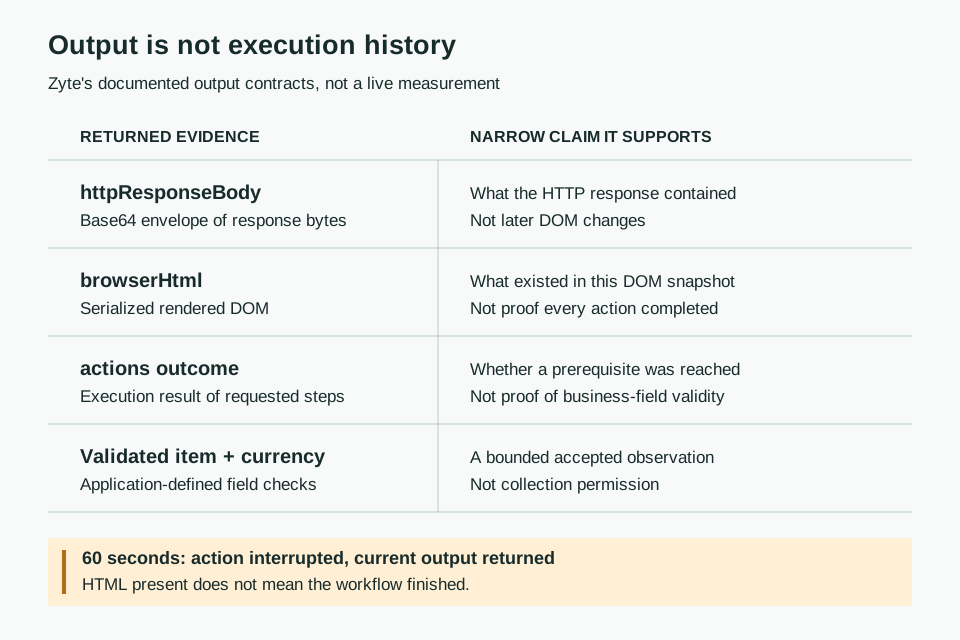
The browser output also has structural exclusions. Zyte says iframe content is empty in browserHtml by default unless includeIframes is enabled, and points to separate handling for shadow DOM content. A serialized outer document is therefore not a guarantee that every visually presented component appears in the returned string. A screenshot may show a component whose text is missing from that serialization. These are different observation surfaces, not necessarily contradictory results. The consumer must know which surface its parser was designed to use.
For a hypothetical owned product fixture, keep the original response and the rendered document as different fixture types. The former can establish what the server sent; the latter can establish the serialized DOM at a chosen point. A selector regression after changing between them should first be investigated as an input-contract change. The headless-browser discussion addresses browser execution requirements; it does not remove the need to identify the precise representation delivered to the downstream parser.
A snapshot can outlive an incomplete action sequence
An artifact service can accept an ordered sequence of browser actions and return output after attempting them. That is not the same contract as handing a controller an unrestricted live browser. Zyte's browser automation reference documents a 60 seconds total browser execution limit for these actions. When the limit is reached, the ongoing action is interrupted, subsequent actions are not executed, and the requested HTML or screenshot is returned as rendered at that time. An available artifact can therefore coexist with an unfinished workflow.
This has a concrete consequence for downstream records. Suppose an authorized catalogue fixture first opens a category, then waits for a currency indicator, then reads an item. If the wait is interrupted, the returned document might contain the default currency rather than the requested one. The parser can still produce a syntactically valid price. The failure is not necessarily a missing element or an API transport error; it can be an unmet precondition before the snapshot. The workflow result needs the action outcome and the currency evidence together.
Zyte documents an actions response field containing execution details, including errors and timing information. That field should be interpreted according to its documented schema rather than reduced to a single “HTML present” boolean. An action not executed after the deadline differs from an executed action whose selector did not resolve. Both can leave a similar document behind. A useful diagnosis identifies the first unmet application precondition and keeps the returned artifact available for inspection, subject to the data-retention policy.
The same browser reference differentiates selector-based actions from other interfaces: ordinary action selectors cannot interact with iframe or shadow DOM content in the same way that dedicated mechanisms can. A missing element can thus reflect the action's supported scope, not a slow page. Increasing an arbitrary wait does not change that scope. Before treating elapsed time as the explanation, compare the documented action surface with the location of the required component. This is an interface-contract check, not a recipe for accessing protected content.
Output generation timing is consequently part of data meaning. “Price observed” should require the relevant item identity, currency and application readiness condition in the artifact that actually supplied the price. A screenshot from another stage cannot silently supply missing context. If the API contract does not expose sufficient action evidence, classify the result as unresolved for that use case. A narrower supported claim is more useful than a complete-looking row whose prerequisites were never established.
A structured field has an extraction history
Some services return parsed records rather than leaving every selector to the caller. Zyte's automatic extraction documentation describes extraction as another output capability. A structured field removes parsing work from the consumer's immediate path, but it also introduces an interpretation boundary. The consumer sees a value chosen or normalized by the extractor. Unless the response supplies the relevant provenance, the value alone cannot establish its original text, document position or relationship to another visible value.
For example, a hypothetical catalogue contains a current price, a crossed-out previous price and an installment amount. All three can be legitimate numbers on one document. A returned price requires a field definition explaining which role it represents. The downstream schema should retain currency and item identity alongside the value rather than assume they can be reconstructed later. This example is a consumer-side data contract, not a claim about how a named service resolves those competing values internally.
Source selection also matters. The HTTP/body distinction means that an extractor reading response bytes may receive a different set of candidate values from one reading rendered HTML. Changing the input representation or extraction settings can change what the resulting time series measures. A normalized field can remain well-formed while its selection context changes. Version the consumer's extraction contract so a later analyst can distinguish an apparent market change from a change in how observations were produced.
Missing, empty and unverified values should not collapse into one value. A missing field can mean the extractor did not supply it. An explicitly empty value can describe the returned document. An unverified value can be present while lacking the evidence needed for the consumer's decision. The business schema owns these distinctions, even if the provider uses a simpler response shape. Keeping a validation outcome beside the raw provider result avoids silently promoting every delivered field to an accepted fact.
Screenshots and captured network responses can help resolve some questions, but they are not interchangeable with field provenance. Zyte documents networkCapture as a filtered capture of responses during browser rendering, including action execution. A filter that captures one relevant response does not establish that every request was retained. A screenshot records visible pixels, not the complete request history. Choose supplemental artifacts to answer a specific ambiguity, and avoid collecting unrelated account content merely because the service can return more data.
Session continuity is not browser continuity
A service session label can describe a narrower continuity guarantee than a persistent browser. Zyte's shared-features documentation describes session features; its CDP documentation provides a separate live-browser interface. Consumers must read the relevant persistence rules instead of inferring that repeated requests run in the same renderer. Shared cookies or routing conditions do not, by themselves, prove that in-memory JavaScript objects or a previously open page survive.
The distinction becomes visible in an owned multi-step fixture. A server-side preference represented by a cookie can persist while a temporary value held only in a page variable disappears. These are different storage locations and lifetimes. If a workflow requires continuing within the same live page, the required capability is page continuity, not merely a repeated session identifier. Record that requirement before choosing an interface. Otherwise, an integration can mistake a fresh page with remembered cookies for the same ongoing browser workflow.
Network identity is another separate condition. A provider may document session-related routing behavior without exposing the actual route for every subresource. A returned user-agent string does not prove the TLS connection properties, and an API region parameter does not independently establish the destination-observed exit. The response should identify which observations are supplied and which are only requested settings. When the use case concerns an owned application's received traffic, its own authorized server-side records can supply evidence the returned artifact lacks.
Provider-specific lifecycle details already have an owner in the Browserbase responsibility discussion. Its terminal statuses and Context rules should not be transferred to another service just because both offer hosted execution. The same caution applies to retry behavior: a library's documented retries are not evidence that an arbitrary HTTP client or every backend request follows that policy. Distinguish provider behavior, SDK behavior and your scheduler's decisions when assigning responsibility for repeated work.
Returned evidence cannot describe every exposed signal
Receiving a document does not enumerate what the destination observed during its production. A browser can expose script-readable properties while the network connection supplies other information. An API response is an output contract, not automatically a comprehensive audit of those exposures. If it contains HTML and a screenshot but no source-attributed runtime log, it cannot establish which particular script read a browser API. Ordinary rendering activity and automation activity must not be relabeled as vendor collection evidence.
BotBrowser's browser overview documents profile-backed browser-surface controls, while proxy configuration documents routing for its own runtime. These controls belong to a browser deployment you actually operate. Passing a local executable option to your own automation code cannot change a remote API provider's executable unless that provider explicitly supports such a configuration. The layer boundary remains important even if both integrations use familiar automation terminology.
Privacy review should follow the actual data path: request URL and supplied state enter the service; the provider obtains or renders content; selected artifacts return; your application stores or exports them. Cookies, page content, screenshots and debugging artifacts can carry information beyond the final business record. The relevant retention and processing terms need to cover those artifacts explicitly. Removing one returned field does not prove that the provider never processed its source, just as declining a screenshot does not establish a universal deletion policy.
An owned fixture can reduce unnecessary exposure while evaluating the contract. Use harmless content and narrowly scoped state, then check the required artifacts and validation outcomes. This does not establish anonymity, legal compliance or destination acceptance. Authorization to collect and permission to forward content to a processor remain separate decisions that neither a passing parser nor a consistent browser profile can make for the operator.
A response contract makes unknowns explicit
The following choice table concerns a hypothetical owned catalogue. It assigns each intended claim to a required evidence type. It does not prescribe a provider request or report an executed experiment. Its expected result is a validation decision: accept the narrow claim only when the corresponding evidence exists; otherwise retain an unresolved outcome. This makes absent observability visible rather than turning it into a guessed cause.
| Intended claim | Required evidence | What a weaker artifact cannot establish |
|---|---|---|
| The server supplied these bytes | Original HTTP body and relevant response headers | Rendered HTML may contain browser normalization and later changes |
| This text existed in the serialized DOM | Identified browser HTML snapshot and final document context | Original bytes do not establish script-generated text |
| The currency-selection step completed | Documented action outcome plus observed currency state | An available screenshot does not certify every preceding action |
| This price belongs to this item | Item identity, currency, field role and application validation | A lone numeric field does not distinguish installment and current price |
| The same page workflow continued | A documented live-page lifecycle and matching workflow evidence | Shared cookies do not prove the renderer or page object persisted |
| A particular script read a signal | Source-attributed runtime events from that execution | HTML, request counts and a result label do not identify the reader |
Consider three synthetic cases with the same outer 200. In case A, statusCode is 404, so record extraction is not attempted. In case B, browser HTML contains an item but the action outcome indicates interruption before currency readiness; the price remains unverified. In case C, the action condition and required item fields are established, so the application can accept that bounded observation. These are proposed validation rules, not measurements of provider reliability or promises about a destination's behavior.
Keep only the evidence needed to explain that decision, with a link between the accepted record and its limited provenance. If an output limit, omitted iframe, unavailable action outcome or unsupported persistence requirement prevents validation, record the specific uncertainty. The HTTP and browser contracts supply concrete distinctions that a generic “request succeeded” field cannot carry. A consumer can then reject or quarantine an unresolved record without inventing an explanation for the remote execution.
FAQ
Does an API response with status 200 mean the target page succeeded?
Not necessarily. The API transport status and the target status can be separate fields. The target document also needs application-specific validation.
Is browser HTML just the original HTML after decoding?
No. It represents the browser DOM, including HTML normalization and possible script changes. Base64-decoding an HTTP body returns bytes instead.
Does returned HTML prove that every requested action ran?
No. Zyte documents interrupted action sequences that still return the current output. Action outcomes and required page state need separate inspection.
Can BotBrowser configure a hosted scraping API's browser?
Only a provider's explicit supported integration could establish that capability. BotBrowser's own runtime controls do not automatically configure an unrelated remote service.
Sources
- Zyte: HTTP requests
- Zyte: Browser automation
- Zyte: Automatic extraction
- Zyte: Error handling
- Zyte: Shared features
- Zyte: CDP
- BotBrowser: Browser overview
- BotBrowser: Proxy configuration
Practical conclusion
Choose a web scraping API output by the claim your application must verify: server bytes, rendered text, completed action or validated record. Require the corresponding evidence and preserve an unresolved state when it is unavailable. Evaluate that contract on authorized harmless fixtures before sending sensitive state or relying on returned fields for operational decisions.
This article is part of the guide: What Is a Browser Fingerprint? Canvas Fingerprinting
Related Articles
Web Scraping Browser: Which Kind Do You Need?
Getting StartedBrowserbase Web Scraping: Who Owns What?
FingerprintRebrowser Patches: What Changes After a Proxy Works?
NetworkCloudflare and DataDome: Scraping Response Signals
Getting StartedWeb Scraping JavaScript: Rendering, Pagination, Scroll
Getting StartedSelenium Scraping: Capabilities and Records
Run the same check in BotBrowser
Load a profile, keep the signals you just read about consistent inside the browser, and confirm the result on your own machine before a rollout.