Pixelscan Proxy Checker: Credentials and Retention
Separate ordinary checks, account-linked history and saved proxy credentials in Pixelscan Proxy Checker. Understand its retention clock and policy ambiguities.
BotBrowser Team
Want the structured docs for Fingerprint?
This article lives in the editorial library. For step-by-step setup, reference material, and ongoing updates, jump into the docs section.
Pixelscan Proxy Checker has different privacy consequences for an ordinary check and a saved proxy list. Its published policy says ordinary input credentials are removed during processing, while deliberately saved credentials are retained for later authentication. Derived check results can remain linked to your account. BotBrowser controls documented browser and proxy configuration; it cannot change an external checker's storage or deletion practices. Choose whether the check needs persistent connection details before submitting them, rather than treating a masked password field as evidence that nothing was saved.
TL;DR
- The operator's connection to the checker, the submitted proxy connection and the derived report are different data populations. A statement about one does not automatically cover the others.
- Check history excludes proxy usernames and passwords according to the policy, but saved proxy lists can include both when you save them for rechecking.
- The general credential-removal language conflicts with the explicit saved-list provision. The conservative decision is to treat saved credentials as retained and obtain clarification where that distinction matters.
- History, saved lists and associated credentials have a feature-access retention rule, including up to 12 months after access ends. Broader account and billing records have separate wording.
- Proxy scores are informational assessments. They neither describe every browser signal nor guarantee that another platform will accept a connection.
Contents
- Three data populations behind one check
- An ordinary check is different from a saved list
- Derived history remains after raw input
- Retention starts from feature access
- A network assessment is not a browser verdict
- Browser control and external custody
- Practical conclusion
Three data populations behind one check
The Proxy Checker privacy policy, updated 6 November 2026, distinguishes the technical data associated with your own use of the service from the proxy data submitted for analysis. That distinction changes the meaning of a claim such as “the IP address is not stored.” Which address, in which operation, and in which record? A user visiting a checker and a checker authenticating to a submitted proxy are separate participants, even when both connections happen during one task.
Section 1.2 says the service may collect your connection's IP address for security, abuse prevention and diagnostics, alongside browser/device information and usage logs. It expressly separates this population from the submitted proxy data described in 1.3. Consequently, the later promise to discard a submitted proxy IP after determining its properties is not a promise to discard the operator's own connection address. The policy gives those records different contexts, so an assessment must preserve their separation instead of referring to one undifferentiated “IP.”
The second population is the connection material you intentionally submit: a hostname or IP address, port, protocol and optional username/password. Section 1.4 says authentication credentials are used to connect when the proxy requires authentication. Processing therefore occurs even when the service says credentials are not kept in ordinary check history. A rule limiting storage does not imply that a recipient never receives or uses the input. That distinction is especially relevant when the proxy belongs to an employer, client or shared operational account.
The third population is the analysis produced from that connection. Section 1.3 lists provider and ASN, geolocation, proxy type, quality indicators, port/protocol and check time as results stored with the account. These are derived records rather than a copy of every submitted input. They can still describe what infrastructure an account evaluated and when. Removing an input address does not logically remove its associated provider, city or timestamp, and the policy explicitly says these results are stored.
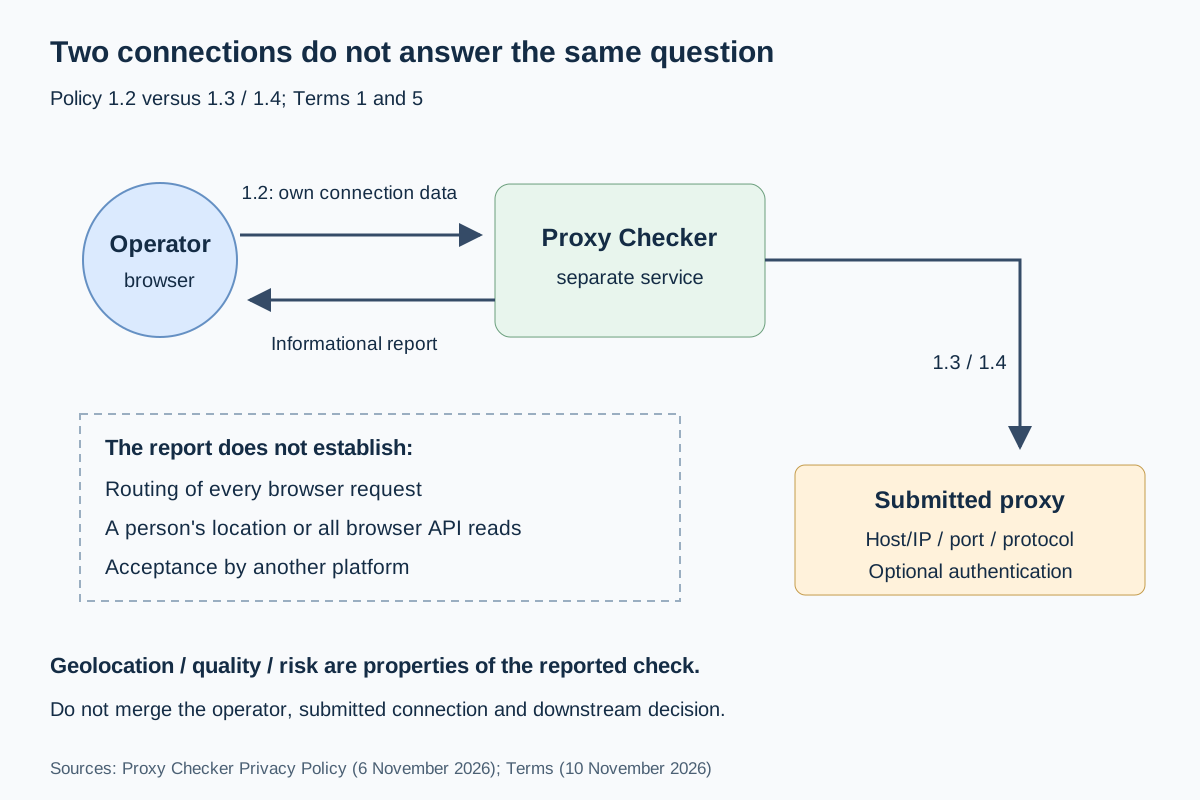
An organization approving a check should identify which of these populations creates the relevant exposure. A concern about a proxy password calls for checking the saved-list branch. A concern about revealing infrastructure geography calls for considering the derived report. A concern about the operator's own work connection calls for reading 1.2. The same action can raise all three questions, but one answer cannot settle them together. The relevant source is the service-specific policy, not a generic explanation of how an HTTP proxy works.
This is also why the checker must be distinguished from Pixelscan's browser fingerprint test and its blog's email-subscription notice. A shared brand does not establish identical collection purposes, retention periods or account features. The policy used here explicitly names Pixelscan Proxy Checker. Its claims about a submitted proxy do not identify which JavaScript APIs a fingerprint-check page reads. The public detector comparison addresses a different question: the tests a published suite says it provides, rather than credentials entrusted to a network-analysis service.
The Proxy Checker terms, updated 10 November 2026, require rights to the submitted IPs and data. Possessing a proxy URL in a configuration file is not itself evidence of permission to send that URL to another service. Before submitting connection material, the responsible operator needs approval for that recipient and purpose. This is a data-sharing decision separate from whether the proxy account can technically authenticate or whether the checker returns a report.
An ordinary check is different from a saved list
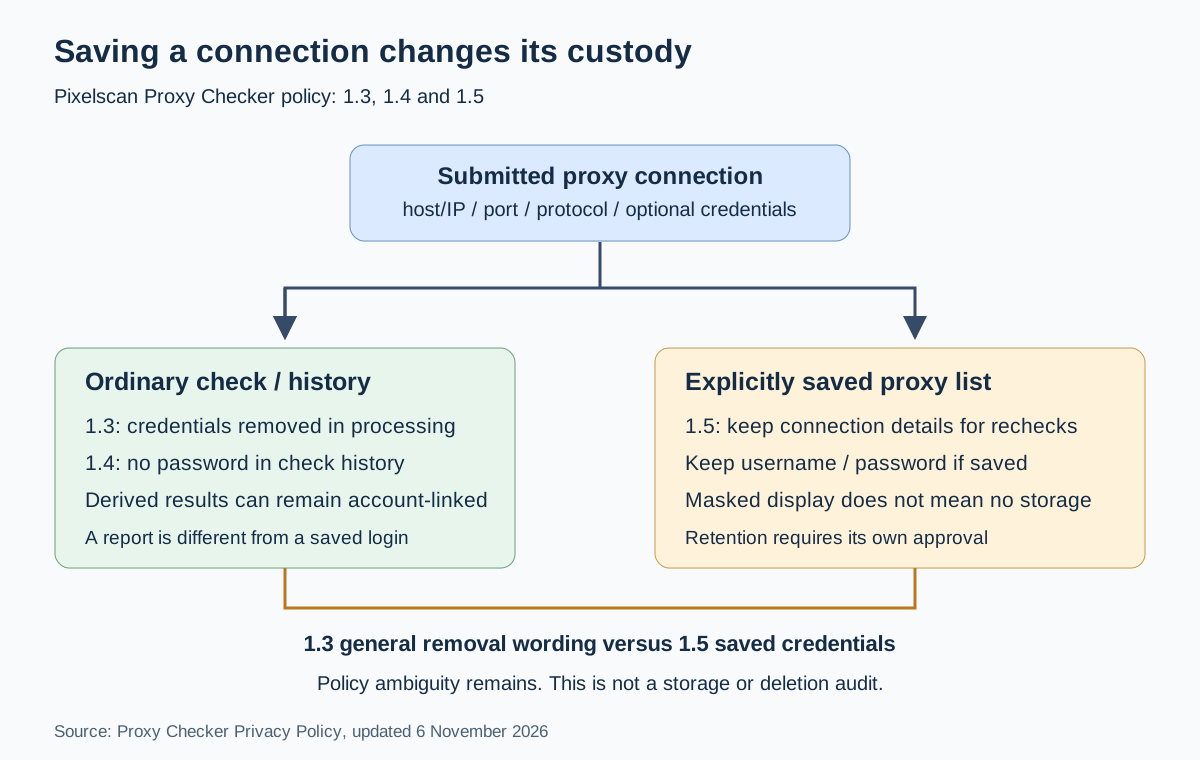
For ordinary checking, section 1.3 says credentials are removed from input during processing, before storage or logging. It also says the proxy IP is used to determine provider, location, type and quality and is not stored after those properties are determined. These statements describe the service's published handling commitments. They are not a measurement of memory lifetime, server logs or backup contents. No credentials were submitted and no storage or deletion experiment was performed for this policy analysis.
The saved-list provision changes the persistence decision. Section 1.5 says adding a proxy to an available saved list stores the hostname or IP, port and protocol so that it can be found and checked again. If the user saves a username/password with the proxy, the service stores those credentials for later authentication. The choice is therefore more substantial than adding a bookmark to a past report. It can create a reusable connection record containing the means to authenticate to the proxy.
Check history is a third case, not another name for a saved list. Section 1.4 describes saved results that may include the date/time, provider/location, type, port/protocol and quality indicators. It explicitly excludes usernames and passwords from that history. A history entry can answer “what did the previous report say?” without being a stored authentication record. A saved list instead supports “which connection should the service authenticate to and check again?” Those questions require different fields and carry different credential consequences.
The removal promise has an explicit wording problem
The policy's 1.3 uses the broad sentence “We never store proxy credentials.” Section 1.5 nevertheless explicitly describes storing credentials when a user saves them with a proxy. Section 4 repeats a general statement about removing credentials before storage or logging. These passages should not be merged into an unconditional assurance that no proxy password is retained. The narrow saved-list passage supplies direct reason to consider that branch separately, but the text does not consistently state the exception wherever it uses broader language.
A reasonable operational interpretation is that ordinary-check removal and deliberate saved-list retention apply to different actions. That interpretation does not establish how the service implements the distinction or resolve every legal meaning of the policy. Where an organization's approval depends on a categorical no-storage promise, the contradictory wording remains a question for the provider. Approval should not depend on silently discarding 1.5 or assuming that the general sentence automatically overrides a feature's expressly described behavior.
The safest decision from the text is concrete: do not select credential-bearing saved lists when continued custody of a proxy password is unnecessary or unapproved. This is not a claim that an ordinary check has no exposure. The ordinary operation still processes connection details, may authenticate and retains derived results. It is simply a narrower persistence choice under the published distinctions. If the interface does not make the selected mode clear, pause submission and establish what action the interface will perform.
A masked field is a presentation property
Section 1.5 says saved credentials are masked in the interface, that Pixelscan team members cannot access them and that the checker uses them only to authenticate to the proxy the user asks to check. These are stated restrictions on display, access and purpose. A masked interface field is not evidence of absence from storage; the same paragraph explicitly explains why the service keeps the credentials. Nor does masking alone demonstrate a particular encryption design, key-management method or access-control audit.
For a security review, keep those claims separate in the decision record: whether a credential is retained, whether it is visible in the interface, who the policy says can access it and which purpose is authorized. A claim in one column should not be used to fill an unverified column. The proxy authentication and credential hygiene analysis explains how browser launch, framework and logging choices can expose a secret locally. This service adds a different recipient and an explicit persistence branch outside that local runtime.
The distinction also affects incident handling. If a credential was deliberately saved, account logout or closing the checker tab does not establish its removal. The private browsing boundaries explain why ending local browser state cannot erase a service's records. If it was used only for an ordinary check, a later history entry does not by itself prove that the password was retained. Identify the action taken and the artifact observed before deciding whether the issue is a saved authentication record, an ordinary derived result or an unrelated local log. The policy supports that classification; it does not supply an audit trail for an individual account.
Derived history remains after raw input
The privacy significance of a check is not exhausted by a password question. Under section 1.3, results are linked to the account and can include provider/ASN, country/region/city, proxy type, connection speed, availability, risk score, port/protocol and check time. Even when the submitted proxy IP is discarded under the ordinary-check provision, this combination can describe an account's infrastructure choices. A derived report is less than the original connection string, but it is not the absence of a record.
Each retained category has a different interpretive limit. A provider or ASN describes a network organization. A country, region or city is the service's proxy-associated location result. Speed and availability concern the check, while a fraud/risk score is an assessment. None of these is automatically a person's location, a permanent quality rating or a complete history of traffic carried by the proxy. The terms' service description explicitly calls location approximate and describes outputs as informational and analytical.
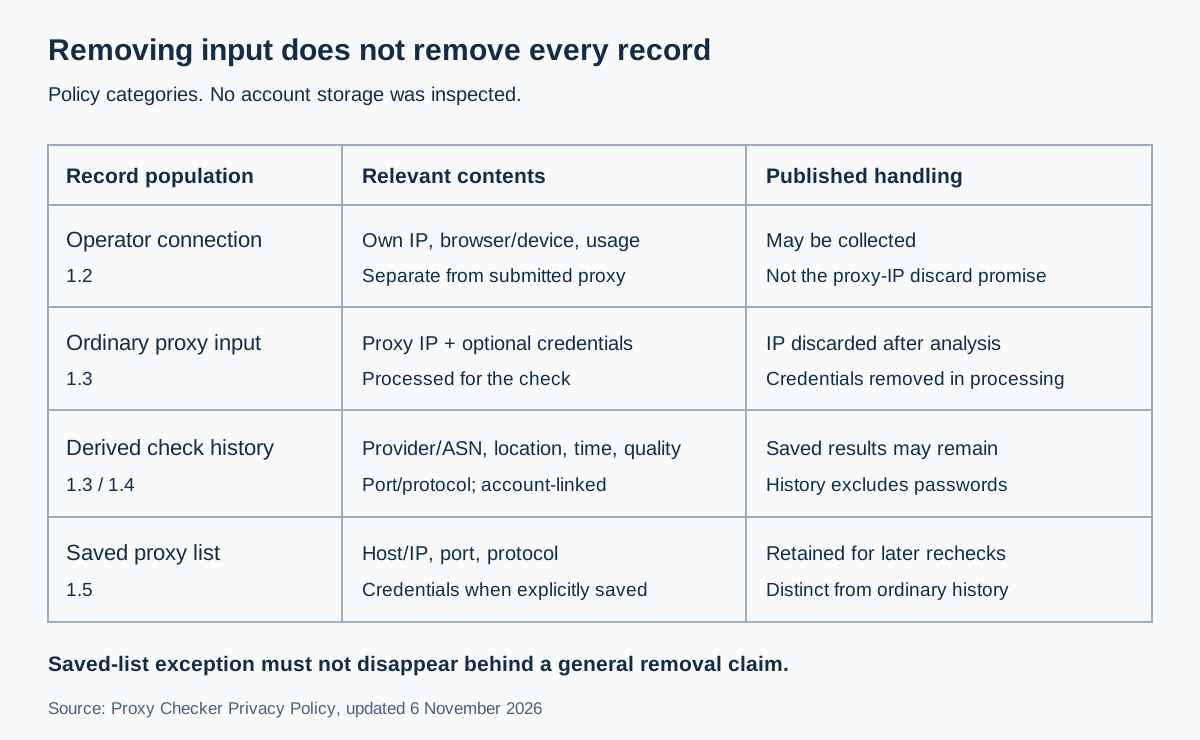
The matrix prevents two opposite mistakes. Treating every report as a stored password exaggerates what 1.4 says. Treating a password-free report as containing no sensitive operational information ignores the account association and metadata categories. An internal reviewer may need to preserve a check date and a coarse outcome while excluding detailed location or provider information from a broadly shared ticket. That is the organization's minimization decision; it does not change what the service says it retains on the account.
Consider a constructed example: an approved operator needs to know whether a connection was available during a support incident. A record of the check time, relevant service mode and availability outcome can support that limited question. Copying a complete connection URL into the ticket adds authentication and routing material that the ticket does not need. Saving an entire proxy list for recurring checks adds persistence beyond the one incident. These are distinct choices even if the interface offers them beside the same result.
A second constructed case concerns comparing two reports. If the provider or location differs, preserve which submitted connection and check time each result concerns in the restricted operational system. Do not infer that the browser's timezone changed or that the person moved. Section 1.2 distinguishes the operator's connection data, and 1.3 describes the analyzed proxy. Without a direct observation of the browser session, a proxy report is not a measurement of that browser's displayed language, timezone, DNS path or other requests.
When exporting or discussing a report, its purpose should determine the audience. A network support team may need a provider category that a billing conversation does not. A password remains inappropriate in either conversation unless a separately authorized secret-handling process requires it. The policy's check-history exclusion is not a reason to assume every screenshot, clipboard entry or local diagnostic is automatically redacted. Those additional copies are created by the operator's own tools and need their own handling rules.
The service's published sharing language also requires careful scope. Section 1.5 says saved credentials are not transferred to another third party, while section 6 describes trusted hosting, payment and email service providers and legally required disclosures for personal data more generally. These provisions concern different categories and should not be flattened into either “nothing is shared” or “all saved passwords are shared.” Any decision needing a more precise subprocessor or access explanation requires that specific information from the provider.
Retention starts from feature access
Section 1.6 defines a particular retention population: check history, saved proxy lists and associated proxy credentials. The service says it keeps these while the account has access to the relevant features. When that access ends, it keeps them for up to 12 months and deletes them by the end of that period. The beginning of that clock is the end of feature access, not necessarily the time of a check, the last successful connection or the closing of a browser window.
That difference matters when an operational account remains active after a single investigation. A check performed today is not promised to disappear 12 months from today if feature access continues. Conversely, “up to” describes an upper bound in the published post-access rule, not a claim that every record is held for the full interval. The policy does not provide an individual record's scheduled deletion time. A retention record should keep the relevant access-end event and policy date rather than inventing a timestamp from the check date alone.
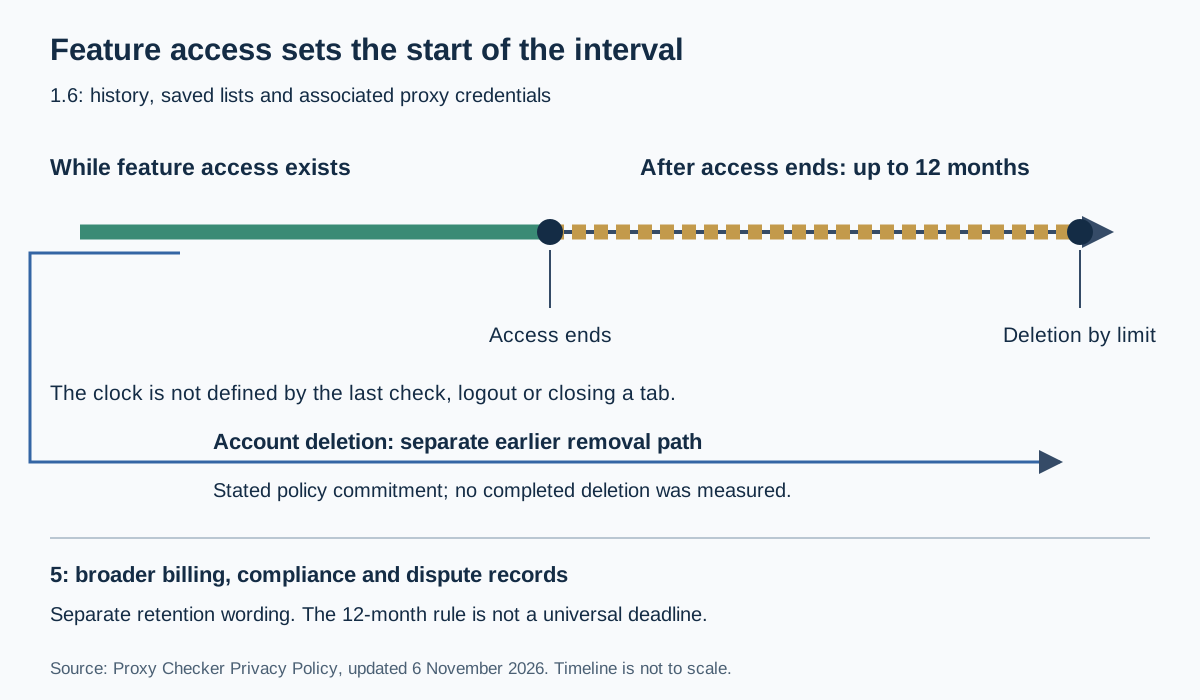
The policy supplies another path: if the user deletes the account, the service removes these data as part of account deletion, even before the 12-month period ends. This is an account-deletion commitment, not proof that a particular request has already completed. No account deletion was requested for this analysis. The text does not specify a separately measured completion delay or demonstrate backup erasure. An organization needing confirmation should retain the provider's response to its authorized request rather than treating a local click or missing screen row as a server-side deletion certificate.
Feature loss, cancellation and deletion are different events
Subscription management does not automatically establish account deletion. Section 1.6 refers to access ending, while the terms' sections 3 and 7 separately discuss account/subscription responsibilities and suspension or termination. A cancelled renewal, an expired feature, a suspended account and an explicit deletion request can have different operational meanings. The relevant question is which documented event occurred for the specific account. The policy does not justify equating every one of these events with immediate removal of saved credentials.
For a handoff, record the selected persistence mode, whether continued access exists and which deletion action was actually requested. If feature access has ended, record that event's date when it is known. If only a renewal was cancelled, do not fabricate an access-end date before the entitlement actually ends. If the account-deletion path was used, preserve the confirmation separately from any assumption about local saved browser state. A missing detail should remain unknown instead of being replaced with a convenient retention estimate.
Section 5 provides broader retention wording for personal data needed to provide the service, maintain billing/compliance records or resolve disputes and enforce agreements. That passage is not identical to the feature-data rule in 1.6. The more specific rule names history, lists and associated credentials; it does not state that all financial, compliance or dispute records follow the same 12-month schedule. Reporting “all account data is deleted within 12 months” would therefore exceed the text that supplies the number.
Saved-list deletion at a finer granularity also remains a separate question. The cited policy clearly discusses account deletion and post-access retention, but it does not establish the complete mechanics or timing of removing one saved entry, overwriting its password, revoking a session or clearing one history item. An interface may offer additional controls; their presence and effect were not tested here. Where a project requires item-level erasure, that requirement needs a direct documented answer rather than an inference from the account-deletion clause.
An organization can reduce future credential utility through its own authorized proxy-account management, but revoking a proxy credential is not the same as removing an existing service record. One changes whether authentication remains valid; the other changes data custody. Keep both completion states if both actions are needed. The credential hygiene discussion separates credential lifecycle from browser configuration; the checker policy adds a provider-side retention lifecycle that the browser cannot end by itself.
A network assessment is not a browser verdict
The terms' section 1 describes fraud scores, IP/network information, approximate location, proxy type and risk indicators. Section 5 calls the output probability-based and expressly declines to guarantee error-free scores, universal acceptance or acceptance by third-party platforms. These limits are part of the service definition, not an afterthought that can be replaced by a favorable visual indicator. A report can help describe a submitted connection while leaving a destination's authorization and decision entirely unresolved.
A fraud/risk score also does not reveal an API-level collector inventory. The privacy policy mentions browser/device information for the operator's service connection in 1.2, but it does not enumerate every JavaScript read, its calling script, its return value or its contribution to a score. No source-attributed V8 trace is available for this article. Consequently, the documented data categories must remain policy disclosures, rather than claims that a named browser API was observed during a particular check or caused a particular result.
The local research material reinforces that limit rather than filling it. The available Pixelscan monitor contains fingerprint-page DOM extraction and request/response observation code. Its descriptive comments disagree about whether backend processing exists. Those comments are analyst tooling, not an executed event log, and they do not verify the Proxy Checker service's storage behavior. No proprietary script was reconstructed, no challenge was solved and no credentials were sent. These materials cannot establish whether a particular proxy credential was stored or removed.
Browser instrumentation could answer a narrower future question if authorized: whether a particular source called an instrumented interface during a recorded session. Such a V8 event would need its script attribution and collection conditions. It would still not certify how long a backend retained a submitted password or whether a saved-list deletion propagated through storage. Different questions require different evidence. The service's 1.5 storage statement cannot be verified by the mere presence or absence of a browser property read.
The connection diagram also explains why checking a proxy does not establish that every request from your browser uses it. The checker evaluates submitted connection material through its own service path. Your browser's traffic configuration is a separate system, and section 1.2 explicitly anticipates information from your connection to the service. A proxy-associated city in the report is not proof that your DNS queries, other tabs or application connections followed the same route. Those require observations of the actual browser setup.
For an approved integration, define the question in terms of the reported property. “The service reported availability for this submitted connection at this check time” is narrower than “this browser can access a destination.” “The report assigned an approximate location” is narrower than “the account holder is in that city.” The browser proxy configuration analysis concerns browser-visible and network context; it should not be used to promote a single checker's estimate into a person's location or a third-party entitlement.
The terms also prohibit submitting IPs/data without rights and using the service against laws or platform rules. A network assessment therefore belongs after authorization for the check, not as a substitute for it. No score changes the rights attached to a dataset, an account or a destination. If a task requires another service's permission, establish that independently. The useful output here is a bounded connection report whose data-handling consequences are understood, not a strategy for obtaining a desired classification elsewhere.
Browser control and external custody
The BotBrowser proxy configuration documentation describes runtime routing and authentication, including how the browser accepts configured proxy connection information. Its browser-native controls and profile-backed fingerprint surfaces concern what the runtime exposes and how it behaves under a declared configuration. They do not administer a Pixelscan account, change which saved-list action an operator selects or delete data that an operator has intentionally submitted to an external checker.
That boundary is also the relevant distinction from a page-level patch. Changing a JavaScript-visible property is a browser-surface intervention. Configuring routing belongs to the browser's network path. Choosing whether a third party stores a reusable proxy password belongs to an external service and the operator's disclosure decision. These layers can interact, but substituting one for another leaves the original privacy question unanswered. No comparison of patches and browser engines is evidence that either controls a checker's retained records.
The following decision table is a constructed approval aid derived from policy sections 1.2 through 1.6. It is not an observed account state or a claim that every feature is offered on every subscription. Its outcome is which mode to consider and which unresolved condition needs an answer before submission.
| Actual requirement | Mode to consider | Privacy condition and remaining question |
|---|---|---|
| One authorized availability assessment | Ordinary check | Accept processing and possible derived account history; verify the action does not deliberately save the connection |
| Review a previous assessment without reusable authentication | Check history, if offered | Policy says history excludes usernames/passwords; derived provider/location/time results remain account-linked |
| Repeated checks of the same approved connection | Saved list, if offered | Saving address and credentials creates persistence; approve that recipient, purpose and retention explicitly |
| No continued custody of a reusable password | Avoid credential-bearing saved lists | General removal wording remains inconsistent with the saved-list clause; obtain clarification if approval needs an unconditional promise |
| Remove the feature-data population earlier than the post-access limit | Documented account-deletion path | Obtain completion evidence; do not extend this clause to every billing or compliance record |
An approval record can be small without being vague. Keep the service name, applicable policy revision, selected mode, necessary data categories, authorization owner and intended exit action. There is no need to paste a real username/password into the review record to prove that a saved list can retain credentials. A statement that the proposed action includes reusable authentication is enough to make the custody decision visible. Actual secrets belong only in a separately approved secret-handling system.
Before approving persistent use, resolve three specific gaps: whether the interface action saves the connection or only its report, how the contradictory credential-removal wording applies to that action and what evidence the provider supplies when deletion is requested. These are targeted provider questions, not an invitation to collect additional fingerprint values. If the task only needs a one-time report, a feature that retains a reusable secret needs its own justification. Convenience alone does not determine the permitted data population or retention period.
FAQ
Does a password-free history mean no password was processed?
No. Section 1.4 says the service uses supplied authentication when necessary to connect, while excluding usernames/passwords from history. Transient use and history storage are different operations.
Does saving a proxy require saving its password?
The policy describes storing credentials if you save them with the proxy. It does not establish every interface option or subscription condition. Confirm the selected action instead of assuming that all saved entries contain authentication.
Is the 12-month interval measured from the last check?
No. Section 1.6 attaches the interval to feature access ending. The cited text does not define it as a period beginning with each check or a browser logout.
Does account deletion cover every category on the same schedule?
The explicit early-removal provision names history, saved lists and associated credentials. Broader billing, compliance and dispute records have separate wording in 5; the account-deletion clause should not be expanded into a universal schedule.
Can a favorable proxy result certify browser privacy?
No. A connection assessment is not a measurement of every browser surface, and the terms explicitly exclude a guarantee of third-party acceptance. The report needs its own scope, date and submitted connection context.
Sources
- Pixelscan Proxy Checker Privacy Policy, updated 6 November 2026: service connection data, ordinary input, check history, saved lists and feature-data retention.
- Pixelscan Proxy Checker Terms of Service, updated 10 November 2026: informational output, authorized use and probability/acceptance limits.
- BotBrowser proxy configuration: browser runtime routing and authentication, separate from external data custody.
Practical conclusion
Choose the smallest service mode that satisfies the authorized task. Distinguish the operator's connection, submitted proxy input and derived account-linked results. Treat deliberately saved credentials as retained under 1.5, preserve the conflicting general wording as an unresolved policy question and base any retention plan on feature access ending rather than the last check. A browser configuration can control its own runtime; credential persistence and deletion at a separate checker require a service-specific decision and evidence from that service.
This article is part of the guide: What Is a Browser Fingerprint? Canvas Fingerprinting
Related Articles
hCaptcha Privacy: Signals and Evidence Boundaries
FingerprintCan Passkeys Fingerprint Users? WebAuthn Privacy Risks
FingerprintRebrowser Proxy: Routing, Profiles and Privacy
FingerprintCreepJS Audio Reports: Rendering and Missing Values
FingerprintBotright: Automation Scope and Privacy Boundaries
FingerprintAkamai Bot Manager: Sensor Data and Privacy
Run the same check in BotBrowser
Load a profile, keep the signals you just read about consistent inside the browser, and confirm the result on your own machine before a rollout.