Akamai Bot Manager: Sensor Data and Privacy
Separate Akamai sensor declarations, browser observations and edge data. Understand collection exposure, processing roles and the limits of browser controls.
BotBrowser Team
Want the structured docs for Fingerprint?
This article lives in the editorial library. For step-by-step setup, reference material, and ongoing updates, jump into the docs section.
Akamai Bot Manager combines information available at the network edge with observations from a script in monitored pages. Akamai publicly names behavior analysis and browser fingerprinting, but those declarations do not establish a universal list of JavaScript reads. Understanding the privacy exposure requires keeping browser collection, transmission and subsequent processing separate.
BotBrowser supports repeatable browser-engine surface checks using declared profile settings. It does not determine Akamai's collection purpose, retention, account history or classification, and it does not guarantee anonymity or access.
TL;DR
- Akamai describes both a page-script component and request assessment at the edge. A browser privacy setting affects only part of that system.
- A source-attributed V8 event can establish a browser operation in a particular run. A request capture, script download or unexplained score cannot establish the same fact.
- Akamai's privacy statement distinguishes processing roles and service contexts. Its broad Service Log examples do not specify every sensor message.
- For an owned deployment, choose collection and retention rules from the actual purpose and configuration. Check browser exposure separately from server processing.
Contents
- The page sensor and the edge
- What the available evidence establishes
- Browser surfaces and privacy exposure
- Transmission, logs and processing roles
- What browser-engine controls can change
- Decisions for an owned deployment
- Practical conclusion
The page sensor and the edge
A site does not need a page script to observe every relevant property of a request. An edge service receives traffic before the document reaches the browser. The request and connection already provide information about where traffic arrived, which resource was requested and when the exchange occurred. That visibility has a different owner from a value produced by JavaScript after the page loads.
Akamai's Bot Manager product description explicitly includes both parts. Its configuration description says behavior anomaly detection uses a script injected into monitored pages. Its monitoring description says the service sees traffic at the edge and assigns a Bot Score to requests. Those statements establish a declared architecture. They do not reveal which browser operation produced a particular score or which observations a particular customer enabled.
The distinction matters when a page appears to work differently after changing a browser setting. A browser-side difference can coexist with unchanged server history. A changed network route can coexist with the same rendering behavior. A different response can result from application configuration without proving any new browser signal was collected. Each explanation refers to a different part of the system.
The browser fingerprinting overview separates request, navigator, rendering and application layers for the same reason. Akamai's product description adds a vendor-specific declaration about how page monitoring and edge assessment participate. It does not collapse those layers into one browser property that a setting can switch on or off.
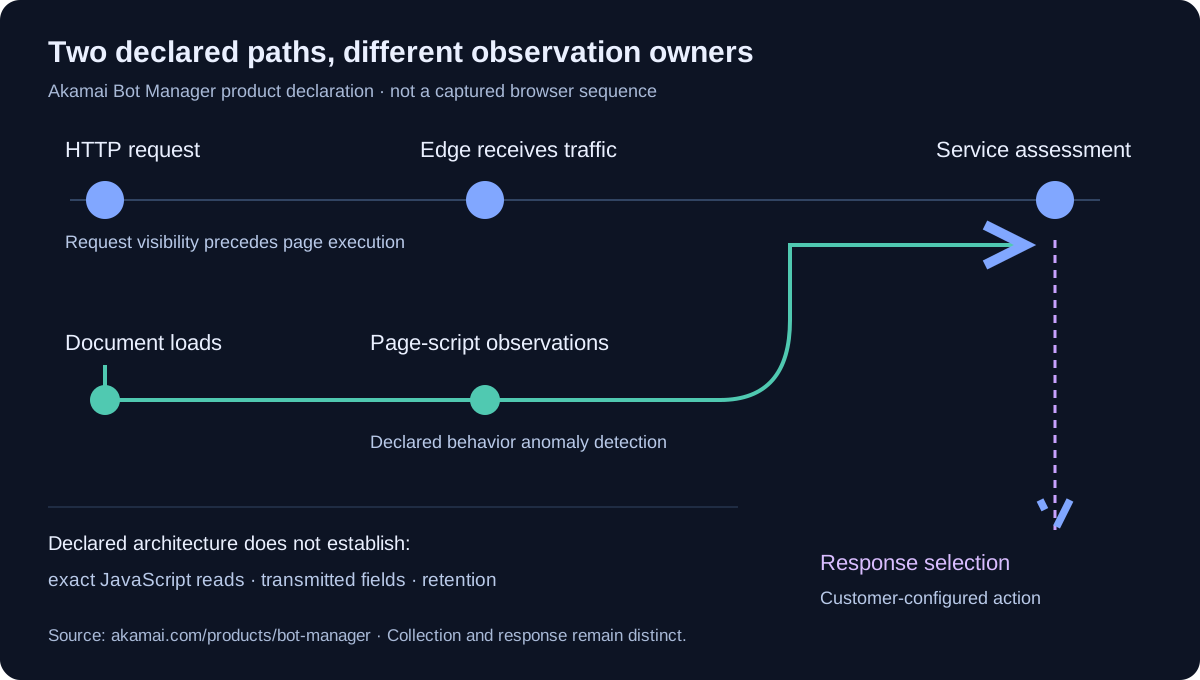
A sensor is only one collection context
The word sensor often makes readers imagine a single fixed questionnaire. A deployed browser component instead runs inside a page with a particular origin, loading order, lifecycle and set of available resources. What is available before an interaction may differ from what is available after a navigation or permission decision. That does not establish which opportunities the component actually uses.
The Cloudflare and DataDome response guide concerns another observable boundary: what a client receives. A response classification can describe a document, redirect or challenge. It does not reconstruct what a different vendor collected earlier, and it does not reveal how a customer configured a response policy. Applying those limits consistently prevents a visible outcome from becoming an invented collection history.
Collection and response have different purposes
An application operator may use bot management to protect availability, investigate unwanted automation or distinguish categories of automated requests. Those purposes can lead to different deployment choices. A public product page describes available capabilities across customers. An individual deployment has its own configuration, application flow and operational responsibilities.
For privacy assessment, the useful question is what the actual deployment needs for its stated purpose. The existence of an optional capability is not evidence that every visitor encounters it. Conversely, a quiet browser console is not evidence that the edge received no information. Network and application observations remain relevant even when a script produces no obvious visible interface.
The W3C fingerprinting guidance distinguishes passive characteristics available through requests from active observations obtained through executable content. These categories help locate collection. They do not assign a legal basis, prove proportionality or determine how a specific business uses the result. Those decisions require deployment and processing information from the responsible organizations.
A Bot Score is an assessment, followed by a response choice
Akamai's product FAQ describes a score from 0, labeled human, to 100, labeled bot. It says assessment starts with the first request and that the score can increase as requests from the same bot accumulate. These are the vendor's descriptions of its service, not measurements of a browser session. The endpoints of the scale are labels, not published probabilities of human identity or malicious intent.
That request-history qualification is relevant to privacy. A service that evaluates a sequence needs some basis for treating requests as related. The FAQ does not identify the exact linking mechanism or how long each association persists. It supports a question about relationships across requests, without establishing a specific identifier, storage method or cross-site relationship. A source-attributed browser read would still not answer how the server combines the history.
The response-strategy declaration names three configurable segments: Cautious Response, Strict Response and Aggressive Response. It describes watching, challenging and mitigating traffic, while allowing customers to adjust the actions and score boundaries. Those choices sit after assessment. A visible challenge therefore reflects both the service assessment and the deployment's selected response; it is not a direct display of a particular browser observation.
For an application operator, that separation affects accountability. The vendor supplies an assessment capability, while the customer chooses how it participates in the application flow. A visitor experiencing an unexpected interruption needs a review of the deployed decision and its context, including ordinary accessibility or navigation differences. Changing a response rule does not prove that the underlying collection changed, and collecting an additional browser value does not by itself explain why a response rule applied.
The edge-layer explanation describes why a page cannot inspect every service-side condition. Akamai's FAQ provides a concrete example: per-request assessment and configurable response are related operations, but they have different owners and evidence. No particular score or action has been measured for the browser controls discussed below.
What the available evidence establishes
Three kinds of evidence answer different questions: a vendor declaration describes an offered capability, a browser trace records operations during a run, and a network record describes an exchange. None automatically contains the information supplied by the other two. A collection claim becomes misleading when a report crosses those boundaries without additional evidence.
The inspected local research contains request-capture configuration and a source-attribution utility, but does not establish a current source-attributed V8 measurement. Specific browser reads therefore remain unverified. Request capture can locate an exchange; existing analysis code does not prove that its expected event was emitted.
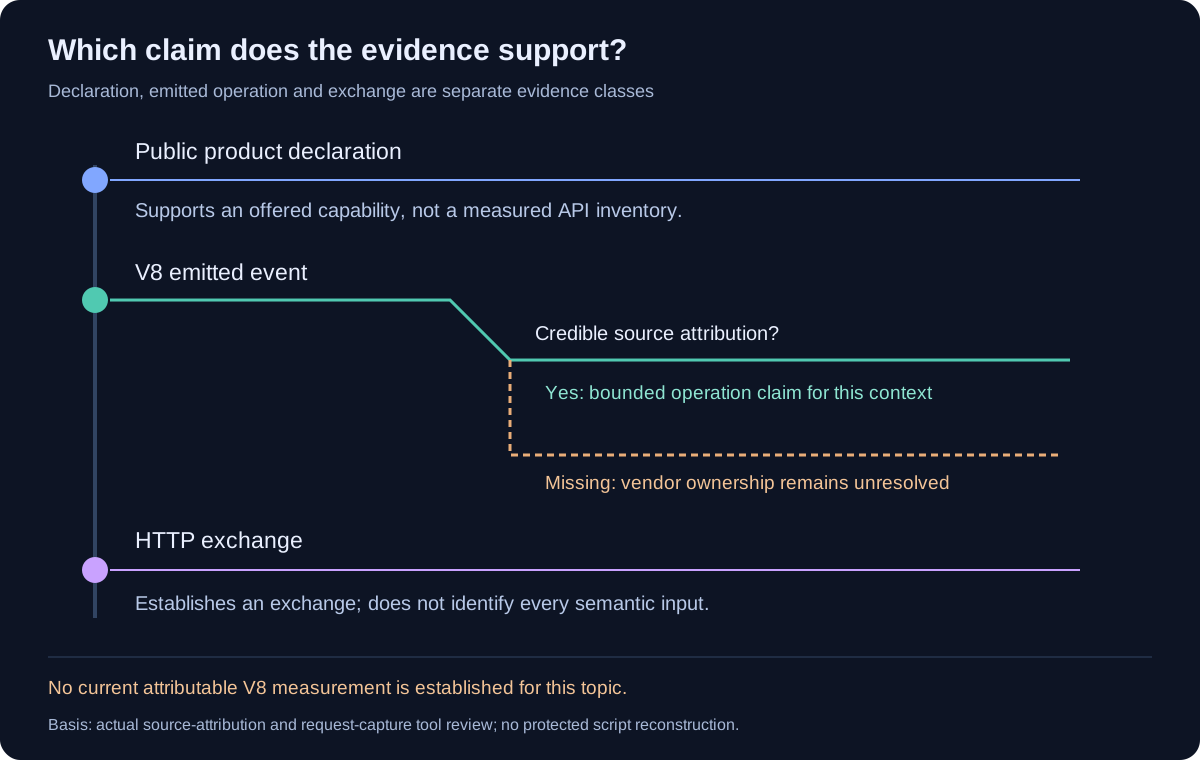
Why source attribution changes the conclusion
A modern page runs application scripts, analytics, embedded content and diagnostic tools. An API call recorded during that page load could belong to any of them. The fact that bot management is installed does not assign every browser operation to its sensor. Attribution needs a connection between the event and the code responsible for it.
A V8 log is an observation tool for browser-interface activity. An event identifying the operation and a credible script source can support a claim about that run. A missing source, document-only context or same-run blob label does not independently assign the operation to Akamai. Application scripts and diagnostic tools can produce their own events during the same visit.
The cross-surface privacy discussion explains why context matters across pages and workers. A measurement must preserve the context it actually observed. Moving an unattributed event into a vendor column loses that context and can overstate both collection and the effect of a browser control.
Reading, sending and keeping are separate facts
An emitted browser event can establish that an operation occurred. It does not necessarily establish that the result was included in a request. A network exchange can establish that data crossed a boundary, but an opaque body does not independently reveal its semantic inputs. Neither proves a retention duration or the purpose of subsequent server processing.
These limits matter for both positive and negative findings. A missing event can reflect incomplete recording, a different execution phase or unavailable instrumentation. It is not proof that no read occurred. A matching browser value also does not prove that the site ignored it. Browser observations describe returned values; service use requires separate evidence.
| Available evidence | Supported conclusion | Additional evidence still needed |
|---|---|---|
| Vendor product declaration | The vendor offers the named processing capability | Actual deployment configuration and collection |
| Emitted event with credible source | That source performed the recorded browser operation in that context | Whether the result was transmitted or retained |
| Outbound request | A network exchange occurred | Meaning of its contents and responsible processing purpose |
| Customer processing record | The documented purpose and handling rules | Whether the deployed implementation follows those rules |
The table gives an owned-site team a choice rule: use the row matching the evidence actually available. If the question belongs in the next column, obtain that information from the relevant system owner rather than converting uncertainty into a confident claim. The W3C guidance supplies the broader collection model; an actual deployment supplies its missing details.
Browser surfaces and privacy exposure
Fingerprinting exposure includes how observations can be linked, how long that relationship remains useful and which organization controls the combination. A name is not required for recognition.
The W3C guidance describes how active and passive characteristics contribute to fingerprinting. Browser compatibility information, rendering differences and request properties can have different stability and collection costs. A family shared by many users can still narrow a population when combined with another family. Akamai's product page explicitly names "browser fingerprinting"; that supports examining this category without inventing its implementation.
The fingerprinting pillar distinguishes a recognizable pattern from proof of identity. The same distinction applies to Akamai. A browser classification does not establish a legal identity, a device owner or a person's intent. Treating it as such adds conclusions the underlying observation may not support.
Compatibility information can become correlation material
Web applications use browser information to choose compatible content, format text or adapt layout. Collection for those purposes is not inherently a fingerprinting claim. The privacy exposure changes when an application combines the answers for recognition or associates them with continuing activity. Purpose and combination matter alongside the individual browser surface.
For example, navigator.language can support localization. An installed resource can affect rendering. A viewport describes the current presentation area. These examples illustrate normal browser exposure, not a statement that Akamai reads each value. The language and localization discussion explains that a functional preference and a tracking inference are different uses of related information.
An owned-site assessment should distinguish the minimum compatibility decision from a more persistent record. If a page needs only to choose a suitable layout, keeping a long-lived history of the supporting observations needs its own justification. The browser cannot determine that business purpose. Application and service owners must be able to explain it.
Rendering exposes implementation differences
Graphics and text rendering can vary with fonts, browser implementation and the rendering environment. That makes rendered output relevant to generic fingerprinting analysis. It also means changes can occur for ordinary maintenance reasons. A different output is not automatically a different person, a suspicious session or proof of deliberate manipulation.
The WebGL discussion and canvas analysis explain those surfaces individually.
Rendering data can create exposure even without a human-readable name. Its value may be in distinguishing a configuration or correlating visits. The relevant handling questions are whether raw output is needed, whether a coarser category would answer the operational question, and whether the result is associated with other activity. A browser trace alone cannot answer the final association question.
Interaction and timing need a time boundary
Akamai explicitly describes user behavior analysis.
Behavioral observations describe activity over an interval. Their meaning depends on the page, interaction opportunity and accessibility context. A visitor navigating with a keyboard may produce a different interaction pattern from a visitor using touch. A background tab may have different timing from a foreground tab. Those differences require context from the deployment before they can explain a classification.
The performance timing analysis shows why a transient measurement must not be treated as a permanent property. The same discipline applies when reviewing a vendor declaration about behavior. The declaration, the recorded interval and the resulting service decision remain separate pieces of evidence.
Transmission, logs and processing roles
A browser privacy explanation becomes incomplete if it ends when a script returns a value. Information may cross into an application, an edge service or a retained operational record. The organization controlling the later processing may have different purposes and responsibilities from the page component that made the initial observation.
Akamai's privacy statement, updated August 18, 2026, makes an important scope distinction at its opening. It covers processing by Akamai in a controller role or equivalent role. It says processing performed on behalf of customers in a processor role is addressed through the data processing agreement available from its Trust Center. A reader should not merge those two contexts into one universal notice.
The statement also discusses circumstances in which Akamai processes Service Logs in a controller or business role. That is why simply saying the vendor is always a processor would be too broad. The role depends on the processing activity and applicable arrangements. The product name alone does not resolve that question for every dataset.
Service Log purposes extend beyond a single response
The Service Logs declaration lists traffic and security analytics, customer billing, service improvement, capacity and deployment planning, troubleshooting and aggregate reporting as purposes of Akamai's own processing. It gives improved threat intelligence as a service-improvement example. These purposes describe what may happen after delivery of the page; they are not simply alternative names for the decision to return a challenge.
The distinction changes what a site needs to explain. A record used to calculate service charges answers a different question from a record used to investigate a security event. An aggregate traffic report is different from a browser observation associated with an individual request. Identifying the purpose helps determine the necessary detail and who can justify access, rather than assuming that every retained item remains necessary because the original request required assessment.
The statement also declares partnerships with third parties for traffic and security analysis of Service Logs, with some partnerships including analysis of the partner's traffic and security data. That is a declared processing relationship, not proof that every Bot Manager observation is shared with every partner. For an owned deployment, the applicable service description and agreements need to identify which relationship applies. The presence of a browser script alone cannot answer that question.
In the same section, Akamai describes security analytics that can validate credentials in Service Logs against lists of stolen credentials to recognize malicious access and account takeover attempts. This is a service-wide example whose applicability depends on the purchased service and relevant data. It must not become a claim that every Bot Manager page script reads credentials or that every ordinary page visit transmits them. The DataDome analysis similarly keeps a provider's processing declarations attached to the component and purpose they describe.
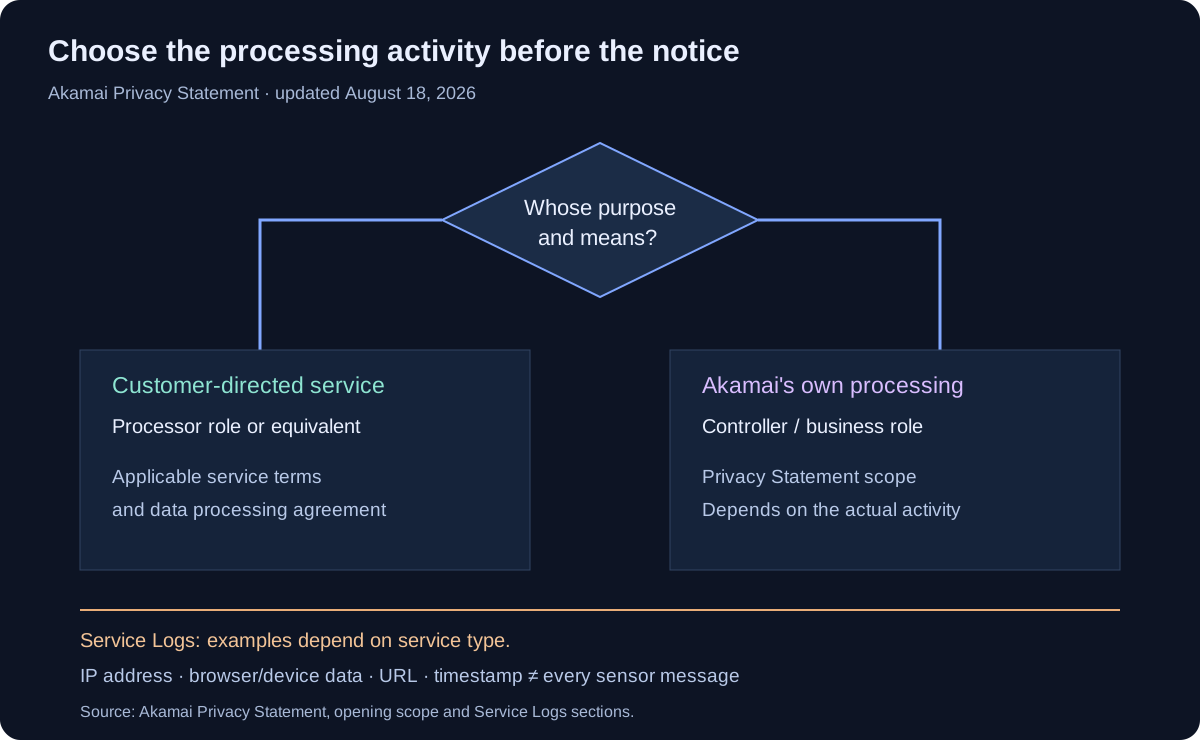
Service Log examples are conditional
The Service Logs section gives examples including an end user's IP address, browser and device data, URLs visited and timestamps. It also lists other categories that may apply depending on the service used. The scope is the operation of Akamai services generally. These examples must not be relabeled as fields present in every Bot Manager sensor message.
That distinction has a concrete consequence for a deployment inventory. A team should identify which service it bought, which data paths it enabled and what the governing documents say about those paths. Copying every category from a service-wide statement would overstate its observed collection. Removing categories merely because they do not appear in browser JavaScript would understate the edge's independent visibility.
The network-versus-browser explanation provides a useful starting point. A server can observe a request address without asking a page API for it. A page can obtain a rendering result that the server cannot directly read until some representation is transmitted. Data-location questions therefore need both the browser and service sides.
Direct visits to Akamai are another context
The privacy statement separately discusses Device and Usage Data collected through interactions with Akamai's own sites. Examples include browser and operating-system information, pages viewed and usage information. That context is distinct from a customer using Bot Manager on a separate application.
A person reading an Akamai product page is not automatically encountering the same configuration as a visitor to a customer's checkout. A site's analytics, promotional technologies and account flows may have their own notices and purposes. Keeping these contexts separate prevents a general website privacy statement from being misrepresented as a precise sensor specification.
For an owned deployment, the customer notice and contractual service terms need to describe the actual relationship. The vendor statement contributes information about the vendor's own processing. A browser measurement contributes information about observable behavior. Neither replaces the customer's responsibility to understand what it enabled and how that fits its stated purpose.
The published retention schedule has several scopes
Akamai's retention table gives concrete periods for Service Logs concerning individuals accessing its customers' websites, applications or corporate systems, excluding Cloud Computing services. For security analytics, it says data is retained for up to 90 days in most cases. Where specific security events require updates to an existing algorithm, it specifies up to 180 days. For traffic analytics and forensic aggregated data, it specifies up to 3 years.
| Published Service Log context | Stated period | Boundary of the statement |
|---|---|---|
| Security analytics in most cases | Up to 90 days | The listed customer-site Service Log context |
| Specific security events requiring algorithm updates | Up to 180 days | A stated exception, not every request |
| Traffic analytics and forensic aggregated data | Up to 3 years | The specified analytics and aggregated-data purposes |
These are declarations in the statement's controller or business scope. They are not a universal retention promise for every Bot Manager sensor message, every customer-directed processor dataset or all services offered under the Akamai name. The separate Cloud Computing row has a different formulation. An owned-site team must map the actual processing activity to the applicable row and contractual arrangement before using one of these periods in its visitor notice.
The phrase up to also matters. It describes an upper period in the stated context, without proving that a particular record remains stored for the whole interval. Conversely, a short-lived cookie does not establish that associated service records disappear when that cookie expires. Browser-local state, security analytics and an aggregate forensic dataset are different objects with different handling questions.
For privacy assessment, the practical difference is between request-level detail and a later aggregated record. The statement names both purposes but a browser response cannot verify their implementation or the exact transformation between them. A team seeking deletion, access review or a retention explanation needs the responsible processing owner and the relevant dataset, rather than only the cookie lifetime visible in browser tools.
The DataDome privacy analysis also distinguishes browser-state duration from server processing. Here, the published Akamai periods provide a concrete starting point. Deployment-specific contractual terms and actual data handling still determine which answer applies to an owned application.
What browser-engine controls can change
A browser-engine layer operates where the browser produces behavior visible to web content. BotBrowser's fingerprint documentation describes controls for browser surfaces such as graphics, fonts and timing. A declared context can make repeated authorized comparisons easier to interpret because the relevant profile inputs can be recorded.
That capability has a defined ownership boundary. It does not rewrite an edge service's previously received requests, remove application account history or alter the vendor's processing purpose. It also does not establish that a remote system will classify a session in any particular way. Those outcomes depend on information and rules outside the browser layer.
The engine-versus-patch comparison distinguishes the scope of a library patch from the browser environment behind it. The useful comparison is which layer owns a value and how consistently that layer behaves across contexts. A vendor acceptance rate is a separate question and is not established by that architectural distinction.
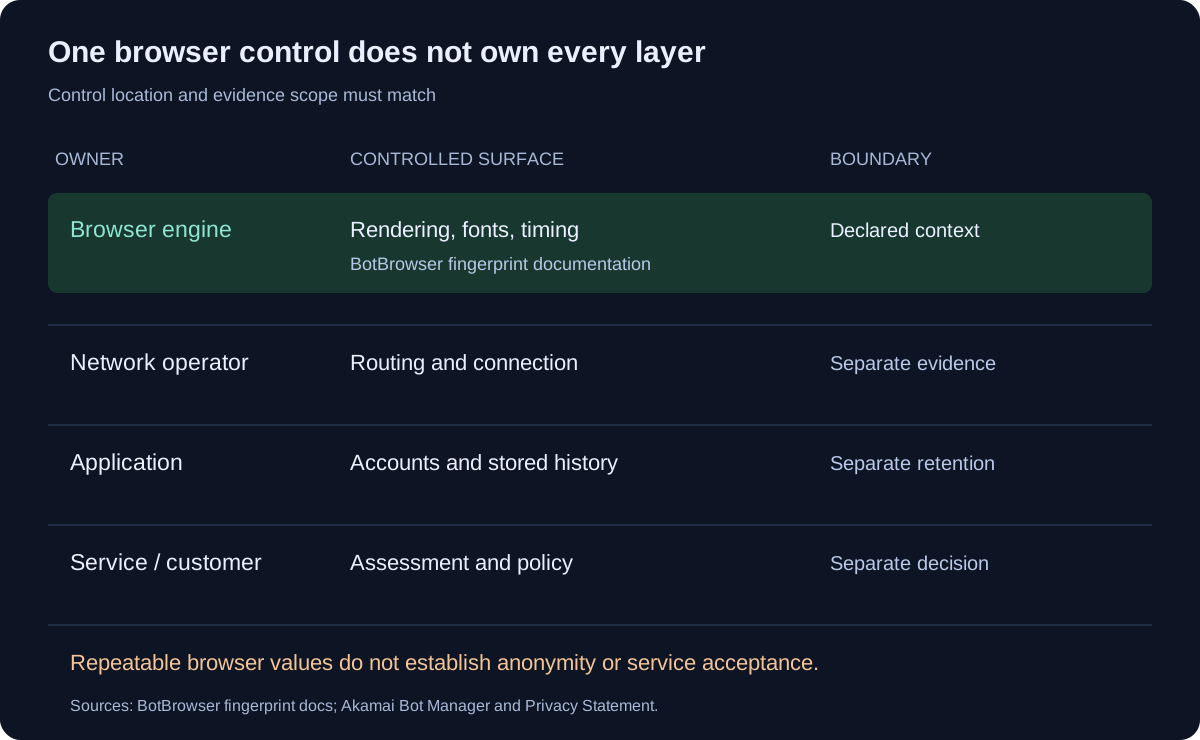
An API patch changes behavior at its patched boundary; an engine control has a different implementation location. Neither label proves coverage across every document, frame or worker context. The cross-surface privacy discussion explains why those contexts require their own checks. Repeatable values can support a comparison without demonstrating unlinkability or a measured change in Bot Score.
Decisions for an owned deployment
An owned-site team can review collection without collecting a complete device dossier. Start with a specific operational question: what problem requires this observation, where is the result used and what less detailed alternative would answer the same question? A broad label such as security does not by itself explain every field or retention period.
Use the deployed service configuration and applicable terms to identify the responsible processing activity. Use browser evidence to establish what the client actually does. Use network and server evidence to establish which results leave the page and what happens afterwards. The W3C guidance supports minimizing fingerprinting exposure; it does not replace a deployment inventory.
| Decision | Evidence to obtain | Resulting action |
|---|---|---|
| Is a claimed browser read actually attributable? | Emitted event and credible source context | Keep attribution unresolved when either is missing |
| Does a read become transmitted data? | Authorized comparison with the relevant exchange and implementation record | Do not infer transmission from availability alone |
| Which privacy role applies? | Purpose, service configuration and applicable contractual terms | Use the notice governing that processing activity |
| Is raw output necessary? | Operational need and a less detailed alternative | Prefer the minimum detail that answers the question |
| How long is the result needed? | Purpose-specific retention rule and deletion owner | Align access and deletion with that rule |
Keep diagnostic collection smaller than the problem
A diagnostic record can create its own privacy exposure. Raw browser logs may include resource locations, identifiers or values that are unnecessary for a public explanation. Preserve sensitive detail only where an authorized investigation needs it, with restricted access and a retention rule. A public report can often describe the category and limit without reproducing the record.
For browser observations, record the build, context, evidence date and relevant configuration. These conditions make a comparison interpretable without exposing protected scripts or raw messages. The fingerprinting overview demonstrates how a small declared-input comparison can remain useful without claiming to identify a device owner.
Service cookies are distinct from an own-site cookie banner
The Cookies in Akamai Services section describes session and persistent cookies used by certain services encountered through customer applications. Its examples include determining whether an interaction is with a human or a bot and identifying devices that have already been authenticated. These are declarations about service functionality, rather than an inventory of cookies verified on a particular Bot Manager deployment.
Akamai also states that such cookies follow privacy-by-design principles and do not identify or track individuals. That is the vendor's characterization. The statement alone is not an independent measurement of linkability, and authenticated-device recognition is a narrower concept than identifying a legal person. A privacy explanation should retain both descriptions instead of interpreting the absence of a person's name as absence of any relationship between requests.
The same paragraph includes web-performance and media-analytics examples. Those describe other service functions and must not be transferred to Bot Manager as proof about its collection. In particular, a statement about a named performance-analytics service does not establish what a security sensor sends or what a service edge retains. The service-specific example and the general cookie description have different scopes.
For security-service cookies, Akamai's statement says it classifies them as strictly necessary for the requested service and does not have to offer an opt-out mechanism. This is an attributed provider position, not a finding that every cookie is legally necessary in every jurisdiction or every customer implementation. The statement separately discusses browser settings and customer cookie-management tools, including the possibility that refusing cookies affects service functionality.
That distinction is relevant when a visitor sees a cookie banner on the customer's application. A preference concerning optional site technologies does not by itself document the security service's storage behavior or stop edge requests from reaching the provider. For an owned deployment, verify the actual cookie classification, application behavior and applicable notice together. No cookie names, token contents or settings intended to change a remote assessment are needed to explain that responsibility.
FAQ
Does Bot Manager also classify known bots?
The feature list describes continuous updates to a known-bot directory as well as other assessment methods. A known category is different from a browser measurement or a judgment about a person. The declaration does not reveal the directory membership for a particular request or establish that every automated client has the same operational effect.
Does a cleared cookie erase the collected information?
Clearing local state changes the browser's stored data. It does not recall requests already received at the edge or delete an application's retained records. Whether later requests are related to earlier activity depends on the remaining observations and service processing. A local storage action is not a server deletion request.
Can useful crawler traffic still affect performance?
Yes. Akamai’s good-bot and performance use cases distinguish desirable activity from resource impact. A useful crawler can still add load at an unsuitable time, and the page describes scheduling or different content delivery as management choices. This is an availability purpose, rather than proof of malicious intent or a reason to collect an unrestricted device history.
Does mobile coverage mean identical JavaScript collection?
No. The product features extend coverage to mobile applications, but that declaration does not specify identical browser APIs or execution contexts. A native application and a web document need separate collection inventories. A trace from one platform cannot establish the other platform’s access, permissions or processing configuration.
Sources
- Akamai Bot Manager product description, retrieved public declaration.
- Akamai Privacy Statement, updated August 18, 2026; controller scope, Service Logs and direct-site data sections.
- W3C Mitigating Browser Fingerprinting in Web Specifications.
- BotBrowser fingerprint documentation.
Practical conclusion
Akamai declares page-script behavior analysis, browser fingerprinting and edge request assessment. The privacy exposure spans those boundaries; a specific API inventory, transmission claim or retention rule needs its own evidence. For an owned deployment, map the purpose and processing role first, then verify the minimum relevant browser observation. Use browser-engine controls for the surfaces they own without treating them as control over service policy or identity.
This article is part of the guide: What Is a Browser Fingerprint? Canvas Fingerprinting
Related Articles
Kasada Challenge Signals and Privacy Explained
FingerprintPerimeterX Signal Groups and Privacy Explained
FingerprintWhat Is DataDome? Signals and Privacy Exposure
FingerprintreCAPTCHA Privacy: Signals and Evidence Boundaries
FingerprinthCaptcha Privacy: Signals and Evidence Boundaries
FingerprintFunCaptcha: Signals, Sessions and Privacy
Run the same check in BotBrowser
Load a profile, keep the signals you just read about consistent inside the browser, and confirm the result on your own machine before a rollout.