hCaptcha Privacy: Signals and Evidence Boundaries
Separate hCaptcha privacy disclosures, browser observations, verification traffic and retention. Learn which controls affect each layer and what remains unknown.
BotBrowser Team
Want the structured docs for Fingerprint?
This article lives in the editorial library. For step-by-step setup, reference material, and ongoing updates, jump into the docs section.
hCaptcha privacy depends on more than whether a challenge displays pictures. Its public policy describes interaction information, while its integration documentation separates a client widget from server verification. Those sources establish disclosed categories and processing responsibilities, not a complete measurement of a particular visitor. BotBrowser supports profile-backed controls for browser-exposed fingerprint surfaces, but cannot determine hCaptcha's server decisions, change its retention terms or guarantee that an application accepts an operation.
TL;DR
- hCaptcha's disclosures distinguish visitors using an integrated service from integrators, customers and other account holders. A category listed for one population cannot automatically be assigned to another.
- Mouse movement, scrolling, keypress and touch events are disclosed as applicable interaction information. That does not establish the content, frequency or identifying power of every event in a particular deployment.
- Browser execution, transmission, server verification and retention require different evidence. A successful client callback or an allowed network connection does not establish all four.
- V8 events can support source-attributed browser-read observations. The local research material available here contains monitoring contracts and summaries, but no raw attributable events supporting a current hCaptcha API inventory.
- Browser-native controls and page-level changes have different scope. Neither controls a provider's contracts, retained server records or an application's authorization rules.
Contents
- Separate the populations in the privacy policy
- Interpret the disclosed interaction information
- Trace browser and server processing separately
- Read V8 evidence without turning it into a collection claim
- Distinguish a browser read from upload and retention
- Compare browser-native controls with page-level changes
- Assign privacy questions to the owner with evidence
- Practical conclusion
Separate the populations in the privacy policy
The hCaptcha privacy policy, dated October 7, 2025 in the reviewed capture, describes several relationships. Integrators incorporate the service into their own websites. Customers may use its data-labeling services. End-users encounter the service through an integrator. An accessibility user, a dashboard account holder and a person submitting a protected form can therefore have different relationships with the same provider. Combining every paragraph into one universal visitor profile changes the scope of the source. A different service has different scope rules: FingerprintJS Pro processing and privacy examines its documented workspace and customer-copy boundaries without transferring those terms to hCaptcha.
The distinction matters immediately in the information-collection section. Its Analytics Information paragraph describes automatic collection resulting from an Integrator's or Customer's use of the Sites or Services. It gives examples such as browser type, device type, operating system and access time. A separate paragraph describes information collected from End-Users to determine whether they are human. Reading the first list as a measured inventory for every end-user would discard the policy's own population labels. The policy supplies a disclosure, not an execution trace.
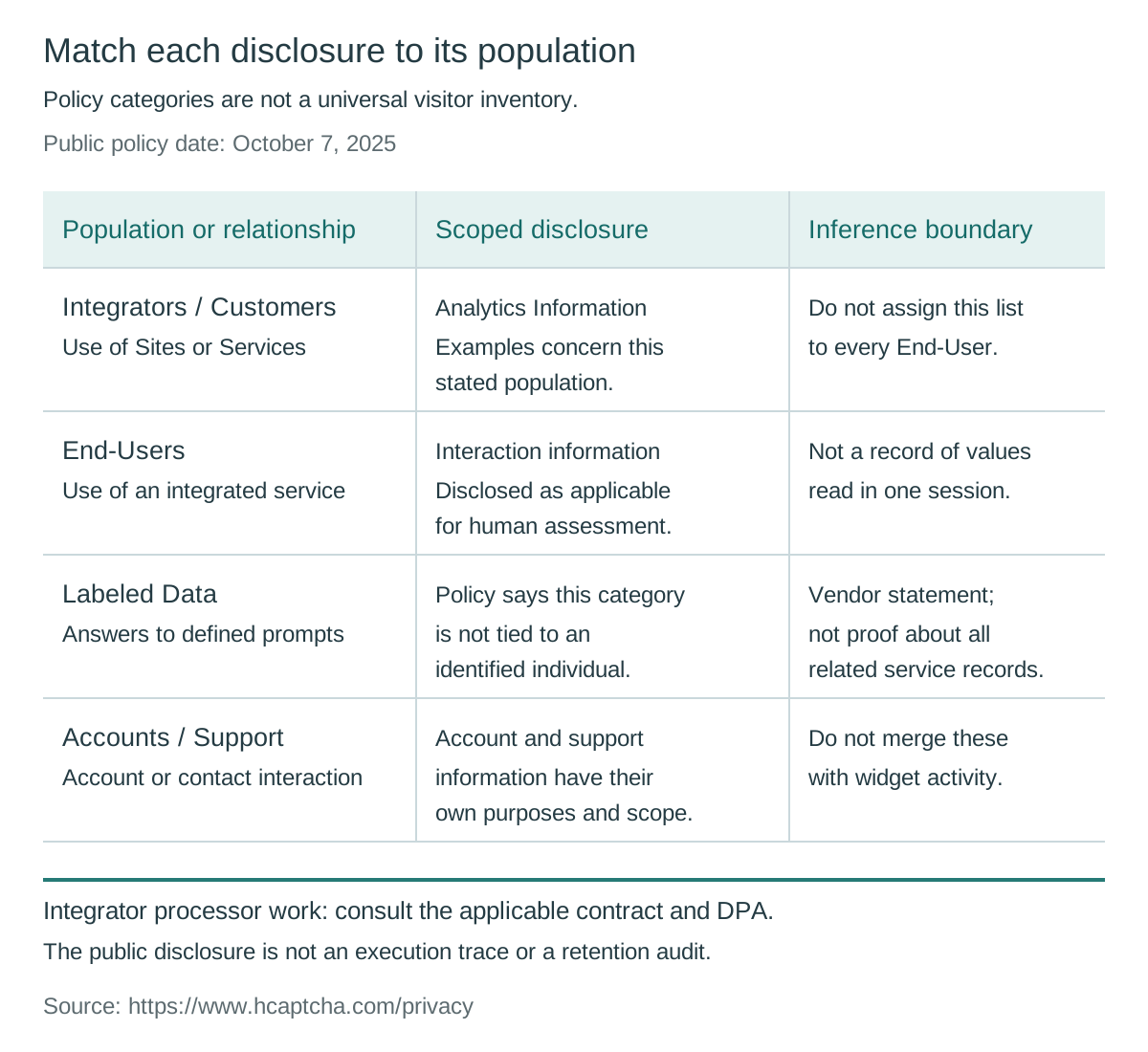
The policy also separates controller and processor responsibilities. Where IMI processes personal information on behalf of an integrator, it says the integrator is the controller or business and IMI is a processor or service provider. That processing is governed by the relevant contract and data-processing arrangement, rather than simply by the public privacy policy. The policy's European data-subject discussion directs applicable requests to the entity that contracted for the processing. A supplier policy alone is consequently not the entire notice for an integrated website. For a different provider, the FunCaptcha privacy analysis preserves Arkose’s production-purpose categories and its explicit warning about page URLs, rather than transferring hCaptcha disclosures.
For a website owner, the immediate artifact is a population-and-purpose record. Identify whether a question concerns a dashboard account, a protected form, an accommodation arrangement or a support conversation. Then identify the applicable notice and processing relationship. An account email voluntarily supplied during registration and an event generated while using a widget are not interchangeable data categories. The fact that both involve hCaptcha does not make their purposes, retention or request routes identical.
The policy's Labeled Data category needs the same care. It describes answers to prompts for machine-learning applications and says labeled data is not tied to an identified individual. That is a vendor statement about the category it defines. It is not evidence that every challenge has the same labeling use, that all service records are disconnected, or that the website operating the form knows nothing about the submission. Attribute the statement to the published disclosure and leave deployment-specific processing to the applicable terms and owner.
A useful privacy assessment therefore begins before any browser measurement. State whose data is being discussed, which interaction produced it and which organization determines its purpose. Without those distinctions, even an accurate list of browser properties can answer the wrong question. A visitor asking about a protected appointment form needs the site's processing explanation; a customer asking about dashboard analytics may need the provider's account-facing explanation. The two requests can involve different records and responsible functions.
Interpret the disclosed interaction information
hCaptcha's information-collection disclosure names mouse movements, scroll position, keypress events, touch events and similar information, as applicable, among information used to determine whether end-users are human. These categories explain why privacy exposure is not limited to an image answer. Interaction information concerns how a session proceeds, not just the text a person intentionally enters into a form. The wording nevertheless does not specify every listener, sampled value, frequency or collection phase.
A mouse-movement category can describe activity associated with a visible interface without proving that a particular trace uniquely identifies someone. Scroll position can describe where an interaction occurred without revealing a complete history of everything read elsewhere. A keypress event is not, from its name alone, proof that the contents of every field were recorded. Touch events do not establish a physical device identity. Those stronger conclusions require evidence about the actual values, contexts, processing and linkage, not merely the presence of a category in a policy.
Privacy exposure and proven misuse are different findings. A behavioral measurement can add detail about a session, including aspects of interaction that the user did not deliberately submit as an answer. That creates questions about necessity, notice, access and retention. It does not by itself prove advertising profiling, unauthorized disclosure or linkage across websites. hCaptcha's policy makes its own statements about purposes and sharing; a technical observer should not replace those with an allegation derived from a single event name.
The context in which an event is obtained also matters. A top-level application, embedded component and unrelated page script are distinct potential actors. If a trace shows activity on a page that embeds hCaptcha, the page address alone does not identify which script read an interface. Attribution must connect an event to its actual source and execution context. Otherwise the measurement may assign a site's own form behavior or another dependency's activity to the challenge provider.
This is where a source-attributed V8 observation could add substance to the public disclosure. It could establish that a particular script read a particular browser interface during a defined recorded phase. It would still not establish every deployment, future service version or downstream processing purpose. Event counts can change with phase duration, repeated rendering and the user's actions. A count without a capture interval and context is not a stable measure of how much a service knows about a person.
The challenge-family classification separates a visible interaction from the mechanism and decision behind it. For hCaptcha privacy, the same distinction prevents an interface observation from becoming a data inventory. Seeing an image task does not reveal every signal used before it appeared. Seeing no task does not prove that no processing occurred. The documented interaction categories are the starting point; current collection and transmission remain separate questions with their own evidence requirements.
Trace browser and server processing separately
The official integration documentation describes a browser-side component and server-side verification. The browser presents the configured interaction and supplies a completion result to the application. The application's backend verifies the submitted result with the provider before performing its protected work. A client callback is therefore not the same event as backend verification, and backend verification is not the same event as completing a purchase, registration or other application operation.
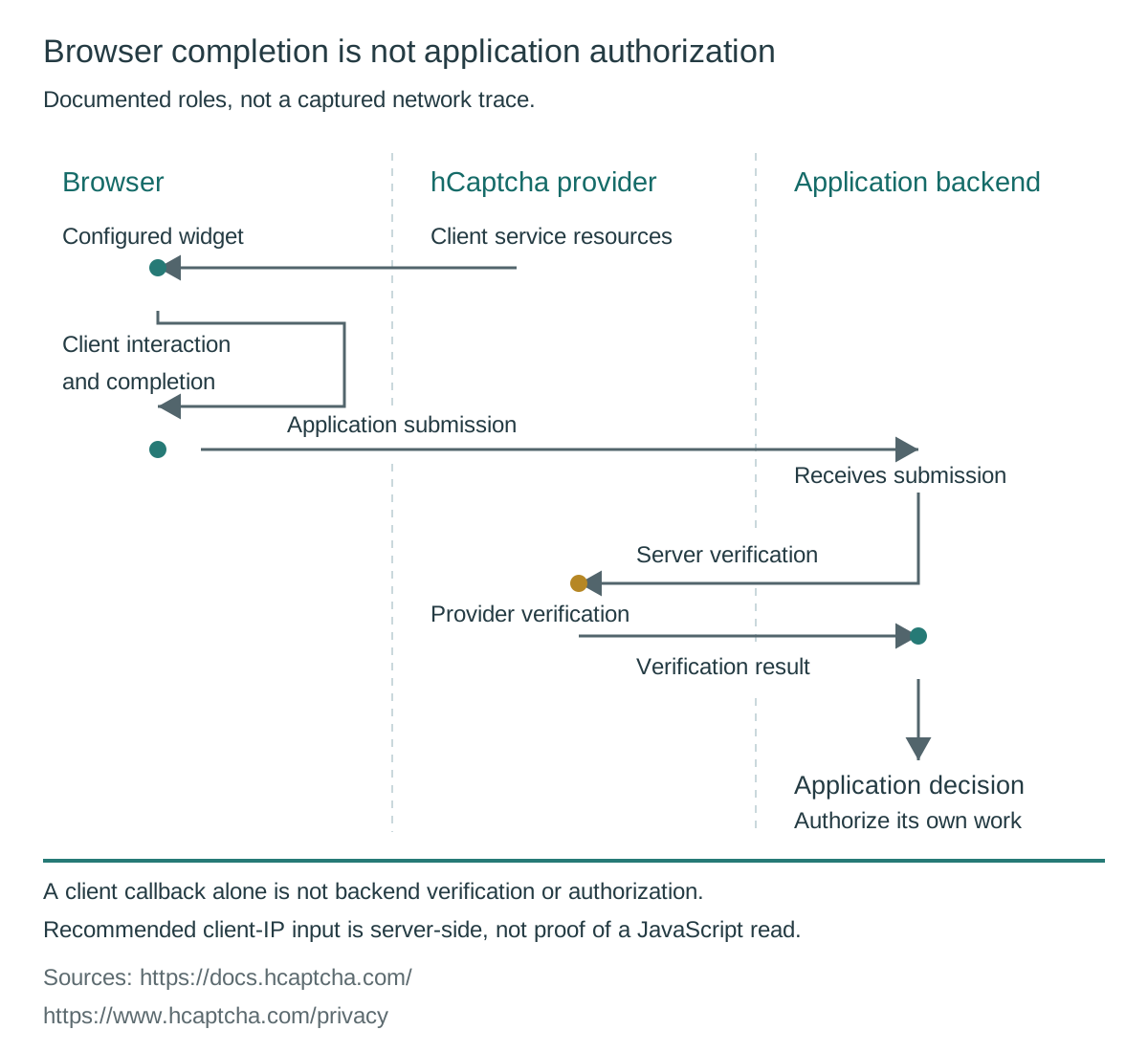
This separation changes how network-related privacy statements should be read. The integration reference recommends supplying the user's IP address during server verification. A server can provide that input without JavaScript discovering it through a browser API. The application already receives a network request and has its own relationship with infrastructure handling the connection. The exact address it should associate with the user depends on its trusted deployment architecture. The recommendation documents a server-side processing path, not an observed browser read or a universal address-resolution procedure.
Provider infrastructure receiving a connection also has network-level observations separate from browser-exposed properties. A browser privacy control does not eliminate the fact that a request travels through network endpoints. Conversely, a network request does not reveal every property available to page JavaScript. Treating network identity, browser surface information and a verification input as one undifferentiated fingerprint obscures which participant obtained each observation. The integration contract supports the separation, not a claim that those paths are equivalent.
Content Security Policy adds another distinction. hCaptcha documents script, frame, style and connection categories needed for its integration. Those permissions establish what a site's policy allows. They do not demonstrate that every permitted resource loaded, that every possible connection occurred or that particular data was transmitted. An allowlist is a capability boundary, not a request log. The reference also cautions against assuming that a particular asset subdomain remains fixed across regions or time.
For an owned application, a redacted network record can establish whether an expected connection occurred and which component made it. That record should distinguish the page's resource loading from backend verification. A browser-only capture will not automatically contain the application's server-to-server request. An absent request in DevTools therefore cannot prove that the backend did not contact the provider. Equally, a backend success record cannot reconstruct which browser interfaces were read before completion.
The same reference warns that the returned hostname is derived from the user's browser and should not be treated as authentication evidence. A field appearing in a verification response has the semantics assigned by the verification documentation, not whatever assurance its familiar name suggests. Privacy and security analysis both need that discipline: distinguish the field's documented origin from independent proof of identity, and distinguish verified challenge material from the application's own decision to authorize work.
Read V8 evidence without turning it into a collection claim
BotBrowser's --bot-v8-log is an observation tool for examining browser-interface activity. The useful evidence is an emitted event with enough source and context information to attribute the operation. It is not a substitute for the provider's processing contract, and it does not require transforming proprietary challenge code into a reproduction. For privacy analysis, the question is what can be observed and attributed, not how to recreate a private decision process.
The local research material inspected for this topic contains a V8 monitoring procedure, capture-validation logic and historical summaries. In the inspected local and monitor directories, no raw JSONL event file was available for independent verification. Some summaries refer to other environments or generated probes. Those materials establish how a monitoring workflow was intended to distinguish discovery from later probing, but cannot support a current inventory of hCaptcha API reads. No new live challenge, login or browser capture was executed for this publication.
The monitoring contract is still informative about evidence quality. Its validation distinguishes missing output, a failed trial, incomplete channel coverage, zero attributed API rows, parse errors and dropped events. Those are different failure modes. A report file can exist even when the capture failed, because the workflow records an error outcome. Existence of a JSON file is consequently not a successful-observation criterion. A reviewer needs the actual status and the underlying event references before accepting the conclusion.
A generated probe presents a specific attribution problem. It may ask the browser for a value that an analyst selected. That can measure the browser's answer to the probe, but does not prove that a vendor script asked the same question. The distinction survives even if a generated file contains the provider's name. A label, research directory or manifest is an organizational reference, not proof of the caller responsible for an emitted event. Original source attribution and the execution phase must remain attached to the measurement.
Parsing and event loss affect what a negative result can mean. If a capture cannot be parsed or loses events, absence of an interface in the resulting summary is weaker than absence in a complete, scoped record. Even a complete record only covers the captured execution. A script path that did not run, a different configuration or another phase can change coverage. Neither “not seen” nor “seen once” establishes a provider-wide collection policy. The public privacy disclosure and technical observation serve complementary, not interchangeable, purposes.
Source attribution has its own limits. A substring match on a source label can be useful for narrowing a dataset, but is not enough to settle every caller relationship. Embedded execution, shared libraries and missing source information can leave ambiguity. Keep ambiguous events unassigned rather than filling the gap with the page's product branding. A privacy assessment becomes more useful when uncertainty stays explicit: a known browser operation with an unknown caller is a narrower finding than a claimed hCaptcha collection point.
The available material therefore supports a concrete limit, not a blank check to list familiar fingerprinting interfaces. No Canvas, audio, graphics or timing read is asserted here as an observed hCaptcha event. Such interfaces are documented browser surfaces and can be discussed in general privacy terms, but assigning them to this provider requires evidence not present in the reviewed local record. That boundary prevents a generic browser fingerprinting list from acquiring the appearance of vendor-specific measurement.
Distinguish a browser read from upload and retention
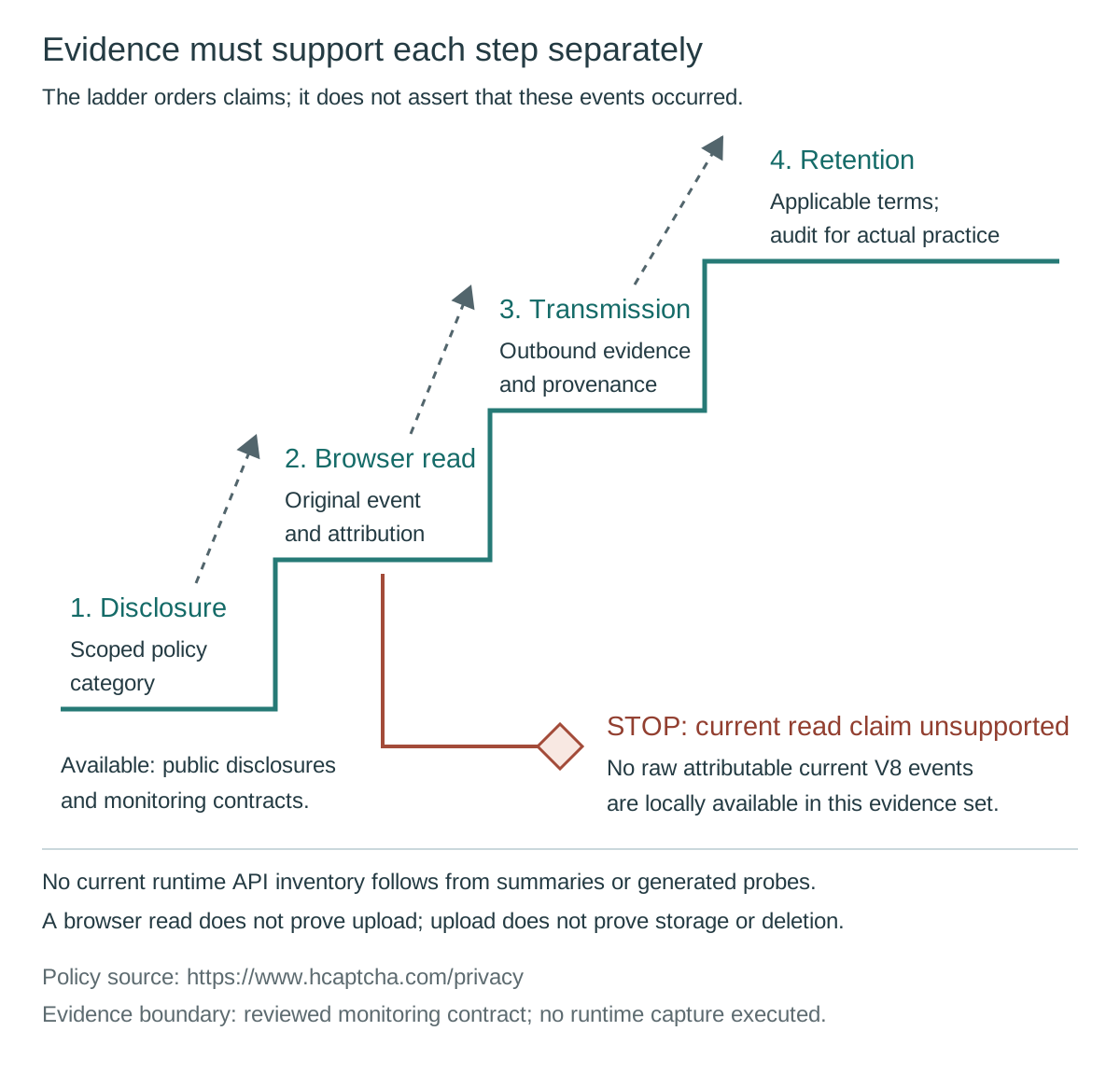
A source-attributed browser read is the first of several possible events. It establishes an operation in a recorded execution. It does not automatically show that the returned value left the browser. A program may use information locally, modify it, discard it or combine it with other inputs before making a request. Establishing transmission requires a permitted observation of the relevant outbound processing, with sensitive content handled appropriately. A raw API count is not a count of uploaded personal-data fields.
Likewise, a network connection alone does not establish which browser values it carried. The integration documentation explains resource and verification roles, but an architectural description does not decode a particular request. Request presence, response success and message size answer narrower questions than data provenance. Publishing raw challenge material or private identifiers is unnecessary for documenting that distinction. A redacted record can state which processing stage was observed and which question remains unresolved without exposing reusable service artifacts.
Retention lies beyond that browser-to-network boundary. A captured upload cannot show how long a provider kept the information, which access controls applied or whether later aggregation removed an association. hCaptcha's policy contains retention statements with different populations, purposes and qualifications. Its discussion of processor work also refers to contractual terms. Those are the appropriate sources for stated retention obligations; they are not technical observations of actual deletion in a particular deployment.
The policy's general Data Retention section refers to account life, necessary purposes, legal requirements and other criteria. It separately discusses newsletter contact information, support communications and technical analytics. Some statements include exceptions or different forms of processing. Quoting a single number from one category as the lifetime of every end-user interaction record would misrepresent that structure. A person maintaining an integrated application should identify the relevant data category and agreement before answering a retention question.
The same care applies to sharing and advertising language. The California section states that IMI did not sell personal information or share it for cross-context behavioral advertising in the stated preceding period, using the defined statutory terms. That statement is not identical to “no information is processed,” “no service providers receive data” or “every integrated website has the same practices.” The policy also describes disclosures to service providers and other circumstances. Scope, definitions and time period belong with the statement.
For an application owner, the practical output is a four-layer evidence register. A row can contain a documented category without an observed read. Another can contain a verified browser observation without a known downstream retention outcome. Unknown values should remain unknown. Completing every column by inference makes the register look finished while reducing its accuracy. The following choice rules keep the source and the conclusion aligned.
| Evidence available | Supported conclusion | Additional evidence needed for a broader claim |
|---|---|---|
| A scoped paragraph in the privacy policy | The provider discloses that category for the stated population | Applicable deployment terms and, for runtime claims, a current observation |
| An attributable emitted V8 event | That source performed the recorded operation in the captured phase | Outbound provenance before claiming the returned value was transmitted |
| A redacted record of an outbound request | That connection or documented processing step occurred | Content and provenance evidence before assigning a specific browser value |
| An applicable processing agreement | The stated contractual responsibilities and retention terms | Operational audit evidence before claiming actual storage or deletion behavior |
| An old probe result or summary without original events | A research artifact exists with the stated limitations | Original attributable events before claiming vendor API execution |
Compare browser-native controls with page-level changes
BotBrowser's browser fingerprinting overview documents profile-backed controls over browser-exposed surfaces through native browser paths rather than page JavaScript injection. That describes where the product's controls operate. It is not a measured hCaptcha outcome and does not establish that a particular collection point was exercised in the available research record. A product capability source must not be used as evidence about a third party's current implementation.
A page-level property change and a browser-native control can also differ in coverage. A change attached to one JavaScript environment affects the paths that actually encounter it. It does not, by being present, establish the state of every other context or native operation. A native browser setting operates outside the individual page script, but its precise supported behavior still comes from the relevant product documentation and configuration. No universal consistency result follows merely from the labels “patch” or “native.”
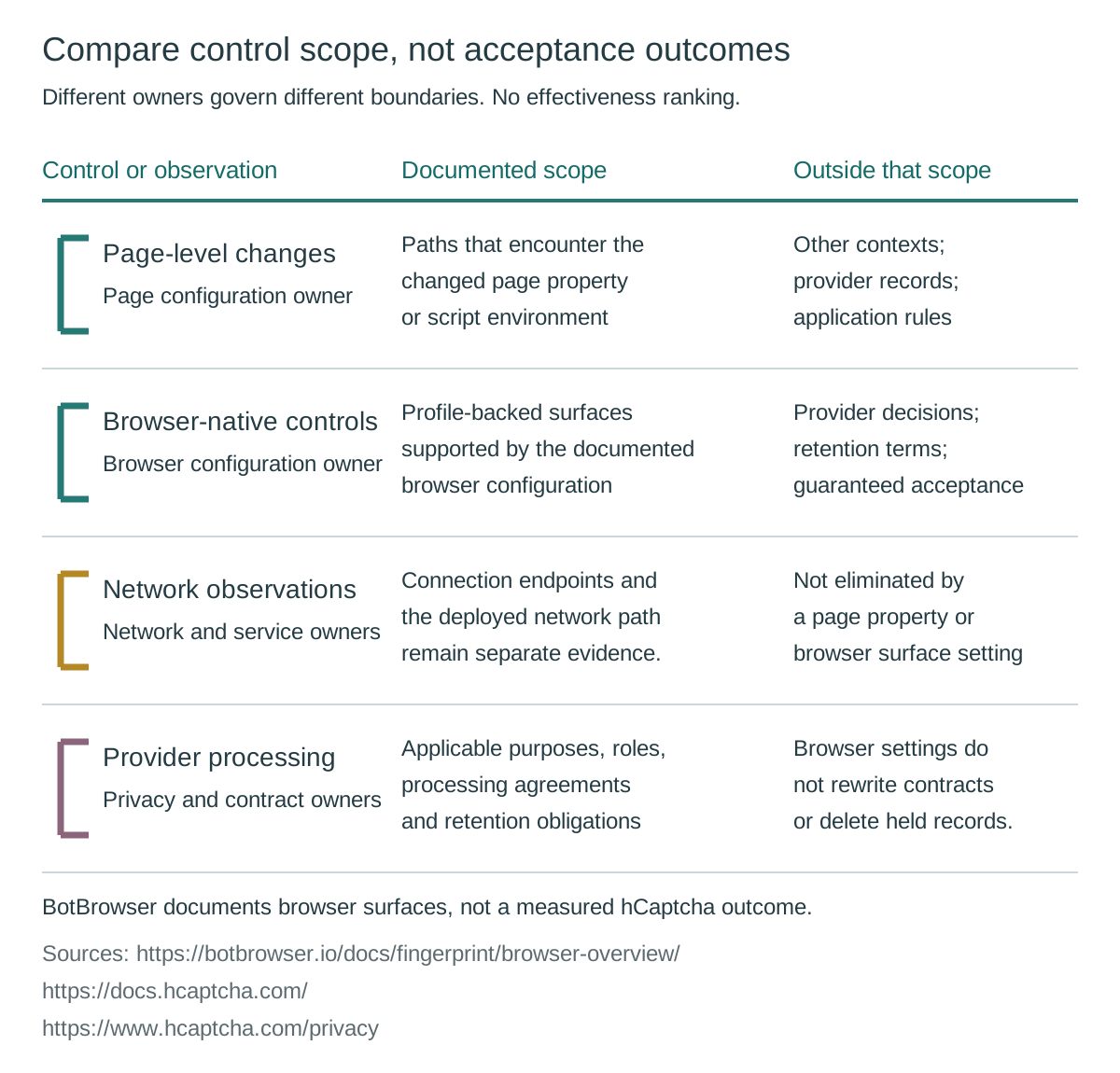
For privacy work, the meaningful comparison is the location and responsibility of a control, not a promise about acceptance. Does it affect a page-visible property, a documented rendering surface or a browser-level configuration? Which contexts are actually covered? Which observations remain outside the browser? A controlled comparison on an owned fixture can answer a narrow compatibility question. It cannot demonstrate that a provider no longer receives any identifying information or that unrelated sites will accept the session.
The external boundaries remain substantial. A browser surface setting does not rewrite the integrator's processing agreement. It does not delete records already held by the provider, alter an application's chosen difficulty or supply an accessibility accommodation. It also does not determine the source address visible to every network participant. These are separate layers with separate operators. The official hCaptcha integration and privacy policy identify responsibilities that a browser configuration cannot assume.
This separation avoids another common inference: a consistent-looking browser observation is not necessarily less personal, less identifying or legally sufficient for a particular use. Consistency concerns relationships among exposed values. Privacy exposure additionally concerns what is collected, its linkability, purpose, recipients and retention. A stable set of values can still carry information about a session. Reducing one inconsistency is not evidence that all correlation paths disappeared. Claims about the effect must stay tied to the measured surface and configured environment.
The existing invisible-mode diagnosis provides the neighboring integration boundary. A browser setting cannot select an account capability or convert removal of a checkbox into a guarantee of no challenge. The privacy question here is different: which information is disclosed, what can be observed and which participant controls its processing? Keeping those questions separate makes both investigations more actionable and prevents an interface change from becoming an unsupported privacy claim.
Assign privacy questions to the owner with evidence
An owned integration needs a small, purposeful assessment rather than an exhaustive capture of everything a visitor does. Start with the applicable population and the business operation. Then identify the browser component, backend verification and processing relationship involved. The integration reference documents those architectural roles; the site supplies its deployed configuration and processing notice. Do not ask a visitor to share a live response artifact, credentials or a full browsing trace merely to establish that a privacy question exists.
For example, suppose a service owner wants to explain whether interaction information is processed when a form is used. The public policy supplies a disclosed category. The owner still needs to identify the applicable integrated service and terms. If the question then narrows to a browser interface read, a scoped, permitted source-attributed observation would be relevant. If it narrows to retention, a larger browser log will not answer it. The next action changes with the question rather than with how much technical data is available.
| Question | Evidence owner | Appropriate next action | Evidence that does not settle it |
|---|---|---|---|
| Which population and purpose apply? | Site privacy or service owner | Match the interaction to its notice and applicable processing agreement | A generic provider promotional claim |
| Did a script read an interface? | Authorized browser-observation owner | Inspect attributable emitted events for the defined phase and coverage | A generated probe or a manifest label |
| Did the backend verify this submission? | Application backend owner | Correlate a redacted verification result with that operation | A browser completion callback alone |
| What retention terms govern the information? | Contract and privacy owner | Check the applicable category, role and processing arrangement | A browser API count or connection duration |
| Which browser controls are supported? | Browser configuration owner | Check the documented surface and configured environment | A claim that one changed property covers every layer |
The hCaptcha policy lists applicable rights and contact arrangements, while explaining that some end-user processing requests belong with the integrator acting as controller. A useful request names the service, relevant interaction and category of concern without transmitting secrets. The responsible organization can then determine the applicable process. An engineering explanation should identify that route rather than announce a universal legal conclusion for every jurisdiction or contract.
Testing also needs a defined question. The official documentation says its test keys exercise integration behavior and provide no anti-bot protection. An application can use its supported test environment to establish that frontend and backend handling are connected. That result is not evidence of production signal collection, a provider assessment or a real visitor's privacy outcome. A test response is useful within its declared contract; reclassifying it as a live measurement would erase the distinction the test mechanism exists to provide.
The concrete limit for the reviewed research remains unchanged: no raw local source-attributed V8 record supports a current hCaptcha API inventory. The substantive next observation would need that original evidence and a defined phase, not another list of plausible browser interfaces. Meanwhile, the public sources already support better notices, clearer role assignment and more accurate claims about where browser controls stop. Those are practical privacy improvements without inventing runtime facts or reproducing a private collection implementation.
FAQ
Does a privacy policy prove that every listed signal was read in my session?
No. A disclosure describes categories under its stated population and conditions. A session-specific read requires an attributable observation, and a read still does not establish upload or retention.
Does a keypress-event disclosure mean that a provider records every password?
That conclusion does not follow from the category name. The disclosure does not establish the contents, scope or processing of every field. A specific content-capture claim requires evidence beyond an event label.
Can a browser-only network capture show backend verification?
Not automatically. Server-to-server verification occurs outside the browser's request context. The application's backend owner needs a correlated, redacted record for that stage.
Can V8 logging prove that data was deleted?
No. V8 logging concerns recorded runtime activity, not later provider storage. Applicable retention terms and operational evidence address deletion; browser events cannot substitute for them.
Does browser-native protection remove the need for a site's privacy notice?
No. Browser controls concern documented exposed surfaces. They do not replace the website's processing explanation, contractual responsibilities, user-rights process or verification policy.
Sources
- hCaptcha privacy policy
- hCaptcha developer documentation and server verification
- BotBrowser browser fingerprinting overview
Practical conclusion
hCaptcha privacy questions become answerable when disclosed populations, observed browser operations, transmission and retention stay separate. Use the applicable policy and processing agreement for responsibilities, attributable original events for browser-read claims and backend records for verification. The available research does not establish a current hCaptcha API inventory. For an owned integration, assign the specific unanswered question to its evidence owner before collecting more data or changing browser configuration.
This article is part of the guide: What Is a Browser Fingerprint? Canvas Fingerprinting
Related Articles
hCaptcha Invisible Still Shows a Challenge: Check the Mode
FingerprintFunCaptcha: Signals, Sessions and Privacy
FingerprintreCAPTCHA Privacy: Signals and Evidence Boundaries
FingerprintAWS WAF CAPTCHA: Tokens, Signals and Privacy
FingerprintKasada Challenge Signals and Privacy Explained
FingerprintAkamai Bot Manager: Sensor Data and Privacy
Run the same check in BotBrowser
Load a profile, keep the signals you just read about consistent inside the browser, and confirm the result on your own machine before a rollout.