FunCaptcha: Signals, Sessions and Privacy
What does FunCaptcha measure? Separate Arkose client signals, challenge sessions, URL exposure and server verification, with privacy limits grounded in primary sources.
BotBrowser Team
Want the structured docs for Fingerprint?
This article lives in the editorial library. For step-by-step setup, reference material, and ongoing updates, jump into the docs section.
FunCaptcha is often identified with the puzzle a visitor sees, but Arkose's documentation describes a larger session: client-side data collection and classification, an optional Enforcement Challenge, and server-side verification. A puzzle answer is only one part of that process. BotBrowser provides documented browser-native controls for browser-exposed fingerprint surfaces; those controls do not determine Arkose's assessment, a website's authorization decision or what its processors retain.
TL;DR
- Arkose documents detection without a visual challenge as well as detection with enforcement. No puzzle on screen does not establish that no session processing occurred.
- The client completion callback covers challenged and suppressed sessions. Its token still needs backend verification; completion is not permission to perform the website's protected action.
- Arkose explicitly warns that its client reads and stores the website URL, including query parameters. Sensitive information in a page address creates an exposure that puzzle difficulty does not explain.
- The current privacy policy distinguishes production-service data from commercial outreach and commercial data. Categories and qualifications must stay in their original columns.
- No source-attributed FunCaptcha V8 events were available in the inspected local research. Public disclosures support the architecture and privacy categories below, not a measured current API inventory or a way to obtain a favorable verdict.
Contents
- A challenge is one branch of a session
- Completion, verification and authorization are separate
- A page URL is a concrete privacy surface
- Keep production and commercial outreach disclosures separate
- What a browser observation can establish
- Why two encounters can look different
- Browser controls and provider decisions have different owners
- Assess an owned integration without collecting more secrets
- Practical conclusion
A challenge is one branch of a session
The Arkose client-side instructions describe two implementation components. The detection component collects information and classifies traffic without visual enforcement. The enforcement component includes detection and can present an Enforcement Challenge. The documentation calls the latter an EC. That terminology separates the service session from its visible task: the collection and classification roles do not begin and end with an image appearing. A different provider's AWS WAF token model separates challenge and CAPTCHA timestamps; those AWS semantics should not be transferred to an Arkose session.
The same instructions describe client-side integration as collecting information needed to classify traffic, displaying an EC if applicable, and providing a one-time-use token. Server-side integration then verifies that token. These are documented responsibilities, not observations of a particular visitor. They explain why an image-only description misses important privacy questions, including what page information is available before an interaction and which organization processes the resulting session.
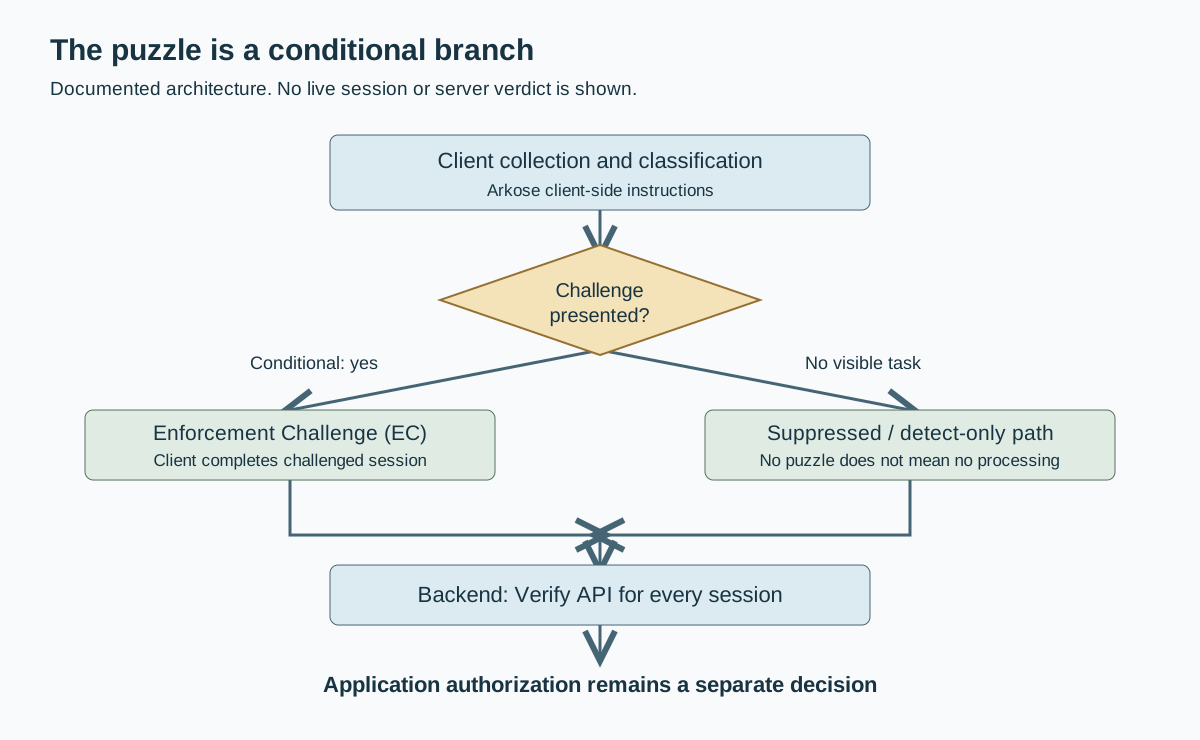
The Verify API overview gives three scenarios. One has no challenge because the service classifies the session as legitimate or low risk. Another presents a challenge. A third uses detect-only mode. The overview requires server verification in all three cases. A person who reports seeing no puzzle has described the interface they encountered, not established which processing path or customer configuration produced it.
For privacy assessment, the difference is consequential. A website may need to describe security-related processing even when a person never clicks a challenge control. Conversely, a visible task does not prove the collection of every browser property commonly discussed in fingerprinting literature. The documented branches establish that the interface is incomplete evidence. They do not supply an exhaustive list of the information used during any branch.
The term FunCaptcha can also blur the distinction between a familiar challenge experience and the broader Arkose product integration described by current sources. A report should name the actual component and configuration it has evidence for. A screenshot of a challenge and an Arkose integration reference can support different facts. The screenshot might document visible presentation; the reference documents intended roles. Neither alone establishes a private model, its complete inputs or a particular person's status.
The neighboring challenge-family comparison distinguishes task families and the kinds of observations they expose. The Arkose-specific question adds a session boundary: which parts occur in the client, which may become visible, and which require a server record? That boundary is more useful for privacy analysis than treating the difficulty, number or appearance of puzzles as a direct measurement of personal information collected.
Completion, verification and authorization are separate
Arkose's Client API reference says onCompleted occurs when a challenged or suppressed session completes. The callback includes a token that must go to the customer's backend for verification. This is a public integration contract. It prevents two mistaken interpretations: that the callback proves a person solved a visible puzzle, and that a client event alone authorizes an application operation.
The Verify API is called from server-side code for each session. Its response indicates whether verification succeeded, with simple and fuller response formats described by the provider. The application owns the handling of that response. A browser observer can see the client-side event without seeing the server-to-server exchange, so the browser record may stop before the evidence needed to explain the application's subsequent behavior.
An account registration illustrates the distinction without requiring a live test. A client component can complete, the backend can obtain a verification result, and the application can still have independent requirements concerning account state or the requested operation. Those requirements belong to the website. The verification overview does not make Arkose the authority for every business rule. A failed registration therefore cannot be attributed to a challenge score from the visible outcome alone.
| Available record | What it establishes | What remains a separate question |
|---|---|---|
| A screenshot showing a challenge | That presentation was visible at the recorded moment | Which collection occurred before it, and how the backend evaluated the session |
| A documented client completion callback | The client reached its completion stage, including a possible suppressed session | Whether the backend verified it and authorized the requested operation |
| A correlated backend verification result | The verification response for that recorded operation | Which application rules were applied afterward |
| An application audit entry | The website's recorded decision about an action | The complete set of private inputs used by the challenge provider |
This table is derived from the client and verification responsibilities. It is not a trace captured from a user session. The distinction keeps a support investigation from demanding excessive data. If the unanswered question concerns the website's backend decision, asking the user for a larger browser fingerprint does not supply the missing server record.
Errors require the same separation. A client loading problem, a transport problem reaching the verification service and an application's refusal to proceed are different events. The Verify overview discusses handling server errors separately from bad requests, with trade-offs assigned to the customer. That is a service-integration concern, not evidence that the affected visitor has a particular identity or that a browser property caused the interruption.
For an owned integration, correlate stages using the application's approved internal audit mechanism and keep credentials and live challenge artifacts out of support conversations. The objective is to distinguish the failing stage, not expose reusable session material. A redacted record of whether verification was attempted and its documented outcome can answer an operational question while excluding the visitor's token, full page address and unrelated account details.
A page URL is a concrete privacy surface
The client-side instructions contain a direct warning: once the code loads on the page, Arkose reads and stores the website URL, including query-string parameters. This is a more concrete disclosure than a general claim about device signals. Page addresses sometimes contain information added by application features, campaigns or account workflows. The challenge interface does not show the visitor which of those values the integration can encounter.
Consider an explicitly fictional appointment service. Its address includes a query parameter that describes the appointment category. No real address, personal record or browser capture is involved in this example. If that information sits in the URL of a page where the client runs, the provider's URL warning identifies a relevant disclosure question. Whether an actual deployment contains such information must be checked against that application's own address design.
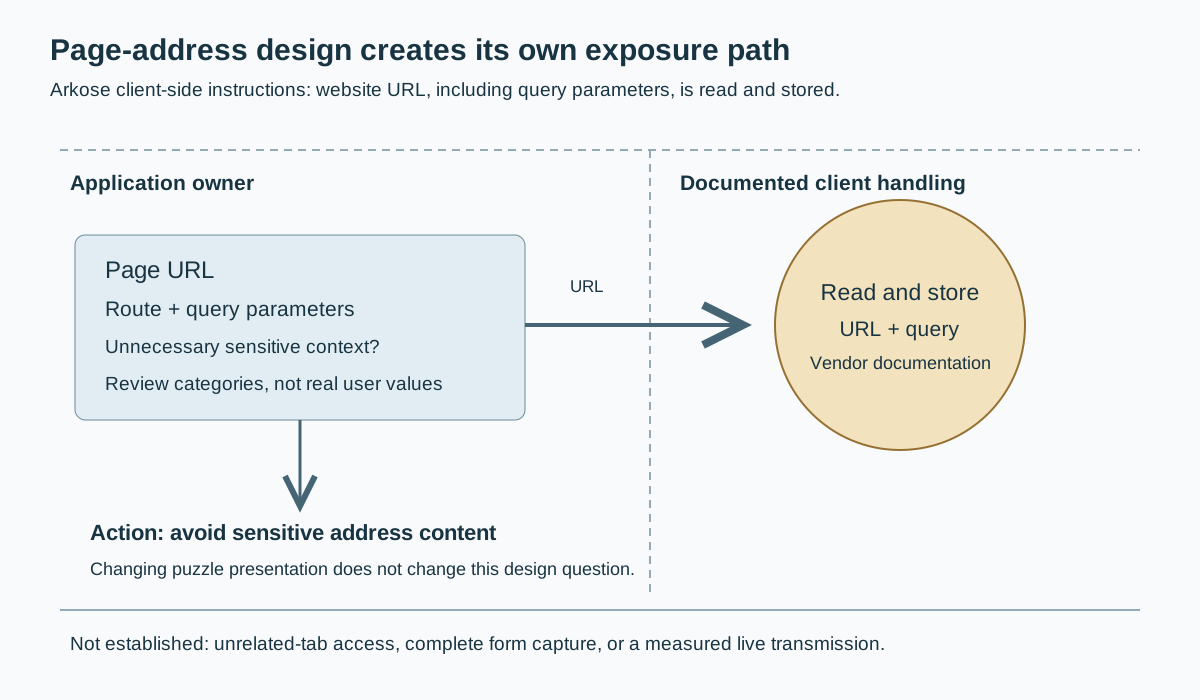
The source recommends keeping sensitive information out of GET parameters and using an appropriate submission method for sensitive content. That advice should not be expanded into a claim that moving a value to a request body makes every recipient unable to access it. Method choice addresses one placement of information. The application still needs to determine which components receive a submission, what the page renders and which processing purposes apply.
The immediate privacy improvement is to avoid putting unnecessary personal context into the page address in the first place. A developer can review route design and the categories of query parameters on pages that load the integration without collecting real visitor values. The documented warning is enough to justify that design review. A broader behavioral fingerprint analysis is not a prerequisite for examining a known URL exposure path.
Scope matters here as well. The warning establishes the vendor's stated handling of a page URL. It does not prove that every form field, browser history entry or unrelated tab is collected. The word URL is not a license to generalize from one address to everything a browser has visited. A deployment assessment should identify the page in scope and classify its parameters, while withholding live account values and any address that itself grants access.
There are also separate infrastructure questions. A website, its own analytics and other network participants can have their own address-handling practices. Arkose's integration documentation only supports the claim it makes about its client. Removing unnecessary sensitive URL content can benefit several processing paths, but a review must establish each recipient independently rather than attribute every logged address to one component.
A useful decision rule follows: if an address category would be inappropriate to disclose to the integrated service, change the application's placement of that information before debating puzzle presentation. The person who controls routes and forms owns that change. A browser graphics setting is not a substitute for a safer page-address design, and replacing the visible challenge style would not address the disclosed URL handling.
Keep production and commercial outreach disclosures separate
The reviewed Arkose privacy policy is effective October 27, 2026. Its data-category table has separate columns for information that may be collected on behalf of customers in production services and information for commercial outreach and commercial purposes. Those column labels are substantive. Reading every example in the table as a production challenge signal would misrepresent the disclosure.
The production Device/IP Data column includes IP addresses with IP-based location information, device or browser type, and other device analytics and identification information. Its examples include version, resolution and aspect ratios, language and session-storage requirements. These are categories in a public policy, not a source-attributed record of current JavaScript calls. The policy does not establish from those words which browser interface obtained every value or whether each example applies to every encounter.
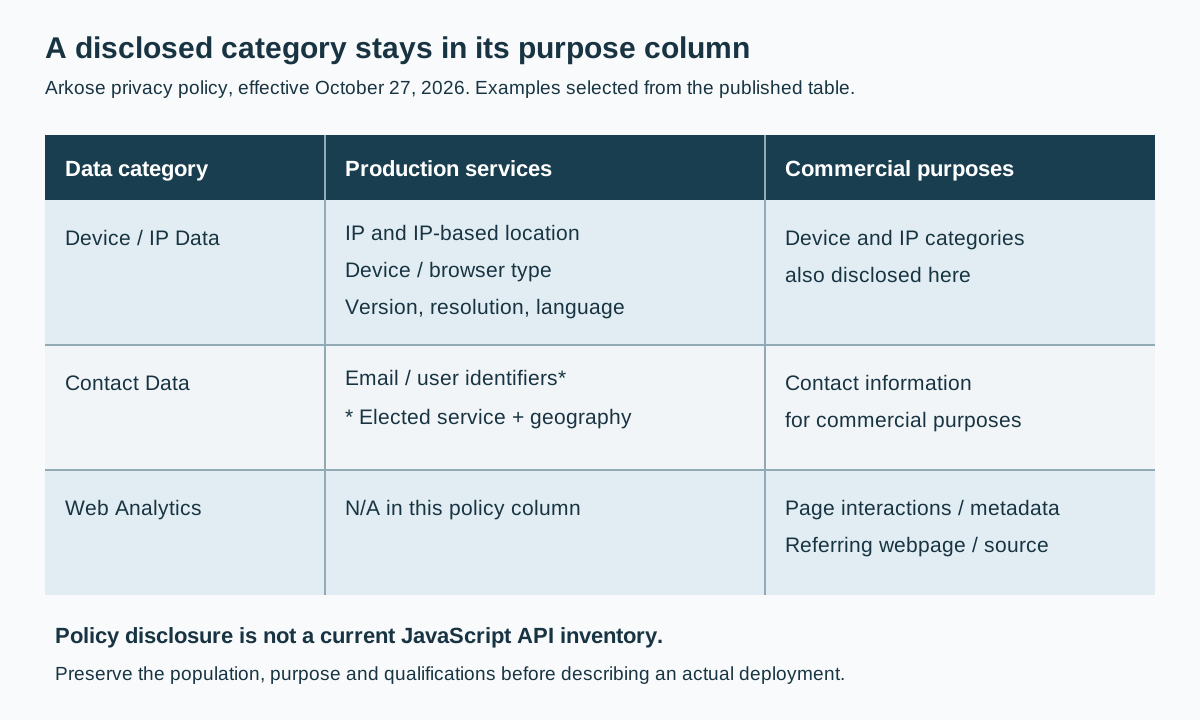
Production contact data has explicit qualifications. Email, user ID and username examples carry a note that they apply only when the customer elects the service offering and are subject to geographic restrictions. The policy therefore does not support saying every challenge receives an email address. It also does not support the opposite universal claim. An integrator must establish the actual offering and data it supplies before describing that deployment.
The commercial outreach column lists categories with different scope, including web-page interactions and metadata, referring sources, employment-related information and inferences about site visitors. Some corresponding production cells are marked N/A. A privacy comparison that assigns those examples indiscriminately to every end-user would lose the distinction between operating a security service and commercial outreach the provider's business. Preserve the source's population, purpose and conditions together.
The policy's production-services discussion identifies Arkose as a service provider or processor for relevant customer processing and directs affected people to the entity that first collected their data. It says the provider processes on behalf of enterprise customers under their requirements. That is a stated allocation of responsibilities, not an independent legal determination about a particular deployment. The website's notice and applicable arrangement remain necessary parts of the assessment.
Sharing and retention statements also require their defined scope. The policy discusses Third Party Provided PII, including identifiable information gathered on sites or apps Arkose does not own. It states limits on its use and disclosure for fraud-related services and says it never shares that defined information from one customer's site with other customers. Retention of that category is determined by the applicable customer. These are attributed policy statements, not browser-observed guarantees or a universal retention period.
The practical consequence is to ask the site owner which production categories and arrangements apply, rather than copy the commercial outreach list into a visitor notice. Device information can raise privacy questions even when a name is absent: its use, association with an operation, recipients and retention still matter. But the presence of a category does not by itself establish persistent identification, advertising linkage or misuse. Those conclusions require evidence beyond the table.
What a browser observation can establish
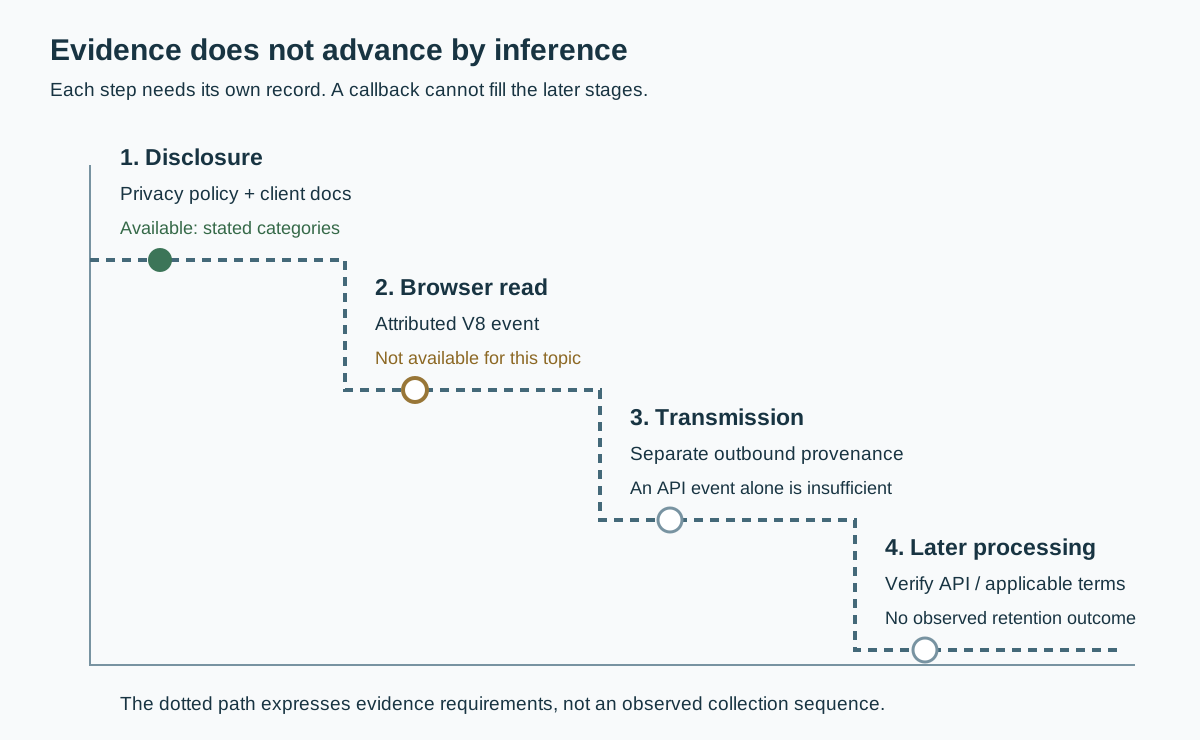
V8 logging can supply a different kind of evidence from documentation: an emitted browser-interface event attributable to the script that caused it. The relevant question is whether a particular source performed an operation during a recorded phase. A vendor name on the page, an old property list or a request count cannot establish that attribution. The event, source information and capture limits need to remain connected.
The inspected local FunCaptcha research includes an injection tool and a monitoring adapter configured to intercept and interpret request material. Those mechanisms are not equivalent to original --bot-v8-log events. No attributable FunCaptcha V8 event file was available in the inspected research material, and a historical local capture directory contained only browser-state remnants. No current vendor-specific API inventory is asserted from those materials, and no proprietary script transformation was used for this publication.
A browser operation is also not automatically a fingerprint measurement. A component can read an interface to render a task, place content, handle accessibility or manage its own lifecycle. Assigning an intent requires additional evidence. Even a correctly attributed graphics operation would not reveal the contribution it makes to a private assessment. The client-side documentation describes classification as a role, not the purpose or model weight of every operation.
Transmission is another boundary. An event can show that a value was obtained without showing that the value left the browser. Conversely, a request can occur without disclosing which browser reads supplied its contents. A privacy report should not convert message size or a completion callback into a list of transmitted attributes. The Verify reference also places backend communication outside a browser-only observation, so one capture cannot automatically cover the whole session.
Negative evidence needs a scope statement. A missing event might reflect a branch that did not run, an observation window that ended early, missing attribution or incomplete logging. Even a complete capture describes the recorded execution, not every future version or customer configuration. The absence of locally verifiable events here therefore means that API-read claims are unsupported by this evidence set. It does not mean that the service never reads browser interfaces.
Retention cannot be measured by leaving the browser open for longer. Storage at the provider, access by its operators and eventual deletion happen beyond the browser's event stream. The privacy policy and applicable customer terms state relevant responsibilities; an operational audit would be needed to establish actual handling. A page read, outbound request, verification outcome and retention obligation should occupy separate rows in an evidence register.
That register can be small. For each consequential claim, identify its source and whether it concerns disclosure, observed browser activity, a backend result or a contractual statement. Mark unknown stages as unknown. This avoids collecting an oversized trace in the hope it will answer every question. It also makes future evidence useful: an attributed event can refine one runtime claim without silently replacing the policy's separate processing and retention terms.
Why two encounters can look different
The Verify overview already establishes that challenge presentation is conditional. Two encounters can therefore have different visible paths without proving that one browser property changed. Customer configuration and session classification are documented parts of the architecture. A screenshot comparison does not isolate their contributions, and the provider's public overview does not reveal every reason for a particular decision.
The Client API says resetting the client creates a new session. That matters when interpreting repeated encounters: a new session is not simply another frame of an otherwise fixed observation. A record should distinguish continuity within one session from an explicitly new session. This is an interpretation boundary, not an instruction for obtaining a different result or a claim that resets improve any outcome.
Arkose's risk-score documentation separates global and customer-specific assessment information and says the feature must be enabled for the relevant keys. The distinction establishes a documented source of configuration differences. It does not provide a universal model that an observer can reconstruct from puzzle difficulty. A feature's absence from an integration or a response is not evidence that all underlying session analysis was absent.
The same reference discusses using assessment information either in challenge strategy or in a customer's internal models. Those are different consumers of the information. A visible interaction cannot tell an outsider which customer-side use applies. Even an authorized owner who sees a documented server response must avoid attributing every later account decision to Arkose. The application's own records establish what it actually did with that response.
| Comparison being made | Confounder documented by the sources | A narrower defensible statement |
|---|---|---|
| Puzzle shown in one encounter, absent in another | Conditional challenge paths and customer configuration | The visible presentation differed; the cause is not isolated |
| A repeat encounter after a reset | Reset creates a new session | The comparison spans sessions rather than one continuous lifecycle |
| Different customer integrations | Customer-specific assessment and optional features | Their configuration and interpretation may differ |
| Client completion versus an unsuccessful application operation | Backend verification and application handling are separate | Client completion alone does not explain the final operation |
These rules are derived from public integration contracts, not a measured performance comparison. They are especially useful when someone asks whether a browser change caused a result. A causal conclusion needs a controlled, authorized investigation of the relevant stage. A before-and-after screenshot with different sessions, settings or backend behavior supplies too many changing variables to identify that cause.
For privacy purposes, variability also means that one quiet encounter cannot establish a permanently empty data path. The appropriate notice concerns applicable processing, not only the most recent visible task. At the same time, uncertainty about a private model does not justify attributing every imaginable signal to it. The published categories and actual deployment records provide a bounded starting point; unsupported possibilities should remain unanswered questions.
Browser controls and provider decisions have different owners
BotBrowser's browser fingerprinting overview describes profile-backed controls implemented through native browser paths rather than page JavaScript injection. That source supports a statement about the product's documented layer of control. It does not establish how FunCaptcha currently measures a session, nor does it supply a result against Arkose. Product documentation and third-party execution evidence answer different questions.
A page-level property patch changes the behavior of the paths that actually encounter it in the affected JavaScript environment. That fact alone says nothing about every embedded context or native rendering operation. A browser-native control has a different implementation scope, but its coverage still depends on the documented feature and configuration. Neither label establishes universal consistency across all interfaces, lower identifying power or a website's acceptance of an operation.
The privacy question is which information the user can control at each boundary. A documented browser surface can fall within browser configuration. An application's URL design belongs to the application. A backend verification request belongs to its server integration. Provider-side handling belongs to the applicable processing arrangement. Trying to solve all four with one page property change assigns responsibilities to a control that does not own them.
The hCaptcha privacy analysis addresses a neighboring provider with a different disclosure structure. Its evidence does not transfer into an Arkose API inventory. Shared browser concepts can help frame questions, but each provider's categories and conditions require their own sources. This also prevents a comparison between browser layers from becoming an unsupported ranking of challenge outcomes or a claim about competitors' detectability.
Consistency itself is not a synonym for anonymity. A set of coherent exposed values can still communicate information, and a provider can still receive an authorized application request. The BotBrowser overview should be read for its supported browser capabilities, while the Arkose policy addresses its stated processing roles. A browser control cannot delete an existing provider record or substitute for the website's privacy notice.
For a team selecting controls, the decision artifact should name the surface, the owner and the evidence of coverage. Avoid a single label such as protected session that implies every layer has been assessed. A browser configuration review can be valid and useful while leaving a customer retention question unresolved. Separating those outcomes is more accurate than describing either one as complete privacy protection.
Assess an owned integration without collecting more secrets
An application owner can begin with documented data paths, not a visitor's full browser trace. Identify which pages load the component, whether their addresses contain sensitive categories, which production-service options are enabled and where server verification is recorded. The client instructions and privacy table support those questions directly. None requires a challenge-solving experiment or the publication of session artifacts.
| Finding in an owned integration | Responsible function | Appropriate first action |
|---|---|---|
| Sensitive context appears in an integrated page's query parameters | Application route and privacy owners | Remove unnecessary sensitive address content and assess the documented recipient path |
| A notice copies commercial outreach-only categories into the production description | Privacy and service owners | Reconcile the notice with actual enabled production processing and source qualifications |
| A support case has client completion but no known backend outcome | Application backend owner | Inspect the correlated redacted verification and application records |
| An engineering report names vendor API reads from an old injected probe | Observation owner | Reclassify that result as probe behavior until attributable original events exist |
| A user asks how long production information is kept | Customer contract and privacy owners | Check the relevant data category and applicable processing arrangement |
These are choice rules derived from the sources, not claims about an existing customer's deployment. For example, a route review can record that a parameter category is inappropriate without storing real values in its evidence. A configuration review can record that an optional service is enabled while excluding account credentials. The amount of evidence should match the question, particularly when the concern is unnecessary disclosure.
An external visitor has a different role. They may not have access to backend configuration or contracts, and a browser observation cannot fill those gaps automatically. A useful privacy request identifies the website, the relevant operation and the category of concern, while avoiding live tokens, passwords or sensitive full URLs. The policy directs production-processing questions toward the entity that first collected the information, subject to the applicable rights and relationship.
The unresolved runtime question remains specific: which browser interfaces did an attributable vendor source read in a defined execution? No original V8 event evidence in the inspected local material answers it. Public documentation nevertheless supports concrete improvements in URL design, notice accuracy and separation of client completion from backend verification. Those actions do not require inventing a signal list or treating a private assessment as observable browser behavior.
FAQ
Does completing a FunCaptcha puzzle mean the website must accept the action?
No. Client completion, backend verification and the application's own authorization are separate stages. Arkose documents server verification even when no challenge was presented.
Does the absence of a puzzle mean the service collected no information?
No. Arkose documents detection without visual enforcement and sessions in which a challenge is not presented. The visible interface does not establish an empty processing path.
Does Arkose's privacy table say every challenge receives an email address?
No. The production contact examples have elected-service and geographic qualifications. An actual deployment's options and submitted data must be established before assigning that category to its visitors.
Can V8 logs reveal the complete server assessment?
No. Attributable emitted events can support claims about recorded browser operations. They do not reveal every server input, subsequent application decision or provider retention practice.
Does changing browser fingerprint surfaces fix sensitive URLs?
That does not address the application's placement of sensitive context in its page address. Arkose's documented URL handling makes route design a separate privacy responsibility.
Sources
- Arkose client-side instructions
- Arkose Client API
- Arkose Verify API overview
- Arkose risk-score documentation
- Arkose privacy policy, effective October 27, 2026
- BotBrowser browser fingerprinting overview
Practical conclusion
FunCaptcha's visible challenge is one conditional part of an Arkose session. The documented privacy surfaces include page URLs and qualified production device or IP categories, while client completion and backend verification remain distinct. Review sensitive URL placement and applicable production disclosures first. Use attributable original events for any later browser-read claim, and ask the responsible application or privacy owner about server decisions and retention rather than inferring them from a puzzle.
This article is part of the guide: What Is a Browser Fingerprint? Canvas Fingerprinting
Related Articles
AWS WAF CAPTCHA: Tokens, Signals and Privacy
FingerprinthCaptcha Privacy: Signals and Evidence Boundaries
FingerprintreCAPTCHA Privacy: Signals and Evidence Boundaries
FingerprintKasada Challenge Signals and Privacy Explained
FingerprintPerimeterX Signal Groups and Privacy Explained
FingerprintWhat Is DataDome? Signals and Privacy Exposure
Run the same check in BotBrowser
Load a profile, keep the signals you just read about consistent inside the browser, and confirm the result on your own machine before a rollout.