PerimeterX Signal Groups and Privacy Explained
HUMAN’s declared PerimeterX signal groups, cookie lifetimes and storage fallbacks, with clear limits on V8 evidence, linkability and browser controls.
BotBrowser Team
Want the structured docs for Fingerprint?
This article lives in the editorial library. For step-by-step setup, reference material, and ongoing updates, jump into the docs section.
PerimeterX signal groups describe several kinds of information, not a single browser fingerprint. HUMAN’s public documentation names browser and device characteristics, network information, rendering capabilities and interaction patterns. BotBrowser’s engine and profile controls address consistency in browser-facing information within that collection boundary. They cannot determine HUMAN’s remote risk score, a website’s enforcement policy or how long a service retains information already received.
The privacy question is therefore specific: which declared signals describe the browser, which connect activity across visits, and which conclusions require evidence beyond a public product description? HUMAN’s storage documentation makes that distinction tangible. A short-lived _px* session cookie sits alongside year-long visitor cookies and storage fallbacks. None of those published entries establishes that every key exists on a particular website.
TL;DR
- HUMAN describes a Sensor, Detector and Enforcer. Browser collection, cloud risk analysis and server policy are separate stages, so a browser observation cannot establish the final decision.
- The detection overview declares signal families. Its references to rendering, window objects and interaction timing do not supply an observed JavaScript API inventory.
- Published
_px*,_pxhd,_pxvidandpxctsentries serve different purposes and have different lifetimes. Cookie expiration does not specify server retention. - Random visitor identifiers and hashed identifiers can still connect activity. Neither a first-party cookie label nor a security purpose establishes anonymity or legal compliance.
- No accepted current V8 observation supports an API-level finding here. Source-attributed V8 events could establish particular browser accesses under recorded conditions, with additional evidence needed for transmission and downstream use.
Contents
- Where the Sensor, Detector and Enforcer divide responsibility
- Declared signal groups and the privacy decisions they support
- Interaction patterns are different from interaction content
- What a V8 event could establish
- Storage purposes, lifetimes and fallback relationships
- Identifiers, cookie flags and retention answer different questions
- Browser controls and website responsibilities
- Practical conclusion
Where the Sensor, Detector and Enforcer divide responsibility
HUMAN’s Applications Protection overview describes three major elements: the Sensor, Detector and Enforcer. The names identify responsibilities that are easy to conflate when a visitor sees only a browser page. The Sensor collects browser-side information about devices, behavior and network activity. The Detector is the cloud risk-analysis service. The Enforcer applies a decision at infrastructure such as a CDN, load balancer or origin.
According to that overview, the Detector evaluates request data from both the Sensor and Enforcer. It determines a risk score from 0-100, which the Sensor encrypts or encodes and places in a client cookie. The cookie carries information between browser and server stages. Its presence does not make the browser the authority over the score, and the published scale does not identify which scores cause a particular website to restrict access.
The Enforcer receives the score through the client request cookie or, when the cookie is missing or invalid, requests it through the Risk API. That documented alternative matters for privacy interpretation. A browser’s cookie state is one input to a broader architecture. An absent cookie is not evidence that server-side request assessment has stopped, and a browser-only recording cannot describe every input the Enforcer sends to the Detector.
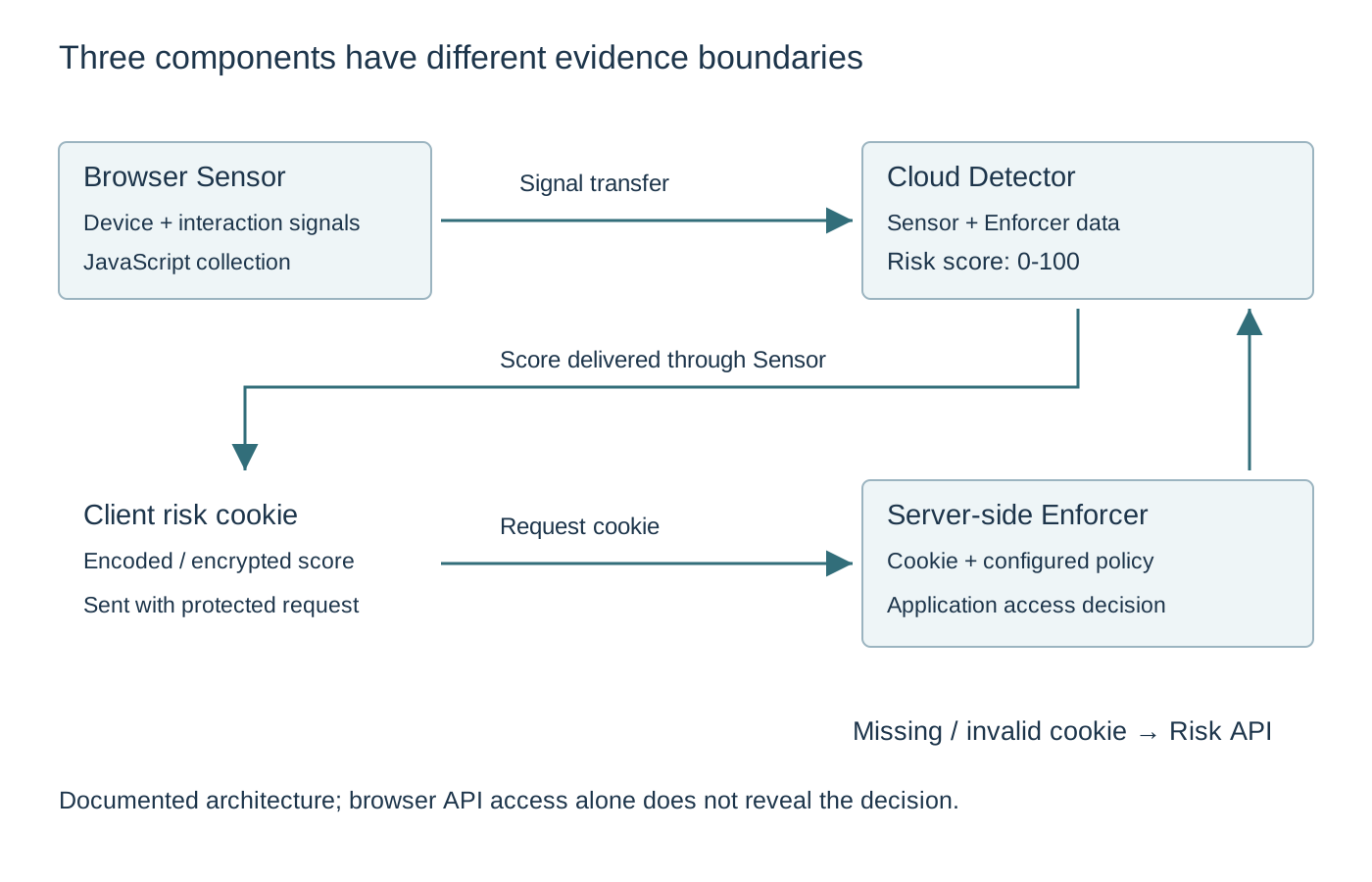
The same overview.md assigns the final block-or-allow decision to the Enforcer using the score and policy rules configured in the HUMAN Console. A declaration that browser characteristics contribute to assessment therefore cannot establish that one characteristic determines access. It also cannot establish that two sites using the service make identical choices. The policy configuration and the information available at the server remain outside a browser interface observation.
Product scope is equally important. The architecture page is explicitly for Applications Protection, while the cookie document lists several HUMAN products, including Bot Defender, Sightline Cyberfraud Defense and Code Defender. The PerimeterX name connects the topic to familiar browser-security terminology; it does not turn all HUMAN product features into one collection schema. A claim about a named storage entry must retain the product usage attached to that entry.
The architecture also separates infrastructure choices. HUMAN recommends a server-side Enforcer, whereas the Sensor is loaded through a JavaScript snippet. Its broader privacy policy, Section 2: Processor Data, describes a Product that can include, at the customer’s option, a client-side Detection Tag, server-side integration and log-consumption service. Those policy terms cover a broader Product scope than the Applications Protection diagram. A website’s integration inventory should identify which components it actually uses before assigning the policy’s possible collection routes to its own deployment.
Declared signal groups and the privacy decisions they support
The Detection Overview describes hundreds of indicators from browser, mobile and network sources. Its examples include a cookie-based HUMAN ID, visual and audio rendering capabilities, traffic source and type, window objects, browser plugins and extensions. These are vendor-declared categories. They establish the breadth of the published description, without establishing which interfaces a currently deployed script reads or how often it reads them.
The following matrix records the source boundary as of November 14, 2026. Each choice concerns a privacy question rather than a detection score. The evidence column distinguishes an official declaration from the additional observation needed to describe one deployment. No row supplies a list of required JavaScript calls, a site acceptance prediction or an estimate of identifying power.
| Signal group | Public declaration | Privacy question | Evidence needed for a deployment-specific decision |
|---|---|---|---|
| Browser and device | bd-detection-overview.md names device features, window objects, plugins and extensions | What environment information is exposed during the visit? | Attributable browser events and deployment context before naming exact interfaces |
| Rendering | The same source names visual and audio rendering capabilities | Could device-dependent characteristics contribute to correlation? | An observed rendering access, with purpose and transmission evaluated separately |
| Network | Detection names traffic source and type; overview.md includes Enforcer request information | Which information comes from the request rather than a page script? | Server-side integration details alongside browser evidence |
| Interaction | Detection names clicks, touches, cadence and timing | Are behavior measurements distinct from entered content? | Event and data-flow evidence before asserting content collection |
| Continuity | Storage documentation names _pxvid, pxcts and px_hvd | Can visits or tabs be associated through an identifier? | Relevant product, storage scope and lifecycle before claiming actual persistence |
Rendering illustrates the difference between a family and an implementation. HUMAN’s bd-detection-overview.md mentions visual and audio rendering capabilities. That wording does not identify a particular drawing operation, audio graph, output format or browser API. Different implementations can use different measurements within the same family. Naming an exact interface on the strength of this declaration would add information that the source does not contain.
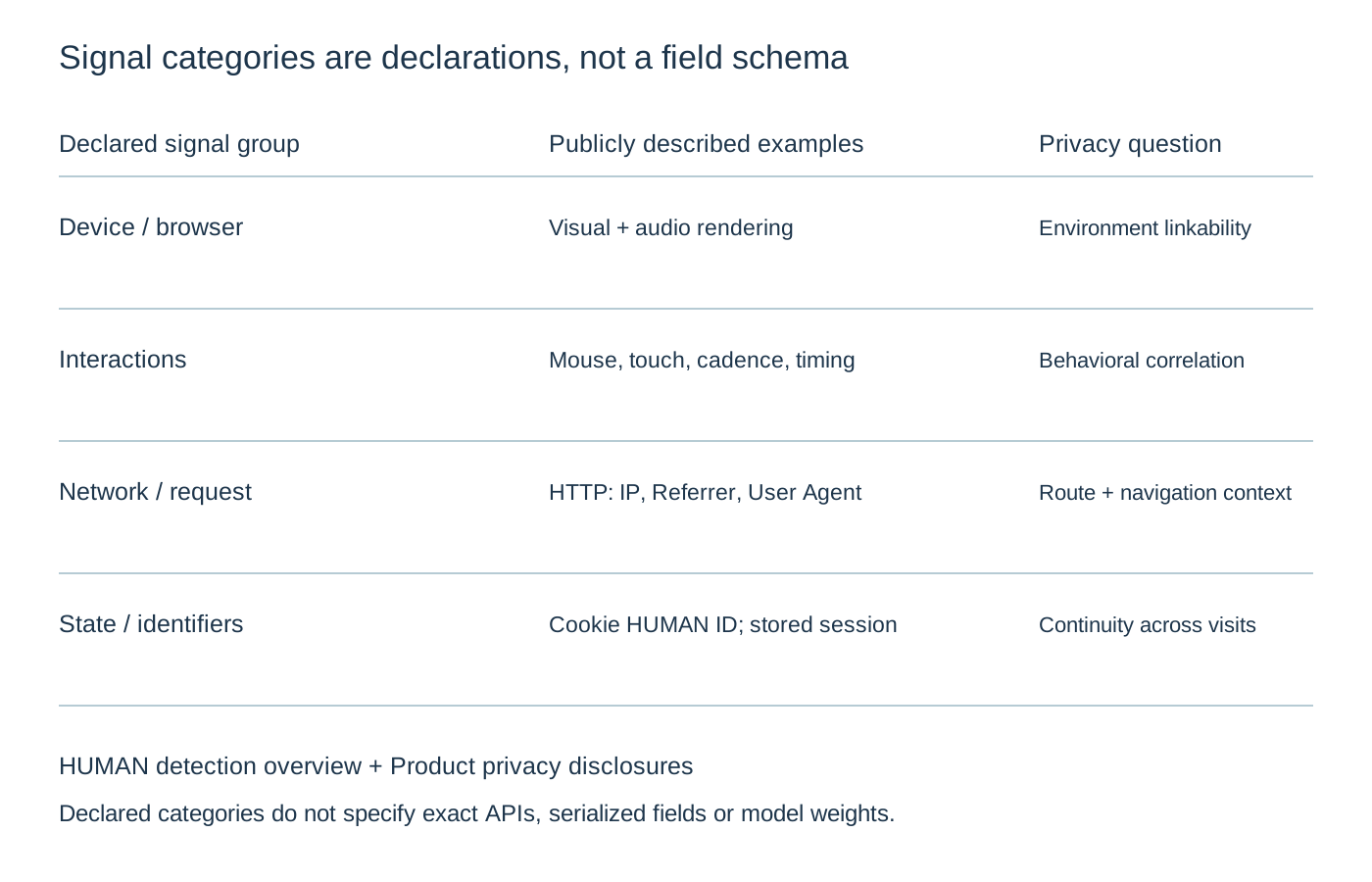
The same caution applies to the browser and device group. Window objects, plugins and extensions are examples in bd-detection-overview.md; they are not an assertion that a script can enumerate all installed software. Browser exposure varies with interface restrictions and execution context. A privacy description can identify the category while leaving its concrete reach unresolved until an attributable observation establishes what happened.
For the network group, the Product/Processor policy supplies more concrete examples than the detection overview: parts of HTTP request information including IP address, HREF, Referrer and User Agent. These examples belong to the policy’s Product description, rather than an observed Sensor API list. They direct a website operator toward request handling and server integration as well as page scripts. The browser fingerprinting overview covers the broader identification question; the additional HUMAN-specific issue is the combination of request context with browser-side signals.
HUMAN also describes comparisons against profiles assembled from aggregated customer sets and external resources in bd-detection-overview.md. Its Product/Processor policy adds a distinct collection route: customers may optionally pass parameters and information from integrated third-party web services for reporting. The named examples are campaign ID, account ID, placement ID and ad ID. The policy says some services provide macros for passing such identifiers, and customers may elect to send them to HUMAN for reporting on non-human activity and other fraud behaviors.
Website-supplied identifiers and browser visitor identifiers
An optional account ID has a different provenance from the randomly generated visitor identifier described for _pxvid. The former is a customer-supplied reporting parameter in the Product policy; the latter is a browser cookie entry in the storage reference. The policy does not say that the account identifier always represents a signed-in website user, nor that its format matches the browser identifier. The useful decision is to establish what the customer’s parameter represents before describing the relationship between a report and a person, campaign or account.
A campaign ID, placement ID or ad ID can describe reporting context rather than a browser characteristic. Their presence in the policy means a collection inventory limited to fingerprint surfaces would be incomplete for an integration using those options. A website operator should distinguish information supplied by its own configuration from information obtained through browser observation. Those categories may arrive at the same service while requiring different explanations of origin, purpose and customer choice.
The optional nature of those parameters is material. Section 2 does not say every customer enables them, every Bot Defender integration sends advertising identifiers or every page visit carries all four examples. Its wording identifies a customer-controlled reporting possibility across HUMAN’s Product scope. For an actual integration, the decision is whether such parameters are configured and what they mean. The published declaration supports asking that question; it does not supply the site’s configuration or a record of a transmission.
This also changes how to interpret the _px* statement that its cookie does not correspond to a web-application user ID. That statement describes the cookie family. It is compatible with a separate, optional route for customer-supplied reporting parameters elsewhere in the Product. Neither source should be expanded to cover the other: the cookie description is not a promise that the entire service never receives account-related information, and the policy’s optional account parameter is not evidence that the cookie contains it.
Interaction patterns are different from interaction content
Under machine learning and predictive models, HUMAN’s bd-detection-overview.md names user-interaction anomalies involving mouse clicks, screen touches, cadence and timing. That declaration concerns patterns of interaction. It does not state that every text field’s contents, password or message body is collected. Equating a reference to clicks with a complete recording of user input would change the claim from behavioral metadata to content collection without supporting evidence.
Interaction information also has a temporal dimension. A single browser property can describe an environment at one moment, while cadence describes relationships across activity. HUMAN’s reference to timing therefore raises questions about observation windows and association, even when the measured data contains no text content. Those windows and retention periods are not specified by the detection overview. The published cookie durations cannot be substituted for a behavioral-record retention schedule.
The Cloudflare Turnstile measurement discussion separates browser-side measurement from a verification result. HUMAN’s architecture introduces a different practical question: the Enforcer combines a score with customer policy. For a website choosing its visitor explanation, that distinction determines whether the explanation concerns collected interaction signals or the service’s role in a policy decision. A click or touch category answers the former question, not the reason for an individual response.
Interaction data can also have different meanings depending on context. Timing across a page load, activity within one tab and association across visits are distinct relationships. The storage reference explicitly calls pxcts a cross-tab session mechanism, but it does not tie that key to a particular behavioral model. A cross-tab identifier establishes a declared continuity purpose; it does not reveal which interaction features the Detector associates with that identifier.
What a V8 event could establish
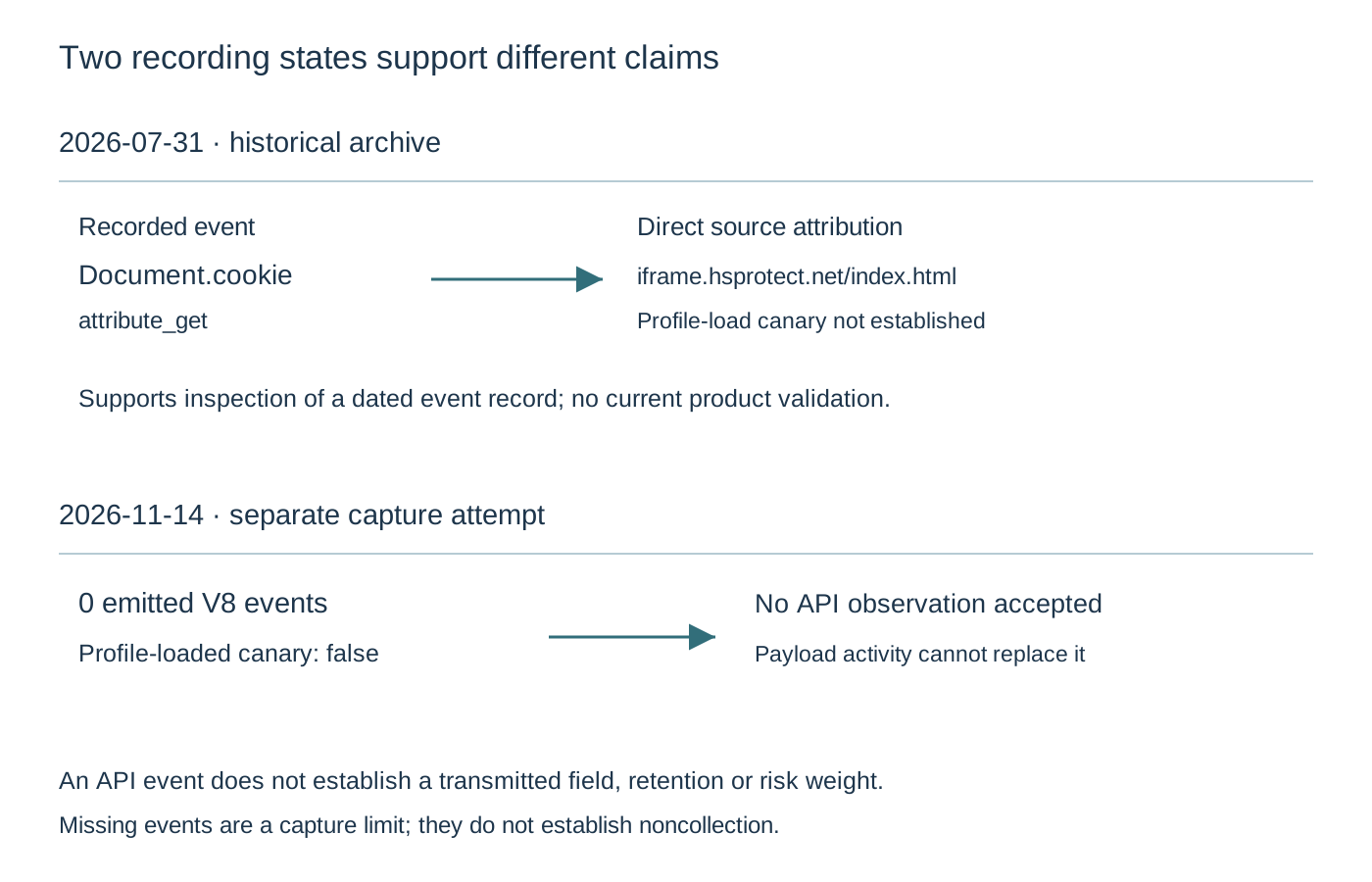
An actual source-attributed V8 event can support a narrow runtime statement: a particular script accessed a particular browser interface during a recorded execution. The record needs enough context to distinguish the executing source, event type and environment. BotBrowser’s --bot-v8-log evidence belongs to that observation category. It is more direct evidence of browser interface access than a reconstructed interpretation of protected vendor code, but it is still evidence of one execution.
As of November 14, 2026, no accepted current V8 observation supports a deployment-specific API claim for this topic. The attempted fresh capture did not yield usable renderer events, and profile-loading confirmation was unsuccessful. The cause of the missing log remains unresolved. Missing events establish a recording limitation; they do not establish that the Sensor accessed no browser interfaces or that the browser’s privacy controls produced a particular result.
Historical renderer logs exist as a separate discovery lead. Their environment and profile confirmation remain unresolved, so they do not establish current deployment behavior or validated BotBrowser capability. An archive’s age, source attribution and environment are separate properties. Finding genuine event records improves the evidence category compared with a collector item total, but it does not automatically satisfy all three properties for a new conclusion.
| Evidence category | What it can establish | What still needs evidence |
|---|---|---|
Public bd-detection-overview.md declaration | Signal families HUMAN says its system uses | Exact accesses in a specified deployment |
| Source-attributed V8 event | A browser interface access in the recorded execution | Broader coverage, collection purpose and transmitted representation |
| Network request or collector callback | Activity at the recorded network or callback boundary | Which browser operation produced each item |
| Storage observation | A key existed in the observed scope at that moment | Its full lifecycle and remote retention |
| Website response | The recorded request received that response | The Detector’s reasoning and alternative policy outcomes |
An interface name alone is insufficient for interpretation. A read, a method call and a returned value can have different meanings. Attribution also matters: a page may execute application code, third-party scripts and browser-managed activity in related contexts. A --bot-v8-log event needs a supported connection to the relevant source before the access can be described as a HUMAN Sensor observation. Mere coexistence on a page supplies no such attribution.
Coverage is another independent condition. An event log reflects the pages, contexts and activity that actually occurred while recording functioned. It can establish an observed access without establishing that every relevant branch executed. A total of distinct labels is therefore a property of a capture and its classification method, not a complete API inventory for the product. Unobserved interfaces may be unused, outside the activity exercised or outside the recorder’s effective coverage.
The gap between access and transmission also limits privacy conclusions. A browser operation may produce an intermediate result, a local decision or data later incorporated into a request. Evidence that the operation happened does not identify which result left the browser. This distinction also applies to the Product policy’s optional account ID: a browser-interface log alone cannot establish that a customer configured or transmitted that reporting parameter. A transmission claim needs evidence at the relevant integration boundary, whether browser-side, server-side or log-based.
The DataDome signals and privacy discussion distinguishes current Tag declarations from historical evidence about specific components and versions. HUMAN’s evidence problem here is the recording state: historical renderer material exists, while the November attempt lacks usable events and accepted profile confirmation. Component identity and recording validity are different requirements. A genuine archive event can satisfy source attribution while leaving the environment needed for a current product claim unresolved.
Storage purposes, lifetimes and fallback relationships
HUMAN’s Use of cookies & web storage lists cookies, local storage and session storage across several products. The table below maps selected documented purposes to their published lifetimes. It is a purpose-and-lifetime map, not an observation that all entries occur together. Product usage, browser policy and website configuration must be known before applying a row to an individual deployment.
| Entry | Storage and documented purpose | Published lifetime | Product scope in the source |
|---|---|---|---|
_px*, including _px, _px2, _px3 | JavaScript cookie family maintaining a HUMAN session | 5.5 minutes | Sightline Cyberfraud Defense and Bot Defender |
_pxde | JavaScript cookie for data enrichment | 5 days | Sightline Cyberfraud Defense and Bot Defender |
_pxhd | HTTP cookie for server-side detection, containing a random visitor identifier | 1 year | Sightline Cyberfraud Defense and Bot Defender |
_pxvid | JavaScript cookie for browser detection, containing a random visitor identifier | 1 year | Sightline Cyberfraud Defense, Bot Defender and Code Defender |
pxcts | JavaScript cookie maintaining a cross-tab session | Session | Sightline Cyberfraud Defense, Bot Defender and Code Defender |
pxcts fallback | Local storage holding session data when first-party cookies are blocked | No fixed duration supplied in the local-storage table | Same three products |
px_hvd | Local storage containing a hashed visitor identifier | No fixed duration supplied | Sightline Cyberfraud Defense and Bot Defender |
_pr_c | Session storage containing the previous session’s client UUID for cross-session mapping | No numeric duration supplied | Sightline Cyberfraud Defense and Bot Defender |
px_fp | Session storage containing fingerprint data as a fallback when local storage is unavailable | No numeric duration supplied | Sightline Cyberfraud Defense and Bot Defender |
The _px* lifetime of 5.5 minutes describes that cookie family’s expiration. It does not describe the lifetime of every identifier in the system. The same document lists _pxhd and _pxvid at one year. Treating the shortest expiry as the duration of all association would erase a material distinction in the published storage design. Each entry needs its own purpose and lifetime, even when several entries support the same product.
The pxcts relationship is more specific than a general statement that storage may persist. HUMAN explicitly describes a cookie-to-local-storage fallback when first-party cookies are blocked. The local-storage entry retains a session-data purpose, but its table does not supply the cookie’s session expiration as a fixed local-storage deadline. Browser storage type and application lifecycle must therefore be considered together before claiming when that fallback is removed.
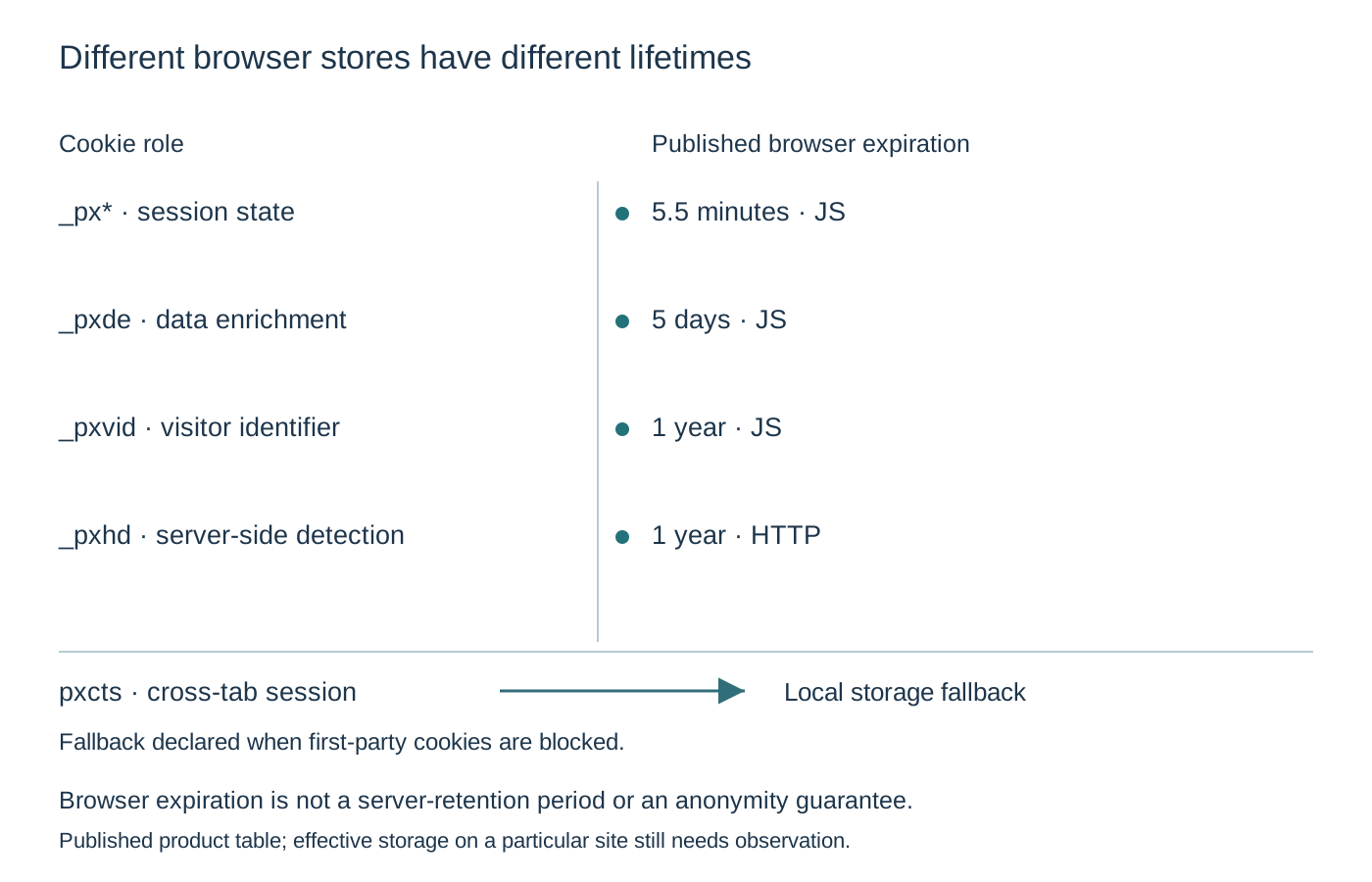
The px_fp entry describes a different fallback: fingerprint data in session storage when local storage is unavailable. That is not the same path as pxcts, which concerns blocked first-party cookies. Combining both into “cookies are copied everywhere” would misstate the source. The documented triggers and purposes differ, and neither entry establishes that a particular browser executed the fallback during a visit.
The _pr_c description also deserves literal reading. HUMAN calls its function cross-session mapping and says it contains the client’s UUID from the previous session. Its placement in session storage does not cancel that declared purpose. The storage container’s lifecycle and the information represented by a value answer different questions. Understanding how a deployment populates or removes it requires lifecycle evidence beyond the label of the container.
For _pxde, the source describes enrichment and notes hashed incident and access-control identification information. Its 5-day expiration does not explain the hash construction, whether values can be associated with other records or when related server information is removed. The useful privacy distinction is between an enrichment entry and a visitor identifier, not a claim that every hashed value has identical identifying properties. No cookie contents are needed to preserve that distinction.
Finally, the first-party classification in use-of-cookies-web-storage.md concerns storage context. It does not identify every processor with access to related information, nor does it establish cross-domain association. The documented product list is broader than any one site. A deployment-specific inventory must identify the relevant domain, product and storage scope before turning this published map into a statement about actual collection or persistence.
Identifiers, cookie flags and retention answer different questions
HUMAN describes _pxvid and _pxhd visitor identifiers as randomly generated. Randomness describes how an identifier originates; linkability concerns whether the same identifier can associate later activity. A random value can support continuity without containing a person’s name or website account number. The absence of a direct account identifier therefore does not settle whether visits can be connected within the scope where that value is available.
The _px* row says the session cookie does not correspond to a user ID in the web application and does not store personally identifiable information. Those are HUMAN’s declarations about the listed cookie family. They do not establish that all related service processing is anonymous. The same row mentions visitor and session identifiers, while other rows describe continuity purposes. Privacy interpretation must consider the relationship between records, not only whether a cookie contains readable identity information.
Hashing raises a related issue. The local-storage entry px_hvd is described as a hashed visitor identifier. A hash can change a representation while preserving an association useful to the system. Whether the result can be linked depends on inputs, stability, scope and available auxiliary information. The public storage table does not provide enough detail to establish irreversible anonymity, and the word “hashed” should not be treated as a complete account of privacy protection.
Cookie flags answer yet another question. HUMAN’s use-of-cookies-web-storage.md says its cookies are not set with HttpOnly and Secure by default. Its explanation is that the Sensor needs script access and that the system supports both HTTP and HTTPS. It also says Secure can be set where all traffic, including APIs, uses HTTPS. These statements describe documented defaults and options, not observed attributes on every deployment.
HttpOnly restricts access by client-side scripts. Secure restricts cookie transmission to HTTPS. An HTTP cookie type such as the table’s _pxhd classification must not be read as proof of the HttpOnly flag, and “JavaScript cookie” must not be read as proof that HTTPS is absent. Transport restrictions and script readability are independent properties. Both require the actual cookie attributes when assessing a specific site.
The source also describes encryption, hashing and signatures as protection for information carried by cookies. Those mechanisms can serve confidentiality or integrity purposes, but their presence does not establish that processing cannot connect requests. A signed or encrypted continuity token may still perform its intended association role. The architecture’s 0-100 score description likewise says nothing about whether a visitor can interpret the cookie or whether the service retains related observations.
Expiration and retention need separate answers. The _pxvid row’s one-year expiration concerns the browser cookie. The source does not specify the server-retention period for observations associated with that identifier. Cookie removal can change future browser state, but it is not evidence of deletion from service records. Conversely, a browser cookie’s continued existence cannot establish that every related server record remains stored for the entire cookie lifetime.
Product processing and declared recipients
The privacy policy’s Processor Data section explicitly describes HUMAN acting as a processor or service provider for information collected from customers to provide the Product. It says collection, use and disclosure are governed by customer contracts. That is substantive service-processing information already available publicly. It identifies a contractual relationship and processing scope, while the applicable customer agreement supplies the deployment-specific terms. It does not make the policy’s broader Product description a list of conduct performed by every Bot Defender installation.
In Section 2’s use-and-disclosure provisions, HUMAN says Processor Data may be integrated into the Product and shared with other clients to enhance anti-fraud functionality. This is a declared possibility involving downstream use and recipients, beyond storing a first-party cookie. The policy does not identify which records are shared for a particular customer or visitor. A website assessing that provision needs to determine how its agreement and integration address this use, rather than assuming either that all collected information is shared or that first-party storage excludes other-client sharing.
HUMAN states in its Product/Processor disclosure that its primary means of providing customer information is aggregated reporting through the Product, including an access-controlled dashboard. The word “primary” matters: the same paragraph separately permits certain identifiers in Processor Data to be provided to government entities for anti-fraud and intelligence purposes, without attribution to a specific customer. Lack of customer attribution describes that disclosure condition. It does not say the identifiers cannot connect activity, and it does not establish that a government entity received information from any particular website.
These clauses address different recipients and should remain separate in an integration assessment. A customer report is information provided back to the customer; possible other-client sharing supports Product functionality; possible government disclosure concerns certain identifiers and the stated agency purposes. Section 2 does not provide a per-deployment recipient ledger. The practical question for a customer is which arrangements apply to its Processor Data under its contract, including any conditions governing those possible uses and disclosures.
The same Product section’s additional-use provisions say HUMAN may use Processor Data for Product security and analytics, with behavior-pattern detection as an example. The section also permits aggregation for general corporate promotion and industry benchmarking. Those stated purposes distinguish security analysis from uses of aggregated information beyond an individual request assessment. A customer evaluating purpose limitation should identify the applicable permitted processing for its integration. Browser consistency settings cannot change those contractual purposes after information has been supplied to the service.
Section 2 additionally describes possible disclosure to service providers, as required by law or legal process, and in specified business transactions such as a merger or sale. These are policy declarations about potential processing circumstances. They are not evidence of an observed transfer or of a current recipient’s access to a visitor record. A concrete website disclosure should distinguish its service relationship from hypothetical transaction conditions, while its service assessment should account for the relevant contractual provisions covering both.
The Product/Processor section supplies no numeric retention period for these records. Retention language in the policy’s preceding Controller section concerns a different processing capacity and cannot be reassigned to Product data. The available answer is therefore asymmetric: Section 2 provides real information about collection routes, reporting, purposes and possible recipients, while the duration of this customer’s Processor Data still requires applicable contractual or service information. An unspecified Product retention period should remain unspecified rather than being inferred from _pxvid or from Controller terms.
A website’s “Strictly Necessary” or “Analytics” classification is also different from a legal conclusion. HUMAN’s storage table supplies those categories for its entries, but it does not assess every jurisdiction, website purpose or implementation. Legal compliance requires the applicable facts and obligations. Neither choosing a privacy-focused browser nor citing a vendor’s cookie category establishes compliance, anonymity or the absence of processing obligations for the website operator.
Browser controls and website responsibilities
BotBrowser’s Browser Fingerprinting Overview describes profile-based controls for browser-exposed information. Within the HUMAN signal matrix, those controls concern the browser and rendering side of the relationship. They can support consistency in what web content encounters. They do not configure the Detector’s processing, change a website’s contractual retention terms or decide how the Enforcer applies its policy.
BotBrowser’s Bot Script guide describes a privileged automation context and debugger access. That context can support an authorized browser observation, but it is not a source of information about HUMAN’s customer agreements. The distinction is practical for evidence collection: a browser event belongs with the runtime record, an optional reporting parameter belongs with the integration configuration, and a permitted downstream use belongs with the service-processing terms. None of those records substitutes for the others.
For a visitor, the published pxcts fallback is a reason to distinguish cookie controls from a complete storage assessment. Changing one storage permission does not establish that every documented continuity mechanism is unavailable. Browser controls should be evaluated against the relevant storage type and site scope, with functionality consequences considered separately. That is a privacy and compatibility question, not a route to a guaranteed enforcement outcome.
For a website operator, the Product policy makes the integration review more concrete. Establish whether the deployment includes the Detection Tag, a server integration, log consumption or a combination. Then identify whether customer-passed account ID, campaign, placement or advertising parameters are enabled and what each represents. That inventory distinguishes optional reporting information selected by the customer from browser-generated continuity entries. It also identifies which collection routes a browser-only inspection would leave unexamined.
A separate service review should address Section 2’s declared processing arrangements: Product enhancement, possible sharing with other clients, reporting and possible identifier disclosure to government entities. The relevant question is how those provisions apply to the customer’s Processor Data under its agreement. A network capture could establish a particular outbound transmission, but it would not reveal all subsequent service processing. Conversely, permission for a possible disclosure in a policy does not establish that such a transmission or disclosure occurred.
For retention, request the period or determining criteria that apply to the customer’s Product data, including the relevant deletion arrangements. The public sources already identify _px* at 5.5 minutes and _pxvid at one year, so those browser lifetimes can be stated precisely. They leave the corresponding remote period unanswered. Recording that unresolved service question alongside the known browser expirations produces a more accurate storage assessment than borrowing a duration from the Controller section or treating every category as unknown.
Kasada describes a different product division: automatic request handling in Bot Defense and account relationship assessment in Account Intelligence. The Kasada challenge privacy analysis separates those decision units from browser exposure controls, so HUMAN's storage lifetimes and component roles are not carried over to another service.
Sources
- HUMAN Applications Protection: Overview. Public declaration of Sensor, Detector, Enforcer, the score scale, policy and Risk API path, consulted November 14, 2026.
- HUMAN Applications Protection: Detection Overview. Public declaration of signal families, interaction examples and analysis categories, consulted November 14, 2026.
- HUMAN Applications Protection: Use of cookies & web storage. Published product scopes, storage purposes, durations and cookie-flag explanations, consulted November 14, 2026.
- HUMAN Privacy Policy, Section 2: Processor Data. Product collection routes, HTTP request examples, optional customer-passed identifiers, customer-contract scope, processing purposes and possible recipients, consulted November 14, 2026. The preceding Controller section supplies no Product retention period.
- BotBrowser: Browser Fingerprinting Overview. Product documentation for browser-facing profile controls.
- BotBrowser: Getting Started with Bot Script. Product documentation for automation context and debugger access, separate from third-party collection findings.
Practical conclusion
For an actual deployment, pair the domain’s storage inventory with its HUMAN integration configuration and Product processing terms. Start with whether customer-supplied reporting identifiers are enabled, then obtain the applicable Processor Data retention information. Those two customer-specific answers resolve questions that a browser fingerprint inventory and the public cookie expiration table cannot settle.
FAQ
Does PerimeterX measure visual and audio rendering?
HUMAN’s detection overview names visual and audio rendering capabilities as indicators. That is a vendor declaration about a signal family, not an observation of a specific API executing on a current site.
Does a five-minute cookie mean association ends after five minutes?
The listed _px* expiration is 5.5 minutes. Other published entries include year-long visitor cookies and storage fallbacks, so that single expiration cannot define the entire system’s continuity or server retention.
Are all listed cookies present on every protected website?
The reference covers multiple HUMAN products. A row’s existence does not establish that the relevant product, feature or fallback is active on a particular domain.
Would a complete V8 log explain a risk score?
An attributable log can establish browser interface accesses within its effective coverage. The score also involves remote analysis and Enforcer inputs; its meaning and policy effects require evidence beyond browser execution.
This article is part of the guide: What Is a Browser Fingerprint? Canvas Fingerprinting
Related Articles
Kasada Challenge Signals and Privacy Explained
FingerprintAkamai Bot Manager: Sensor Data and Privacy
FingerprinthCaptcha Privacy: Signals and Evidence Boundaries
FingerprintFunCaptcha: Signals, Sessions and Privacy
FingerprintWhat Is DataDome? Signals and Privacy Exposure
FingerprintreCAPTCHA Privacy: Signals and Evidence Boundaries
Run the same check in BotBrowser
Load a profile, keep the signals you just read about consistent inside the browser, and confirm the result on your own machine before a rollout.