What Is DataDome? Signals and Privacy Exposure
What DataDome reads, how its current Tag differs from historical challenge evidence, and what browser controls can protect without promising anonymity.
BotBrowser Team
Want the structured docs for Fingerprint?
This article lives in the editorial library. For step-by-step setup, reference material, and ongoing updates, jump into the docs section.
What is DataDome measuring when a site checks a browser? Its current JavaScript Tag documentation describes browser characteristics, behavioral observations and consistency checks. Historical research also contains rendering measurements from specifically identified older components. These sources answer different questions. BotBrowser documents controls inside Chromium for browser-exposed properties and rendering; those controls cannot determine DataDome's server decision, erase a site's cookies or establish anonymity.
TL;DR
- The current JavaScript Tag declaration, a historical tag reconstruction and a challenge VM record are different evidence scopes. A canvas operation in one does not establish collection by every DataDome component.
- A local recorder logs collector inputs before the original function runs. Its frame merge can lose records, so an event is neither transmission proof nor a complete inventory.
- A provenance report classifies
222slots, but only11have API-neighborhood hints. Its computed coverage is not a measurement of complete field meaning or identifying power. - Browser consistency, cookie lifetime and server retention require separate decisions. Encryption does not by itself demonstrate that observations cannot be linked.
Contents
- Which DataDome component is being described?
- What the collector recorder actually establishes
- Why 222 classified slots are not 222 explained signals
- Rendering surfaces in the historical research
- Network destinations, cookies and retention
- Engine controls and the limits of patches
- A collection decision for an owned website
- Practical conclusion
Which DataDome component is being described?
DataDome's JavaScript Tag documentation names behavioral observations, general browser or device information, and tests of built-in functions or consistency. Its examples include mouse movement, keystrokes and operating-system, browser and graphics information. Those examples identify declared categories, not a complete field schema. The reference does not establish that a particular keystroke's text is collected, or that every category is evaluated on every page. A privacy description should preserve that difference instead of turning a category into an assertion about recorded content.
The same current reference explicitly states that the JavaScript Tag does not collect canvas fingerprinting of the kind the vendor describes as intrusive. It also characterizes its fingerprint as lacking high entropy or uniqueness. These are attributed vendor declarations, retrieved on November 14, 2026. They are not independent population measurements. Establishing how distinctive an output is would require a sampling population, a measurement method and a definition of uniqueness; reading the declaration supplies none of those additional measurements.
The local research archive is pinned to commit bf8203d54eca0e475b70db9c3e5828a3fcce1bf4. Its material spans several dates, versions and methods. A March canvas file identifies a historical tags5.4.0 reconstruction. An April research summary identifies 5.6.1. An August provenance generator consumes a captcha1.32.0 source, while a later controlled VM result describes v1.33. These labels should travel with the claims they support. They are not evidence that any one of those versions remains deployed today.
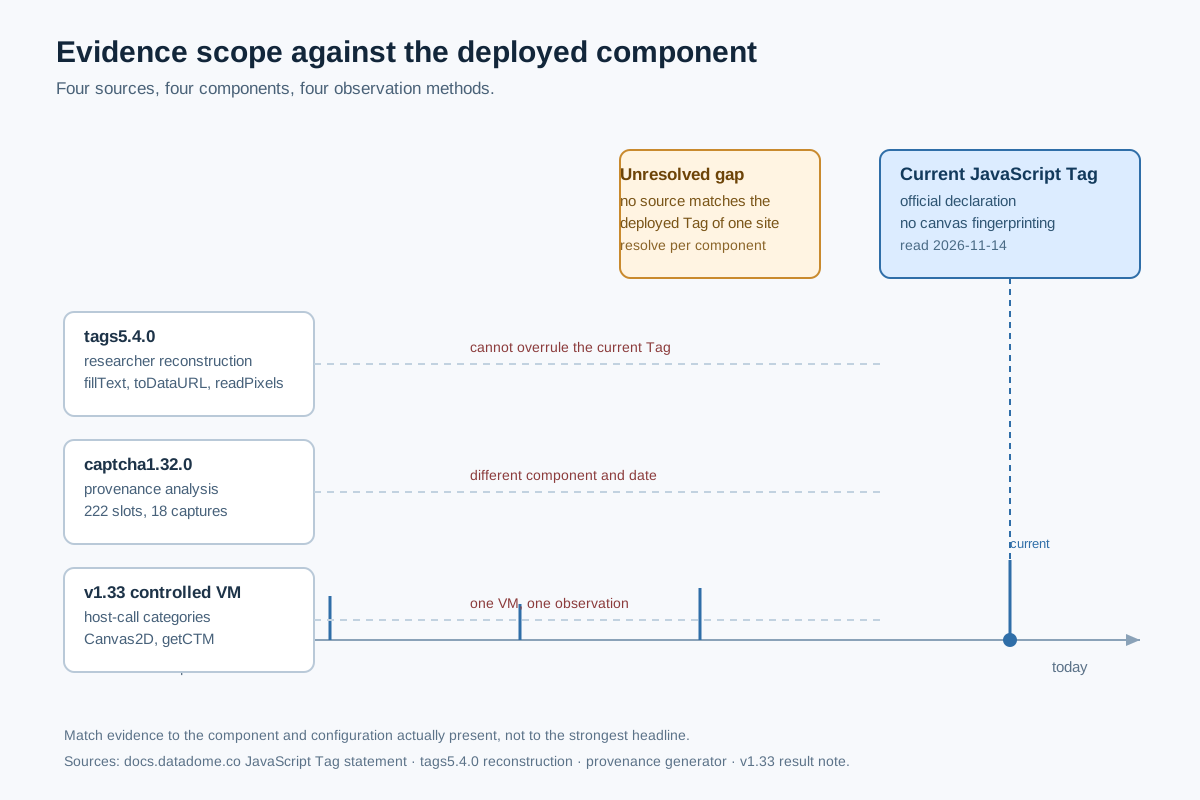
The apparent conflict between the current Tag declaration and historical rendering evidence therefore has no responsible one-line resolution. The sources differ in component, version, date and observation method. A researcher-authored tags5.4.0 reconstruction cannot independently disprove a current JavaScript Tag statement. Conversely, a current statement about that Tag cannot erase a historical challenge observation. Resolving a deployed site's behavior requires matching evidence to the actual component and configuration present there, rather than choosing whichever source gives the strongest headline.
The client-response analysis owns another distinction: a challenge or blocked response describes an outcome seen by the client. It does not expose all the measurements behind the outcome. A page can contain a Tag and later navigate to a challenge, but that sequence alone does not prove that both components collected the same fields. A component map is more informative than treating the vendor name as a single script with one permanent fingerprint. The Turnstile signal study uses a different recorder and preserves its own frame and observer limits; its API counts cannot be transferred to DataDome. The Akamai privacy analysis maps service-specific processing roles and the published Service Log retention periods, which cannot be transferred from DataDome’s component policies.
| Evidence | Supported conclusion | Conclusion requiring more evidence |
|---|---|---|
| Current JavaScript Tag reference | Declared categories and the vendor's no-canvas statement | Exact reads on a particular deployed page |
Historical tags5.4.0 reconstruction | APIs used in that researcher-authored reconstruction | A current vendor implementation or its transmitted fields |
captcha1.32.0 provenance analysis | Heuristic grouping of archived slots and nearby API names | A complete schema or reliable information-flow map |
Controlled v1.33 VM result | Host-call categories reported for that historical environment | A current Tag inventory or production verdict |
The matrix changes a concrete privacy decision. If a site's notice promises a particular collection boundary, the relevant question is which deployed component and processing arrangement support that promise. A historical method name is useful for selecting an investigation, not for silently expanding a present-day notice. If exact implementation evidence is unavailable, the unresolved scope belongs in the assessment. Neither an unqualified accusation nor an unverified assurance is an adequate substitute for a component-specific answer.
What the collector recorder actually establishes
The archive's inject.js is not a general recorder of every browser API getter. Its central path wraps a collector function. Around inject.js:50-93, the wrapper records the collector input and a stack before calling the original function. This ordering determines the evidentiary boundary: the recorded argument existed at the call boundary, but the original collector had not yet accepted, transformed, discarded or serialized it. Naming the record a transmitted signal would skip stages that the wrapper does not prove.
That distinction matters even when the collector completes successfully. A caller may supply a value that becomes normalized, combined with another value, or omitted from a later representation. The local record does not supply a verified mapping for all those transformations. A request observed nearby in time cannot fill that gap merely because it belongs to the same page. Connecting a recorded argument to a network field requires an applicable data-flow observation, not just an argument log plus a successful HTTP response.
The wrapper also converts undefined into null when recording inputs. In JavaScript those values have different meanings, but the saved representation collapses them at this point. A later analyst cannot reliably decide whether a recorded null originated as an explicit null value or the recorder's replacement for absence. This is an information-loss property of inject.js:91, not a finding that DataDome itself treats both inputs identically. The affected distinction has already disappeared before the archive is analyzed.
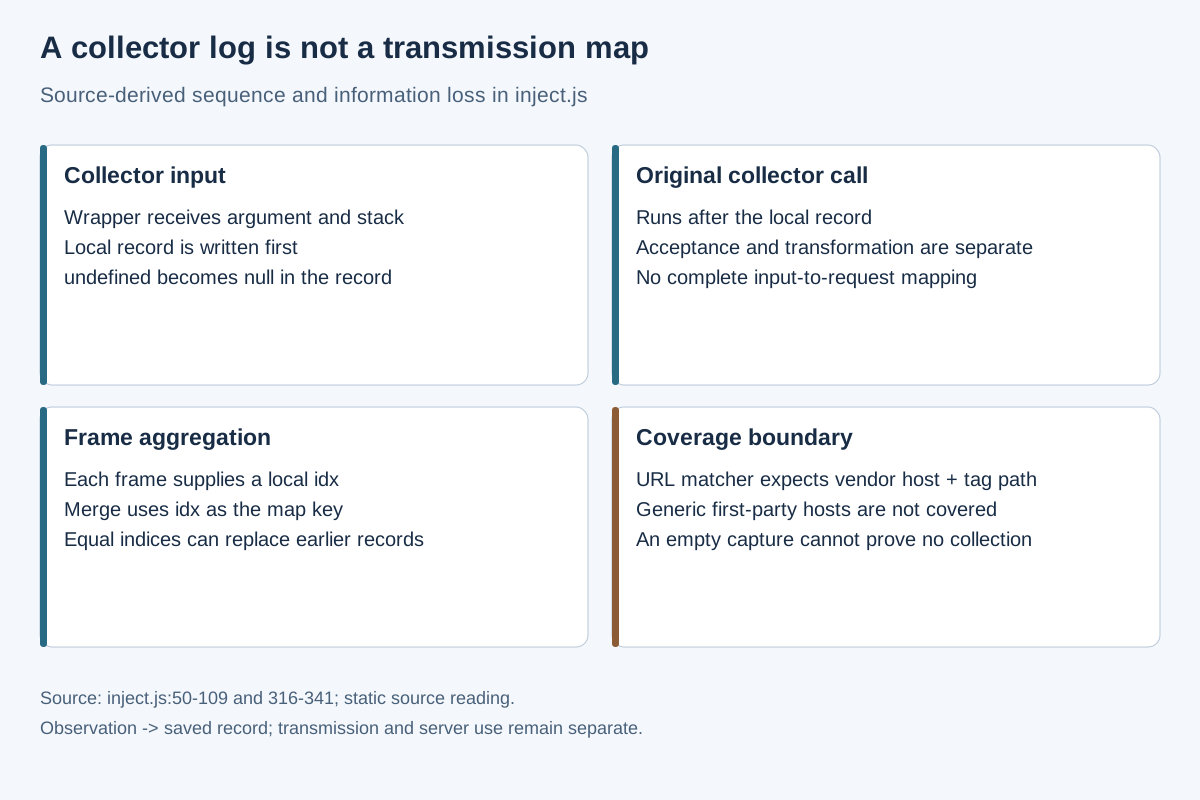
Coverage has another limit in inject.js:98-109. The URL matcher expects a vendor hostname together with a tag-path pattern. Although a nearby comment mentions first-party arrangements, the actual matching expression does not establish support for every customer-owned hostname. An empty capture under an unsupported URL shape is therefore not proof that no collection occurred. The source code's matching conditions, rather than the comment's broad description, define what this particular recorder can observe.
Frame aggregation introduces a separate loss. The collection path around inject.js:316-341 merges frame results and deduplicates them using a frame-local idx. Two frames can produce the same local index. When those records share the resulting map key, one can replace another, and the merged output no longer preserves an unambiguous complete event sequence. Frame identity is not retained as an independent part of that key. Increasing the number of archived records would not repair a collision that has already removed context.
Stack strings do add location evidence, but they do not automatically supply semantic attribution. A stack position can point into transformed source, a helper or an intermediate call. The provenance generator later uses that position to examine nearby text, which adds a candidate explanation rather than proving every dependency. The evidentiary chain has several links: invocation, saved representation, source location, proposed API meaning and eventual transmission. Confidence in one link does not transfer automatically to every other link.
The archive also includes controlled environments and synthetic interaction fixtures. Those conditions can change what a program observes. No new fixture, challenge or reconstruction was executed for this assessment, and no current browser comparison is claimed. The useful result is narrower: a specific recorder design has identifiable blind spots and lossy transformations. A privacy team can account for those limits before interpreting a missing event, while avoiding the opposite error of treating every saved argument as proof of a retained visitor attribute.
Why 222 classified slots are not 222 explained signals
The archived docs/datadome-field-provenance.json was generated on August 26, 2026. It reports 222 slots across 18 captures, of which 15 are marked as BotBrowser captures. Its classes total 118 constant, 20 session, 36 runtime-derived, 25 profile, 21 platform, 1 detector and 1 host. These are the generator's grouping results over that sample. They are not a vendor-published taxonomy or a census of every current DataDome input.
The category names describe patterns the analysis uses when comparing observed values. A constant label means the sample did not show the variation used by the classifier; it does not mean the underlying observation is harmless or globally identical. A session label describes sample variation, not a guarantee that successive sessions cannot be linked. A profile or platform grouping can suggest an environmental dependency without identifying the browser API or proving a one-to-one relationship with a particular device property.
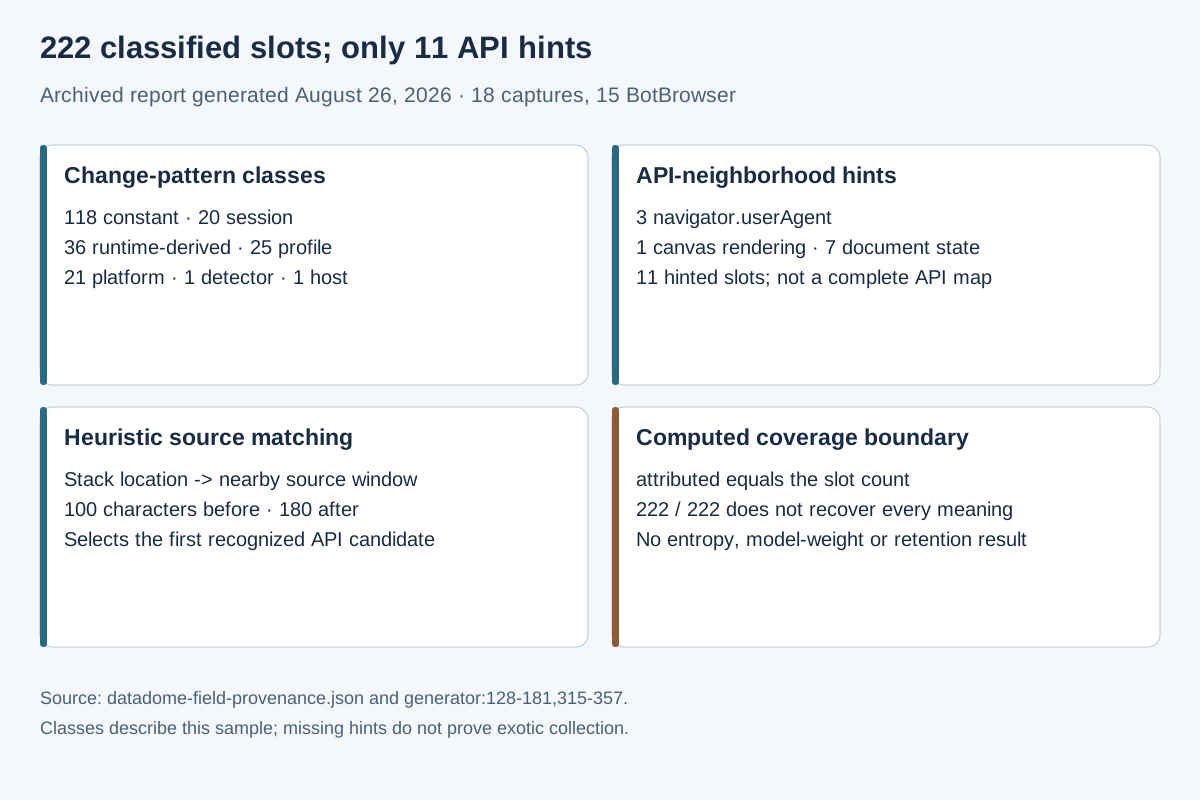
Only 11 slots carry API-neighborhood hints: 3 associated with navigator.userAgent, 1 with canvas rendering and 7 with document state. Those counts describe the report's hints, not a complete API inventory. A slot without a hint is not proof of an unknown exotic technique; it can simply reflect the limitations of source matching. Likewise, one canvas hint does not establish one canvas invocation, one transmitted field or one bit of identifying information. The counted unit changes across those claims.
The generator makes the method inspectable. Around monitor/tools/datadome-field-provenance.mjs:128-141, regular expressions recognize selected API-looking text. Around lines 160-181, a stack location selects a source window extending roughly 100 characters before and 180 after the location. Subsequent matching examines that neighborhood, and lines 315-319 select the first API candidate. This is a proximity heuristic. It can associate a slot with nearby text, but it does not trace values through every intermediate expression or establish which candidate produced the saved value.
One summary field deserves particular care. Around generator lines 345-357, the reported attributed count is assigned from the total, producing a complete-looking coverage ratio by construction. The ratio therefore cannot serve as independent evidence that every slot has a recovered meaning. The report can be useful while its summary label remains too broad for a different question. Reading the assignment explains why 222 classified entries coexist with only 11 API hints; there is no need to invent an unseen complete attribution dataset.
The historical v1.33 comparison provides an independent warning about representational layers. Its limitations say that the final binary output does not expose recovered JSON key/value boundaries and that final bytes are not assigned to browser APIs. The accompanying field-candidates list is empty for that reason. A byte difference can be real without revealing its cause. Output length, changed positions and a digest cannot tell a reader which browser property changed when intermediate state and transformations remain unresolved.
For privacy analysis, the appropriate artifact is a claim ladder. 222 grouped slots support the statement that the archived analysis found many positions with several change patterns. The 11 hints support a limited set of source-neighborhood associations. Neither result measures population entropy, cross-site linkability, retention or classifier influence. Those questions require different evidence. Publishing the aggregate and its limits supplies useful information without releasing raw identifiers, opaque field names, captured values or a representation that could be mistaken for a replayable fingerprint.
Rendering surfaces in the historical research
The historical 20260316/detection-scripts/01-canvas-measuretext.js is a researcher-authored reconstruction identified with tags5.4.0. It creates a canvas, configures a two-dimensional rendering context, chooses a font-fallback sequence, draws text, serializes the result and examines text metrics. The file is evidence of what the reconstruction computes. It is not a fresh trace of the current official Tag, and the exact drawing inputs are unnecessary for explaining the privacy surface. No fingerprint artwork or replay values are reproduced here.
Two output families deserve separate names. toDataURL serializes canvas content; measureText returns a TextMetrics object describing a text measurement. The reconstruction attempts to read 12 candidate metric properties. That attempt does not establish that every property exists in every browser, that the vendor currently requests all of them, or that all returned information reaches a server. A candidate-property list is a program's requested surface, while supported outputs and transmitted fields are further questions.
The canvas fingerprinting explanation describes why rendered text and metric results can vary with a rendering environment. The DataDome-specific issue is attribution: the historical reconstruction combines serialization and measurements, whereas the current Tag declaration has a different date and scope. A canvas is not an image of unrelated tabs, the desktop or a camera feed. The exposure concerns a computed result and characteristics of the implementation that produced it, rather than unrestricted access to a person's screen.
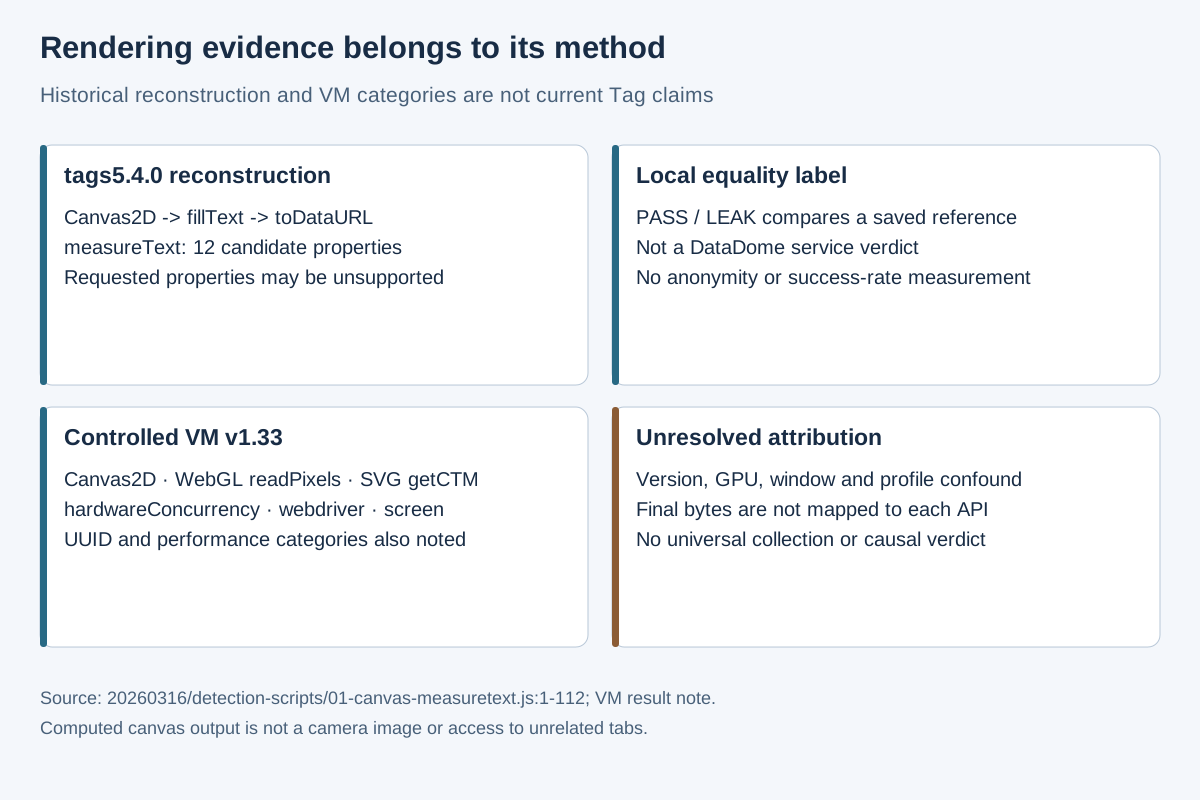
The reconstruction's labels also need interpretation. A custom PASS or LEAK result comes from comparison with a hard-coded reference output. That local equality check is not DataDome's decision, an independent anonymity test or a measured privacy breach. A mismatch can indicate that the reconstruction produced a different result under its conditions. Calling it a vendor rejection would substitute the researcher's test predicate for a service decision that the file does not observe.
The later v1.33 result note reports a different method: controlled VM host-call observation. Its listed categories include navigator.hardwareConcurrency, webdriver, screen properties, Canvas2D, WebGL readPixels, SVG getCTM, randomUUID and performance-related calls. The list establishes categories reported for that historical experiment. It does not establish a present-day universal list, or that every invocation supplied useful identifying information. Some calls can serve internal computation or compatibility checks; use in a model requires additional attribution.
Rendering and geometry operations also expose different kinds of context. Pixel readback concerns generated image output. A transformation matrix from SVG geometry concerns a coordinate transformation. A processor-concurrency property describes a reported capability. Combining these into the word fingerprint can be convenient, but it hides which output carries which information. A privacy assessment should retain the API category long enough to ask whether the data is necessary, how precisely it is represented and whether a less detailed result could serve the stated purpose.
The result note names environmental confounds, including version, GPU, window and profile differences. These prevent turning a stock-versus-BotBrowser difference into a single-variable product verdict. The unresolved final-byte attribution further limits causal claims. No success rate follows from these artifacts, and no setting is prescribed to change a security outcome. Their defensible contribution is a source-specific surface map with a method boundary, so the rendering discussion remains educational rather than a recipe for reproducing or defeating a challenge.
Network destinations, cookies and retention
The official JavaScript Tag reference describes a first-party setup in which /tags.js supplies the script and /js/ receives signals through the site's infrastructure. A request can therefore use the site's hostname while participating in a vendor processing arrangement. The hostname tells a network observer where the browser sent the request; it does not, by itself, identify every downstream processor or the ultimate handling of the data. No reverse-proxy configuration is needed to understand that distinction.
This has a practical consequence for a collection inventory. Counting only requests whose host contains a vendor name can miss first-party delivery arrangements. The local recorder's restrictive URL matching compounds that problem: an unsupported host shape can produce an empty record even when the documented integration still operates. Neither observation proves concealed behavior. Together, they show why a hostname-only audit cannot establish the absence of a processing relationship, and why actual component ownership matters more than the visual appearance of a URL.
DataDome's cookies and storage reference describes the datadome cookie as participating in both client-side and server-side detection. The table attributes encryption and the absence of personally identifiable information to the cookie's design, and lists a lifetime of 1 year. These are vendor statements about that entry. Encryption limits intelligibility to parties without the relevant access; it does not independently prove that a service cannot recognize a returning state or associate it with other observations. HUMAN publishes a different combination of session and visitor lifetimes: the PerimeterX storage and signal-group analysis separates those browser expirations from server retention and describes its documented storage fallbacks.
The separate Data privacy configuration reference describes a data-retention and collection setting of up to 30 days depending on the subscription plan, and cookie-lifetime choices from 7 days to 1 year. Those settings refer to different objects. A cookie's expiration is not the same as the retention period of a server record. Neither page alone settles every account-specific contract, infrastructure log, deletion obligation or downstream application record associated with a deployment.
The two documents should be reconciled by scope rather than treated as contradictory numbers. A reference table can state a cookie lifetime while a configuration page documents available choices. The effective setting for a particular customer requires verification. It would be inaccurate to tell every visitor that all DataDome-related information disappears after 30 days, just as it would be inaccurate to infer a year of server-side storage from one cookie expiration. The affected resource and responsible operator belong beside each duration.
Browser-side minimization and processing-side minimization are therefore complementary. An engine control can affect what an exposed browser surface returns, while a site operator remains responsible for deciding what its integration collects and how long relevant records persist. A status code, encrypted cookie or reduced browser signal does not answer all those questions. The useful privacy record identifies the collection purpose, receiving arrangement, storage object and effective retention separately, without copying the visitor's cookie or challenge state into an audit document.
Engine controls and the limits of patches
BotBrowser's browser overview documents controls implemented within the browser engine for profile-backed browser properties and rendering-related surfaces. That scope is relevant when an authorized environment needs coherent values across related browser observations. A profile is a configuration of supported surfaces, not an instruction to a remote classifier. No current DataDome acceptance experiment accompanies this static research, so the documentation supports a capability boundary rather than a comparative success claim.
The distinction from a JavaScript patch concerns the layer at which a value is produced. A wrapper can intercept the specific getter or method it replaces in the contexts where it is installed. That alone does not establish control over other contexts, underlying implementation behavior or related outputs. A browser-engine implementation has a different intervention point, but its breadth must still be verified against documented support. Neither architecture justifies saying that all observable browser behavior is controlled or all inconsistencies are removed.
The DataDome archive illustrates why coherent interpretation matters. A navigator.userAgent proximity hint is not equivalent to a rendering output, and a reported concurrency value is not a graphics backend. Altering one exposed string cannot logically establish what another API will return. Conversely, a difference between environments does not identify a broken protection unless the claim, controlled variable and expected behavior are specified. The source material does not supply that experiment for every reported host-call category.
The engine-versus-API comparison covers that architectural question in greater depth. For this component-specific privacy assessment, the direct boundary is smaller: browser controls can change supported browser outputs, while server state and the site's processing policy remain separate. A browser profile cannot retroactively remove an earlier cookie association or decide how a processor handles an existing record. A product paragraph that ignores those distinctions would turn a useful local capability into an unsupported promise about an external service.
Consistency itself also needs a privacy qualification. Mutually coherent outputs can prevent accidental contradictions in an authorized testing environment, but coherence is not a measurement of low identifying power. A stable, unusual combination can remain distinctive. Measuring linkability would require a defined population and repeated observations under a stated method. The archived slot classes and API hints provide neither that population nor a demonstrated anonymity result. Their limits apply to favorable product interpretations as well as unfavorable ones.
The appropriate comparison is consequently a responsibility map. Browser-engine support addresses particular observable outputs. Application integration determines where collection is enabled. Processing settings and agreements govern additional handling. A remote security system evaluates requests under its own policy. Treating all four responsibilities as a single fingerprint setting makes privacy questions harder to answer and encourages unsupported outcome claims. Keeping them separate allows an organization to use browser controls where documented while addressing data collection at the layer that actually owns it.
A collection decision for an owned website
A useful assessment begins with the deployed component, rather than with a generic claim that a visitor was fingerprinted. For an owned website, the operator can identify whether the relevant surface is the JavaScript Tag, a challenge document or another integration component. The current official declaration then becomes a statement to verify at that scope. Historical tags5.4.0 or v1.33 evidence can inform the questions, but it should not silently become a statement about the site's current configuration.
| Observation or question | Appropriate decision | Evidence still needed |
|---|---|---|
A site-domain /js/ request appears | Include the processing arrangement in the inventory | Who receives or processes the signals beyond the hostname |
| A collector argument is recorded | Treat it as a local input observation | Original acceptance and an applicable transmission mapping |
A report claims complete attribution for 222 slots | Separate classification coverage from semantic recovery | Which slots have independently supported meanings |
| A canvas operation appears in historical challenge research | Keep the component, date and method attached | Matching evidence for a claim about the current Tag |
A 1 year cookie and 30 day setting are documented | Identify the resource and effective customer setting | Actual cookie expiry and relevant record-retention scope |
| A browser profile changes a supported output | Check the documented browser capability | Separate evidence for any server decision or anonymity claim |
The table is a choice rule, not a list of ways to influence a challenge. Its recurring decision is to select the evidence scope that matches the claim. If the claim concerns transmission, a local argument log is incomplete. If it concerns present-day collection, a historical reconstruction is incomplete. If it concerns retention, a browser output comparison is incomplete. The missing evidence can be named precisely without collecting more visitor secrets or pretending that every uncertainty requires another intrusive experiment.
A compact internal assessment can record the component identifier, observation date, responsible operator, declared category and unresolved evidence boundary. It need not include a cookie value, opaque request body, exact fingerprint output or a visitor identifier. For example, an entry can say that the datadome cookie is present and that its effective expiration requires confirmation. That is enough to assign the configuration question while avoiding another durable copy of security state in the documentation system.
An effective privacy change should also have a falsifiable result at its own layer. A retention change needs evidence about the relevant records and effective policy. A browser-surface change needs an authorized comparison of the supported surface. A notice correction needs wording consistent with the deployed component and processing purpose. None of those results can be replaced by a green challenge outcome. Separating the checks helps prevent a service compatibility observation from being misreported as reduced data collection.
Frequently asked questions
Does the current no-canvas statement mean historical rendering evidence is false?
No. The official claim is scoped to the current JavaScript Tag description, while the archive includes a researcher reconstruction and challenge VM evidence from identified historical versions. A direct comparison needs matching component and method evidence; the vendor name alone is insufficient.
Does an encrypted cookie rule out tracking?
Encryption does not answer whether an authorized recipient can recognize or associate the state. The official cookie entry and privacy settings describe different aspects of processing. Actual linkage, purpose and retention require evidence about the deployed arrangement rather than an inference from encryption alone.
Can the provenance report identify the most important signal?
No. Its change-pattern classes and 11 source-neighborhood hints do not reveal classifier weights. A frequently changing slot, a constant slot and an API-looking source window are different observations, none of which provides a ranking of influence on the service's decision.
Sources
- DataDome JavaScript Tag: declared signals, privacy statement and first-party integration
- DataDome data privacy: retention and cookie-lifetime configuration
- DataDome cookies and storage
- BotBrowser browser fingerprint overview
- Historical local research:
DataDome-Privacy-Research, commitbf8203d54eca0e475b70db9c3e5828a3fcce1bf4;inject.js, provenance generator and report, historical canvas reconstruction, and versioned VM result notes. Static reading only; raw visitor state and protected implementation material are excluded.
Practical conclusion
DataDome privacy exposure is a component-specific question about browser observations and their handling. The current Tag declaration, historical collector records and rendering research supply different pieces of evidence. The defensible decision is to identify the deployed component, distinguish input observation from transmission, and verify the actual storage and retention arrangement. BotBrowser's documented engine controls address supported browser surfaces; a site's collection policy and an external service decision remain separate responsibilities.
This article is part of the guide: What Is a Browser Fingerprint? Canvas Fingerprinting
Related Articles
Cloudflare Turnstile: Signals and Privacy
NetworkCloudflare and DataDome: Scraping Response Signals
FingerprintAkamai Bot Manager: Sensor Data and Privacy
FingerprintKasada Challenge Signals and Privacy Explained
FingerprintPerimeterX Signal Groups and Privacy Explained
FingerprintFunCaptcha: Signals, Sessions and Privacy
Run the same check in BotBrowser
Load a profile, keep the signals you just read about consistent inside the browser, and confirm the result on your own machine before a rollout.