Kasada Challenge Signals and Privacy Explained
Understand Kasada challenge signals, device and account relationships, data processing roles, and the limits of browser privacy controls.
BotBrowser Team
Want the structured docs for Fingerprint?
This article lives in the editorial library. For step-by-step setup, reference material, and ongoing updates, jump into the docs section.
A Kasada challenge can raise a privacy question even when no puzzle appears: what information does the browser expose, and which other records can the service connect to it? Kasada describes Bot Defense as operating without CAPTCHAs and reading signals from the browser, operating system and hardware. BotBrowser documents browser-engine controls over browser properties and rendering, but those controls do not determine Kasada's server decisions, account relationships or data retention. The practical distinction is between controlling an exposed browser surface and controlling what a remote service does with available information.
TL;DR
- Kasada publicly describes browser, operating system and hardware signals. These categories are declarations, not a published inventory of JavaScript calls made on every protected page.
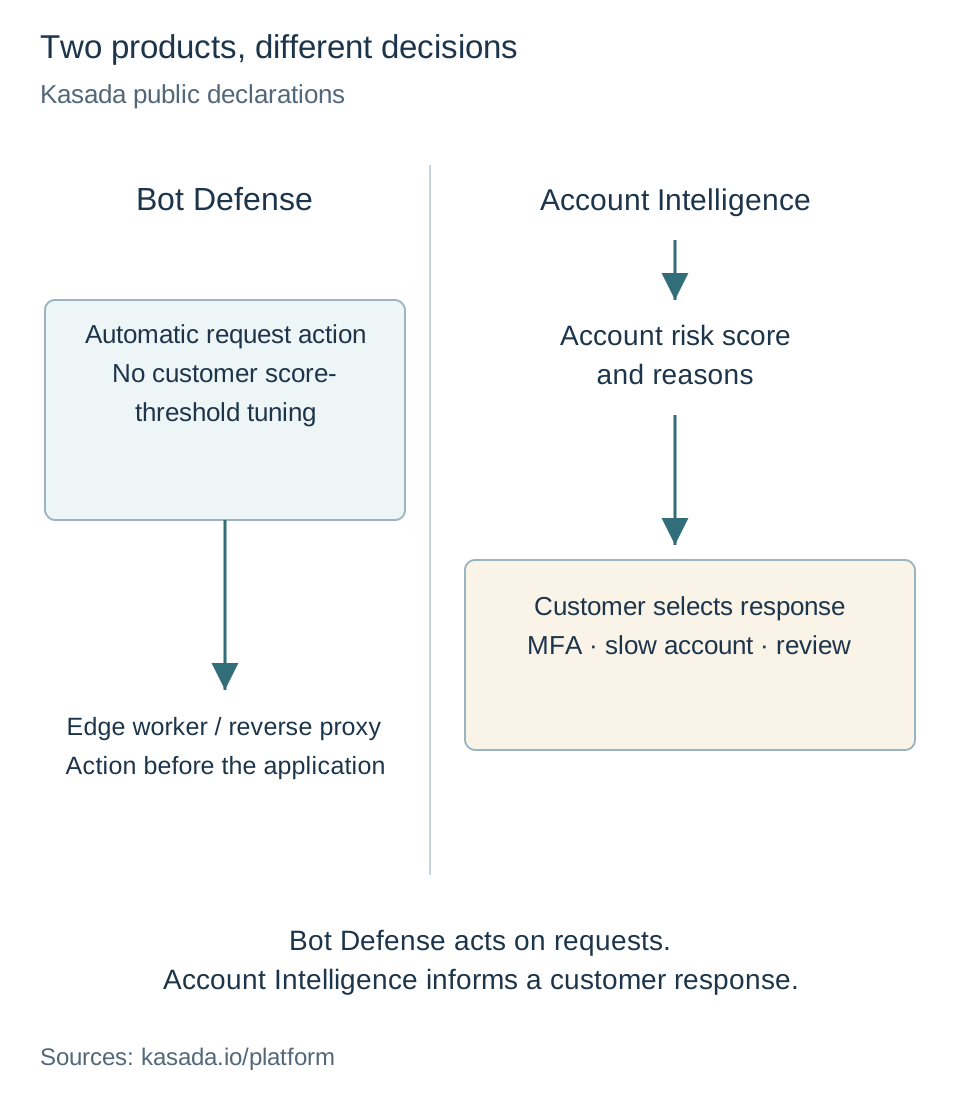
- Bot Defense and Account Intelligence serve different decisions. The former describes automatic request blocking; the latter describes account relationships, risk scores and reasons for a customer's response.
- Kasada's privacy policy lists device ID, IP address, geolocation and browser data among broader personal-information categories. A policy category does not prove that every deployment collects every item.
- Local research did not establish a genuine, source-attributed Kasada V8 recording. Page-only graphics records and a synthetic test fixture cannot substantiate a runtime API claim.
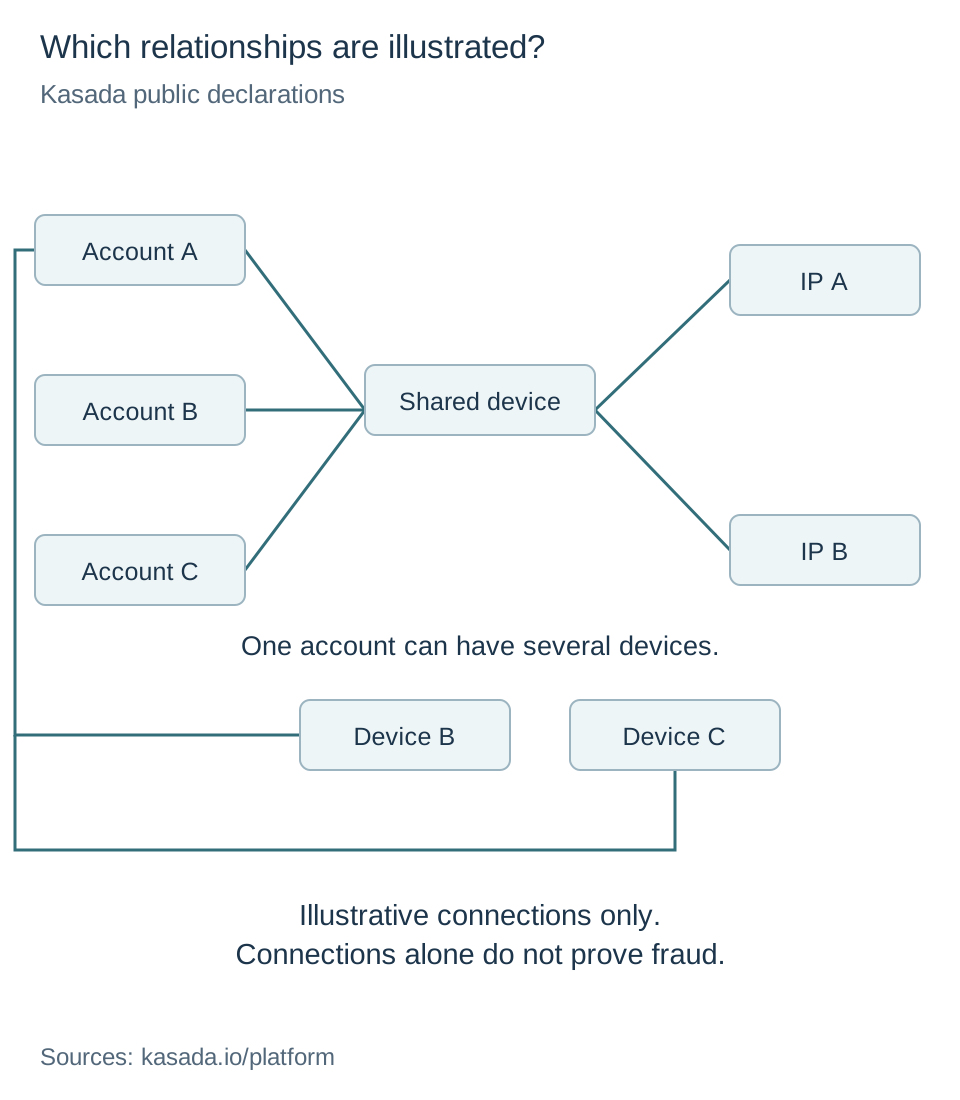
- Shared devices, changing IP addresses and related accounts create privacy-relevant connections. The vendor's own example says connections alone do not prove fraud.
- Browser exposure controls, customer response policy and processor obligations require separate checks. None establishes anonymity or guarantees permission to use a site.
Contents
- An invisible challenge still has a browser and a request boundary
- Browser signals and account relationships serve different decisions
- Declared device data creates several kinds of privacy exposure
- Processing roles determine where privacy questions go
- What an attributable browser observation can establish
- Browser controls and an owned site's response policy
- Practical conclusion
An invisible challenge still has a browser and a request boundary
The word challenge often suggests a visible task. A service can instead evaluate a request while the page runs client software and exchanges information in the background. Kasada's platform description explicitly says it does not use CAPTCHAs. That statement describes the advertised interaction model; it does not establish that the page performs no collection or that a visitor can never experience a request failure. Visible effort and information exposure are different properties of the same interaction. The AWS WAF token privacy analysis provides a separate documented example of silent validation and session state, not evidence of Kasada's token contents.
Kasada identifies browser, operating system and hardware as input categories for Bot Defense. A browser can expose characteristics of its environment through web interfaces, while a request also arrives with network context. The public category names do not identify an exhaustive list of interfaces, their arguments or the conditions under which each is accessed. Treating the names as a fixed collector schema would attach specificity that the published description does not provide. Product language about inconsistencies is likewise not an independent measurement of classification accuracy.
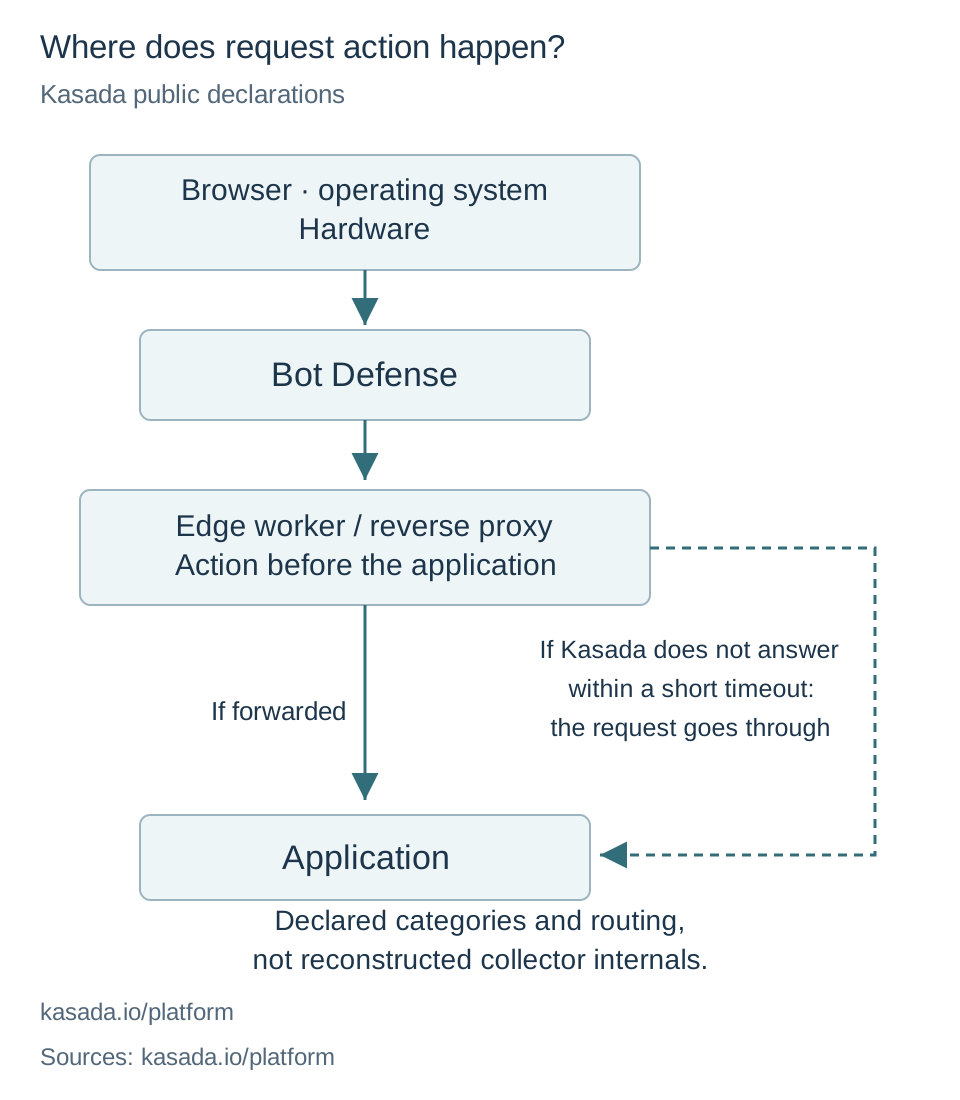
Deployment placement changes who can explain an apparent interruption. Kasada says it can run as an edge worker with an existing CDN or as a reverse proxy. Its platform FAQ also says a request goes through if Kasada does not answer within a short timeout. This is a declared availability behavior, not a numerical timeout guarantee. An operator investigating an incident needs the effective integration and its recorded outcome; a browser screenshot alone cannot distinguish an explicit response from an unavailable decision service.
The distinction matters for privacy as well as reliability. An edge integration can see a request before the application processes it, while application records may already associate the request with an account. The mere placement of an integration does not establish which headers, account fields or other context it forwards. A useful deployment inventory identifies the integration boundary, enabled products and actual data flow. The vendor's edge description supplies a starting architecture question, not an assurance that every customer's data flow is identical.
An absence of CAPTCHAs is therefore a narrow user-interface fact. It should not be translated into absence of personal information, absence of profiling or absence of a review need. Kasada's privacy policy separately acknowledges automated tools used to identify and block malicious bots, which may involve personal information. The policy also describes an objection and human-review route. Those disclosures concern processing and recourse, even when there is no visual puzzle for a visitor to solve.
For someone diagnosing an unfamiliar page, the visible interaction is still useful evidence of what happened locally. It is insufficient evidence of the responsible subsystem or the categories sent remotely. The existing challenge-family comparison separates interaction from placement and decision ownership. That separation keeps the Kasada question focused: determine the deployed service and data responsibility before attaching an explanation to a visible interruption. No public category list establishes a particular visitor's score or a site's reason for refusing a request.
Browser signals and account relationships serve different decisions
Kasada's platform combines several products, but they should not be treated as interchangeable names for one browser test. Bot Defense describes automatic action on requests and says the customer does not have to set score thresholds. Account Intelligence describes a different output: an account risk score with reasons, evaluated alongside account activity and location. Projecting the latter's account score onto a browser-side Bot Defense field would invent a public interface. The product and the decision unit must remain attached to every claim.
The platform's account example says several accounts can share a device, and that the device can appear under more than one IP address. It also describes the reverse relationship, one account associated with several devices. These are relationship claims about records, not proof that a device is one natural person. Kasada labels the relationships illustrative and states that connections alone do not prove fraud. That qualification is essential when a security team considers the privacy effects of linking otherwise separate sessions.
Shared-device use supplies an ordinary example of why the distinction matters. A household computer or a managed workstation may be used for more than one account. Conversely, an individual may use a phone and a laptop. These examples illustrate the ambiguity of the relationship, rather than a measured frequency in Kasada deployments. An account review needs relevant activity and context in addition to a device connection. The product description itself includes account activity and location in that assessment, rather than presenting connectivity as a self-sufficient verdict.
Changing an IP address does not remove every other possible relationship. The vendor specifically describes recognizing shared-device relationships despite IP changes. This is a privacy-relevant scope statement because it separates network continuity from device-associated continuity. It does not identify the device-linking algorithm, demonstrate how long a link persists or prove which visitor was linked. A procurement or privacy review can ask for those deployment-specific properties without asking for protected detection code. The public platform statement supports the question, not a universal answer.
Kasada describes customer responses to Account Intelligence findings as options such as additional authentication, slowing an account or sending it for review. Those are application and operational choices. A browser property cannot authorize an additional authentication step or determine which employee may inspect the reasons. Operators need an owner for the response and a way to assess its effect on legitimate activity. The stated response options are examples of customer action, not instructions for a visitor to change signals to obtain a different result.
A product and decision-owner table
| Question | Published Kasada scope | Evidence still needed from the deployment | Responsible decision |
|---|---|---|---|
| Why was a request interrupted? | Bot Defense describes automatic request handling | Effective integration outcome and application response | Edge or application operator investigates the actual request |
| Why were accounts connected? | Account Intelligence describes device, IP and account relationships | Relationship purpose, effective identifiers, retention and relevant activity | Authorized account-review team assesses context |
| Why was another authentication step requested? | Customer response options include MFA | Enabled policy and application audit record | Application owner explains the response |
| How long does a device relationship remain? | General policy says retention follows purpose and applicable law | Product-specific period, deletion behavior and downstream copies | Customer and relevant processing parties establish the rule |
| Can browser properties be controlled? | BotBrowser documents profile-backed engine controls | Supported surface and actual configuration | Browser owner manages exposure; remote decisions remain separate |
The choice rule is to identify the product and decision unit before selecting an explanation. A request event needs request evidence; an account relationship needs account-processing evidence. The Kasada platform supplies the distinctions, while the privacy policy supplies broad processing terms. Neither document alone resolves a particular site's policy. The table helps an owner request the missing record from the correct team without treating a visible browser symptom as an account-risk explanation.
Declared device data creates several kinds of privacy exposure
Kasada's policy lists device ID, IP address, geolocation and browser data under device information. It also lists identity, contact, communication, service and website-usage information in its broader scope. These categories span the vendor's websites and services; they are not a claim that every protected-page script collects every listed item. The policy's scope and collection sections must stay attached to the list. Otherwise a broad organizational disclosure can be misreported as a concrete JavaScript collection event on a customer's page.
Device identifiers raise a persistence question: can information from separate interactions be associated with the same identifier? The name device ID does not establish its construction, uniqueness, lifetime or storage mechanism. The policy does not turn it into a hardware serial number, a particular cookie or a specific browser fingerprint. Each possibility has different privacy implications and needs its own evidence. The defensible claim is the declared category, followed by an operator's question about the effective identifier in the enabled product.
An IP address adds network context, but its interpretation depends on the connection. Shared networks and changing network assignments make it an imperfect identity label. The privacy exposure comes from using that context alongside other available records, not from assuming that one address equals one person. Kasada's account relationship example explicitly separates devices, accounts and IP addresses. A data inventory should therefore preserve these as different categories and record their purpose, rather than merge them into an undocumented visitor identity field.
Location needs equally careful wording. The policy names geolocation in its device category and describes city and state in its California notice. Neither statement proves that a web page requested precise browser location permission. Geolocation can be a broad policy category, and different products may receive context through different routes. A claim about an actual permission prompt or a specific location reading needs a corresponding observation. The privacy notice supports asking for granularity and source, without manufacturing a browser API call.
Browser data can expose characteristics relevant to grouping an environment, but the phrase does not supply a complete fingerprint definition. A privacy assessment benefits from separating descriptive properties, persistent identifiers, observed activity and inferences. These categories answer different questions about collection and use. The BotBrowser browser overview documents controls over browser and rendering surfaces; it does not claim that changing one surface removes information already available through an account or network relationship. Consistency of exposed properties is a browser capability, not proof that remote association is absent.
Security purpose and relationship reuse
The policy says information is used to provide services, authenticate identity, communicate, process payments, meet legal requirements and understand website usage. Those purposes are broader than one protected request. A review should ask which purpose applies to which category in the enabled service. Payment and recruitment information in an organizational policy, for example, should not be silently relabeled as visitor telemetry. The collection and use sections distinguish direct interactions and other sources, making scope a material part of the privacy analysis.
Linking information can increase exposure even if the underlying fields are individually ordinary. An account relationship may make a device connection visible to a fraud team; browser context may help describe a request; account activity may supply additional interpretation. The platform's account workflow describes combining relationships with activity and location. The operator's task is to limit the relationship to its justified purpose, control who sees it and define its useful lifetime. None of those properties follows merely from the fact that a security product is installed.
Kasada says it does not sell personal information. The California section also uses the legal terms sale and sharing and includes a qualification about activities that may be interpreted within those definitions. Those terms should not be replaced with an allegation of advertising use, nor should they be expanded into a promise that no disclosure occurs. The same policy describes service providers, affiliates, legal obligations and business transfers. Declared non-sale and declared operational disclosure can coexist; they answer different questions about recipient and purpose.
Processing roles determine where privacy questions go
Kasada says it typically acts as a data processor under the GDPR and may act as a controller in some situations. It describes third-party vendors used for processing as subprocessors. Under the CCPA, it says it operates primarily as a service provider and follows business obligations where it acts as a business. These are policy declarations about roles, not a legal determination for every integration. The effective customer arrangement determines which organization explains a protected site's processing and which party can act on a request.
An operator can make that distinction concrete by separating its own relationship with a visitor from the vendor's relationship with a customer or website user. A protected site's account record may be governed by that site's purposes, while a vendor's business-contact record has another purpose. The policy scope covers Kasada's websites and services and says it does not apply to third-party websites. A visitor should therefore be able to find the protected site's notice and contact route as well as relevant vendor disclosures. One policy link cannot explain every party's responsibilities.
Recipients, transfers and retention
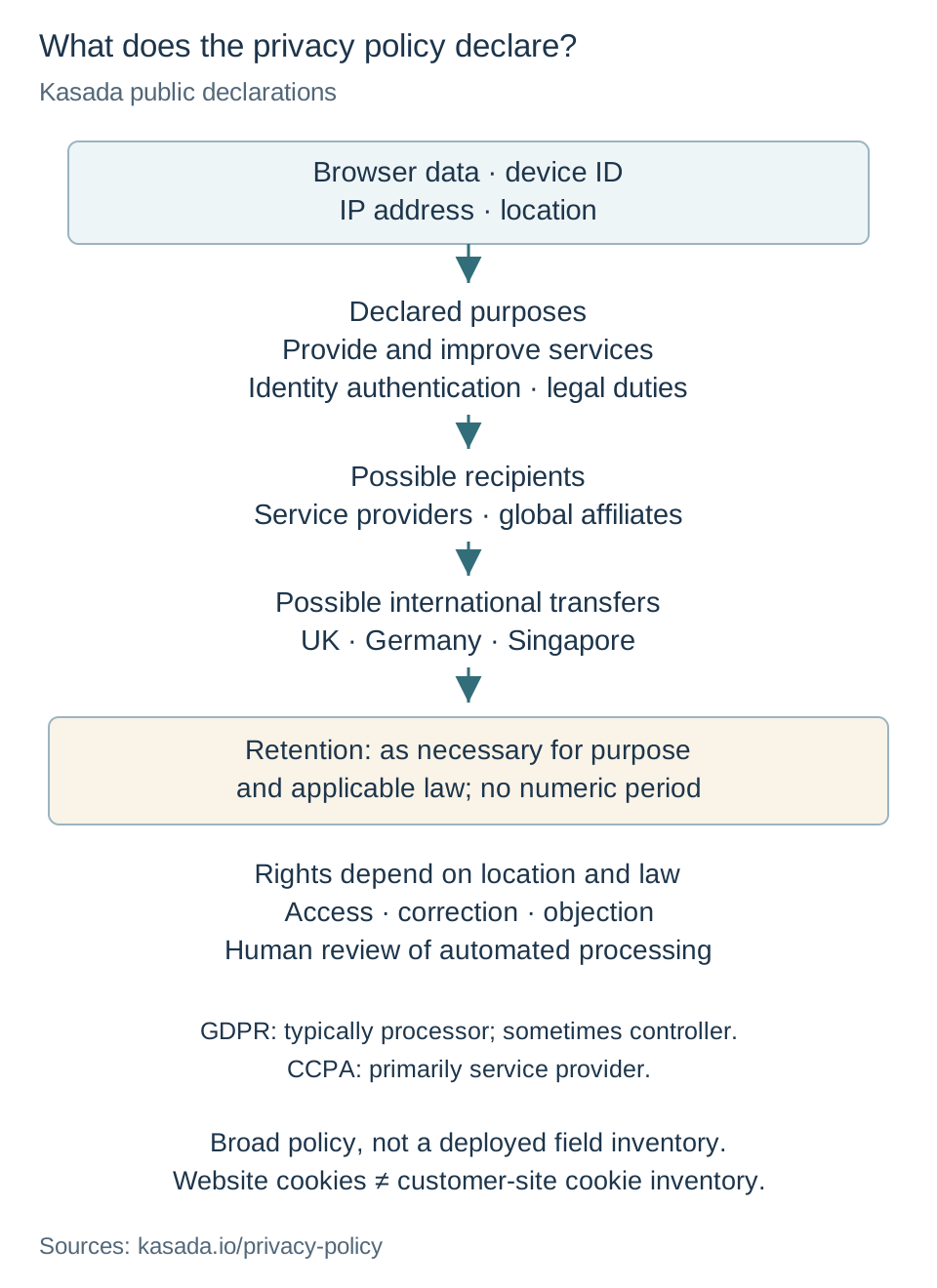
Kasada says it shares information with third-party service providers when needed to provide its services, subject to data processing agreements. It also describes sharing within global affiliates, with consent and in business-transfer circumstances, alongside stated service and legal purposes. A processor assessment can ask which parties receive which categories and under which arrangement. The recipient disclosure does not establish that every listed recipient receives every visitor record. A product-specific recipient list and the customer's agreement are more useful than an unsupported universal statement about all traffic.
The international-transfer section names possible transfers outside Australia and the United States, including the United Kingdom, Germany and Singapore, and states that legal requirements are fulfilled before transfer. That is not a guarantee that a particular request stayed in, or traveled through, any one country. Data location, remote access and onward processing may require separate contractual answers. The published transfer terms establish an inquiry about applicable destinations and safeguards, without supplying a live routing trace or a country-specific legal conclusion.
Retention is described by necessity for the collected purpose and applicable law. The policy does not give a universal numerical lifespan for a browser identifier or account relationship. An operator should ask for the period or criterion for each relevant record, how deletion propagates and whether a security or legal requirement changes the handling. Those are implementation and agreement questions. A number borrowed from HUMAN's published cookie periods would be particularly misleading here: the Kasada retention statement supplies no such shared calendar.
The policy's cookie section describes personalizing the experience and tracking website usage, with a warning that disabling cookies can affect functionality. That is not a catalog of cookies installed by every customer integration. It does not identify a protected site's effective cookie names, purposes or expiration settings. The cookie disclosure should remain within its stated scope, while a site owner checks its actual deployment and notice. Browser-side storage duration and server-side record retention also require separate evidence; deleting one does not demonstrate deletion of the other.
Rights and a usable review path
The policy describes access, correction, erasure, restriction, portability, objection, withdrawal of consent and complaint rights, qualified by location, applicable law and circumstances. It separately says people can object to certain automated processing and request human review. These are declared routes and qualifications, not a guarantee that every request produces immediate deletion or an account decision reversal. An accurate notice should preserve the conditions instead of converting a list of possible rights into an unconditional service commitment.
A useful operational review separates two issues: an access problem that needs application support, and a personal-information request that needs the appropriate privacy contact. They may concern the same interaction but require different records and authority. The policy's role and contact sections provide vendor routes, while the protected site should identify its own route. A support team can collect the minimum information necessary to locate the incident without asking a visitor to export unrelated browsing history, account credentials or a full browser profile.
A California notice is not a browser sensor specification
The California notice organizes information into legal categories and marks whether it was possibly collected or shared in the preceding twelve months. It includes identifiers, commercial information, internet or network activity, geolocation, employment information and inferences. These rows do not all describe the same population or collection channel. A recruitment record and browser activity can both fall within one organization's privacy notice while belonging to different processing purposes. The notice's twelve-month reporting window is also not a promise to retain every record for twelve months.
The notice marks biometric information and sensory data as not collected or shared in that table. It separately marks inferences as a possible category, describing attempts to determine preferences and behaviors from collected information. Those statements should remain distinct: an inference category does not establish biometric identification, audio recording or a particular identification model. Nor does a negative row independently validate every current deployment. The accurate description follows the published notice's wording and scope, with product-specific evidence required for a narrower technical claim.
The policy also says Kasada does not intentionally collect sensitive personal information or knowingly process information about children under eighteen. These are vendor policy statements, not measurements of every person who reaches a protected page. A site serving younger audiences still needs its own processing assessment and appropriate arrangement; it cannot infer that browser requests contain no personal information merely from a vendor's general statement. The policy's broad scope and exclusions make audience and purpose questions for the responsible site owner rather than fields deducible from browser graphics.
Legal basis, consent and human review are separate questions
Kasada names consent, contractual obligation and legitimate interest among the legal bases it relies on, and says it establishes a basis before processing. The list does not select the applicable basis for a specific protected site's visitor. It also does not mean every processing operation depends on consent. The distinction affects how an owner explains an objection or withdrawal request: the relevant purpose, role and basis need to be identified before describing the available response. The GDPR and rights sections provide the declared framework without resolving an individual legal case.
Withdrawal has a specific qualification in the policy: where processing is based on consent, withdrawal does not change the lawfulness of earlier processing before withdrawal. Erasure is described as available in certain circumstances, while objection and restriction have their own qualifications. Combining all of these into a single delete-everything instruction would lose those conditions. An application can instead direct a request to its privacy owner, identify the processing involved and communicate the resulting action. The published rights language supports that differentiated handling rather than an unconditional technical guarantee.
The automated-decision section says tools may process personal information to identify and block malicious bots, offers objection and human review, and states that these tools do not engage in the described decisions with legal or similarly significant effects. The GDPR section separately describes qualified rights concerning solely automated processing with such effects. Both statements appear in the policy. Neither is an independent finding about the effect of an individual site's refusal. Applying the stated legal conditions requires an assessment of the visitor's actual circumstances.
What an attributable browser observation can establish
Public categories are useful for identifying privacy questions; an actual browser observation can test a narrower technical claim. A source-attributed V8 event can record that a particular browser interface was accessed by an identified script during a dated run. It still needs context about instrumentation, execution and coverage. The distinction is consistent with the separate Turnstile evidence analysis: recorded activity, recorder-generated activity and remote service outcomes must not be merged into one fact. API access is one stage, not the complete processing chain.
For the scoped local Kasada research reviewed here, no eligible genuine source-attributed V8 run was established. Two graphics recorder archives identified the page URL rather than a proven vendor-script caller. A separate V8 sample was a synthetic test fixture containing deliberate parser and dropped-event cases. Neither category establishes what Kasada read on a production page. This limitation does not negate the vendor's published signal categories; it prevents those categories from being presented as independently observed calls. No current API inventory is claimed.
The difference between page context and caller attribution is substantive. Multiple scripts can run on the same page, and a recorder may itself access properties while formatting its output. A label naming the page does not by itself select the script responsible for the operation. Similarly, a fixture can contain realistic labels without recording an actual service interaction. The broader fingerprinting explanation covers how surfaces contribute to browser descriptions; it does not establish a particular vendor's use of a surface without additional evidence.
Observation and transmission are also separate. A local read can support a statement about an interface access in that run. It cannot independently establish which value was sent, how long a receiver retained it or whether it affected a decision. These later claims need corresponding network, service or processing evidence, gathered within the applicable authorization and privacy constraints. Kasada's policy disclosures identify categories and broad processing terms; they do not fill in missing per-request events, server weights or a visitor's individual outcome.
The absence of an accepted event must remain an observation limit. It may reflect missing coverage, an incomplete recording, different execution conditions or an interface that was not accessed during that interaction. Without evidence, selecting one explanation would be speculation. The platform's broad category declaration and a scoped missing recording can both be reported accurately. Neither supports the assertion that an API is never used, that a browser configuration is accepted or that a visitor cannot be linked through other information.
Browser controls and an owned site's response policy
BotBrowser documents a profile system that controls browser-exposed properties at the engine layer, including rendering-related surfaces. Its browser overview describes native API paths rather than page-context JavaScript modification for those controls. That architectural distinction is relevant when an owner needs a consistent declared browser environment. It does not establish that every possible surface is controlled, that a third-party service accepts the environment or that account information outside the browser has changed. Those are different claims requiring different evidence.
Patch-level tools operate within the scope of their actual implementation and attachment point. Comparing them with browser-engine controls requires reading their supported behavior and checking the affected context, rather than assuming that a product label describes all exposed properties. The existing patch-versus-engine comparison addresses that architectural question directly. For Kasada privacy, the useful conclusion is limited: browser exposure belongs to one layer, while remote account relationships, customer policy and retention belong elsewhere. The comparison supplies no detector-performance ranking.
An owned deployment can measure impact without collecting everything
Kasada's platform invites customers to evaluate an integration in monitor mode on a login or API endpoint before blocking traffic. It recommends comparing detection, customer friction and operational workload. These are vendor-described evaluation options, not results from a test conducted here. An owner can define a bounded evaluation around legitimate application use, enabled products and the smallest relevant incident records. That makes it possible to investigate an interruption without treating maximum visitor collection as the default requirement for understanding the service.
A meaningful evaluation distinguishes the event units. Counted requests, affected sessions and reviewed accounts are different populations; one cannot be substituted for another when describing impact. A request-level failure also needs the actual integration outcome and application result, including availability behavior where relevant. Kasada's platform statements separate automatic request action, account-review options and the timeout route. Preserving those distinctions prevents an operator from attributing every login interruption to one invisible browser challenge or interpreting an account relationship as a measured request error rate.
Data minimization can be assigned concrete owners. The application team decides what account context the integration needs. The privacy and security teams establish who may inspect relationship information and for what purpose. The processing arrangement should supply a retention criterion and a route for relevant requests. The published policy establishes why those questions exist; it does not resolve their deployment-specific answers. The browser owner separately manages exposure through documented settings, while the site retains responsibility for its collection and response choices.
Sources
- Kasada platform and product distinctions
- Kasada privacy policy
- Kasada bot mitigation explanation
- BotBrowser browser overview
Practical conclusion
A privacy assessment of a Kasada challenge starts with the enabled product and its decision unit. Record the declared browser categories separately from observed calls, distinguish request handling from account relationships, and obtain effective recipient, retention and review information from the responsible deployment owners. Browser-engine controls can manage documented exposed surfaces. They do not supply authority over remote processing or prove a visitor's identity, intent or anonymity.
- PerimeterX signal groups and privacy
- Cloudflare Turnstile measurements and limits
- Challenge families and decision ownership
FAQ
Does a Kasada challenge always show a CAPTCHA?
Kasada says its products do not use CAPTCHAs. Background browser processing and an interrupted request can still exist without a visible puzzle. The public declaration does not prove an individual site's data flow or explain every failed interaction.
Does Kasada publish every JavaScript API it reads?
The cited platform page names browser, operating system and hardware categories, not an exhaustive per-deployment API inventory. No eligible source-attributed V8 run was established in the scoped research, so specific current API calls are not asserted.
Does a shared-device relationship prove that accounts belong to one person?
No. The platform's relationship illustration explicitly says connections alone do not prove fraud. A device relationship is not by itself proof of a natural person's identity or intent.
Does changing browser properties erase existing account relationships?
Documented browser controls govern their supported exposure surfaces. They do not establish deletion of server records or changes to customer account policy. Retention and deletion require the responsible processing parties' actual rules and evidence.
Is there one published retention period for all Kasada signals?
The cited policy uses necessity for the collected purpose and applicable law. It does not give a universal numerical period for every device identifier, account relationship or customer deployment.
This article is part of the guide: What Is a Browser Fingerprint? Canvas Fingerprinting
Related Articles
Akamai Bot Manager: Sensor Data and Privacy
FingerprintPerimeterX Signal Groups and Privacy Explained
FingerprintFunCaptcha: Signals, Sessions and Privacy
FingerprinthCaptcha Privacy: Signals and Evidence Boundaries
FingerprintAWS WAF CAPTCHA: Tokens, Signals and Privacy
FingerprintCross-Surface Browser Privacy: Keep One Context Coherent
Run the same check in BotBrowser
Load a profile, keep the signals you just read about consistent inside the browser, and confirm the result on your own machine before a rollout.