Scraping LinkedIn: Access, Consent, and Browser Limits
Scraping LinkedIn requires separating visible profiles, exports, API grants, and reuse authority. Browser settings cannot grant permission.
BotBrowser Team
Want the structured docs for Fingerprint?
This article lives in the editorial library. For step-by-step setup, reference material, and ongoing updates, jump into the docs section.
Scraping LinkedIn is not authorized merely because a profile renders in a browser. The first decision is whether the proposed use has an approved API, an account-data export, or another explicit basis covering collection and reuse. BotBrowser can configure profile-backed observable browser surfaces in an operator-controlled context, helping separate browser configuration from an observed view. It cannot grant LinkedIn access, add API scopes, supply collection permission, or promise that LinkedIn will accept a browser session.
TL;DR
- A visitor view and a member view describe what was rendered for an observer; neither establishes a reusable dataset entitlement.
- An employer-funded seat has service-specific rights. It does not make the employer the owner of the member's personal account.
- An account export concerns the account holder's data rights; an API grant concerns an application, approved products, requested scopes, and member consent.
- Choose a route by its documented coverage of the intended data and purpose. An unresolved permission or field requirement is a reason to narrow the proposal, not a browser setting to change.
Contents
- Five boundaries that answer different questions
- What a profile view actually establishes
- Account ownership, exports, and application grants
- A decision record for choosing a supported route
- Browser contexts and observer uncertainty
Five boundaries that answer different questions
The phrase “LinkedIn data” hides several different objects: a field displayed to a visitor, a field displayed to a particular member, a copy supplied to an account holder, and a response supplied to an authorized application. Treating these as interchangeable creates a planning error before any technical work begins. LinkedIn's User Agreement, especially §8.2, restricts scraping or copying the service and unauthorized automated access. A rendered value does not cancel those restrictions.
The useful distinction is between evidence of presentation and evidence of authority. A screenshot can establish that a particular view included a job headline at a particular moment. It cannot establish that bulk copying, redistribution, enrichment, or continued retention is covered. An API permission can establish a narrower application capability, but its endpoint and purpose still matter. These are separate claims with separate supporting records, even when they concern the same profile.
| Boundary | Question it answers | Evidence it can supply | Inference it cannot supply |
|---|---|---|---|
| Visitor-rendered view | What appeared without a member session? | A view tied to its access channel and time | Permission to compile profiles |
| Member-rendered view | What appeared to this member? | A view conditioned by settings and relationships | Identical access for every member |
| Account data export | What copy can the account holder request? | The delivered account-data categories | Ownership of other members' information |
| API consent and grant | What may this application request? | Approved product access and granted scope | General website-data access |
| Collection and reuse authority | Is this proposed purpose covered? | Applicable terms, consent, agreement, and legal assessment | A conclusion derived only from visibility |
The final row is not an additional technical interface. It is the decision that must fit the chosen interface and intended use. For example, permission to display a member-authorized result inside an application does not itself answer whether the same result may become a prospecting database. That question needs the governing product terms and the proposed downstream purpose, rather than a comparison of browser screenshots. The legal and terms decision record addresses those responsibility questions in more general collection settings.
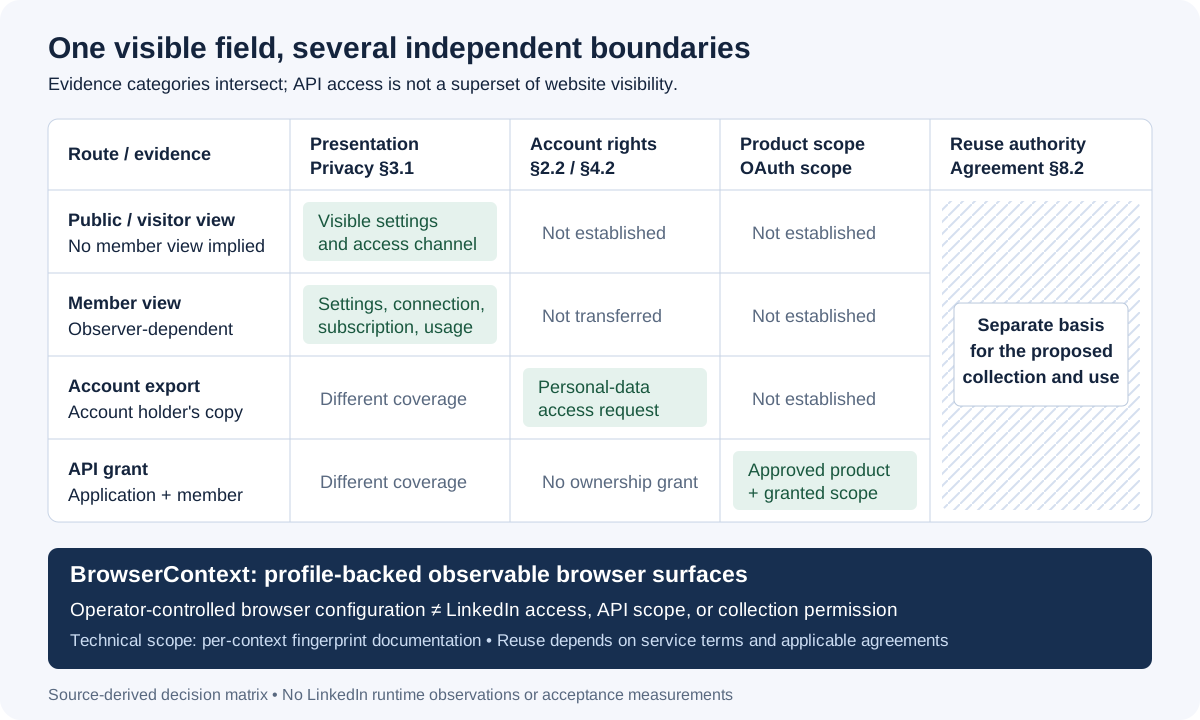
The matrix marks the kind of evidence each route provides, not a progression toward unrestricted access. In particular, API access is not a superset of everything visible on the website. A product can expose a narrow response even when a browser shows a richer page; an export can contain account information with no corresponding public view. The scope boundary and the presentation boundary therefore intersect without containing one another.
What a profile view actually establishes
Privacy Policy §3.1 describes how profile visibility depends on settings and on the viewing member's degree of connection, subscriptions, service usage, access channels, and search types. Those conditions matter more than a simple public/private label. Even within member access, a search by name and a search by keyword are not guaranteed to yield the same profile availability or fields. The policy does not justify assuming that every signed-in member receives an identical record.
Consider a proposed comparison of two existing, legitimately supplied observations. One shows a headline, and another also shows an additional profile section. The difference supports the statement that the views differ. It does not isolate the cause. The observers could differ in subscription, relationship, settings, channel, or observation time. A browser configuration difference may also exist, but the visible result alone does not identify it as the explanation. Record the known conditions before assigning a cause.
An absent field deserves especially careful wording. “Not shown in this member view” is an observation; “the member has no such information” is a claim about the underlying account. A public result that contains less information likewise does not show that the full profile is empty. Privacy §3.1 describes conditional availability, so missing presentation evidence should remain missing rather than being converted into a negative fact about a person.
The same discipline applies to apparent completeness. A page can look detailed without being a complete representation of account data or an API response. A subscription label cannot serve as a schema contract, and a successful render cannot establish that every requested field will remain available later. A requirements document should distinguish “field needed for the business purpose” from “field seen in one view,” because only the former describes the proposal being evaluated.
Public job listings are a neighboring but different workload. The public job-board browser boundary owns listing access classes and extraction stops, while Indeed and LinkedIn job-field interpretation covers posting fields, pagination, and job identity. A listing's presence is not evidence about access to a member's connections or account history. Mixing those records under one “LinkedIn coverage” percentage would hide the change in subject and authorization.
For source analysis, the useful output is a qualified claim such as member-view / headline present / relationship unknown, rather than a promise of universal coverage. That description preserves what the evidence supports and exposes the missing variable. It also lets a decision maker reject an unsuitable source without commissioning a collection experiment simply to discover that its access assumptions were incomplete.
Account ownership, exports, and application grants
Account access begins with the person, not the workstation. Agreement §2.1 and §2.2 specify one real-name account and prohibit sharing or transferring an account. Section 2.2 also distinguishes an employer's rights over a purchased service from rights over the member's personal account. An employer may control access to a paid seat and receive reports about its use, but payment does not transfer ownership of that personal account.
That distinction changes how an organization evaluates a data request. A subscription invoice can establish that a service was purchased. It cannot establish that the organization owns the employee's profile, connections, or account history. A manager's access request and a member's own data request are therefore not equivalent evidence. The correct record identifies whose rights are being exercised and which service-specific rights apply, without treating a shared workstation as a shared account entitlement.
Account exports concern the account holder
Privacy §4.2 describes rights to access personal data and request a copy, including a machine-readable copy of personal data provided to LinkedIn. This supplies a relevant option when the actual need is an account holder's own information. It is a different route from compiling other people's profiles, and its suitability depends on the categories actually supplied and the purpose for which they will be used.
An export should consequently be evaluated as a delivered package with a defined subject and coverage. If the business question concerns the account holder's own records, the package may answer it without reproducing website presentation. If the question concerns an entire market of people, the right to request one's own data does not establish market-wide coverage. Privacy §4.2 is evidence for the access right it describes, not a guarantee of every category or historical version a project might want.
Application consent is product-dependent
The LinkedIn authorization-code documentation describes an application asking a member for access using the scope parameter. Available scopes depend on the Products or Partner Programs approved for that application. Product approval and member consent answer different questions: the first concerns what the app is eligible to request, and the second concerns what the member has granted within that request.
The documentation also states that changed scope permissions require users to authenticate again so the requested permissions are explicitly granted. A previous consent record cannot simply be read as approval of later expansion. When evaluating an integration, the relevant evidence is the current approved product coverage and the current granted scope set, together with the endpoint requirements. A generic “connected to LinkedIn” badge omits exactly the distinctions needed to judge a new data requirement.
Browser sign-in is a third state, separate from both eligibility and application consent. MDN's cookie guide explains how cookies can support session management between a browser and a server. That browser session is not an API access token or proof that an application has a particular grant. Conversely, an application grant is not general permission to copy the website. The authorization documentation concerns member-authorized API calls under requested scopes, not arbitrary rendered pages.
These routes should be compared by coverage rather than convenience. The account holder's export, a product-approved API, and a separately documented agreement may each answer a different legitimate requirement. Where none covers the proposed data and reuse, the unresolved item is the proposal itself. No conclusion about an alternative route follows merely because one of these options lacks a desired field.
A decision record for choosing a supported route
A useful approval record starts with a narrow question: whose data is needed, which fields are necessary, who receives the result, and what will happen to it afterward? Those details determine which evidence is relevant. “Research,” “recruiting,” or “internal use” alone is too broad to distinguish an account-holder request from a new database of other members. Agreement §8.2 makes copying and use material issues, while Privacy §4.2 and OAuth scope describe different supported access mechanisms.
The table is an original decision aid derived from those source distinctions. It is not a statement that a listed proposal is automatically approved. Its choice rule is to select a route only when the required evidence covers both the requested data and the proposed purpose; otherwise keep the missing item explicit and reduce or suspend that part of the requirement.
| Proposed need | Required evidence | What remains unknown | Action |
|---|---|---|---|
| An account holder needs their own record copy | Privacy §4.2 request basis and actual export categories | Whether the package contains the needed history | Evaluate the export's documented contents |
| An app needs member-authorized data | Approved Product or Partner Program, endpoint requirements, current granted scope | Whether the desired fields and use are included | Compare the requirement with current API coverage |
| A team wants to retain profile fields seen by a visitor | Agreement §8.2 assessment and explicit authority for that use | Collection, retention, and redistribution coverage | Resolve those terms before selecting a collection mechanism |
| An employer wants information from a funded seat | Seat terms plus the personal-account boundary in §2.2 | Which organizational reports are covered | Prefer the service's supported reporting options |
| Two supplied profile views disagree | Privacy §3.1 conditions and observation provenance | Which condition caused the difference | Preserve the discrepancy without inventing a complete record |
A field-level requirement can be rejected without rejecting the whole project. Suppose the needed output is an account holder's activity summary, while a suggested extra column concerns unrelated members. The export route might fit the first part; it supplies no automatic answer for the extra column. Separating them exposes a smaller viable purpose instead of allowing an optional enrichment idea to redefine the entire authorization basis.
Evidence also has a time dimension. An old product approval, a former seat assignment, and a historical consent statement may describe past conditions. The OAuth documentation's changed-scope requirement is a concrete example of why current coverage matters. A decision record should identify the version or date of the relevant terms and the consent scope being evaluated, without storing secrets or reproducing account-session material. A reference to the responsible system's approval record is more useful than an unexplained “authorized” flag.
Finally, distinguish a provider's description from its demonstrated coverage. A third party offering “LinkedIn data” may supply an export-derived dataset, a licensed product, or something else entirely. The label alone establishes none of those routes. Ask which source, contractual basis, permitted purpose, and update limitations apply to the exact dataset. Agreement §8.2 expressly addresses information obtained through third parties, so intermediary delivery does not remove the need to examine the underlying rights.
Browser contexts and observer uncertainty
The per-context fingerprint documentation describes profile and browser-setting controls attached to a BrowserContext. That is the relevant BotBrowser capability here: an operator can keep the browser's configured observable surfaces attributable to a particular controlled context. The documentation supplies browser-layer controls; it does not establish a LinkedIn entitlement, an API permission, or an explanation for a particular LinkedIn response.
General context separation is covered by multi-account browser isolation. Its technical separation should not be read as LinkedIn permission to create multiple accounts: Agreement §2.1 remains a distinct account rule. Likewise, browser site-data clearing and account boundaries owns cleanup semantics. Clearing local state is not evidence that a server-side API grant has been revoked, and a private browsing context is not a guarantee of anonymity to a service.
A synthetic A/B/C observation comparison
The following is a harmless, synthetic reasoning example, not an actual LinkedIn run, a measured acceptance result, or a recommended collection procedure. The rows represent fictional observations supplied for analysis. No accounts, credentials, or real profile data are involved.
| Fictional observation | Supplied conditions | Visible result | Defensible interpretation |
|---|---|---|---|
| A | Visitor view; channel recorded | Headline shown; detail section absent | This visitor presentation lacks that section |
| B | Member view; relationship and subscription unknown | Headline and detail section shown | The member presentation differs; cause unresolved |
| C | Application response; approved product and scope documented | Only product-supported fields returned | API coverage is narrower than the requested website comparison |
Comparing A with B does not isolate a browser effect, because membership and other visibility conditions differ. Comparing B with C does not show API failure, because the API's product contract differs from page presentation. Privacy §3.1 supports retaining the first uncertainty; the OAuth documentation supports retaining the second. Neither comparison establishes that a missing value can be recovered by altering a browser profile.
A useful analytical rule is to attach every conclusion to its evidence class. Label A as presentation evidence, B as conditional member-view evidence, and C as application-scope evidence. Record the absent relationship information as unknown rather than filling it with a plausible explanation. This keeps browser controls in their proper role and prevents a richer screenshot from silently becoming a promise of a more complete authorized dataset.
FAQ
Does a paid LinkedIn seat make an employee's account company property?
No. Agreement §2.2 gives the purchaser rights over the paid service, including access control and usage reports, while preserving the distinction from the member's personal account. A procurement record therefore needs the seat's reporting terms, not an assumption that payment transfers the account.
Can consent to one API request cover newly requested scopes?
The authorization documentation requires renewed authentication when scope permissions change, so the expanded request is explicitly granted. Product eligibility must also cover the requested scopes. An earlier consent event is not evidence that a later, broader requirement was approved.
Is a profile field missing from an export necessarily unavailable everywhere?
No. An export, a rendered page, and an API response have different coverage. The delivered export's contents answer a package-specific question. Missing export data does not prove absence from a page, and page visibility does not create an export or API entitlement.
Can an observation establish that LinkedIn accepted a browser configuration?
A particular supplied view can establish what appeared under its recorded conditions. It cannot establish future acceptance, a general success rate, or the reason for a difference between observers. No runtime acceptance measurements are reported here.
Sources
- LinkedIn User Agreement: §2.1 account eligibility; §2.2 account and paid-seat rights; §8.2 copying and automated-access restrictions.
- LinkedIn Privacy Policy: §3.1 visibility conditions; §4.2 access and data-copy rights.
- LinkedIn authorization-code flow: member consent, product-dependent scopes, and changed-scope authorization.
- BotBrowser per-context fingerprint documentation: profile-backed browser controls scoped to a context.
- MDN HTTP cookies guide: browser/server session-state model.
Practical conclusion
The decision for scraping LinkedIn starts with the data subject, intended use, and a supported access basis. Visitor visibility, member visibility, an account export, and an application grant supply different evidence; none should silently substitute for the others. Browser configuration belongs after that distinction and cannot complete missing rights or product coverage.
Write one sentence naming the needed data, its subject, recipient, and purpose. Match it to the decision-table row, then identify the exact export category, approved API scope, supported service report, or explicit agreement that covers it. If the match is incomplete, narrow the requested output before choosing browser tooling.
This article is part of the guide: What Is a Browser Fingerprint? Canvas Fingerprinting
Related Articles
Canvas Fingerprint Test: Empty Exports and Errors
FingerprintKasada Challenge Signals and Privacy Explained
FingerprintWeb Scraping API: What the Response Leaves Out
DeploymentGoogle Maps Scraping: Places API or Rendered Listings?
Getting StartedScraping Legal and Terms: What a Team Must Decide First
FingerprintCross-Browser Fingerprinting: What Linkability Shows
Run the same check in BotBrowser
Load a profile, keep the signals you just read about consistent inside the browser, and confirm the result on your own machine before a rollout.