FingerprintJS Pro: Data Processing and Privacy
Separate FingerprintJS Pro workspace correlation, IP pseudonymization, history lookup and encrypted result delivery from browser-side privacy controls.
BotBrowser Team
Want the structured docs for Fingerprint?
This article lives in the editorial library. For step-by-step setup, reference material, and ongoing updates, jump into the docs section.
FingerprintJS Pro is not simply the open-source FingerprintJS hash running with more browser properties. The commercial service, now documented as Fingerprint Identification, processes identification requests through a client-server system. Its privacy consequences depend on the workspace, the processing region, the information returned, and the copies retained by the integrating business. BotBrowser provides profile-backed browser surface controls at the engine layer; it cannot change a separate service's workspace identifiers, erase customer exports, or establish a lawful purpose for processing.
The important distinction is between reducing one disclosed field and ending correlation. Fingerprint documents an IP-pseudonymized mode in which the response IP becomes 0.0.0.0, while existing visitor IDs can continue. It also documents different visitor IDs for unrelated customers, but shared identification across multiple domains controlled by one business. Neither statement means that all observations become unlinkable. The relevant boundary is the service configuration and its documented purpose, not merely the hostname visible in the address bar.
TL;DR
- Commercial Identification is a processor-backed service. The OSS library's local digest does not describe its complete data path.
- Visitor IDs are documented as workspace-scoped. Multiple domains under the same business can participate in that scope; different customers receive different IDs.
- IP pseudonymization changes stored and returned IP information and limits several products. It does not necessarily reset existing visitor IDs.
- The published 7-day, 30-day and 90-day figures describe history lookup windows. Customer webhook copies have a separate lifecycle.
- Sealed Client Results encrypt delivery through the client to the backend. Encryption does not mean that the processor or integrating backend never processes the event.
Contents
- Commercial processing versus an OSS digest
- Workspace scope across controlled domains
- IP pseudonymization and retained correlation
- Region choice and processor custody
- History lookup versus downstream copies
- Encrypted delivery and client visibility
- Browser controls and service-side limits
- Practical conclusion
Commercial processing versus an OSS digest
The Fingerprint privacy documentation distinguishes the open-source library from the commercial client-server API. That distinction changes the first question in a privacy assessment. For a local library, an engineer can inspect what a particular source revision collects and how it derives a digest. For a service, the assessment also needs the receiving party, identifier scope, account configuration, response delivery and customer storage. A package name alone cannot answer those questions.
The existing FingerprintJS OSS source trace covers component states, source ordering and lazy digest provenance at a pinned commit. Those facts do not establish the implementation or data handling of the commercial product. In particular, a locally derived value and a remotely returned identification result can have different histories even when both are casually called a fingerprint. Treating them as interchangeable loses the service boundary before the assessment has begun.
Fingerprint describes the integrating website as a data controller and itself as a data processor. These are the vendor's stated roles under its documented model, not a finding about every deployment. The site decides why it requests identification and how its application uses the response. The processor receives and processes information for the service. A business still has to assess its actual purpose, configuration, contractual terms and obligations; a product's compliance statement does not decide those matters for it. A separate hCaptcha privacy analysis shows why provider, integrator and end-user roles need their own policy scope; its terms are not the Identification contract.
The same privacy and compliance page distinguishes attribution and personalization from fraud prevention and security. It gives guidance about consent and legitimate interest, but that guidance should not become a universal permission to collect. The concrete engineering implication is narrower: identification timing and the business purpose must be explicit. A security integration and a purchase-attribution integration should not silently inherit each other's collection assumptions merely because they use the same software.
According to that documentation, the JavaScript agent stores cookies and other browser metadata during an identification request. Loading an agent and requesting identification therefore deserve separate entries in a data-flow description. The documentation describes explicitly triggering identification in suitable circumstances rather than assuming that every page load must produce an event. That is a collection-design decision for the integrating application, not a browser privacy setting that can be inferred from an installed package.
A useful review separates at least three records: the application's decision to request identification, the service event, and the application's later use of a result. They are related but not identical. A retained application record can outlive the original request. A response can influence a decision without becoming a complete copy of the service event. Recording those distinctions makes it possible to ask which data is necessary for a stated purpose instead of treating the whole integration as one indivisible operation.
The regions and retention documentation supplies service-side configuration facts, while the sealed-results documentation explains one response-delivery option. Neither is evidence that a particular browser executed a particular API. No source-attributed V8 event capture is presented here. A network response or an archived field map cannot establish which browser interfaces the current commercial agent read, in which frame, or during which stage of a request.
That evidence limit leaves the central privacy decision intact. A business can compare workspace scope, retained copies and documented response options without reconstructing a proprietary collector. Conversely, a runtime API trace would not by itself prove the processor's storage or deletion behavior. Browser observation and service governance answer different questions. They should meet in an assessment, but neither should be substituted for the other when the required evidence is missing.
Workspace scope across controlled domains
Fingerprint states that visitor IDs are scoped to a workspace, rather than being a universal identifier shared by all its customers. It says that two customers identifying the same browser or device receive different IDs. That is a meaningful documented limit on one kind of correlation. It is not a promise that no business can connect activity across its own properties, and it does not describe how that business might associate service results with its own account data.
The same source explicitly supports identifying visitors across multiple domains controlled by one business. Its stated condition is that the sites use a public API key from the same workspace. An origin boundary and a workspace boundary therefore answer different questions. Two sites can have separate browser origins while taking part in one documented identification scope. A privacy notice that describes only the current domain can omit that organizational relationship even when the underlying integration is operating as configured.
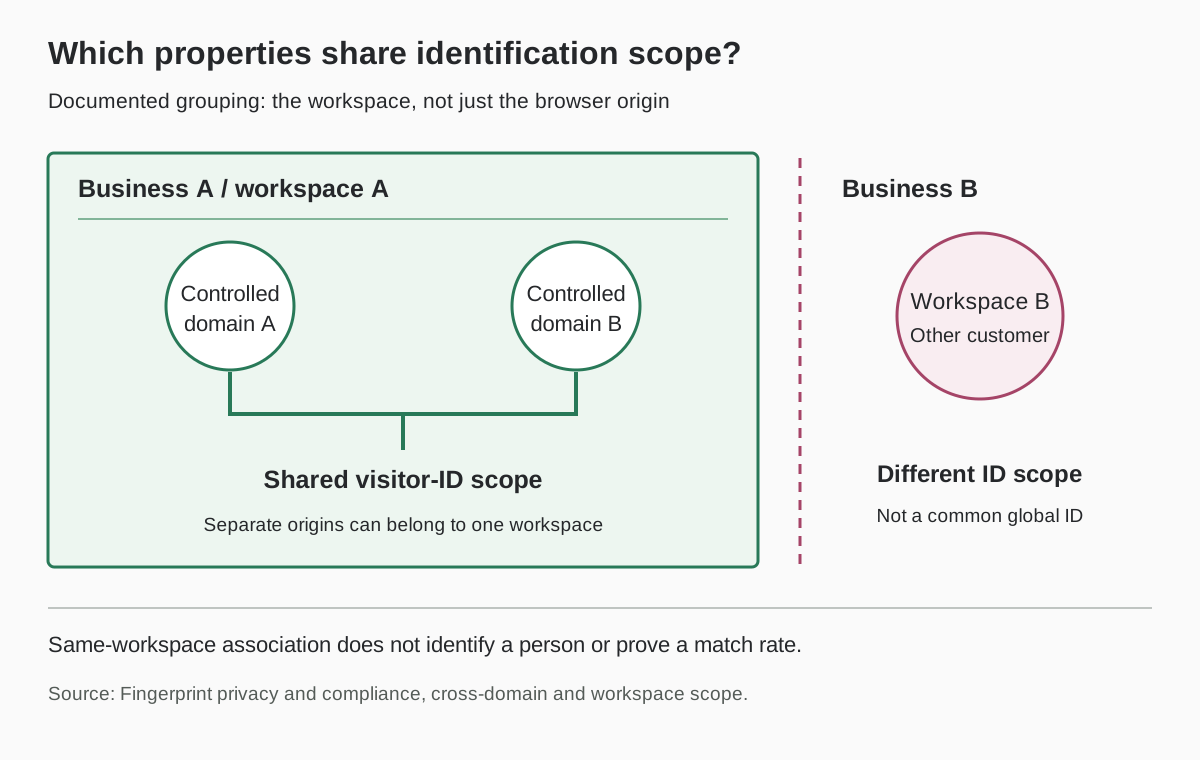
The diagram represents the vendor's stated ownership model, not a measured match rate. The two domains inside one workspace indicate a permitted association across controlled properties. The separate workspace indicates the documented different-customer boundary.
For a business with a landing site and an application, shared scope may support an explicitly chosen attribution purpose. For another business, separating unrelated product contexts may better match its stated data minimization goals. These are purpose and architecture decisions, not instructions for changing detector outcomes. The vendor's cross-domain explanation establishes that cross-domain association is supported; it does not establish that every possible grouping is appropriate or legally justified.
Workspace scope also needs to be distinguished from a person. The documentation describes identifying browsers and devices. An application can separately hold account, purchase or support information. If the application associates a service event with those records, the resulting exposure includes the application's association, not only the visitor ID field. Calling the original output pseudonymous does not describe everything that a customer database may know about it after that association has occurred.
The broader distinction between a browser signature and a person appears in browser fingerprinting and Canvas Fingerprinting. Here the additional question is organizational reach. Who operates each domain? Which workspace does each integration use? What purpose permits the events to be considered together? Those answers define a more useful privacy boundary than a statement that an identifier is merely first-party or merely generated without a third-party cookie.
The privacy documentation says that the system is unsuitable for a global activity graph across unrelated sites because customers receive different IDs. Preserve that qualifier. A global cross-customer identifier and a business's own cross-domain identifier are not the same arrangement. Denying the first does not deny the second. Likewise, the existence of the second is not evidence that unrelated customers receive a common ID or share an activity history.
An integration inventory should consequently identify both browser origins and the workspace relationships that connect them. This is especially useful when one team maintains a public landing site and another maintains the signed-in application. Each team may accurately describe its own frontend while missing a shared service configuration. The documentation provides the reason to check that relationship, but only the business's actual configuration can establish whether the relationship exists in its deployment.
IP pseudonymization and retained correlation
The pseudonymized-IP documentation describes a choice between ordinary IP processing and an alternative representation. In the ordinary mode, Fingerprint says it stores the originating event's IP address as plain text and uses it in identification. In the alternative mode, the original IP is combined with other metadata and cryptographically converted before use by its identification algorithms. These are descriptions of the vendor's processing model, not independent observations of its infrastructure.
The documented response difference is concrete. Ordinary responses expose the original IP address; pseudonymized-mode responses use 0.0.0.0. That value is a representation in the response, not the browser's new network address. It does not mean that the browser sent its request from an all-zero address, nor that no network infrastructure handled a real connection. Confusing the displayed field with the connection would turn a data-handling option into an unsupported transport claim.
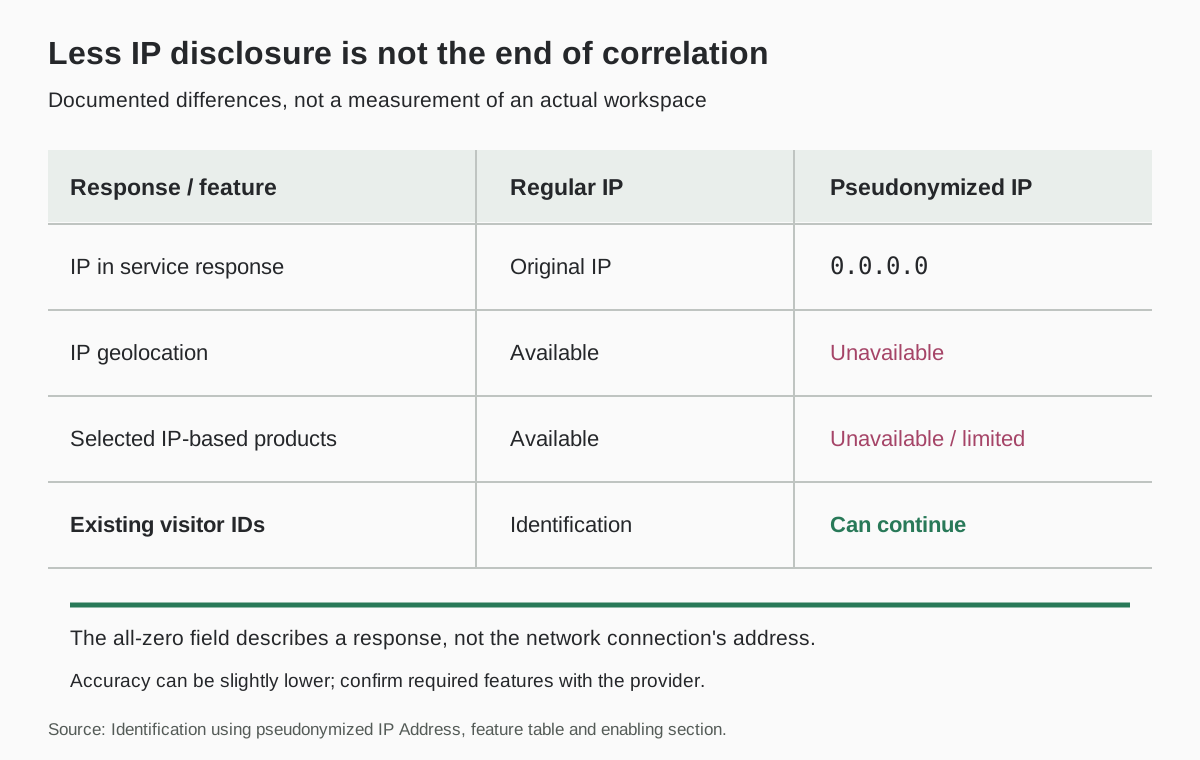
Fingerprint's comparison table lists functional trade-offs. IP geolocation is unavailable in pseudonymized mode. Several IP-dependent Smart Signals are also unavailable, and browser bot detection has limited availability. The relevant question is therefore not whether one can make a field disappear without consequences. It is whether the application needs those outputs for its declared purpose, and whether less exposed IP information is worth the documented loss of some functionality.
The enabling section supplies the most important correlation qualification: an existing workspace can remain, and users can continue to receive the same visitor ID. An application that only stops storing a visible IP field has not necessarily stopped linking visits through another identifier. This does not make pseudonymization meaningless. It means the privacy improvement must be described at the field and processing level that actually changes, rather than expanded into a claim of complete unlinkability.
The same source also contains an accuracy qualification. Its introductory language presents the alternative positively, while the enabling section says identification accuracy can be slightly lower than standard identification. A purchasing or implementation decision should preserve the specific qualification. No accuracy percentage or controlled comparison is supplied here, so neither the size of a change nor unchanged accuracy can be asserted for a particular business's traffic.
| Application requirement | Documented implication | Decision boundary |
|---|---|---|
| Avoid exposing the original IP in identification responses | Pseudonymized mode returns 0.0.0.0 | Still assess other response fields and customer copies |
| Use IP geolocation from the service | Not available in pseudonymized mode | Decide whether that feature is necessary for the stated purpose |
| Keep existing identification continuity | Existing visitor IDs can continue | Do not describe the change as a reset of correlation |
| Preserve every IP-dependent product | Several products become unavailable or limited | Confirm the exact required product with the provider |
This table is a decision aid derived from documented feature differences, not a measurement of a configured workspace. The first row concerns disclosure in a response. The third concerns continuity of another identifier. Keeping those rows separate prevents a common assessment error: treating the removal of one recognizable field as proof that all remaining records lack association value. The service's stated ability to retain visitor-ID continuity directly contradicts that inference.
A customer should also distinguish the processor's transformed representation from its own application data. If an application separately records network addresses or account events, changing one processor option does not rewrite those independent records. The source describes the Identification feature, not every server in the customer's architecture. The meaningful privacy question is which copies and associations change when the option changes, and which remain because they are produced by another part of the system.
Region choice and processor custody
The regions documentation lists three workspace regions: Global in Northern Virginia, EU in Frankfurt and Asia in Mumbai. The documented default is the US region. It also says that the chosen workspace region cannot be changed afterward. Region is therefore a setup decision with an ongoing consequence, rather than a cosmetic dashboard preference that can be assumed to follow the visitor's physical location or the integrating company's postal address.
A region name identifies the service configuration described by the vendor. It should not be confused with a browser profile's operating-system target, a proxy exit, or a website's interface language. Those properties can affect a browser session without changing where a processor says it stores workspace data. An EU-language page is not evidence of an EU workspace. A regional proxy connection is not evidence that an existing workspace has moved to a different processor region.
Fingerprint says that data does not leave the chosen region. That is the vendor's stated service-residency commitment. It does not locate an integrating business's own analytics warehouse, backend logs or exported webhook records. If the business receives an event and stores it elsewhere, the resulting data path includes an additional customer-controlled destination. A complete map needs both the processor region and the places where the customer chooses to receive or retain its outputs.
The documentation requires a non-default region to be specified for the JavaScript agent and the corresponding base URL to be used for Server API access. These are two configuration surfaces associated with the same region choice. A frontend and a backend maintained by different teams can therefore need coordinated configuration. The documented requirement is useful evidence for an integration inventory; it is not a claim that a particular misconfiguration occurred or a prediction of the error a specific deployment would return.
The privacy and compliance page places the business's processing decisions alongside the processor's duties. That division makes region selection necessary but insufficient for the entire privacy assessment. A team still needs to know the purpose of identification, the properties connected to the workspace, the responses it retains and the people or services that can access them. Choosing a named region does not answer any of those questions automatically.
For example, consider a business that selects an EU workspace but sends received events into a separate customer-operated reporting system. The vendor's region statement describes its side of the service. The reporting system introduces a customer decision that must be assessed separately. This example does not assert any particular transfer or legal result; it shows why a processor region and a downstream destination belong in different rows of a data-flow inventory rather than being compressed into one regional label.
The retention and deletion sections then add another independent boundary. A destination answers where a record is processed or stored. A lookup window answers how far back a named interface allows access. A deletion process concerns removal of information. None of those descriptions can substitute for the other two. In particular, knowing the region does not establish how long every record remains, and knowing a lookup period does not establish where customer exports reside.
The region decision should consequently be made before relying on assumptions about relocation. The source explicitly calls the workspace choice immutable. It does not supply a general migration promise in that statement. A business needing a different arrangement should establish the supported process and consequences with the provider rather than assuming that changing a browser setting, region argument or hostname changes the existing workspace's storage commitment. The assessment needs the actual arrangement, not an inferred one.
History lookup versus downstream copies
The heading of Fingerprint's data-retention section is broad, but the text and table define a particular capability: how far back visit history can be looked up through the Dashboard and Server API. The published windows are 7 days for Free, 30 days for paid self-service plans, and 90 days or longer for Enterprise according to contract. Those figures should retain their named interface and plan context whenever they are quoted.
The distinction matters because access and erasure are different events. A record no longer appearing through one lookup interface does not, by itself, prove that every underlying or downstream copy has been deleted. Conversely, the lookup table does not prove indefinite retention either. It establishes the availability window the vendor describes. Questions about actual deletion need the applicable agreement, supported deletion process and evidence appropriate to that claim, rather than an extrapolation from an interface's history limit.
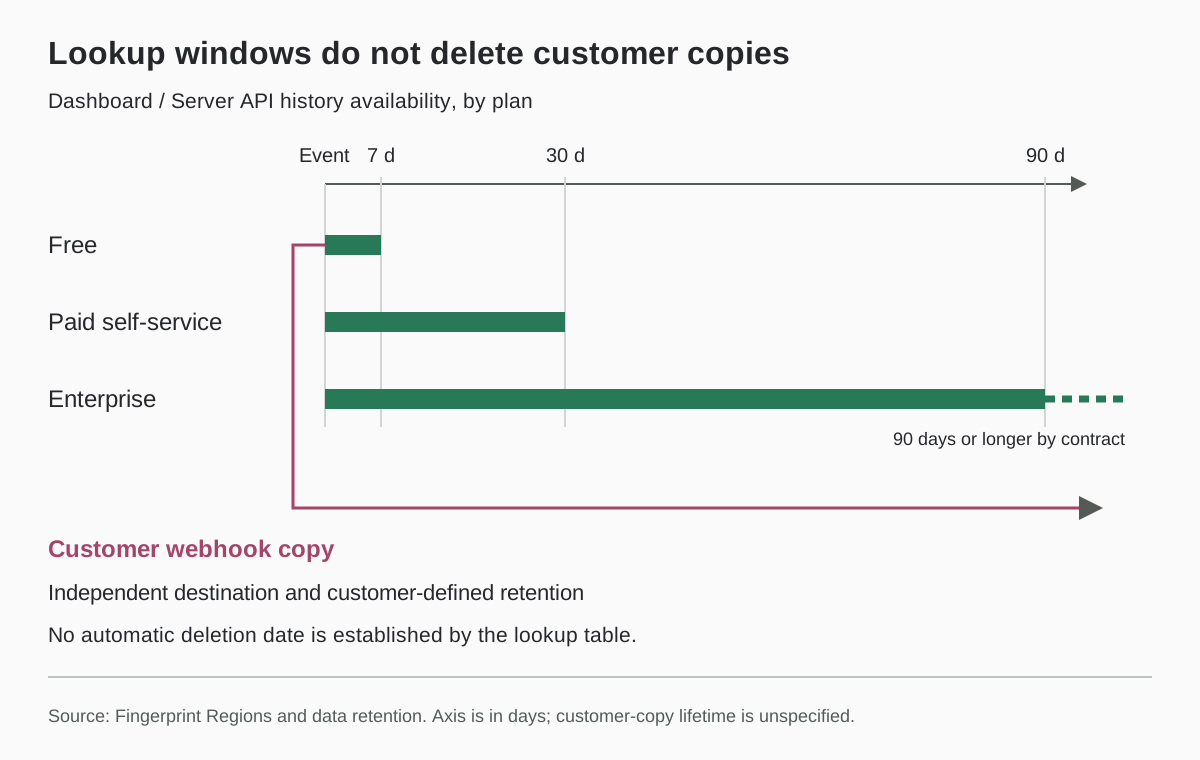
The same documentation explicitly offers webhooks for customers that need longer storage or a custom storage solution. Each identification response can be delivered to a customer endpoint and saved in the customer's database. This is direct evidence that a service lookup period and a customer copy can have different lifecycles. The diagram therefore puts the customer copy on a separate branch instead of extending a vendor lookup bar into an invented universal retention schedule.
A customer using that option needs its own decision about how long the received data is useful and who can access it. That decision is not determined by whether the service plan says 7 days or 30 days. The published table cannot establish the customer's database cleanup behavior. A business that describes its entire retention policy using only the plan's lookup window risks describing the service interface accurately while omitting the copy that its own systems still maintain.
The deletion section says that Fingerprint, acting as processor, will delete information belonging to a browser or device upon a controller request, and directs customers to support. That is a documented process and role assignment. It is not a production deletion test, a guaranteed completion deadline, or evidence that a customer's independent exports are removed at the same time. Those additional claims require their own applicable commitments and verification.
The controller's inventory can distinguish three useful cases. First, an application may retrieve an event only when needed and avoid keeping a full copy. Second, it may retain selected fields for a defined business purpose. Third, it may retain the full delivered response in a separate system. These are illustrative customer choices, not claims about defaults. They create different access and cleanup responsibilities even though all three businesses could use the same service plan and processor region.
According to the plan-window explanation, upgrading from Free to a paid plan increases the lookup window to 30 days. That is an access change, not a basis for claiming that a historical deletion was reversed or that all previously unavailable data will always become recoverable. The public statement supports the stated window change. Details of any particular account's historical availability should be established through that account's supported service behavior and contractual terms.
For privacy decisions, the practical distinction is between a service feature and an end-to-end retention commitment. The service feature has a named interface, plan and period. The end-to-end commitment must account for the processor and customer destinations actually involved. A short service window can coexist with a longer customer copy; an encrypted response can also be retained after decryption. Neither a small number in a pricing table nor an encrypted transport representation establishes the lifecycle of every resulting record.
Encrypted delivery and client visibility
Sealed Client Results provide an alternative delivery mechanism for event information normally obtained through the Server API. The documented design returns an encrypted result through the client agent, intended to be decrypted and used on the integrating backend. The privacy property concerns who can read the result along that delivery path. It does not remove the original service processing or the backend's ability to receive the event in usable form.
In an ordinary Server API arrangement, the backend retrieves the event from the service. In the sealed arrangement, the browser carries an encrypted result to the backend, which decrypts it. The two paths differ in delivery and client visibility, but both still involve the service and the integrating backend. The relevant comparison is not “data versus no data.” It is whether the event travels through a particular participant in readable or encrypted form, and what happens after an authorized recipient obtains it.
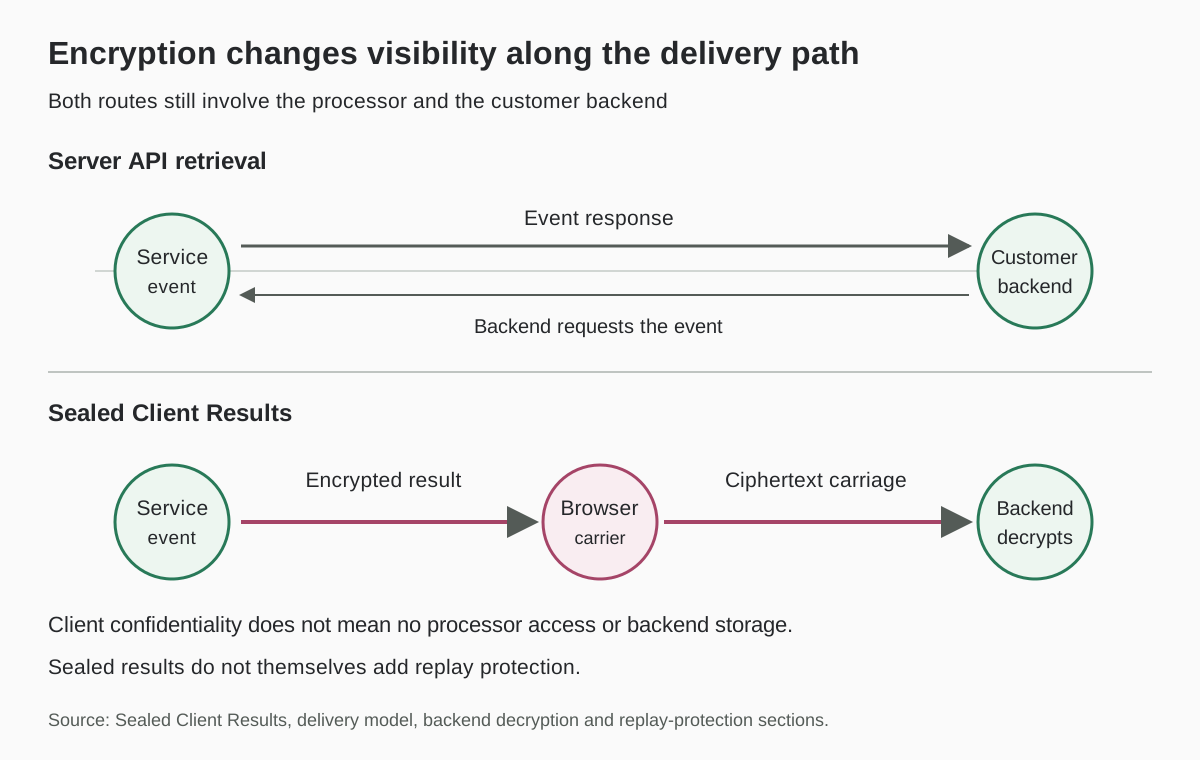
Fingerprint describes the sealed result as containing the event information otherwise available through its event endpoint. Encrypting that package does not establish data minimization by itself. It can reduce exposure of the result to client-side readers while leaving the amount of information available to the backend unchanged. A team deciding which fields its application needs should therefore make that decision separately from choosing whether delivery is encrypted.
The configuration documentation places decryption on the backend. That boundary matters for application design: the encryption key and the decrypted event are not intended to become ordinary page-readable state. This is a documented delivery architecture, not a claim that every integration implements it correctly. An assessment of a real deployment would need to examine where the application actually exposes the result and where it records the decrypted information.
Encryption also should not be expanded into a freshness claim. The replay-protection section explicitly says sealed results do not themselves add replay protection. Authentic delivery and application acceptance are separate properties. An encrypted event can still require application-side decisions about relevance and freshness. No protected-service interaction or acceptance procedure is supplied here; the important privacy lesson is that one mechanism cannot be credited with guarantees the provider says it does not supply.
The browser's role as carrier can otherwise produce misleading descriptions. Saying that a result passed through a browser does not mean that the page could read all its contents. Saying that the page could not read the encrypted contents does not mean that the processor never handled them. Those statements refer to different parties and stages. A data-flow diagram should identify the party, representation and destination together rather than giving the entire transaction a single label such as private or client-side.
The history documentation remains relevant after the delivery decision. Once a backend receives a usable event, any customer storage belongs in the copy inventory regardless of whether the event arrived through the Server API, a webhook or a sealed result. Sealed delivery does not set the customer's deletion schedule. Nor does a service lookup window prevent a backend from retaining an event that it has already received through an authorized integration.
Browser controls and service-side limits
BotBrowser's browser fingerprinting documentation describes profile-backed controls implemented at the browser engine layer rather than by injecting page JavaScript. That is a statement about the browser surface exposed to content. A page-level patch operates through a different modification layer. Neither layer, by itself, determines a commercial processor's workspace organization, the customer's use of an identifier, or the lifecycle of information already received by an external system.
This separation prevents an unhelpful product comparison. The engineering question about native browser surface consistency is different from the governance question about whether two business properties share an identification scope. A browser setting is not a processor deletion request. A coherent browser surface is not evidence that a vendor returns a particular score or that a website authorizes an action. Those outcomes require their own authority and evidence, not an inference from the layer where a privacy tool operates.
The general browser fingerprinting explanation covers how exposed properties can contribute to correlation. The commercial-service decision adds the parties and configurations that surround collection. Browser privacy controls can address their documented browser surfaces; the integrating business still chooses whether to request identification, where the workspace is based, which properties share it and which returned fields enter its own records. These responsibilities remain separate even when one organization evaluates both at the same time.
For a concrete privacy review, the decision table below assigns each question to the evidence that can actually answer it. None requires reconstructing a proprietary collector. A browser API inventory would need a different evidence set, including attributable runtime events if runtime claims are made. A service-retention claim would need service and customer records. Keeping that distinction explicit avoids collecting sensitive browser outputs merely to answer a question about a contractual storage or correlation boundary.
| Question | Relevant evidence | What that evidence does not establish |
|---|---|---|
| Can controlled domains share identification? | Workspace configuration and vendor scope documentation | A person-level identity or a universal cross-customer graph |
| What changes under IP pseudonymization? | Current feature table and actual workspace option | Complete unlinkability or unchanged accuracy |
| How long is history available? | Plan-specific Dashboard and Server API lookup terms | Deletion of all processor and customer copies |
| Who reads a sealed result? | Documented delivery design and application implementation | No processing, no retention or automatic freshness protection |
| Which browser APIs executed? | Source-attributed runtime events from the relevant capture | Processor storage, deletion or third-party acceptance |
Frequently asked questions
Does a workspace-scoped visitor ID mean that every domain gets a separate identifier?
No. The vendor's stated model supports identification across domains controlled by the same business when they use the same workspace. Domain scope and workspace scope should be documented separately.
Does 0.0.0.0 in a response mean that no originating IP existed?
No. It is the documented response representation for pseudonymized mode. It is not a statement that the original network connection had no address, and existing visitor-ID continuity can remain.
Does the lookup window define the lifetime of a webhook copy?
No. The retention documentation describes customer webhook storage as a separate option. The customer needs its own access and cleanup policy for that destination instead of copying the service lookup period into an unsupported deletion claim.
Sources
- Fingerprint privacy and compliance
- Regions and data retention
- Identification using pseudonymized IP addresses
- Sealed Client Results
- BotBrowser browser fingerprinting overview
Practical conclusion
Assess FingerprintJS Pro through its documented service boundaries: workspace correlation, processor region, IP representation, response delivery and retained copies. Choose each for the actual processing purpose. An all-zero response IP, an encrypted client result and a short history lookup window describe three different properties; none establishes that all correlation or storage has ended. Before integrating or changing the service, map the controlled domains and customer destinations that participate in the chosen arrangement, then confirm the relevant current terms and configuration with the provider.
This article is part of the guide: What Is a Browser Fingerprint? Canvas Fingerprinting
Related Articles
FingerprintJS OSS: Collection and Visitor Provenance
FingerprintAkamai Bot Manager: Sensor Data and Privacy
FingerprinthCaptcha Privacy: Signals and Evidence Boundaries
FingerprintreCAPTCHA Privacy: Signals and Evidence Boundaries
FingerprintAWS WAF CAPTCHA: Tokens, Signals and Privacy
FingerprintKasada Challenge Signals and Privacy Explained
Run the same check in BotBrowser
Load a profile, keep the signals you just read about consistent inside the browser, and confirm the result on your own machine before a rollout.