Ecommerce Price Monitoring: The Browser Layer
Split a price-monitoring workload into scheduling, browser, and change-detection layers, then pin locale, currency, region, and render timing so a price diff has one cause.
BotBrowser Team
Want the structured docs for Network?
This article lives in the editorial library. For step-by-step setup, reference material, and ongoing updates, jump into the docs section.
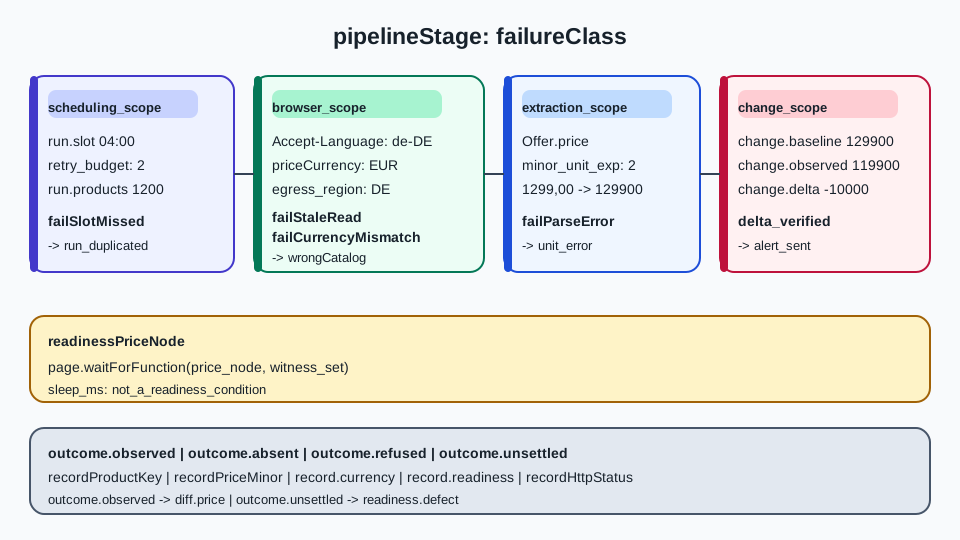
An ecommerce price-monitoring browser is one stage of a pipeline, not the pipeline itself. A recorded price can differ from the previous run because the page rendered in a different currency, because the read happened before the price element settled, because the route egressed from a different region, or because the retailer genuinely changed the number. Only the fourth is a data fact; the other three are measurement defects the browser layer either prevents or silently introduces, including the case where the route egresses from a region the operator did not intend. BotBrowser provides a configurable Chromium runtime that launches from an operator-supplied configuration and returns the rendered page, so the browser stage can be held fixed while other stages are measured. It does not schedule jobs, store history, compute diffs, decide whether a retailer permits collection, and it does not guarantee what price a page shows. The procedure assumes an owned fixture or an explicitly authorized target and gives no method for evading a retailer's protections.
TL;DR
- Write the pipeline as four stages with one owner each: scheduling, browser render, extraction, and change detection. A price diff can only be attributed if the stage boundaries are recorded per observation.
- Pin three browser-visible inputs before comparing runs:
Accept-Languageplusnavigator.languages, the currency used for formatting, and the egress region. Clear or fix the cookie and stored-preference state on the first observation too, since a persisted preference can override all three. Any of them changing produces a different rendered number on the same product. - Replace "wait for the price" with a named readiness condition, such as a non-empty price node whose text parses as a number and whose surrounding offer block is complete. A fixed sleep is not a readiness condition.
- Store money in integer minor units with the ISO 4217 currency code beside it.
19.99as a float loses the cent boundary that a diff depends on, and¥1,980is not the same quantity as$19.80. - Classify every observation as one of: price observed, price absent, request refused, or page not settled. Collapsing those four into "no price" is the defect that makes a monitoring pipeline look accurate while it is not.
Contents
- Decompose the workload into four stages
- Pin the browser-side variables
- Define render timing and stale reads
- Separate browser error from data error
- Practical conclusion
Decompose the workload into four stages
A price-monitoring job answers one question per product per run: what number did this page display at this moment, for this currency, from this region? Everything else in the pipeline exists to make that answer comparable to the previous answer. Splitting the work into stages is what makes a difference explainable, because each stage can fail in a way the others cannot.
| Stage | Owns | Can produce this failure | Cannot fix |
|---|---|---|---|
| Scheduling | Which product, how often, which slot, retry budget | Missed slot, overlapping runs, duplicate observations | A wrong or stale read |
| Browser render | Locale, currency, egress region, readiness condition | Wrong-currency read, wrong-region price, stale read | A changed price |
| Extraction | Which node, which parser, which fallback | Parse error, unit error, wrong field | A page that never settled |
| Change detection | Baseline, tolerance, alert rule | False alert, missed alert, drift | A bad observation |
The table is a diagnostic instrument, not an org chart. When a diff appears, the first question is which stage produced the two observations, because a diff computed from two different browser configurations is not a price change. A monitoring pipeline that reports "price changed" without recording the currency, region, and readiness condition of both observations has produced an unverifiable claim.
Why the stage boundary has to be recorded per observation
Storing configuration once per job is not enough. A job that changes its currency setting halfway through a batch, or that fails over to a route in another region after a proxy error, produces observations that are not comparable to each other even though the job identifier is the same. Record the effective configuration beside each observation, not beside the run.
The fields worth recording per observation are small and stable: the browser build identifier, the profile identifier, the effective Accept-Language, the currency code used for extraction, the egress region as reported by the route, the readiness condition name, the timestamp of the read, and the HTTP status of the document response. With those eight fields, two observations can be compared or explicitly declared incomparable. Without them, a diff is an opinion.
What the browser stage can and cannot report
The browser can report what it rendered: the text content of a node, the attributes present on it, the document's HTTP status, the response headers the server sent, and when the chosen readiness condition became true. It can also report the request timing for the document and its subresources.
The browser cannot report why a number is what it is. It cannot tell you whether 1,299 means 1,299 units of the display currency or a rounded regional price, whether the retailer applied a member discount to a different account, or whether a promotion ended between two runs. It also cannot report whether a page it never received would have shown a different price. Those are extraction and business questions, and attributing them to the browser stage produces the wrong fix: a team that treats every price diff as a browser problem can end up rotating profiles when the actual cause was a currency default.
One product, one comparison unit
Before any pipeline code, decide what counts as the same product across runs. Retailer product identifiers are not stable across regions: the same item can carry different identifiers per storefront, and a regional catalog may list a variant the global catalog does not. Use a stable operator-side key as the comparison unit, and store the retailer's own identifier beside it as an attribute.
If the operator-side key is built from the URL, normalize it first: strip tracking parameters, normalize case in the path where the storefront does, and drop session fragments. Two URLs that differ only in a campaign parameter point at the same product, and treating them as two products doubles the observation count without adding information.
Pin the browser-side variables
Four surfaces on the request path change the number a page displays without any change at the retailer. Three are set inside the browser: the language the page negotiates, the currency the storefront selects, and the preference or cookie state that persists between requests. The fourth is the route egress region, which belongs to the routing layer and is only observable from the route, not from the page. Each is independent, and each has a different failure mode.
Language negotiation and its resolution chain
A storefront usually selects a language from Accept-Language on the document request, from a URL path or subdomain segment, from a cookie or stored preference, or from the egress region, in an order the site chooses. Inside the page, navigator.language and navigator.languages describe what the browser reports, and Intl formatting resolves against a locale tag.
Those are four separate surfaces and they can disagree. A request that sends Accept-Language: de-DE while navigator.languages reports en-US can produce a German page whose client-side formatting still renders an English-formatted number. The observable result is a page that looks localized but formats money the other way, which is exactly the kind of mixed state that produces a phantom price diff.
| Surface | Set by | Observable from | Typical defect when it drifts |
|---|---|---|---|
Accept-Language request header | The automation library's context options | The captured request headers | Server picks a different storefront language |
navigator.language / navigator.languages | The browser profile | page.evaluate on the page | Client-side Intl output changes |
| URL path or subdomain | The requested address | The final URL | Requests reach a different storefront entirely |
| Stored preference or cookie | Prior navigation or a consent flow | Document cookies, storage | First request and later requests disagree |
The practical rule is to fix all four surfaces to one value set and verify the agreement on the first observation of a run. Playwright exposes context options for locale and timezone, so the header and the navigator values can be aligned in the same launch, and page.evaluate can read back what the page actually sees before any extraction happens.
Currency selection and formatting
Currency is a common source of silent errors in a monitoring pipeline, because a price element usually contains a formatted string rather than a machine-readable number. $1,299, 1.299 €, ¥1,299, and 1 299,00 € can all represent different quantities or the same quantity rendered under different conventions. Separating the symbol from the digits is not enough: the same glyph is used by more than one currency.
Use ISO 4217 codes, never symbols, in stored records. USD, EUR, GBP, JPY, and CNY are unambiguous; $ is not, and ¥ is used for both JPY and CNY. When the page exposes a machine-readable currency, prefer it: schema.org Offer carries priceCurrency and price, and a JSON-LD block is more reliable to parse than a rendered label.
Minor units matter for the same reason. Most currencies use two decimal places, but JPY and KRW use zero, and currencies such as KWD and BHD use three. A pipeline that multiplies every parsed price by 100 to get an integer cent value will mis-scale a zero-decimal currency by two orders of magnitude. Store the ISO 4217 code, the minor-unit exponent for that code, and the integer amount, then format for display from those three fields.
Also record the rounding behavior. Intl.NumberFormat with a currency style rounds to the currency's default fraction digits unless told otherwise, so a page that shows 1.995 formatted as 2.00 has already discarded information before extraction sees it. If the comparison needs the third decimal, the extraction has to read the unformatted value or accept that the pipeline compares rounded prices.
Region comes from the route, not from the browser
Region is the input teams most often assume they control when they do not. The browser can report a timezone and a set of locale tags, and a profile can declare a geolocation, but the storefront decides its regional catalog from what it can observe about the request, which is dominated by the egress address. A profile that claims one region while the route egresses from another produces a page whose regional catalog and whose client-side formatting disagree.
Align them deliberately. If the workload needs the German storefront, the route should egress from a German address, Accept-Language should carry German, the context locale should be a German tag, and the timezone should be the one a German visitor would see. The alignment is a configuration property of the run, and it is verifiable: the final URL, the document's Content-Language header where present, and the rendered currency together tell you which storefront answered.
| Check | What it proves | Where to read it |
|---|---|---|
| Final URL after redirects | Which storefront path answered | page.url() |
Content-Language response header | Which language the server chose | Captured document response |
| Rendered currency code | Which catalog the page drew from | Offer.priceCurrency or the price node |
Intl.DateTimeFormat().resolvedOptions().timeZone | Which timezone the page sees | page.evaluate |
| Route egress region | Which region the request came from | The route's own report, not the page |
The last row is the one that cannot be read from the page, which is why it has to be recorded by the layer that owns the route. A page can render perfectly while the route egresses somewhere the operator did not intend, and nothing in the DOM reveals it. The record a price needs beside it, and the one-context-per-retailer-and-region layout, are covered in fingerprint protection for ecommerce monitoring; pinning region, language and route for a fixed comparison window is covered in browser profiles for SEO monitoring.
A pinned configuration record
Put the pinned values in one record that both the extraction stage and the change-detection stage can read. A workable shape is a small object with the language tags, the currency code and minor-unit exponent, the region, the timezone, the readiness condition name, and the browser and profile identifiers. The record travels with the observation.
Two constraints apply. First, the record describes the effective configuration, not the requested one; a request for de-DE that the site redirected to an English storefront must record what actually answered. Second, a configuration change is a pipeline event, not a routine edit: if the currency setting changes, observations on either side of the change are not comparable, and the change-detection stage needs to know that rather than being handed a diff.
Define render timing and stale reads
Price nodes are frequently present before they are correct. A server-rendered placeholder, a skeleton element, a client-side hydration step, and a promotional banner that rewrites the displayed number can all appear in sequence within the same page load. Reading at the wrong moment produces a number that was genuinely on the page and was never the price.
A readiness condition instead of a sleep
Write the readiness condition as a predicate over the page, not as an elapsed time. A useful predicate has three parts: the price node exists, its text parses to a number under the declared currency rules, and a structural witness confirms the surrounding offer block is complete, such as a priceCurrency value, a stock or availability marker, or an add-to-cart control that is enabled.
The third part is what separates a real read from a lucky one. A page can expose a price node with a numeric string long before the offer block is assembled, and a predicate that only checks the node will pass on a partial render. Waiting for the whole witness set costs a little latency and removes an entire class of stale reads.
Playwright offers the primitives for this directly: page.waitForFunction can evaluate the predicate in the page, page.waitForSelector can gate on the node's presence, and page.waitForResponse can gate on a specific API response when the price arrives over the network rather than in the document. Choosing among them is a decision about where the price comes from, and the choice belongs in the run record because it changes what "ready" means.
| Price source | Readiness primitive | What it proves | Residual risk |
|---|---|---|---|
| Server-rendered document | waitForSelector on the price node plus the witness | The document contained the offer | A later script rewrites the number |
| Client-side hydrated node | waitForFunction on the full predicate | The client finished assembling the offer | A subsequent promotion script changes it |
| Price delivered by an API call | waitForResponse matching the endpoint | The price response arrived | The DOM has not been updated yet |
| Price behind an interaction | A scripted interaction then the predicate | The interaction completed | The interaction was the wrong one |
The fourth row is where a monitoring pipeline can quietly break its own boundary: an interaction that reveals a member price or a regional price is an authenticated or personalized state, and a workload that is only authorized for public pages should classify that observation as out of scope rather than extracting it.
Stale reads, missing prices, and refused requests
These three outcomes look the same to a pipeline that stores only a number or a null, and they demand different responses. A stale read means the readiness condition was wrong and the observation should be discarded, not stored. A missing price means the page was fully rendered and the offer block did not contain a price, which is a real finding about the product. A refused request means the browser never received the page, which is an access question and not a data question at all.
Classify explicitly. Store an outcome code with every observation: observed, absent, refused, or unsettled. Downstream, only observed observations feed a price diff, absent feeds a catalog-change signal, refused feeds an access log, and unsettled feeds a readiness-condition defect count. A pipeline that treats all four as "no price" will report a stable catalog while it is systematically failing to read it.
Conditional requests and what a 304 means
When the workload re-reads a page it has seen before, the server may answer 304 Not Modified to a conditional request carrying If-None-Match with the previous ETag, or If-Modified-Since with the previous Last-Modified. A 304 is not a failure and it is not a fresh observation: it means the representation the server would have sent is unchanged from the one the validator describes.
For price monitoring, a 304 is useful evidence and a trap at the same time. It is useful because it confirms the document has not changed since the validator was issued. It is a trap because the validator describes the document, not the price: a price that is fetched by a separate API call and injected client-side can change while the document's ETag stays identical. If the price arrives over the network, the validator to condition on is the one on that response, not on the document.
Vary complicates the same question. A response carrying Vary: Accept-Language means the cached representation is keyed by that header, so a run that changes its language setting is not re-reading the same cached entry. Recording the Vary header beside the observation prevents a later analysis from assuming two observations shared a cache key when they did not.
Clock, timestamp, and ordering
Store the observation time from one clock, and store the server's own time signal beside it when the response provides one, such as a Date header. The page's Date.now() and the host's clock can differ, and a pipeline that mixes them produces observations whose ordering is not trustworthy.
Ordering matters more than precision here. If two observations of the same product are stored with times that invert their actual order, the change-detection stage will report a price change in the wrong direction and possibly alert on it. Recording a monotonically increasing sequence number per run, in addition to the wall-clock time, makes the ordering recoverable even when two timestamps collide.
Separate browser error from data error
The value of the four-stage split is that it turns "the price looks wrong" into a specific, checkable claim. Use the stage boundaries as the first classification step, then use the observation outcome codes as the second.
Failure attribution matrix
| Symptom | Most likely stage | First check | Do not do |
|---|---|---|---|
| Every product in a region shows a different currency | Browser render | Effective currency and egress region in the run record | Rotate profiles |
| One product's price moves and moves back | Change detection | Tolerance and alert rule | Rewrite the extractor |
| Prices are absent on a subset of products | Extraction | Whether the offer block has a price at all | Retry with a new profile |
| A run has gaps at regular intervals | Scheduling | Slot overlap and retry budget | Increase concurrency |
| Prices are consistently one step behind | Browser render | Readiness condition and stale-read count | Blame the retailer |
| A price is off by a factor of 100 | Extraction | Minor-unit exponent for the currency code | Adjust the alert rule |
The "do not do" column is the operational point. Each of these symptoms has a tempting fix that addresses a different stage, and applying it converts a diagnosable defect into a permanent, unexplained offset.
A run record that supports the classification
The record needs to be small enough that it is actually written and complete enough that the matrix above can be applied without re-running anything. A workable per-observation shape carries the product key, the observation time and sequence number, the outcome code, the raw price text, the parsed integer amount, the ISO 4217 code and minor-unit exponent, the effective language and region, the readiness condition name, the document HTTP status, and the final URL.
Two derived fields make the matrix usable at scale: a stale-read count per run, and a per-stage failure count. The first is the number of observations whose predicate passed but whose witness set was incomplete, which should be zero after tuning. The second groups the outcome codes by stage so a rising refused count is visibly an access problem and a rising unsettled count is visibly a readiness problem.
A pre-run checklist
- The comparison unit is an operator-side product key, with the retailer's identifier stored as an attribute.
- The language surfaces agree: request header,
navigator.languages, URL path, and any stored preference. - The currency is stored as an ISO 4217 code with its minor-unit exponent, never as a symbol.
- The egress region is recorded by the route layer and matches the intended storefront.
- The readiness condition is a named predicate with a witness set, not a fixed sleep.
- Every observation carries an outcome code from
observed,absent,refused,unsettled. - Conditional-request validators are attached to the response that actually carries the price.
- The change-detection tolerance is declared before the first alert, not after the first false one.
- A configuration change is recorded as an event that splits comparable observation windows.
FAQ
Does the browser decide which price a page shows?
No. The storefront decides the price from its own catalog, promotions, account state, and regional rules. The browser layer controls what the storefront can observe about the request, and that observation can influence which catalog or currency is served, but the number itself comes from the retailer's systems. Treating the browser as the cause of a price difference leads to configuration churn that never addresses the actual variable.
Is a longer wait a reliable fix for stale reads?
It reduces the symptom without fixing it. A longer fixed wait lowers the probability of reading a partial render, and it also lowers throughput and still fails whenever the page is slower than the chosen delay. A readiness predicate that names the price node and its witness set fails visibly and specifically, which is what a monitoring pipeline needs: an observation that says "not settled" is usable, while an observation that silently captured a placeholder is not.
Should prices be stored as floats or integers?
Integers in minor units, with the ISO 4217 code and its exponent stored beside the amount. Binary floating point cannot represent most decimal fractions exactly, so a stored 19.99 is not exactly nineteen and ninety-nine hundredths, and repeated arithmetic on such values accumulates error. Integer minor units make equality and difference exact, and the exponent keeps a zero-decimal currency from being scaled as if it had cents.
Practical conclusion
Start with the stage boundary rather than the browser configuration. Write down the four stages, name the owner of each, and record the effective browser-side configuration beside every observation instead of beside every job. Then replace the sleep with a readiness predicate that names both the price node and a structural witness, and classify every observation into one of the four outcome codes: observed, absent, refused, unsettled.
The next action is small: take one product on an authorized page, record its price twice under a pinned configuration, and confirm that both observations carry the same currency code, region, readiness condition, and outcome code. If they do, the pipeline can attribute a future difference. If they do not, the difference is already there and the browser layer is the first place to look.
Sources
- Playwright: BrowserType.launch
- Playwright: Network
- Playwright: Browser contexts
- RFC 9110: HTTP Semantics
- RFC 9111: HTTP Caching
- Schema.org: Offer
- ISO 4217 currency codes
- ECMA-402: Intl.NumberFormat
- BotBrowser: Playwright getting started
- BotBrowser: Proxy and geolocation alignment
- BotBrowser: Timezone, locale, and language
This article is part of the guide: Proxy Configuration Overview: A Browser Network Decision Map
Related Articles
Fingerprint Protection for E-Commerce Price Monitoring
DeploymentBrowser Profiles for SEO Monitoring and SERP Tracking
NetworkNetwork-Layer Browser Consistency for Privacy Protection
DeploymentJob Board Scraping: Browser Boundaries
NetworkDynamic proxy switching for separate browser contexts
NetworkTLS Certificates and Browser Connection Trust
Run the same check in BotBrowser
Load a profile, keep the signals you just read about consistent inside the browser, and confirm the result on your own machine before a rollout.