Network-Layer Browser Consistency for Privacy Protection
Page runtime, proxy route, timezone, locale, and language should describe one setup. Learn a repeatable way to validate that agreement and to sort support cases by owner.
BotBrowser Team
Want the structured docs for Network?
This article lives in the editorial library. For step-by-step setup, reference material, and ongoing updates, jump into the docs section.
Browser privacy is often described as a JavaScript problem. That description covers only part of a real session. Before any script runs, the browser has already opened connections, sent headers, and followed a route to the destination. A site can observe the outcome of that route as well as the outcome of the page runtime, and a team that validates only one of them cannot say whether the two agree. BotBrowser can keep the selected profile, proxy route, and geographic settings of a controlled context consistent with each other; it cannot change what a destination server or network decides to do with a connection.
Network-layer consistency means that the identity a browser presents inside the page and the way it travels across the network describe the same setup. The selected profile, the proxy route, and the geographic settings (timezone, locale, and language) should all point to one coherent configuration. When they do not, the mismatch is usually self-inflicted: a profile prepared for one region is routed through an exit in another, or a language list follows the host machine instead of the route.
Teams that run the same workflows repeatedly need a defensive, high-level model: which layers have to agree, how to validate that agreement before and after updates, and how to decide who owns a problem when a case reaches support. Low-level network values are left out here on purpose. A repeatable operating practice matters more than any single observation, and it works the same way whatever the values happen to be.
TL;DR
- Keep the profile identity, network route, exit location, and page-reported regional settings aligned.
- Validate page signals and routing evidence together after browser, profile, proxy, or host changes.
- Assign support cases to the layer that changed; BotBrowser cannot control proxy quality or destination policy.
Contents
- Why Page Runtime and Network Route Must Agree
- The Layers a Session Exposes
- Geography, Language, and Time Follow the Exit Address
- A Repeatable Validation Workflow
- Sorting Support Cases by Owner
- Where BotBrowser Fits and Where It Stops
- Practical conclusion
Why Page Runtime and Network Route Must Agree
A browser identity reaches a site before the first line of page JavaScript executes. The initial request, the headers that travel with it, and the route it took are all part of the first impression. Later, the page runtime adds more information: language preferences, timezone, locale-sensitive formatting, and capability reporting. A reviewer who looks at both halves can ask a simple question: do they describe the same environment?
Record the page-side fields instead of paraphrasing them: navigator.language, navigator.languages, and Intl.DateTimeFormat().resolvedOptions().timeZone. The expected result is that the language order and timezone belong to the same intended region as the exit IP; a mismatch is a failed consistency check even when HTTP status is 200.
Disagreement between layers rarely comes from one dramatic error. It builds up from ordinary decisions made in different places. A proxy credential is rotated by the infrastructure team, a profile is refreshed by the browser team, and a locale default is changed by whoever maintains the automation script. Each change is reasonable by itself. Together they can leave a session whose network exit sits in one country while the page reports a language list and timezone from another. Coherence is therefore a property of the whole configuration, not of any single setting.
Production traffic also adds conditions that a single manual test never reaches:
- Sessions move through authenticated proxies whose behavior the team does not own.
- Profiles run on host operating systems that differ from the platform they describe.
- Workflows include redirects, embedded media, account pages, and long navigation chains.
- Several contexts in the same browser instance may carry different identity and routing settings.
- Browser and profile updates can change behavior in places that an ordinary screenshot does not show.
Each of these conditions is a place where layers can drift apart. A validation practice that exercises real navigation paths, and that is repeated on a schedule, finds the drift while it is still a configuration question rather than a production incident.
Consider a team that checks a regional storefront on a schedule. Its profile describes a desktop platform, its route now exits in a neighboring country because the provider rebalanced its pool, and the automation script still passes a fixed language list copied from an earlier project. Every page loads, so a simple smoke test passes. Yet the timezone follows the new exit, the language list follows the script, and the checkout page shows content for a third market. Only a comparison of the layers explains why the result changed, and only a stored earlier run shows when it changed. A related use case is covered in Fingerprint Protection for E-Commerce Price Monitoring.
The Layers a Session Exposes
It helps to name the layers explicitly so that every member of the team uses the same vocabulary when discussing a case:
- Profile identity: the browser identity that the selected profile describes, including platform and capability reporting.
- Route: the proxy or direct path that carries the connection, together with the credentials and DNS behavior attached to it.
- Exit location: the address the destination sees, and the country, region, and network operator that address maps to.
- Locale behavior: the timezone, locale, and language preferences that the page can read.
- Release state: the browser build and profile version that were in use when the evidence was captured.
MDN's overview of proxy servers and tunneling supplies the vocabulary for the route layer. A forward proxy sits between the browser and the destination, a reverse proxy sits in front of the destination, and an HTTP tunnel carries a connection through an intermediary using the CONNECT method. Proxies can also add forwarding headers, and a proxy auto-configuration script can choose a route for each request. Knowing which of these is in play tells a reviewer which party controls which part of the path. DNS handling and real-time connections follow the route as well, and the documents on DNS leak prevention and WebRTC leak prevention describe the related settings. For the address-family side of the same question, see IPv4 and IPv6 proxy consistency in browser workflows.
The launch record should name the route mechanism explicitly: --proxy-server for the browser launch route, a per-context proxy object for an isolated context, or a direct connection. The expected record is one mechanism plus its route label, never an unqualified note such as “proxy enabled.”
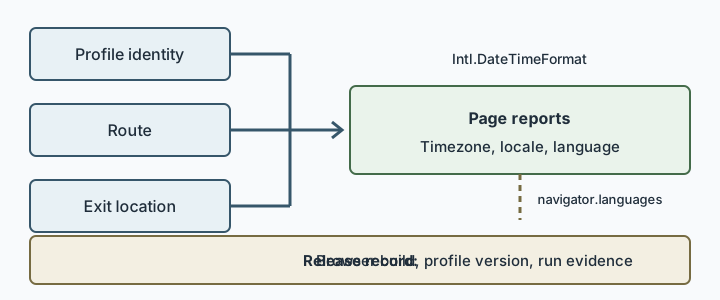
The diagram summarizes the idea. The profile, the route, and the exit location feed the locale behavior that the page reports, and a release record ties the evidence to one build. Any arrow that is missing from the team's own checklist marks a place where a mismatch can hide.
Geography, Language, and Time Follow the Exit Address
Geographic settings are the most visible place where the route and the page meet. A page can read the timezone, the locale, and the ordered language list of the browser. If those values describe a region that the exit address does not, the session contains a contradiction that the team created itself. The simplest way to avoid it is to derive the values from the route instead of maintaining them by hand next to it.
BotBrowser's documentation describes this derivation. When a proxy is configured through the browser's own proxy setting, BotBrowser detects the exit IP, maps it with a local GeoIP database, and sets timezone, locale, and languages to match before the first page loads. If the team already knows the exit IP, it can declare it with --proxy-ip and skip the lookup, which also shortens the first activation of a context. Framework-level proxy options operate at a different layer and do not trigger this derivation, so the route should be set in the browser launch arguments or in the per-context settings. The Proxy and Geolocation guide lists the supported combinations.
Each setting is resolved independently. An explicit timezone, locale, or language list takes priority for the setting it defines, while settings left on auto continue to follow the route. A team can therefore pin the locale for a reporting requirement and still let the timezone and languages follow the exit. The decision to pin should be written into the validation notes, because a pinned value that no longer matches a changed route is a common source of confusion later.
Timing matters as much as values. Geographic derivation happens when a context is activated, so a workflow that creates a page before the route and the exit address are settled can start from incomplete information. Declaring a known exit IP removes one external lookup from activation and makes startup more predictable, which helps when a validation run creates many short-lived contexts. When the exit IP is not known in advance, the validation notes should say that the value was derived, and the run should wait for the context to finish its proxy and geographic update before it navigates.
Per-context routing extends the same idea to several identities in one browser instance. In BotBrowser's documentation, each browser context with its own proxy gets its own connection and its own geographic derivation, and the feature is listed for the ENT Tier3 license. A context without its own route inherits the launch route and its geographic identity. The Per-Context Proxy guide recommends providing the proxy and any --proxy-ip declaration when the context is created, and waiting for proxy and geographic updates to finish before opening dependent pages or navigating.
Geographic derivation has honest limits. According to the GeoIP Database documentation, country-level mapping is generally strong, city-level mapping can be approximate, and coordinates are approximate rather than GPS-grade. A team whose workflow depends on city-level precision should set explicit values for those settings and validate them instead of assuming that an address lookup is exact. The quality and registration data of an exit address come from the proxy provider and the address registries, and no browser setting changes them.
A Repeatable Validation Workflow
A validation workflow should be small enough to run before every release and specific enough that two people reach the same answer. The following sequence keeps the procedure high-level and independent of any low-level network value:
- Choose the profile, route, and workflow that match production. Use the same proxy type, the same host operating system family, and the same sequence of pages that real sessions follow.
- Record the release state: the browser build, the profile version, and the settings that were pinned instead of derived.
- Run the workflow once and capture page behavior: whether pages load, whether sign-in and media work, and which timezone, locale, and languages the page reports.
- Capture routing behavior: which route carried the traffic, which exit location it mapped to, and whether DNS and real-time features used the intended path.
- Compare broad signal consistency. The page-reported geography and language should agree with the exit location, and the profile identity should agree with the host platform choice that was documented.
- Repeat the same run after each browser or profile update and after any change of proxy provider, and store both runs together.
Use one row per context in the validation table: profile_id, browser_build, proxy_mode, proxy_label, exit_ip, navigator.language, navigator.languages, time_zone, workflow_result, and expected. Set expected=pass only when the page fields match the documented exit region and every required workflow step is pass; otherwise set expected=fail and name the first differing field.
The value is in the comparison, not in any single run. Two runs that differ in exactly one input, such as the browser build, tell the team which change caused a difference. Runs that differ in several inputs at once tell the team very little. For that reason the matrix of routes, profiles, and workflows should grow slowly, and each entry should name an owner who decides when it is out of date. The article on browser release validation covers the release side of this practice in more detail.
Decide in advance which changes trigger a rerun. A new browser build, a profile refresh, a change of proxy provider or route pool, a new host operating system image, and an edit to the automation script that sets locale or language options all qualify. Changes to the destination site do not belong on the list, because the team does not control them; they fall under the external-condition category and are noticed when a previously passing workflow starts to fail. Writing the trigger list down keeps validation from turning into a ritual that is run only after something has already gone wrong.
Evidence should be kept with the release package or the support case so that a later reader can repeat the comparison. Useful artifacts include:
- A short note naming the profile, the route label, the workflow, and the pinned settings.
- The page-reported timezone, locale, and language values for each context.
- The exit location observed for each route, with the date and the source of the lookup.
- A functional outcome for each workflow step, recorded as pass, fail, or changed.
- The browser build and profile version for both the earlier and the later run.
Synthetic accounts and test destinations are enough for this work. Collect no more than the comparison requires, and remove temporary captures once the review period ends. A validation record that is small, dated, and owned is more useful than a large archive that nobody reads.
Sorting Support Cases by Owner
When a session behaves unexpectedly, the first useful question is who owns the cause. Looking at the route and the page runtime separately makes that answerable without a long investigation, because each layer has a different owner and a different next step:
- Profile configuration: the selected profile, the pinned settings, or the per-context flags do not describe the intended setup. The browser team fixes the configuration and reruns the workflow.
- Route alignment: the route in use is not the route that was intended, or the exit location changed after the profile was prepared. The team that manages routing corrects the assignment.
- Browser runtime behavior: the configuration and the route are both correct, yet the page reports something that the other layers contradict. This is the case to send to the browser vendor together with the evidence package.
- External page condition: the destination changed its flow, a third-party script failed, or the origin applies its own policy to the session. These causes sit outside the team's browser configuration and should be labeled as such.
Proxy quality and exit-IP location deserve a separate note. Provider behavior, address reputation, and the way an origin treats a given address are not controlled by the browser. A case that ends with "the route works and the configuration is coherent, but the origin still declines the session" should be reported as an external condition with the evidence attached, not reopened as a browser defect. Credential handling for the route is a related topic covered in browser proxy authentication and credential hygiene.
Triage is faster when the first reply to every case asks for the same small set of facts: the profile and release state, the route label, the page-reported geography, and the observed exit location. Cases that arrive with those facts can usually be assigned in one step. Cases that do not should be sent back for the missing facts rather than investigated blindly.
A short example shows the pattern. A support case reports that a workflow shows content for the wrong region. The timezone was pinned in the configuration and still matches the intended region, but the observed exit location does not. The profile configuration is therefore correct, the page runtime follows that configuration, and the route is the layer that moved. The case goes to the team that manages routing, with both runs attached, and the browser team has nothing to change.
The intake contract makes that decision testable: require route_label, exit_ip, time_zone, navigator.languages, browser_build, and profile_version. Route owner handles a changed exit_ip; profile owner handles a changed pinned field; browser-runtime owner handles a contradiction after both values match; destination owner handles an origin response or policy change.
Where BotBrowser Fits and Where It Stops
BotBrowser supports giving each browser context its own proxy route (one the team has approved) and derives that context's timezone, locale, and language from the context's exit IP, so a team can repeat the same profile-and-route workflow before and after updates and check whether network identity and page-runtime identity stay aligned. This helps most when several identities share one browser instance or when releases are validated on a schedule. BotBrowser cannot improve proxy provider quality, choose or control the reputation of an exit IP, guarantee that any site will accept a session, or replace the team's own release validation and evidence review.
Coherence reduces the mismatches that a team creates for itself. It does not decide how an origin treats a session, because acceptance stays specific to each origin and its own policies. Treat a coherent result as a clean baseline for diagnosis, and recheck the per-context proxy and proxy configuration documents, along with current MDN guidance, before changing routing or geographic settings.
Public sources
Practical conclusion
Before a workflow runs, compare its profile, route, exit location, and page-reported regional settings in one record. Repeat that comparison after every relevant update, and send a mismatch to the owner of the layer that changed. Treat BotBrowser's consistency controls as browser-context evidence, not as a guarantee about proxy quality or destination acceptance.
This article is part of the guide: Proxy Configuration Overview: A Browser Network Decision Map
Related Articles
Proxy, DNS, and WebRTC Consistency for a Coherent Browser Identity
NetworkBrowser Proxy Configuration: SOCKS5, HTTP, and HTTPS Guide
NetworkEnterprise Browser Network Boundaries: Assign Ownership Without Gaps
NetworkIPv4 and IPv6 Proxy Consistency in Browser Workflows
NetworkDynamic proxy switching for separate browser contexts
NetworkPer-context proxy: route ownership for separate browser work
Take BotBrowser from research to production
The guides cover the model first, then move into cross-platform validation, isolated contexts, and scale-ready browser deployment.