TLS Certificates and Browser Connection Trust
Understand how browsers validate TLS certificates, explain trust warnings, and separate proxy tunnels from managed TLS interception.
Want the structured docs for Network?
This article lives in the editorial library. For step-by-step setup, reference material, and ongoing updates, jump into the docs section.
Why Browser TLS Trust Matters
HTTPS is a combination of an encrypted transport and an authenticated endpoint. TLS protects data in transit, while the certificate lets a browser decide whether the public key belongs to the hostname it intended to reach.
A green lock or a warning is therefore the result of a validation decision, not a claim that every part of the route is safe.
The browser builds that decision from the certificate presented by the server, the certificate chain, the requested hostname, the validity period, and its configured trust store.
These checks have a clear operational boundary between an ordinary proxy tunnel and an explicitly managed TLS inspection service. Certificate warnings should be investigated, never bypassed.
What TLS and a Certificate Do
During a TLS handshake, the server presents a certificate and proves possession of the corresponding private key. The browser and server negotiate cryptographic parameters, then use the authenticated key exchange to protect application data. TLS 1.3 is specified in RFC 8446.
A certificate is not a password and does not encrypt a page by itself. It binds an identity, such as a DNS name, to a public key for a stated period and issuer.
The browser checks the binding before allowing the page to use the connection as trusted HTTPS.
Identity, Chain, and Trust Store
The hostname check compares the requested name with the certificate's Subject Alternative Name entries. A certificate for www.example.test does not automatically authenticate api.example.test. The browser also checks that the certificate is currently valid, correctly constrained for server authentication, and signed through a chain that can be built to a trusted root.
The chain normally contains a leaf certificate and one or more intermediates. A root certificate is a local trust anchor, supplied by the operating system, browser, or an enterprise policy. RFC 5280 defines the profile and path-validation concepts used by X.509 certificates. Trust is therefore a combination of cryptographic signatures and local policy; a mathematically valid chain is not automatically trusted everywhere.
What a Warning Means
Browsers show a certificate warning when a required check fails: the name may not match, the certificate may be expired or not yet valid, a chain may be incomplete, or the issuing root may be unknown. MDN's TLS guide and certificate error reference describe these failure categories and the browser's protective response.
Treat a warning as an incident to explain, not as an invitation to click through. Check the URL, the device clock, the served chain, the intended environment, and whether a managed policy changed the trust store.
A temporary test exception can hide a real hostname or interception problem and should never become a production operating procedure.
Proxies, CONNECT, and TLS Interception
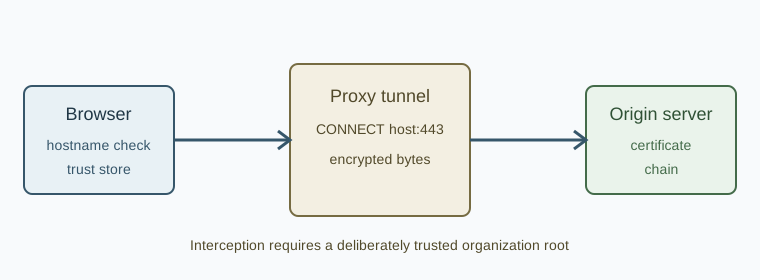
With a conventional HTTP proxy, the browser sends CONNECT host:443 and then performs the TLS handshake through the byte tunnel. The proxy can enforce destination policy and observe connection metadata, but it does not issue the origin certificate or read the encrypted HTTP messages. Certificate validation remains an end-to-end browser decision.
BotBrowser can configure the browser's proxy route and profile-level network policy, but it cannot repair an origin certificate, enlarge the operating system trust store, or make a hostname mismatch valid. Keep certificate verification enabled in the selected profile. For related routing boundaries, see the proxy configuration guide, HTTP proxy semantics, DNS over HTTPS controls, and WebRTC leak prevention.
TLS interception is a different architecture: an intermediary terminates one TLS session and creates another, presenting a certificate generated for the requested hostname. For that to be trusted, the browser profile must deliberately trust the organization's inspection root. Document the owner, scope, rotation, logging, and failure behavior of that root. Do not confuse a managed inspection service with a transparent proxy tunnel.
Users should be able to identify a managed inspection certificate by its documented issuer, public-key fingerprint, and profile policy, rather than guessing from the lock icon. Administrators must maintain a revocation path for the inspection root, remove it from managed profiles when the business need ends, and record the affected scope and replacement trust anchor.
Managed Certificate Responsibility
Website operators are responsible for serving the correct certificate, a usable intermediate chain, current validity dates, and private-key protection. Platform or security teams are responsible for distributing approved trust anchors and removing them when the business need ends. The CA/Browser Forum Baseline Requirements describe public CA issuance and operational expectations.
For a managed browser fleet, record which component owns each check: DNS and hostname ownership, certificate issuance, chain delivery, device clock, trust-store policy, and proxy behavior. When a warning appears, preserve the exact hostname, time, certificate details, browser profile, and route before changing anything.
A Safe Verification Checklist
Use a clean profile to request the exact hostname, inspect the certificate's SAN and validity dates, and verify the chain on the target operating system. Compare direct and proxied connections only when the proxy policy is documented. Confirm whether any enterprise root is intentionally installed, and test renewal before the current certificate expires.
Do not disable certificate checks, accept an unknown issuer, or teach automation to click through a warning. Fix the hostname, chain, clock, issuance, or managed-policy problem that caused the warning. This preserves the same trust decision for browsers, users, and automation. For related route testing, compare the proxy configuration, WebRTC leak prevention, DNS over HTTPS controls, and HTTP proxy semantics.
Reading a Handshake as Evidence
A successful connection is useful evidence only when its context is recorded. Capture the requested hostname, resolved address, protocol version, selected cipher suite, certificate fingerprint, and browser profile. One machine's success does not prove that every operating system has the same root store or clock. Treat the result as a reproducible observation instead of a permanent property of the site.
The server name sent in SNI and the name used for certificate validation normally come from the URL. A load balancer may select a different certificate when SNI is absent or malformed. IPv4 and IPv6 endpoints can also have different deployment states. Record the address family, redirects, and whether the browser resumed a previous session. These details explain why a command-line probe and a browser tab can disagree.
Certificate transparency logs, OCSP responses, and stapled status information add evidence, but they do not replace hostname and chain validation. A revoked certificate, a failed status service, and an unknown root are distinct conditions with different owners. Do not collapse them into one “TLS error” label in monitoring. A useful incident record names the failed predicate and the component that supplied the evidence.
Certificate Lifecycle and Renewal
Renewal is a workflow, not a calendar reminder. Inventory every public hostname, internal hostname, wildcard, and service endpoint. For each entry record the issuing account, validation method, private-key location, intermediate chain, deployment target, and rollback path. Owners should know whether a load balancer, container image, secret manager, or host agent provisions the certificate.
Before renewal, test the complete chain in a staging profile that uses the production trust policy. Check a fresh connection and a resumed connection. Confirm that the new certificate contains every required SAN and that a client without cached intermediates can build the path. Deploy the leaf and intermediates atomically where possible, then observe handshake errors and application health checks during the overlap period.
Short validity periods reduce the impact of a compromised key but increase the cost of missed automation. Alert well before expiry, alert again when deployment has not occurred, and keep a human-readable runbook. Never solve an expiry incident by installing a broad root certificate on all clients. Correct the issuance or deployment pipeline and remove emergency exceptions after recovery.
Diagnosing Name and Chain Failures
Begin with the exact browser error and the certificate actually presented. Compare the SAN list with the URL, including trailing dots, internationalized names, and port-based routing. Inspect every issuer link until the chain reaches a trust anchor. A server that sends only its leaf may work for clients that cached an intermediate and fail for a clean profile. Sending an unnecessary intermediate can also cause path-building surprises on older platforms.
Clock errors are easy to overlook in virtual machines, suspended laptops, and isolated test networks. Compare the browser clock with a trusted time source and record the timezone separately from the UTC instant. A “not yet valid” certificate often indicates deployment in the wrong region or a clock that drifted during resume. Do not treat a successful request after manually changing the clock as proof that the certificate is correct.
When several services share an address, inspect the SNI route and selected virtual host. A correct certificate on one listener does not fix a default certificate on another. Test redirects, alternate ports, and health-check paths independently. Preserve a packet capture only when policy permits it; certificate metadata and browser diagnostics are usually sufficient and expose less user data.
Proxy Policy and Privacy Boundaries
Document a proxy as a policy enforcement point with a narrow responsibility. A CONNECT tunnel can authenticate the client, restrict destinations, apply rate limits, and produce connection metadata while leaving origin TLS end to end. The proxy should state which fields it logs, how long they are retained, and which administrators can read them. DNS resolution location also matters: resolving names at the proxy can change routing without changing certificate validation.
Inspection services have a larger privacy and key-management burden. The inspection root must be distributed through an authenticated channel, scoped to managed profiles, and rotated with overlap. Log access to decrypted content separately from connection metadata, and define exclusions for sensitive destinations where policy requires them. A browser warning after enabling inspection may be correct evidence that the root was not delivered to the intended profile.
Do not infer interception merely from the presence of a proxy. Compare issuer, public-key fingerprint, and validity period with a direct authorized reference. If the issuer changes only on managed networks, record that as an architectural difference and ensure users can recognize the managed certificate. Transparent routing, CONNECT tunneling, and deliberate TLS termination should have different names in diagrams and runbooks.
Automation and Browser Profiles
Automation should consume the same trust policy as a person using the profile. Keep certificate verification enabled in Playwright, Puppeteer, WebDriver, and command-line clients. A setting that ignores HTTPS errors can make a test pass while hiding a broken chain, incorrect hostname, or accidental interception. If a test environment uses a private CA, install it in the isolated profile through documented provisioning and assert that unrelated public sites still use public roots.
Profile portability adds another variable. Moving a profile between operating systems can change the native trust store, enterprise policies, smart-card providers, and clock behavior. Record the target operating system and browser build with the profile. Identity settings need an explicit host contract, and routing signals need a documented network policy. For proxy setup, see proxy configuration.
Use a clean profile for acceptance tests and a long-lived profile for renewal rehearsal. The clean profile catches missing intermediates and accidental local roots; the long-lived profile catches stale policy and cached-session behavior. Store only the minimum certificate metadata needed to reproduce a failure. Never export private keys into test artifacts or attach them to support tickets.
Monitoring, Ownership, and Incident Response
Effective monitoring checks more than expiry. Probe the public hostname with a validating client, verify the expected issuer and SAN set, and measure handshake time. Run probes from regions and network paths that users actually use. A dashboard should distinguish DNS failure, TCP failure, TLS failure, HTTP status failure, and application failure so the correct team is paged.
Ownership should be visible in the certificate inventory. The website team owns names and deployment; security or platform owns public issuance and trust policy; the network team owns proxy routing; endpoint management owns enterprise roots. During an incident, freeze failing certificate details before rotating anything. A replacement can remove evidence needed to explain whether the original problem was issuance, delivery, validation, or policy.
After recovery, test revocation and rollback in a controlled environment. Remove temporary roots, close emergency firewall exceptions, and update the runbook with the observed error string. Review whether alerts fired early enough and whether logs contained sensitive URLs. The goal is a predictable trust decision that remains understandable after the people who performed recovery are no longer available.
Design Review Questions
Before approving a TLS architecture, ask which component authenticates the hostname, which component terminates each session, and which local policy supplies trust. Ask whether a client can build the chain with no cache, whether renewal is tested before expiry, and whether a proxy can be removed without changing the origin certificate. Ask how a user distinguishes a managed inspection certificate from an origin certificate and how administrators revoke the inspection root.
Also ask what is deliberately out of scope. A certificate does not prove that an application is safe, that a DNS record is correct, or that a proxy operator cannot observe metadata. Encryption does not erase authorization or logging obligations. Keeping these boundaries explicit prevents a green lock from becoming an overly broad security claim.
Operational Summary
The reliable path is consistent: identify the hostname, validate the complete chain against the intended trust store, confirm the device clock, and record the route. Separate origin TLS from proxy transport and from managed interception. Renew through an owned workflow, test with clean and long-lived profiles, and keep verification enabled in automation. When a warning appears, preserve evidence and fix the failed predicate instead of teaching clients to ignore it.
Change Control and Review
Treat a certificate change like any other production change. Link the request to the hostname inventory, name the approver, and record the exact old and new fingerprints. Review SAN additions for authorization, because adding a name can expose a service to a wider audience than the renewal itself. Verify that private-key permissions, secret-manager references, and deployment logs are unchanged except where the change requires them.
During rollout, keep the previous certificate available for a short, documented rollback window. Test from a clean browser profile, a managed profile, and an automation client. Check both the primary URL and every redirect target. If a proxy or CDN is involved, test each edge region rather than assuming configuration replication is immediate. A green health check from one edge cannot certify another edge that is serving an older chain.
At closure, attach validation output without private keys or user content. Note the date, operator, issuer, SAN set, chain order, trust-store result, and any expected issuer difference caused by managed inspection. This small record makes future warnings faster to classify and prevents teams from repeating unsafe click-through workarounds.
Keep the record searchable by hostname and certificate fingerprint. That simple index connects an alert to an owner, a deployment, and a rollback decision without retaining decrypted traffic.
Sources
Related Articles
Take BotBrowser from research to production
The guides cover the model first, then move into cross-platform validation, isolated contexts, and scale-ready browser deployment.