Connection Allowlists: Chrome Rollout and Boundaries
Read the Chrome Connection Allowlists rollout, draft status, context scope, and safe validation limits without assuming browser support.
BotBrowser Team
Want the structured docs for Network?
This article lives in the editorial library. For step-by-step setup, reference material, and ongoing updates, jump into the docs section.
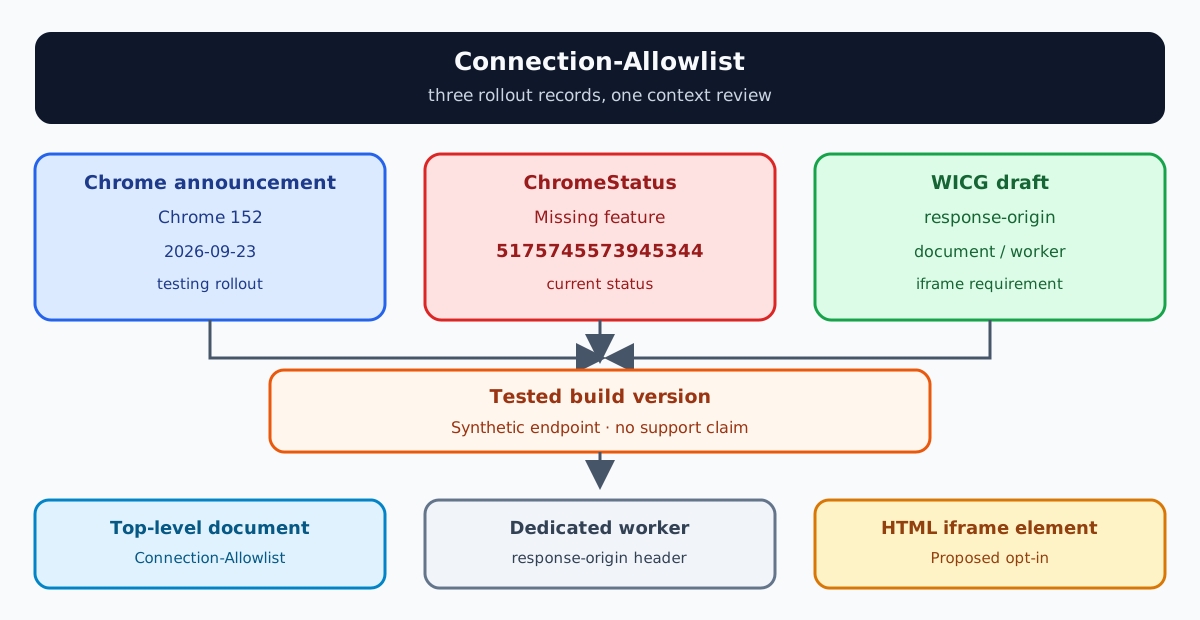
BotBrowser can repeat an authorized browser workflow in a declared context and record visible outcomes, but it does not claim to implement or enable Connection-Allowlist. This article contains no BotBrowser test result. The proposal is a response-header policy intended to restrict explicit network connections made for a document or worker. Chrome's announcement dated 2026-09-23 describes a Chrome 152 testing rollout, while the current ChromeStatus entry labels the feature “Missing feature” and has no announcement URL. Treat that mismatch as a versioned evidence problem: read the announcement as a dated rollout statement, the status page as a separate snapshot, and the WICG text as a draft design rather than proof that a browser you operate enforces it.
TL;DR
Connection-Allowlistis a proposed response-header policy for explicit connection endpoints, not a replacement for every part of Content Security Policy.- The WICG document is a Community Group draft. Its syntax and examples are design material, not cross-browser support evidence.
- Chrome's 2026-09-23 announcement says Chrome 152 introduces the feature for testing; ChromeStatus feature 5175745573945344 currently says “Missing feature.” Record both claims with their dates and build scope rather than merging them into “supported.”
- Policy ownership follows a document or worker context. Embedded enforcement adds a separate proposed parent requirement and opt-in path; it must not be inferred from the parent header alone.
- BotBrowser can be used for authorized, declared browser-context workflows generally, but it has no announced implementation or measured Connection-Allowlist support claim here. A safe fallback is to retain the existing policy controls and test expected application failure behavior.
Contents
- What the proposal controls
- Read rollout evidence without flattening it
- Map the policy to its context
- Plan a safe rollout fixture
- Classify failures and choose a fallback
- BotBrowser capability boundary
- Practical conclusion
What the proposal controls
The WICG proposal gives a server a way to deliver an allowlist with a response. A user agent would check a destination before establishing an explicit connection on behalf of the context. The proposal discusses Fetch and other platform connection paths, including WebRTC, WebTransport, FedCM, Web Payments, DNS prefetch, and navigations. The central design goal is broad coverage of explicit communication initiated for that context, rather than a collection of independent resource-type directives.
An illustrative header from the proposal is:
Connection-Allowlist: (response-origin "https://cdn.example" "https://api.example"); report-to=connection-policy
This is a design example, not a deployment instruction that should be copied into production. response-origin represents the origin that delivered the response. Literal URL patterns express other destinations. A proposed reporting parameter connects violations with a Reporting API endpoint. The exact grammar, matching rules, supported connection types, and reporting behavior must be checked against the specification revision and browser implementation under review.
The allowlist is not a general content-integrity policy. The WICG threat model focuses on communication channels and says the policy does not solve content injection or cross-site scripting. If injected script can read sensitive page data, blocking a subset of explicit outbound connections may reduce one path for exfiltration, but it does not remove the injection, prevent every side channel, or repair a compromised response header. Treat it as one defense-in-depth control with a narrow promise.
This distinction matters when comparing it with Content Security Policy. CSP remains useful for source restrictions, script controls, and other resource-specific protections. The WICG rationale is that a connection-focused rule could cover an explicit connection surface more holistically than a set of resource categories. That is a design motivation, not evidence that CSP is obsolete or that a new header automatically composes correctly with every policy. Existing controls should remain until a target browser's behavior is established for the exact request class.
The proposal addresses endpoints, not business meaning. A request to an allowed API may still contain data the application should not disclose. A blocked request does not establish that the page is secure, that its data was not observed through another channel, or that a service-side operation did not occur earlier. Authorization, consent, input validation, and server-side auditing stay with their existing owners.
Read rollout evidence without flattening it
The Chrome announcement published on 2026-09-23 is titled “Connection allowlists: Secure your web application's network access.” It says Chrome 152 introduces connection allowlists and frames the change as a way to restrict a page's network access. That statement is useful rollout evidence, but it does not by itself identify the exact Chrome channel, platform, enabled-by-default state, enterprise availability, API coverage, or final shipping milestone for every deployment. Preserve those qualifiers when recording what the announcement says.
The ChromeStatus page for feature 5175745573945344 is a second source with a different role. The current page names the feature “Connection Allowlists,” describes an authorized endpoint list delivered through an HTTP response header, and says matching destinations would be permitted while non-matching destinations would be blocked. Its current web_feature field is “Missing feature”; the stage records do not supply an announcement URL. That snapshot conflicts with the announcement's Chrome 152 wording if both are read as statements about the same current release state.
Do not resolve the discrepancy by silently choosing the more optimistic page. A status dashboard can lag, use a different milestone definition, or represent a feature-detection field that is not equivalent to a Chrome product announcement. Conversely, a blog announcement can describe an experiment, developer testing, a staged rollout, or an intended release without proving that a particular installed binary has the behavior. The available pages do not settle which explanation applies. The defensible conclusion is narrower: the announcement reports a Chrome 152 testing introduction; the status snapshot currently says “Missing feature”; the WICG specification remains a draft; support must be verified for a named build and channel before relying on enforcement.
Record a compact evidence tuple rather than a Boolean support flag:
| Evidence item | Record | Do not infer |
|---|---|---|
| Announcement | Canonical URL, publication date, exact Chrome milestone wording | Universal stable support or all-platform availability |
| ChromeStatus | Feature ID, retrieval date, displayed status and stage fields | That a dashboard field fully describes a product experiment |
| Specification | WICG revision or retrieval date and draft status | That normative-looking prose has shipped in browsers |
| Runtime check | Browser product, full version, channel, OS, policy response, request outcome | That one fixture proves every API path or future build |
The Chrome announcement is the dated Chrome rollout account; the ChromeStatus feature record is a live status surface and can change after publication. Save a dated copy or review note internally when the rollout decision depends on it. Do not call a page “supported” merely because a feature has a ChromeStatus entry, and do not call it “unavailable” solely because one status field says so when a dated announcement reports testing. The Private Verification Tokens proposal raises a similar distinction between Chrome proposal status and available behavior. The contradiction is itself a reason to scope the decision.
Map the policy to its context
The base proposal places policy in the response that creates a document or worker context. The governing question is not just “what domains are listed?” It is “which context received which policy, from which response, and which operation initiated the connection?” A page's policy should not be assumed to constrain a different document that has its own response and policy container. The WICG text discusses inheritance for some local-scheme and created contexts, but exact inheritance must be checked in the relevant draft and implementation.
An iframe introduces a second policy owner. A parent that restricts its own connections cannot simply assume that a cross-origin child uses the same response policy. The WICG repository's embedded-enforcement explainer proposes that an embedder can require a child allowlist and that the child must opt in through a sufficiently strict policy, an explicit response header, or an inheriting local-scheme document. It also describes passing a requirement to the child and inheriting the constraint through nested descendants. This is a separate design proposal in the repository; do not treat it as a universal, already-shipped iframe behavior.
| Context or event | Question for a rollout review | Conservative expectation before verified support |
|---|---|---|
| Top-level document | Did its final response carry the intended policy? | Keep existing CSP and server controls; do not assume a source template equals the delivered header. |
| Dedicated or shared worker | Which response created the worker, and is its policy actually inherited or separately asserted? | Test the worker path independently with synthetic endpoints. |
| Cross-origin iframe | Did the child opt in to any parent requirement, and what response did the child return? | Treat the child as a separate policy boundary until observed otherwise. |
| Nested frame | Is the proposed requirement propagated and unable to loosen at deeper levels? | Test each nesting edge; do not infer ancestry enforcement from a direct child case. |
| Redirect response | Does the target implementation block or allow the redirect under the selected parameter and policy? | Preserve redirect failures as distinct results; do not add a broad exception to make the test pass. |
| Browser-initiated navigation or unrelated process | Is this an explicit connection governed by this context's policy? | Do not assume user navigation or another context is constrained by the page's header. |
The word “allowlist” can make the boundary sound stronger than the proposal warrants. A context-specific rule is only as complete as the request types covered by that version, the contexts to which it applies, the response headers actually delivered, and the browser implementation that enforces it. Worker creation, service worker activity, nested frames, redirects, preconnects, WebRTC setup, and navigation should each receive a named test case if they matter to a product decision.
Connection-Allowlist also is not proxy configuration. It expresses an application-side destination policy. A proxy controls or forwards network traffic at a different layer and has separate routing and authentication concerns. The enterprise browser network-boundary map assigns those browser, proxy, enterprise-network, and destination responsibilities. For protocol details, the HTTP proxy semantics guide describes request, CONNECT, DNS, and origin boundaries. Likewise, the Permissions Policy guide covers delegated browser capabilities; permission delegation is not the same mechanism as deciding which network endpoints a context may contact.
Plan a safe rollout fixture
Before a real service adopts a new enforcement feature, define one owned test page with synthetic data and a short list of expected endpoints. The fixture should make the policy decision observable without collecting account identifiers, production request bodies, credentials, or user browsing traces. Use controlled endpoints on a test domain; keep each response and expected result under the team's control. Never send sensitive material to a destination simply to prove that a blocker works.
Start with two cases. The first makes one request to an endpoint intended to match the policy. The second attempts a request to an endpoint intentionally absent from the list. Use a local test receiver or a controlled test service and verify whether the request arrived there. A console message alone may be useful diagnostics, but the receiver's result and the page's visible application state answer different questions. Keep an expected-denial case from being confused with a DNS, TLS, CORS, timeout, or server error.
Add cases only for paths that the product depends on: Fetch, an image or script resource, a worker request, a nested frame, or a WebRTC/WebTransport setup. The WICG proposal aims to cover several explicit connection mechanisms, but the test suite should be driven by the application's actual call graph and the browser's documented implementation scope. Do not build a network-path inventory of users; the fixture only needs a small synthetic set with clear owners.
A review record can have a stable shape:
{
  "fixture": "connection-policy-smoke-v1",
  "browser": "declared product, version, channel, and OS",
  "context": "top-level-document",
  "policySource": "test response header revision",
  "case": "listed-endpoint",
  "expected": "request received by owned test receiver",
  "observed": "record the actual bounded result",
  "applicationFallback": "keep primary content usable and offer retry",
  "dataClass": "synthetic"
}
This JSON is a shape example, not a result or a BotBrowser run. Replace the placeholders only in a real, authorized test record, and retain only fields required to reproduce the decision. Do not place a real URL with a secret token, raw request body, cookie, account ID, or persistent profile identifier in a public article or durable evidence file. A browser version and fixture revision are useful; a full user trace is not.
Keep the fixture observable at three layers. At the response layer, verify the final document response and exact policy header after redirects. At the browser layer, record the intended request path and whether the browser reports or blocks it. At the application layer, assert that the page displays the expected success, blocked, or unavailable state and that essential content remains usable. A pass at one layer cannot substitute for the others. A header in source configuration does not prove that a CDN delivered it, and a UI marker does not prove that a network request was blocked.
Bound timeouts and make setup failure explicit. If the test page cannot load, report an availability failure. If the test receiver is unreachable, report that the expected endpoint outcome was not observed. If the browser does not recognize the policy, report the feature as unverified rather than mapping the request result to “allowed.” Avoid a test harness that treats any thrown error as proof of successful blocking. Error categories need to preserve the original phase and cause.
For rollout staging, use a report-only or telemetry mode only if the implementation and specification explicitly provide one and its semantics are verified. Do not invent a monitoring header or infer that report-to behavior is active from an example. If enforcement has no safe observation mode, begin with a non-production fixture and a reversible change plan. Define who can approve the allowlist, how additions expire, how a failed essential dependency is restored, and how emergency exceptions are reviewed. A wildcard or “allow everything” fallback defeats the very decision being evaluated.
Classify failures and choose a fallback
| Observed result | First owner to check | Safe next step |
|---|---|---|
| Final response has no policy header | Origin, CDN, or deployment configuration | Compare the delivered response with the intended test revision; do not infer browser support. |
| Listed endpoint fails before the receiver sees it | DNS, TLS, route, server, or pattern mismatch | Check the request phase and exact normalized destination using synthetic data. |
| Unlisted endpoint reaches the receiver | Browser implementation, scope, or coverage mismatch | Preserve the artifact, identify build/channel/context/API, and do not rely on this feature as a control. |
| Browser blocks a listed endpoint | Header syntax, pattern semantics, redirect behavior, or implementation defect | Reproduce with one variable changed; do not broaden the list before the cause is known. |
| Request is blocked and the page becomes unusable | Application fallback and dependency ownership | Restore the known-good configuration or expose a readable unavailable state while correcting the narrow policy. |
| A frame behaves differently from its parent | Child response and embedder requirement | Record both responses and opt-in state; do not copy the parent result to the child. |
An unavailable third-party service and an enforcement rejection are not interchangeable. The user-facing response should say that the feature or resource is unavailable, preserve the rest of the page, and offer a deliberate retry when appropriate. Avoid showing a security success message merely because a request failed: a timeout can be a network outage, not an allowlist decision.
Keep rollback paired with the configuration change. Preserve the last known-good response header and application dependency list so an owner can restore an essential endpoint without editing unrelated security controls. Any temporary exception should name the destination, reason, owner, expiry, and follow-up test. Do not convert a temporary operational problem into a permanent wildcard, disable CSP, or drop a denial assertion to make a build green.
The right enforcement decision may be to defer. If the browser version is unknown, the status sources disagree, a required API path lacks evidence, or the application's fallback would expose sensitive behavior, retain existing server-side authorization and CSP controls and keep the Connection-Allowlist claim in the “not yet relied upon” column. A staged rollout should have a stop condition: for example, an unlisted synthetic endpoint reaching the receiver means the feature is not an accepted control for that build and context.
BotBrowser capability boundary
BotBrowser's general role can include repeating an authorized browser workflow in a declared context and recording outcomes that the application exposes. That does not mean this product already sets, parses, enforces, or reports Connection-Allowlist. No BotBrowser implementation documentation or test record for this feature is cited here, and no BotBrowser execution was performed for this article. A reader must not interpret the fixture model above as a product command, supported option, or measured compatibility result.
If a team later evaluates the feature in an authorized BotBrowser workflow, it should first confirm the exact binary, version, platform, profile, launch conditions, response header, and receiver-side result. It should separately verify document, worker, and frame cases rather than assuming one context represents another. If the runtime does not enforce the header, a policy-shaped response or an application error cannot manufacture support. Keep the result scoped to the tested build and fixture, and preserve a safe application fallback.
BotBrowser cannot control a site's response headers, make Chrome's experiment available in an unrelated browser, guarantee endpoint matching across implementations, certify a site's security posture, remove XSS, prevent every side channel, or prove that a remote server did not receive data through another path. It also cannot make a browser status dashboard and a dated announcement agree. Those are evidence and implementation boundaries, not settings to work around.
For teams validating the larger security control set, the Content Security Policy guide explains the separate role of CSP directives. Treat the two mechanisms as potentially complementary, then verify actual composition in the target runtime instead of replacing one with the other on the strength of a proposal summary.
Practical conclusion
Connection Allowlists are a promising, narrowly framed proposal for controlling explicit connections initiated by a document or worker, but the evidence must stay time- and context-bound. The Chrome announcement dated 2026-09-23 says Chrome 152 introduces the feature for testing; ChromeStatus currently labels feature 5175745573945344 “Missing feature”; and the WICG specification is a draft. Publish those three facts together in a rollout note, identify the exact browser build and policy scope, and defer reliance until a synthetic fixture confirms the relevant paths.
The safe next action is to keep existing policy and server controls in force, build an owned two-endpoint test with a readable fallback, and review the official sources again before changing production headers. A successful controlled check would establish only that the named browser, context, response, and fixture produced that outcome. It would not prove universal support, full exfiltration prevention, or BotBrowser support.
For adjacent evidence about browser trust signals, read Private Verification Tokens: Chrome's Proposal and BotBrowser Today and Enterprise Browser Network Boundaries: Assign Ownership Without Gaps. They cover proposal status and ownership boundaries that this rollout note deliberately keeps separate.
Sources
- Chrome: Connection allowlists: Secure your web application's network access (2026-09-23)
- ChromeStatus: Connection Allowlists, feature 5175745573945344
- WICG: Connection Allowlists specification
- WICG: Connection Allowlists explainer
- BotBrowser: Advanced features
Practical conclusion: preserve existing controls and verify one declared build and context before treating the proposal as an enforcement dependency.
This article is part of the guide: Proxy Configuration Overview: A Browser Network Decision Map
Related Articles
Private Verification Tokens: Chrome's Proposal and BotBrowser Today
NetworkQUIC Proxy Routing for HTTPS and HTTP/3
NetworkNetwork-Layer Browser Consistency for Privacy Protection
DeploymentContent Security Policy for Browser Application Owners
NetworkTLS Certificates and Browser Connection Trust
NetworkEnterprise Browser Network Boundaries: Assign Ownership Without Gaps
Take BotBrowser from research to production
The guides cover the model first, then move into cross-platform validation, isolated contexts, and scale-ready browser deployment.