Browser Automation Agent: When Decisions Go Stale
Separate page observation, agent decisions and browser actions. Learn why fresh locators do not guarantee a fresh business decision, and what to verify next.
BotBrowser Team
Want the structured docs for Deployment?
This article lives in the editorial library. For step-by-step setup, reference material, and ongoing updates, jump into the docs section.
A browser automation agent can choose the correct record from a page snapshot and still act on the wrong record a moment later. The page continues changing while the agent decides. BotBrowser provides context-scoped browser identity settings with a documented configuration lifecycle; it does not preserve the meaning of an old snapshot, freeze an application's data, or authorize a subsequent action. A repeatable browser environment and a current business decision are separate requirements, and neither guarantees a destination's response.
The difficult boundary is between observation and execution, not between an agent package and its browser executable. The headless browser integration guide owns launch and tool visibility, while the browser-use configuration guide owns that framework's setup. A running agent needs an additional temporal contract: which facts justified its decision, which changes invalidate those facts, and which result establishes what actually happened.
TL;DR
- An observation describes a page at a particular point; it is not a lock on its later state.
- A Playwright locator resolves current DOM elements for each action. That can avoid a detached node without preserving the business identity behind an earlier selection.
- Actionability checks establish interaction conditions, not a current price, recipient, record revision or authorization.
MutationObserverreports configured DOM changes. Silence from a narrow observer does not establish that the application's state stayed constant.- Before a consequential action, compare the specific business fields that justified it. Application-side revision checks are needed when an intervening change must be rejected atomically.
- After an uncertain submission, reconcile its application outcome before proposing another write.
Contents
- The loop has three different clocks
- A current locator can select an expired decision
- Actionability is not semantic freshness
- Mutation evidence has a configured scope
- Define a decision record before the next action
- Revalidate without pretending the page is locked
- Attribute outcomes and stop repeated uncertainty
- Practical conclusion
The loop has three different clocks
An observe-decide-act loop is often drawn as a circle, but the page does not wait for the circle to complete. Observation may produce a screenshot, an accessibility tree or selected DOM fields. The agent then reasons over that representation. Execution eventually sends a tool command, resolves its target and interacts with the current page. During those intervals, a timer, response, another tab or another user can change the application. The agent's earlier evidence does not automatically travel forward with the action. A message result is one representation; the AI scraping reduction analysis keeps protocol delivery distinct from what the model can actually observe.
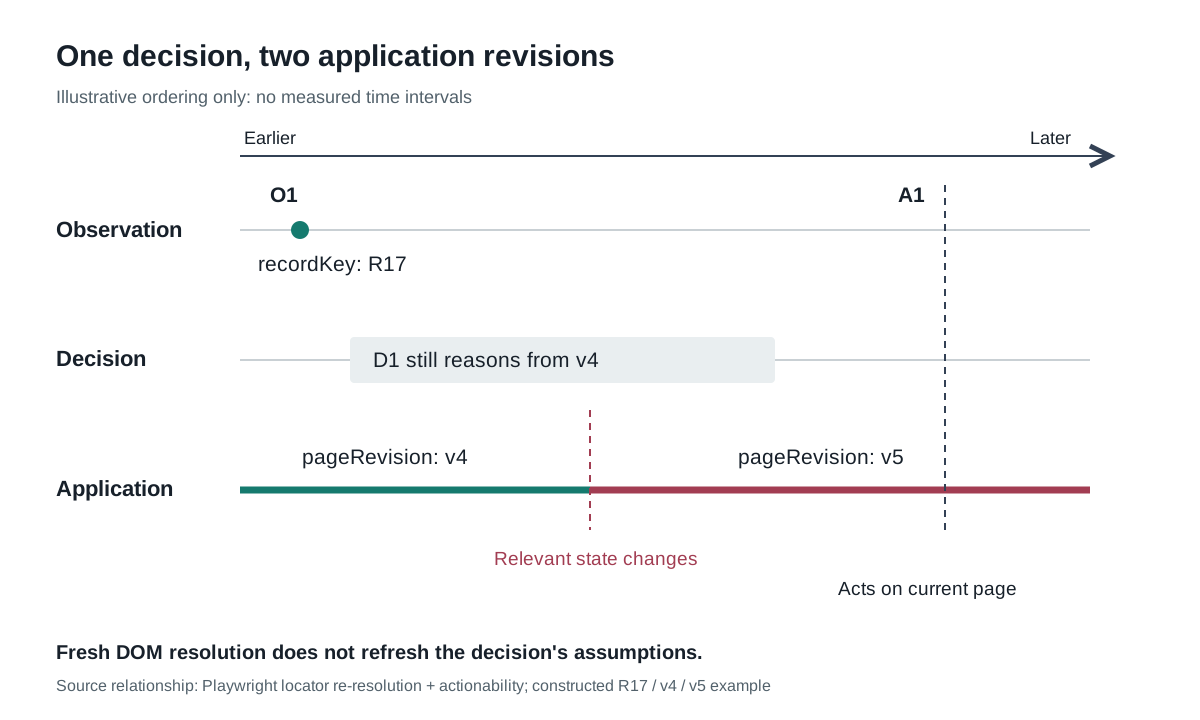
There are at least three useful boundaries to record: observation completed, decision produced, and action began. An illustrative sequence might label them O1, D1 and A1; these are logical markers, not measured durations. The gap from O1 to A1 includes model latency, host queues, approval waits, tool transport and browser-side waiting. A short model response therefore does not establish that execution used fresh application state. Conversely, a long delay does not prove a decision expired: that depends on what changed.
The timeline separates two claims that are easy to collapse. O1 can accurately report revision v4, while the action at A1 can correctly interact with revision v5. Both tools may work exactly as designed. The failure is a decision that still assumes v4. The Playwright locator documentation explains fresh element resolution, but it does not describe a snapshot-to-action business transaction.
An agent result should therefore retain the observation boundary rather than just the final prose answer. A host can attach an observation identifier and the relevant record key to the proposed action. If a later tool returns a different key or a different value that mattered to the choice, the host has a concrete reason to request a new decision. Merely storing observedAt is weaker: elapsed time is useful context, but it says nothing about which assumption changed.
A current locator can select an expired decision
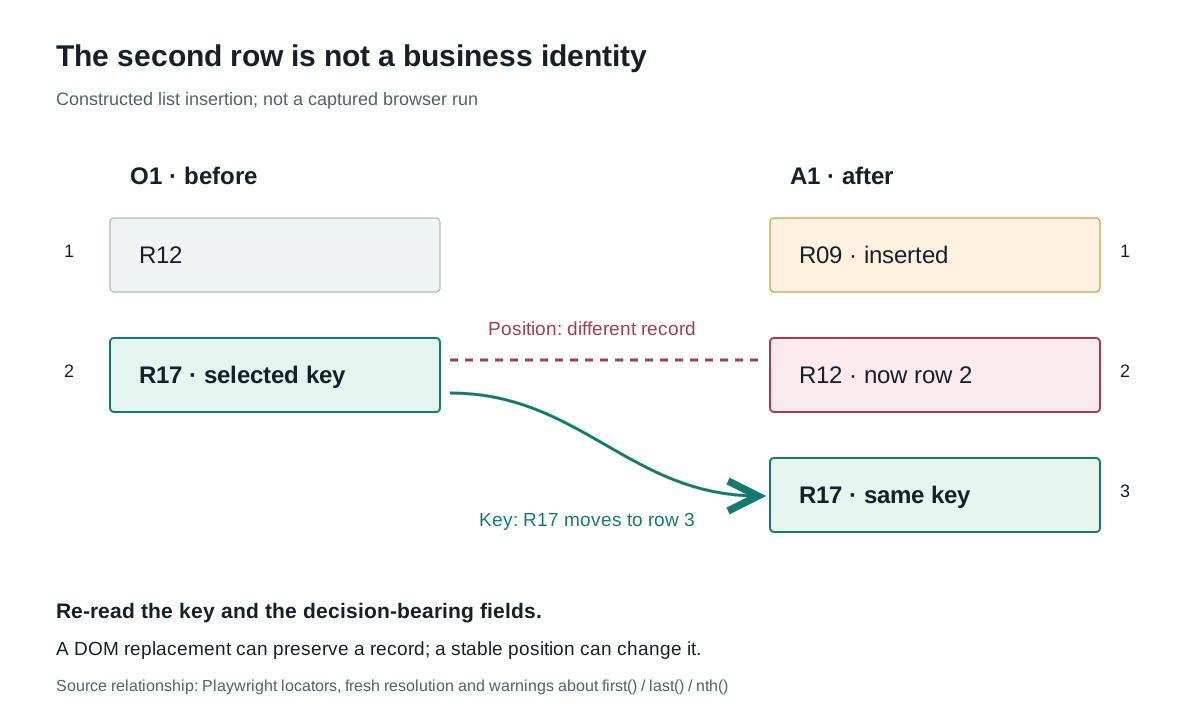
Consider an owned, illustrative task queue. At O1, its first row represents R12 and its second row represents R17. The agent selects the second row because R17 has the required status. Before execution, a refresh inserts R09 at the top. The second row is now R12. A command targeting the second button can resolve a unique, visible and enabled element while referring to the wrong record. This example is a constructed state transition, not a captured browser run.
| Boundary | Ordered record keys | Meaning of the second row |
|---|---|---|
Observation O1 | R12, R17 | Record R17 justified the decision |
Refresh before A1 | R09, R12, R17 | Record R12 now occupies that position |
| Key-scoped re-observation | Locate R17 and read its current status | Identity is preserved only if the application key still identifies the intended record |
Playwright explicitly warns that positional choices such as first(), last() and nth() can select an unintended element when the page changes. Its locator guide also says that each action resolves an up-to-date DOM element. Those properties are compatible: the framework can find the current second button correctly even though “second” no longer expresses the agent's intent. A fresh element reference is not a fresh interpretation of the task.
The reverse case matters too. A framework can replace a DOM node while keeping the same record key and business state. Treating every replacement as a new business object would create unnecessary replanning. A DOM node's lifetime, its position in a list and the application's object identifier describe different identities. The browser automation agent needs the one that matches the task, such as a stable record key plus the status used to make the choice, rather than a universal preference for one selector form.
An accessible name can also remain unchanged while its surrounding meaning changes. Two records might both expose an Open button, or a previously reviewed action can acquire a different amount without changing its label. A role-and-name locator improves target description, but the application still needs a disambiguating record boundary. The decision record should say why that target was selected, not merely reproduce the locator string used to reach it.
Actionability is not semantic freshness
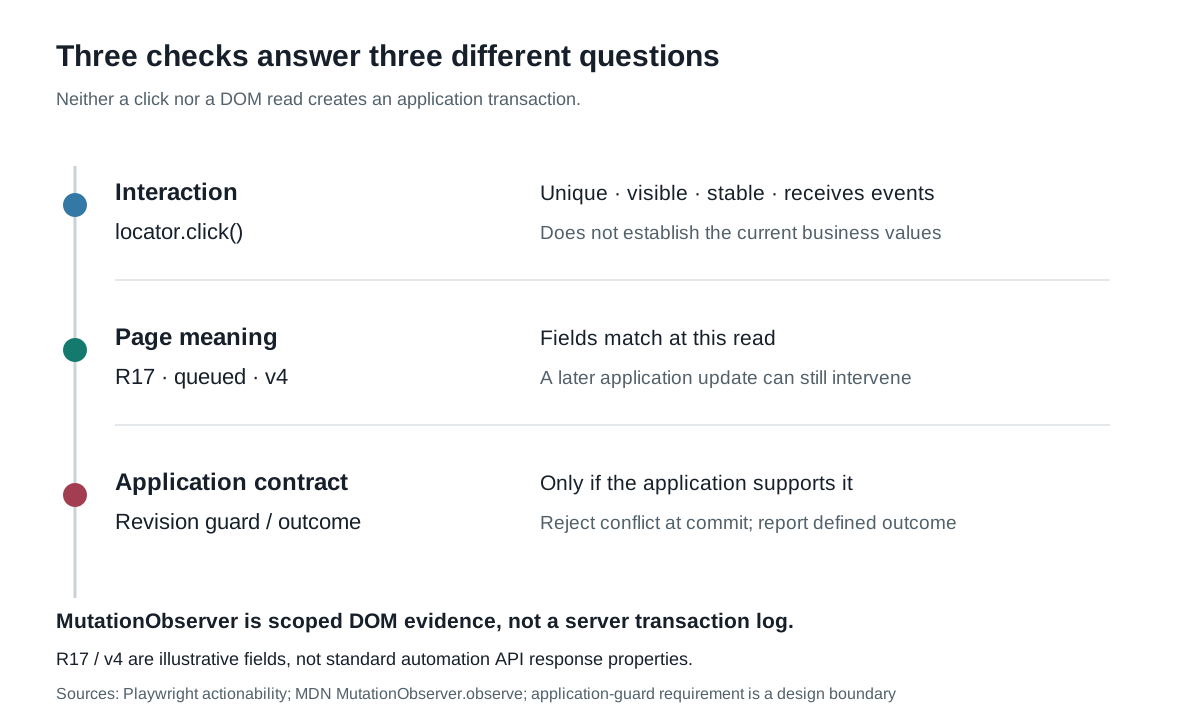
For locator.click(), Playwright checks that the locator resolves to one element and that the element satisfies its documented interaction conditions. These include visibility, stability, receiving events, enabled state and the current documentation's not-inert condition. The actionability reference defines stability in terms of an unchanged bounding box across at least two consecutive animation frames. It does not define stability as unchanged business data or an unchanged server revision.
That distinction affects seemingly strong checks. A button can stop moving while its associated record changes. It can receive pointer events while the price in the adjacent field updates. An enabled control can submit a request that the application later rejects. These are not contradictions in auto-waiting: the browser interaction layer is answering a narrower question. A host that records only click completed has not recorded whether the decision's preconditions survived.
| Evidence layer | Concrete check | Conclusion supported | Conclusion still missing |
|---|---|---|---|
| Interaction | locator.click() passes actionability | The interaction met the API's checks at execution | Whether the selected business values still match the decision |
| Page semantics | Current key R17, status queued, revision v4 | The observed fields matched at that read | Whether a later server mutation uses that revision |
| Application outcome | Application-defined response for R17 | The response establishes its documented outcome | Effects outside that response's scope |
The second row is not a replacement for the third. Reading a revision and then clicking leaves an interval in which the application may update again. If a workflow requires “apply only if still at v4,” that condition must be supported and enforced by the application at the mutation boundary. A browser cannot invent an atomic compare-and-update contract by polling the DOM more frequently.
The third row is likewise not interchangeable with browser feedback. A notification may show that a request was sent, queued or accepted for processing, depending on the application's wording and contract. Treating all three as a completed business operation erases the distinction the agent needs for recovery. Retain the outcome category actually reported rather than translating every green message into finished.
Mutation evidence has a configured scope
MutationObserver can help explain why an earlier page observation no longer matches the DOM. It observes a specified node, optionally its subtree, and configured mutation types. The MDN observe reference distinguishes childList, attributes and characterData; attributeFilter can narrow the attributes reported. Those options make a useful diagnostic instrument, not a universal application-state watcher.
Suppose an observer watches row additions and removals through childList but does not watch attributes. An attribute-only change can occur without the intended notification. Watching a small list does not cover an unrelated account panel or another document. An application may also have pending server state not represented in that subtree. A quiet observer means no matching notification was obtained within that coverage, not that nothing relevant happened anywhere.
The MutationObserver interface documentation also distinguishes receiving callbacks from calling takeRecords(), which removes queued notifications and returns them. A collector that drains the queue has changed what remains available to the callback path. Diagnostic records should retain which mechanism consumed the notifications; two empty outputs cannot be interpreted without knowing whether another consumer already removed them.
Notification timing introduces another boundary. MDN describes how changes in a removed descendant subtree can still be observed until the removal notification is delivered; later detached-subtree changes are no longer reported through that original observation. A record of removal therefore does not grant permanent coverage of a node wherever the application moves it. The observer target and its lifetime belong beside the mutation summary.
Raw mutation records can contain private content. For diagnosing staleness, the useful information may be only record-key changed, revision changed or a count of matching structural changes. Avoid sending full text nodes, form values or old attribute values to the agent merely because the observer can expose them. Coverage and minimization should be explicit: collect the smallest fields that can invalidate the decision, and keep unrelated page material out of the reasoning trace.
Define a decision record before the next action
A decision record binds a proposed action to the evidence that justified it. For the illustrative queue, useful fields include observation identifier O1, logical target R17, relevant status queued, revision v4 if the application exposes one, and the intended action class. Those values are examples of a host contract, not standard Playwright fields or a promise that every website provides revisions. An application without a usable key or revision needs a narrower claim about what can be verified.
| Record field | Illustrative value | Why it matters |
|---|---|---|
| Observation reference | O1 | Connects the decision to one returned representation |
| Context and target | ctx-a, R17 | Prevents an observation from another session or record being reused accidentally |
| Decision-bearing fields | status=queued, revision=v4 | Names the assumptions that require revalidation |
| Proposed operation | open-details | Distinguishes a read from a state-changing submission |
| Current outcome category | not-started | Keeps a proposal separate from an executed action |
Do not include every field just to make the record look complete. If a decision concerns status alone, an unrelated timestamp might cause needless invalidation. If it concerns amount and recipient, a key alone is insufficient. The fields should follow the reason the action was chosen. Their comparison rules also matter: a display string can change formatting without changing its business value, while a rounded number can hide a meaningful difference.
Context membership deserves its own treatment. BotBrowser's per-context fingerprint documentation describes separate context identities and a lifecycle in which identity-bearing configuration is sealed after the first renderer starts. That boundary can help keep a declared browser identity associated with a context. It does not mean the context's page, credentials, remote account or application data stopped changing. A host must still bind O1 and R17 to the intended task context.
The record should also survive tool transport without becoming a protocol tutorial. The MCP message boundary explains why request correlation is different from browser-state ownership. In an agent loop, a message identifier is useful for matching a returned result, but it cannot replace the task's target key or establish that the application state is current. Preserve these as separate fields instead of promoting one identifier into a universal session proof.
Revalidate without pretending the page is locked
Revalidation should answer a specific question: does the current evidence still support this proposed action? For R17, that can mean checking its current key, status and revision through the application's supported interface before opening details. If the status changed, obtain a new observation and reconsider the action. If only an unrelated list row changed, the decision may remain valid. A blanket “DOM changed, restart everything” rule loses that distinction.
There are three increasingly strong but different boundaries. Re-reading fields narrows the age of page evidence. A guarded application operation can reject a mismatched revision if the application supports that contract. A confirmed application result establishes the outcome within its documented scope. None should be presented as an automatic property of an agent framework, a locator or a BotBrowser profile.
Avoid a long sequence of unexamined actions based on one old observation. An agent that selects a record, opens a modal and submits a change crosses several state boundaries. The modal may expose a different recipient, an updated amount or a new permission requirement. The next action should use the newly observed fields, not inherit approval merely because the preceding click succeeded. A changed destination or consequential parameter is a new decision boundary.
Revalidation itself can disclose data. Returning an entire screenshot after every small change can create repeated copies of private content without improving the relevant comparison. An owned application can return a minimal, typed set of decision-bearing fields when that interface is available and authorized. Where only visual evidence is supported, retain the limitation and apply the host's access and retention rules rather than assuming that more context is always better.
Attribute outcomes and stop repeated uncertainty
Failure categories should identify the earliest unsupported assumption. Multiple locator matches indicate ambiguous targeting. A current field mismatch indicates stale decision evidence. A tool timeout can indicate a wait failed, but a timeout after possible submission does not establish that the server made no change. An application rejection is a distinct result again. Restarting the full loop for every category can repeat a consequential action while hiding the original cause.
For the illustrative R17 workflow, a read-only details action can usually be reconsidered from a fresh page observation within the task's authorization. A possible write requires a different recovery path: consult an application-supported status or operation identifier, or hand the uncertain outcome to its owner. The existence of R17 in the DOM is not enough to prove whether an earlier mutation committed. The needed evidence comes from the application's outcome contract, not a stronger prompt.
Bound recovery by meaningful transitions rather than repeated attempts alone. If a new observation still cannot distinguish the target, another identical action adds no evidence. If the application has no way to reconcile a possibly submitted write, stop automated resubmission. If authorization, origin, recipient or amount changed, return to the appropriate host decision boundary. These are observable reasons to stop, not guesses about an agent's confidence.
An operational trace can retain O1, the proposed target, the revalidation result and the outcome category without copying account content. That makes attribution possible: stale observation, incorrect target rule, application conflict and uncertain commit remain separate diagnoses. It also makes cleanup honest. Closing a browser context ends that local task resource; it does not undo a remote mutation or prove that a server discarded the associated data.
FAQ
Does a fresh screenshot make the next action atomic?
No. It provides newer visual evidence, but the application can change after capture. Atomic revision enforcement, where required, belongs to a supported application operation rather than screenshot timing.
Does Playwright auto-waiting keep the agent's decision current?
No. It waits for the action's documented interaction conditions. A currently actionable element can still represent a different record, price or status from the evidence used by the agent.
Can MutationObserver prove that nothing relevant changed?
Not generally. It reports matching DOM mutations within its configured target and options. It is not a complete observer of remote data, other documents or business transactions.
Does an isolated browser identity stop application drift?
No. Context identity configuration and application state have different lifecycles. A task still needs current target evidence, appropriate authorization and an application-defined outcome check.
Sources
- Playwright actionability and auto-waiting
- Playwright locator resolution and strictness
- MDN MutationObserver interface
- MDN MutationObserver.observe coverage options
- BotBrowser per-context fingerprint lifecycle
Practical conclusion
Bind each browser automation agent decision to the observation and business fields that justified it. Re-resolve the intended object, compare the fields that can invalidate the choice, and keep interaction success separate from application success. Use application-supported revision guards when a change must be rejected at commit, and reconcile uncertain writes before another attempt. A controlled context makes the browser environment explicit; it does not make an old decision current.
This article is part of the guide: Browser Deployment and Release: Operations Map
Related Articles
Headless Browser for AI Agents: Launch and Tool Boundaries
DeploymentStagehand Browser Automation with BotBrowser
Getting StartedBrowser-Use Setup with a Controlled Browser
FingerprintWeb Scraping AI: What the Model Does Not See
DeploymentBrowser Automation Signals and Consistency in Playwright
DeploymentPlaywright MCP Setup for a Custom Chromium Build
Run the same check in BotBrowser
Load a profile, keep the signals you just read about consistent inside the browser, and confirm the result on your own machine before a rollout.