Storage Events: Cross-Tab Consistency and Privacy Limits
Use the Web Storage event for same-origin UI updates while respecting source-window exclusion, partitions, timing, and privacy limits.
BotBrowser Team
Want the structured docs for Identity?
This article lives in the editorial library. For step-by-step setup, reference material, and ongoing updates, jump into the docs section.
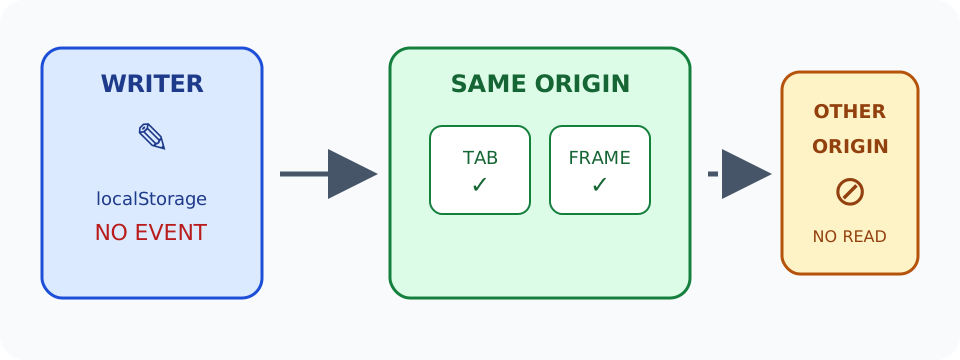
The storage event is a notification about a Web Storage change, not a shared transaction. When one Window changes localStorage, eligible other Documents may receive an event, but the Window that made the change does not receive its own event. The event is limited by origin, browsing context, and storage partition rules. A missing event does not prove that another tab is absent, and a received event does not prove identity, persistence, ordering, or race-free application state. BotBrowser can provide isolated profile fixtures for storage-event compatibility tests and record visible cross-context outcomes, but it does not expose another origin's storage or guarantee race-free state, event ordering, or persistence.
TL;DR
- A
localStoragechange can notify eligible other Documents of the same origin. - The Window that performs the change does not receive that storage event.
sessionStoragehas different context semantics, especially for top-level browsing contexts.- Events are notifications, not durable logs, transactions, identity signals, or ordering guarantees.
- Feature-detect storage, handle races, and keep a useful fallback when events are unavailable.
Contents
- What the storage event means
- Origin, context, and privacy boundaries
- Race-aware UI and fallback design
- Testing with BotBrowser
- Conclusion
What the storage event means
The storage event is delivered to a Window when another Document changes a storage area that the receiving Document can access. For localStorage, the change can be visible to other same-origin Documents that use the same storage area. The writing Window is excluded. A call that does not change the stored value, such as setting a key to the same string, does not represent a useful change notification. clear() can produce an event with a null key when values were removed.
The event exposes key, oldValue, newValue, storageArea, and url. These fields describe the observed change for the receiving Document. They are not a receipt from a server and do not include a complete history. A receiver may be loaded after the write, suspended while the write occurs, or closed before dispatch. The application must read current state when it needs truth rather than assuming that every notification was seen.
Use a small event handler that validates the key and then reads the current record. Do not treat newValue as an authoritative command. Another tab can write again before the handler runs, and a stale event can arrive after a newer value is already visible. A revision number inside the stored record helps a receiver compare state, but it does not create a transaction. The writer should update its own interface directly because it will not receive the event.
localStorage and sessionStorage share a synchronous key-value API, but their context scope differs. localStorage is associated with an origin and is normally shared by same-origin browsing contexts. sessionStorage is associated with a top-level browsing context and origin, so separate tabs normally have separate areas. The storage event rules also differ for these areas. With sessionStorage, an event can be relevant to same-origin Documents in the same top-level context, such as related frames, while it is not a general cross-tab channel. Consult the WHATWG Web Storage section and MDN's storage event reference for the current algorithm.
Do not call the event a synchronization protocol. It does not lock a key, merge concurrent edits, confirm delivery, or guarantee that two tabs converge. If two tabs write the same key, the last visible value may depend on timing. If one tab writes while another is offline or suspended, the second tab may only see the resulting value after a refresh. A product that needs conflict resolution should store a revision, compare it before writing, and show a recoverable choice when revisions diverge.
Origin, context, and privacy boundaries
Storage is scoped by the browser's origin model. Scheme, host, and port participate in the origin, so https and http, different subdomains, or different ports do not share ordinary Web Storage. A page embedded under a different top-level site may also encounter a partitioned storage bucket. The same embedded origin can therefore have separate values under two top-level sites. A successful read in one context says nothing about another context's bucket.
The MDN Web Storage API guide describes the client-side storage surface, while the HTML Standard defines the event dispatch behavior. Browser privacy features can add partitioning or deny storage in restricted contexts. Private browsing, disabled storage, sandboxed frames, and user clearing can all change whether a value exists or whether an event is observable. Treat those outcomes as context facts, not as evidence about a person or device.
The writer exclusion is an important privacy and correctness boundary. A page should not wait for its own storage event to update its UI. It should apply the local result directly, then let other eligible Documents react. Conversely, another tab receiving an event does not prove that the writer is a particular user, browser, or device. Multiple users can share a profile, and one user can have several isolated profiles. Message reachability is not authentication.
Do not use a missing key as an identity test. It may mean a new context, a cleared site, a different partition, a denied storage operation, an expired application record, or a browser policy change. A present key may be a shared preference rather than a person-specific marker. Keep account decisions with authentication and server authorization. Keep location decisions with an appropriate location mechanism. Storage availability is not a substitute for either.
Privacy risk increases when raw storage values are joined to account records, timing data, screen properties, or network hints. Prefer a bounded application outcome such as theme-changed, draft-refresh-needed, or session-state-updated. Do not log full document text, tokens, or detailed keys merely because an event exposes them. Set a purpose and retention period for diagnostic records, and delete temporary fixtures when support work ends. The W3C Privacy Principles support purpose limitation and data minimization.
Storage events also have an ownership boundary. Any script that runs with the origin's authority may be able to read the storage area and observe changes. The event does not protect a secret from another script already trusted by the page. Do not synchronize credentials, recovery codes, or private account content through localStorage. If a sign-out notice is useful, broadcast a bounded state change and require each context to verify the authoritative session before allowing protected actions.
Race-aware UI and fallback design
Start with a UI that works if storage is unavailable and no event arrives. Feature-detect the storage object, catch access and quota errors, and render the current page without waiting for another context. A manual refresh button, a server revalidation, or a worker-based coordination path may be an appropriate fallback. Each fallback has different timing and scope, so document the user-visible behavior instead of promising universal synchronization.
When a tab writes a record, update its own view immediately. Other tabs can receive a notification and then read the record. Include a schema version and revision in the stored value. A receiver should ignore an unknown schema, compare revisions, and request a fresh read when the event is older than its current state. If the read fails, keep the last usable view and expose a retry. Never clear a form or delete a draft solely because a notification was missed.
The event handler should be short and idempotent. Validate the key, parse a bounded value, and schedule one refresh. Do not perform a long network request inside a synchronous storage callback without cancellation and deduplication. A burst of writes can create repeated refresh work, so coalesce keys and cap concurrent reads. A visibility return can trigger one authoritative refresh instead of replaying an unbounded history.
Conflict handling belongs to the application. If two tabs edit a draft, store a revision and detect a mismatch before replacing local text. Offer merge, keep-local, or reload choices according to the product. If the data is shared with a server, perform server-side authorization and conflict checks as well. A storage event can indicate that another context changed something; it cannot choose which edit is correct.
Session state needs a separate policy. A tab can use a storage event to notice a sign-out marker, but it should still verify session validity before a protected request. If the event is missed, the server remains authoritative. For a logout UI, clear local presentation state and show a recovery path without treating event delivery as proof that a person signed out in a particular tab.
Test empty storage, denied storage, quota failure, same-value writes, removeItem, clear, malformed data, old revisions, rapid writes, reload, hidden tabs, suspended tabs, and a writer that closes immediately after writing. Assert that the writer updates itself, that eligible other Documents react, and that unrelated origins do not. Also assert that the baseline page remains usable when no event is delivered.
Make accessibility part of the fallback. A notification should update a named status, preserve focus, and leave a keyboard-accessible refresh action. Do not expose raw storage keys or private values in announcements. Explain “Newer data is available” rather than “storage event received.” Respect reduced motion separately from storage behavior, and keep status changes concise enough for assistive technology.
Testing with BotBrowser
BotBrowser supports isolated profile fixtures for storage-event compatibility tests and can record visible outcomes across declared browser contexts. The limitation is explicit: it does not expose another origin's storage, guarantee race-free application state, guarantee event ordering, or guarantee persistence after context teardown. A fixture can compare a writer Window, an eligible receiving Document, a separate origin, a partitioned context, and a reload path, but it cannot turn delivery into identity evidence.
Build the fixture with synthetic keys and values. Open two same-origin contexts, write a changed value from the first, and verify that the first updates itself directly while the second observes the event. Then repeat with the same value, removeItem, clear, and a delayed listener. Add a different origin or port and record that it cannot read the first origin's storage. Add separate top-level sites for an embedded context when partitioning is part of the supported deployment.
Record browser build, platform, origin tuple, context type, storage kind, key class, revision, listener timing, visible result, and fallback result. Do not record account names, credentials, full documents, or raw private values. Keep compatibility evidence separate from production analytics. A controlled fixture shows what happened in the declared contexts; it does not promise that every browser release, privacy mode, or deployment will behave identically.
Interpret a missing event conservatively. Check whether the listener existed before the write, whether the value changed, whether the receiving context was eligible, and whether storage access succeeded. Check the current stored value directly in the receiving context. Do not label the result as a browser defect until the fixture controls those variables. Likewise, a delivered event proves only that the tested Documents were eligible for that change; it does not prove a shared account or stable device.
A small consistency contract.
Write the consistency rule before choosing the event handler. For a theme preference, the rule may be that a receiving tab updates on the next event or on its next visibility return. For a draft, the rule may require a revision comparison and a visible merge choice. For a logout marker, the rule should require an independent session check before a protected request. These rules make the difference between a useful notification and an unsafe assumption concrete.
Use the storage event only for changes that can tolerate a delayed observer. A banner that says “newer data is available” can wait for a read. A payment confirmation, access grant, or destructive action cannot wait on a best-effort client event. Route those decisions through the authoritative service and let each context refresh its own presentation. This division also makes a browser compatibility result easier to interpret: the test demonstrates a UI update path, not a security guarantee.
Keep the writer and receiver paths symmetrical in documentation. The writer should state which local state it changes, how it updates its own view, and what notification it sends. The receiver should state which key it accepts, which revision it reads, and what it does when the value is missing or malformed. Include the no-event path in the same table. A reviewer should never need to infer that the writer is excluded from dispatch.
Storage is synchronous, so a large serialized value can block the main thread before any notification is dispatched. Keep records small, move structured data to an appropriate asynchronous store, and send a short invalidation key when a larger record changes. The receiving tab can then fetch or read the current record without copying a complete document through the event. This reduces rendering work and limits the amount of data that appears in diagnostics.
Consider cleanup as part of correctness. Remove listeners when a route is abandoned, clear obsolete keys during a documented migration, and do not leave a retry timer running after a component is destroyed. A stale listener can update a hidden screen, trigger redundant reads, or keep a private value alive longer than the feature needs. Test repeated mount and unmount cycles as well as a browser refresh.
When storage is cleared, the product should recover deliberately. A preference can return to a documented default. A draft can remain in the current in-memory view and offer an export or sign-in action. A session marker can require a fresh server check. Do not silently recreate a sensitive record from an old diagnostic copy. The fallback should explain the next user action and should remain usable when storage access is denied.
Finally, record only the evidence needed to maintain the feature. A support note can say that the writer updated its own view, another same-origin tab refreshed after a changed key, and a different origin remained unchanged. It rarely needs the exact stored value. Keep browser release, application revision, context type, and fixture identifier separate from account data. Review that evidence after a browser update or a change to storage partitioning, then retire temporary records when the issue closes.
Conclusion
The storage event is a same-origin notification with an important source-document exclusion. Let the writing Window update itself, let other eligible Documents re-read current state, and design for races, partitions, missing storage, and lifecycle changes. Keep authentication, authorization, identity, and persistence decisions outside the event. BotBrowser makes authorized compatibility fixtures repeatable while leaving browser storage policy and application correctness with the systems that own them.
Related reading
- Browser storage partitioning and privacy
- Cookies, localStorage, and IndexedDB
- BroadcastChannel same-origin messaging
Sources
Related Articles
Take BotBrowser from research to production
The guides cover the model first, then move into cross-platform validation, isolated contexts, and scale-ready browser deployment.