Selenium Alternatives: What Changes in Practice
Compare the protocol, browser lifecycle, waits, and debugging work that changes when a team moves from Selenium to another browser automation framework.
BotBrowser Team
Want the structured docs for Documentation?
This article lives in the editorial library. For step-by-step setup, reference material, and ongoing updates, jump into the docs section.
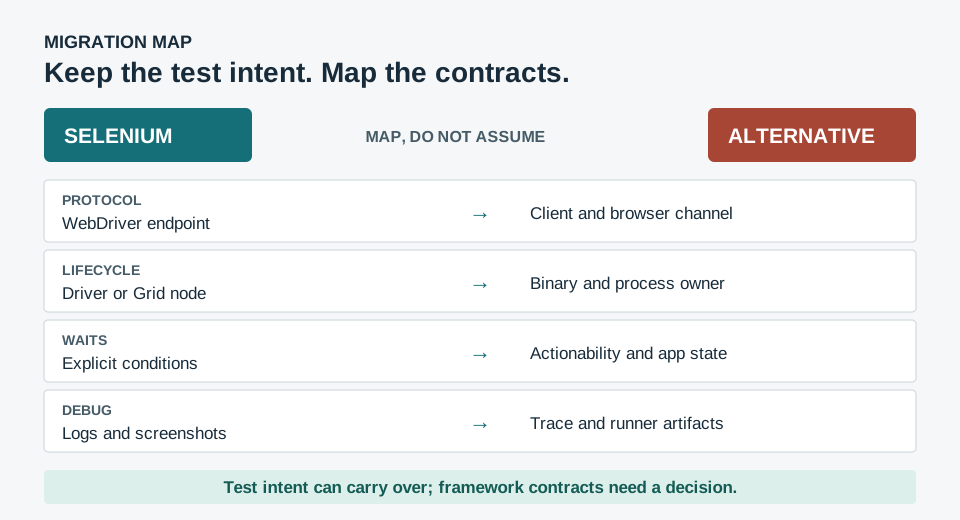
Teams searching for a Selenium alternative usually need more than a list of framework names. They need to know what will change in an existing test suite: how a browser session is created, who manages the browser binary, how an action waits for the page, and what evidence remains after a failure. Those contracts differ even when two tools can click the same button. BotBrowser supports documented browser automation paths, but it does not translate test suites or choose a framework. The practical answer is to migrate one representative test and map those four surfaces before estimating the rest.
For a protocol decision within the same framework, compare WebDriver, BiDi and CDP operation support; a client library name alone does not establish which connection exposes the required command or event.
TL;DR
- Selenium WebDriver uses a standardized remote-control protocol and commonly routes commands through a driver or remote Grid. Other frameworks may use a different client-server protocol or connect directly to a browser debugging endpoint.
- Browser installation and process ownership move with the framework. Selenium Manager can manage drivers and browsers; Playwright manages its supported browser binaries; remote execution adds another owner in either case.
- Playwright auto-waits for documented actionability conditions before many locator actions. Selenium tests usually express synchronization through explicit waits and expected conditions. Neither model removes the need to understand application state.
- Test intent, test data, and business assertions can often carry over. Session setup, selectors, waits, fixtures, browser coverage, and failure artifacts need an explicit mapping.
Contents
- Protocol and session ownership
- Browser and driver lifecycle
- Wait semantics and actionability
- Debugging evidence
- What usually carries over
- A migration worksheet
- Evaluate one test before the suite
- Practical conclusion
Protocol and session ownership
An alternative is not a drop-in replacement just because it offers click(), navigation, and browser selection. The important difference is the contract behind those operations: which process owns the browser, which protocol carries a command, what state the client can inspect, and how a test decides an element is ready. Those differences determine what has to be rewritten and what can stay in the suite.
Keep the search phrase in perspective. “Selenium alternative” can mean a team wants a different language binding, a simpler local setup, a new browser matrix, or a different debugging workflow. The autocomplete variants include Python, Playwright, web scraping, open-source, and Java. They do not identify one universal reason to switch. A migration plan should start with the failing constraint in the current system, not assume that a popular framework is automatically a better fit. The useful comparison is a migration inventory: identify the current dependency, replacement contract, changed code, and evidence that proves the migrated test still checks the same outcome.
Selenium WebDriver is defined by the W3C WebDriver standard. A WebDriver client sends commands to a remote end that controls a browser session. In a local setup, the browser driver commonly provides that bridge; in a distributed setup, Selenium Grid routes sessions to remote nodes. This separation is useful when a team needs a common protocol across supported browsers and wants to keep browser execution remote from the test process.
Playwright distinguishes its browser-server connection from a Chromium CDP connection; its CDP reference describes the latter as lower fidelity than the Playwright protocol connection. Puppeteer documents both CDP and WebDriver BiDi. Selenium's BiDi documentation describes a WebSocket connection for bidirectional browser events, alongside the WebDriver command model. These protocols and endpoints are not drop-in URL substitutions. For a migration, record the browser, client, connection method, version, and exact operations the suite needs, then check feature coverage before changing the session setup.
Write down session ownership before changing code. Is the test process starting the browser? Is a remote Grid, browser service, or long-lived browser process starting it? Which component creates contexts or sessions, and which component closes them after a failed test? A migration that changes framework but leaves the old remote-session assumption in place can fail before the first locator runs.
| Current Selenium assumption | Migration question | Evidence to collect |
|---|---|---|
| A WebDriver session is created by a local driver or Grid | Which process starts the browser in the target framework? | Startup command, endpoint, session ID, and ownership of teardown |
| Capabilities configure a remote session | Which target options map to launch, context, or connection settings? | The accepted option names and the effective browser/version |
| Commands follow WebDriver semantics | Does the target use WebDriver, CDP, or a framework-specific channel? | Protocol documentation and the exact connect method |
Browser and driver lifecycle
Replacing Selenium changes more than a dependency import. A local Selenium setup may rely on Selenium Manager to discover, download, and cache a compatible driver or browser. Selenium Grid may instead provision the browser on a remote node. Playwright installs browser builds for its supported browser channels and launches them through its runtime. A remote Playwright connection moves process ownership to the remote browser service. Puppeteer similarly needs a compatible browser executable or an explicitly configured remote endpoint.
These arrangements shift maintenance responsibility; they do not remove it. Before migration, record where the browser binary comes from, how its version is pinned, when it is updated, how the test runner finds it, and what process cleans up after a timeout. Keep the browser version and the automation package version as separate fields. A framework upgrade and a browser upgrade are distinct changes, even when a package installer couples their default behavior.
The browser matrix can change too. Selenium's protocol is designed for interoperability across browser implementations, while a framework's feature set may differ by browser engine or connection mode. A Chromium CDP endpoint is not evidence that the same workflow has equivalent support in Firefox or WebKit. If cross-browser coverage is a requirement, list the exact engines, versions, and features used by the current suite, then verify each target path against its official support documentation.
| Lifecycle point | Record before migration | Confirm after migration |
|---|---|---|
| Install | Package, browser source, driver source | Reproducible install in a clean runner |
| Start | Local process, Grid node, or remote endpoint | The process that owns the browser and its logs |
| Pin | Framework and browser versions | Both versions are explicit in CI output |
| Close | Session deletion and orphan cleanup | Browser and context close after pass, failure, and timeout |
Wait semantics and actionability
Synchronization is a frequent source of migration regressions because similar-looking calls may wait at different points. Selenium exposes explicit waits such as WebDriverWait with expected conditions. The test author chooses a condition and timeout, for example waiting for visibility or a URL change. Implicit waits affect element lookup behavior and can interact confusingly with explicit waits, so a migration is a good time to inventory and remove accidental mixed timing assumptions.
Playwright locators wait for documented actionability conditions before actions such as clicking. For a click, those conditions include checks such as whether the element is visible, stable, receives events, and is enabled. This reduces hand-written wait code for common interactions, but it does not mean every application-specific transition is automatic. A test may still need to wait for a response, a URL, a domain-specific state change, or an asynchronous job to complete.
Puppeteer offers its own waiting and locator APIs; do not translate a Selenium wait into a different framework by matching method names alone. First name the condition the test needs. “Wait until the button can receive input” is different from “wait until the save request has completed” and different again from “wait until the saved value appears after navigation.” Map the condition, not just the old line of code.
Consider a page with a Save button and a status message. The Selenium version makes the expected transition explicit; a Playwright version can use a locator action and then assert the resulting state:
# Selenium Python: the page has already been opened.
from selenium.webdriver.common.by import By
from selenium.webdriver.support import expected_conditions as EC
from selenium.webdriver.support.ui import WebDriverWait

save = (By.CSS_SELECTOR, "button#save")
WebDriverWait(driver, 5).until(EC.element_to_be_clickable(save)).click()
WebDriverWait(driver, 5).until(
    EC.text_to_be_present_in_element((By.ID, "status"), "Saved")
)
# Playwright Python: page is an async Playwright Page.
from playwright.async_api import expect

await page.get_by_role("button", name="Save").click()
await expect(page.locator("#status")).to_have_text("Saved")
The second example is not a promise that Playwright needs no waits. The locator action waits for its actionability contract, and the assertion retries until its condition or timeout. The test still states the outcome that matters. During migration, preserve that outcome assertion even if the framework removes a separate “is clickable” wait.
Debugging evidence
The failure artifact is part of the automation contract. Selenium teams may rely on driver logs, browser logs, screenshots, Grid session metadata, video supplied by an execution service, or test-runner reports. Which artifacts exist depends on the test runner and infrastructure; Selenium itself does not make every deployment produce the same bundle.
Playwright's trace viewer can present a recorded sequence with actions, snapshots, and related network information when tracing is configured and retained. Puppeteer has its own debugging approaches, including browser DevTools and protocol-level inspection. These artifacts are not equivalent formats. A trace archive does not automatically replace a Grid node log, and a screenshot alone does not explain whether the failure was a locator mismatch, a timeout, a network response, or a browser crash.
Before migrating, list the questions an on-call engineer answers after a CI failure: what action ran, what the page looked like, which request failed, which browser version was used, and whether the browser process exited. For each question, name the artifact and its retention location in both systems. If the new framework captures more data but CI discards it, the practical debugging surface has not improved.
Treat sensitive data separately. Traces, screenshots, and logs can contain URLs, response bodies, account identifiers, or page content. Decide what can be stored, who can access it, and how long it is retained before enabling richer capture on every test.
What usually carries over
The test's intent is usually more stable than its automation code. A requirement such as “a user can save a draft and see the saved state after reload” can remain even if the session API, selectors, and waits change. Test data, domain assertions, and the decision about which browser behaviors matter may also carry over. They should be reviewed, not copied without checking hidden framework assumptions.
Code most likely to need revision includes driver setup and teardown, page-object wrappers, selectors, custom wait helpers, browser capability configuration, parallel-worker setup, and CI artifact collection. A Selenium page object may hide implicit waits or driver-specific behavior; translating its method names while retaining those assumptions can make the new suite harder to diagnose than the old one.
Browser coverage should be treated as a requirement, not a side effect of choosing a framework. If the current suite runs Chrome, Firefox, and Safari through separate WebDriver endpoints, verify how the proposed framework reaches those engines and which capabilities it supports in the chosen mode. A Chromium-only success does not establish that the suite has preserved its previous coverage.
A migration worksheet
Use one representative test and fill this table before estimating the whole suite. “Keep” means the requirement or test data stays the same; it does not mean the underlying automation code remains byte-for-byte compatible.
| Surface | Existing Selenium record | Target record | Migration decision |
|---|---|---|---|
| Test intent | User action and expected business state | Same expected state | Keep the assertion; compare it after reload or navigation if that is part of the requirement |
| Session/protocol | WebDriver endpoint and capabilities | Target protocol and connection mode | Rewrite session setup; confirm remote ownership and supported browser engines |
| Browser lifecycle | Driver/browser provisioning and teardown | Package, executable, service, and context ownership | Rewrite install and cleanup; pin both framework and browser versions |
| Synchronization | Explicit/implicit waits and expected conditions | Actionability, locator retry, or explicit condition | Translate each condition by meaning; remove mixed or redundant waits |
| Debugging | Screenshot, logs, Grid metadata, video | Trace, logs, screenshots, runner report | Map each incident question to a retained artifact and access policy |
| CI behavior | Worker count, session capacity, retry behavior | Target process/context model and artifact hooks | Re-measure concurrency and failure cleanup; do not reuse the old capacity assumption |
The worksheet is useful because it separates a framework decision from a migration estimate. If the team cannot name the protocol endpoint or the artifact required to debug one test, those unknowns should be resolved before converting hundreds of tests. If only one row changes for the team's use case, a broader rewrite may not be justified. For wait-specific Selenium diagnosis, see Selenium waits and stable tests; for a comparison between two CDP-oriented alternatives, see Playwright versus Puppeteer for browser work.
Evaluate one test before the suite
Choose a test that exercises a normal action, one asynchronous transition, and one meaningful assertion. Avoid starting with the most brittle test or the simplest static page: either can produce a misleading estimate. Run the current Selenium test in the CI-like environment and save its version, timing, artifacts, and cleanup result. Then implement the same requirement in the candidate framework without changing the page behavior or expected outcome.
Compare the two runs by questions rather than a single pass/fail number. Did both start the intended browser version? Did each reach the same page state? Did a forced failure leave enough evidence to locate the broken step? Did the browser close after a timeout? Did the candidate preserve all required browser engines? Record any difference and its owner: test code, runner, browser process, or application.
Do not infer that a new framework made the browser more consistent, less detectable, or more accepted by a destination. Framework choice controls automation interfaces and some lifecycle behavior; it is not a declaration of the full browser environment and does not determine a site's response. BotBrowser documents browser inputs that can be selected for supported automation paths, but it does not convert Selenium suites or reconcile their protocol differences. The automation consistency reference describes that separate browser-configuration boundary.
FAQ
Is Playwright a drop-in Selenium replacement?
No. The test intent may transfer, but the session API, protocol, browser lifecycle, selectors, waits, and debugging artifacts can differ. Migrate a representative test and map those differences before estimating the suite.
Does Selenium Manager remove the browser setup work?
It can manage driver and browser installation for supported Selenium workflows, but teams still need to decide version pinning, cache behavior, CI ownership, remote execution, and cleanup. It changes parts of provisioning; it does not remove the lifecycle contract.
Does auto-waiting mean explicit waits are never needed?
No. Auto-waiting covers documented actionability conditions for supported operations. Tests still need to wait for application-specific outcomes such as a completed save, a navigation, or a background job.
Should a migration start by converting every page object?
No. Start with one representative end-to-end test and preserve its outcome assertion. The test reveals whether protocol setup, browser ownership, timing, or failure evidence is the actual migration cost.
Can a framework change make a browser session look different to a website?
Framework and connection choices can change automation behavior, but they do not by themselves specify every browser, network, or device value. Treat those as separate configuration and measurement questions; do not infer identity from the automation library name.
Sources
- W3C WebDriver, Second Edition
- Selenium WebDriver
- Selenium waits
- Selenium Manager
- Selenium WebDriver BiDi
- Playwright actionability
- Playwright BrowserType connections
- Playwright Trace Viewer
- Puppeteer WebDriver BiDi
- Puppeteer page interactions
- Puppeteer debugging
- BotBrowser automation consistency
Practical conclusion
A Selenium alternative is a migration of control contracts, not just a package swap. Compare protocol and session ownership, browser provisioning, wait semantics, and the failure artifacts your team depends on. Keep the test's business intent stable, rewrite the framework-specific edges, and use one representative test to expose the real cost before moving the suite.
Related Articles
WebDriver vs CDP: What Each Connection Can Do
ComparisonPlaywright vs Puppeteer: Four Choices Before You Migrate
DeploymentBrowser Automation Signals and Consistency in Playwright
Getting StartedSelenium Scraping: Capabilities and Records
Getting StartedWebDriver BiDi Events for Stable Browser Automation
Getting StartedSelenium WebDriver Waits for Stable Tests
Run the same check in BotBrowser
Load a profile, keep the signals you just read about consistent inside the browser, and confirm the result on your own machine before a rollout.