F5 Bot Defense: What It Declares and What a Page Sees
Separate the data F5 says Bot Defense processes from what a page observes and what a customer can retrieve after a block or flag.
BotBrowser Team
Want the structured docs for Fingerprint?
This article lives in the editorial library. For step-by-step setup, reference material, and ongoing updates, jump into the docs section.
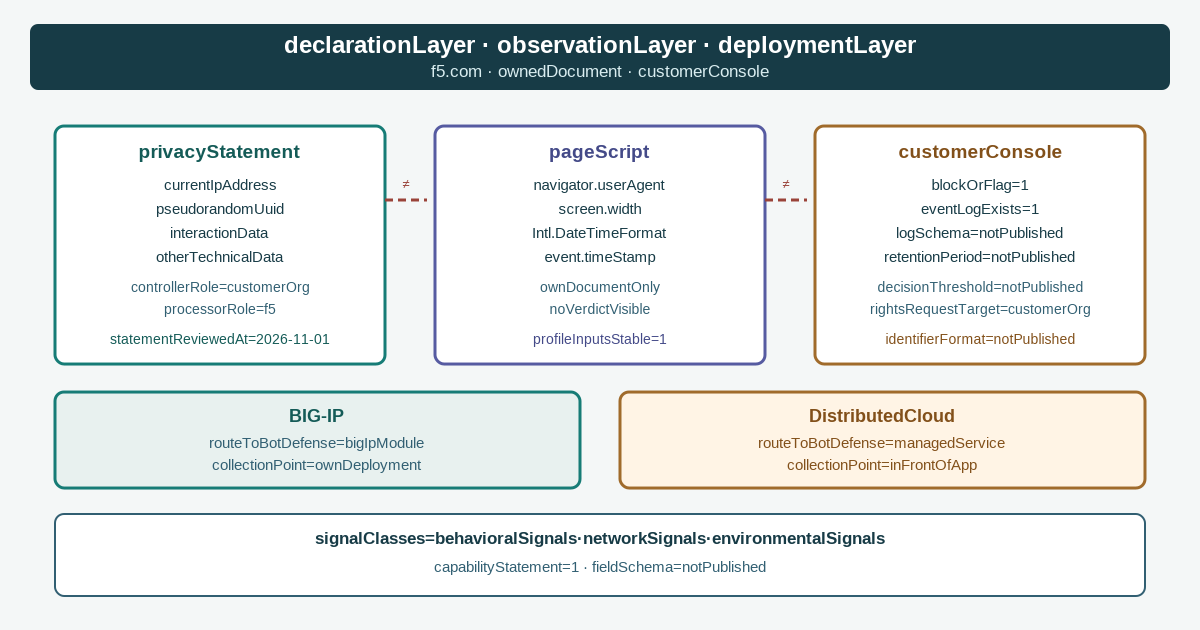
F5 publishes two different kinds of statement about Bot Defense, and they answer different questions. The Distributed Cloud Bot Defense privacy statement names a bounded set of data the service processes and assigns the roles of processor and controller. The Bot Management product page describes a capability: real-time behavioral analysis of client-side signals. Neither page publishes a field-by-field collection schema, a decision rule, a retention period or an identifier format. BotBrowser can make browser-side profile inputs explicit and reproducible, but it cannot change an F5 verdict, the identifier F5 assigns, a retention period or a customer's edge configuration.
That gap is the useful boundary. An operator who wants to reason about Bot Defense has three separate questions: what the vendor says it processes, what a page script can actually report about the browser, and what a deployed service decided and logged. Collapsing them into one claim about "what F5 detects" produces statements that no published page supports.
This article stays on published pages. It quotes the privacy statement's processing list, separates it from the product page capability language, and describes the two deployment paths at the level those pages describe them. It does not reproduce any protected script, sensor program, challenge sequence or identifier algorithm, and it does not describe a customer configuration.
The Imperva declaration map applies the same declaration-versus-observation split to another vendor, and edge layer rules a page cannot see covers which published rules require the network edge rather than the document.
TL;DR
- The F5 Distributed Cloud Bot Defense privacy statement names a bounded processing set: the current IP address and a pseudorandomly generated device UUID, interaction information from the browser or device, and other technical browser or device data used to screen for malicious activity.
- The same statement assigns roles explicitly: F5 is a processor of data about its customer's users, and the customer is or acts for the controller where the data contains personal data.
- The statement says a block or flag creates a log of that event for the customer's later review. It publishes no field-level log schema, retention period, decision rule or identifier format.
- The product page describes inputs as behavioral, network and environmental client-side signals. That wording names a capability, not a published field list.
- Two deployment paths change the collection point: an F5 BIG-IP native module routing to Bot Defense, or Distributed Cloud in front of the application.
- A BotBrowser profile keeps browser-side inputs consistent for a review. It cannot change an F5 decision, the assigned identifier, retention or a customer's configuration.
Table of contents
- What the privacy statement actually names
- The processor and controller split
- What the log statement does and does not promise
- Two deployment paths, two collection points
- From declaration to page observation
- BotBrowser capability and limitation
- Practical conclusion
What the privacy statement actually names
The F5 Distributed Cloud Bot Defense privacy statement was created on 1 July 2020 and shows a last-updated and last-reviewed date of 1 November 2026. It opens by describing the service's function: assessing the security or fraud risk of interactions with F5 customers' online properties, with the option to block or to flag.
It then lists what the service processes generally, across deployment models and configurations:
| Declared item | Wording in the statement | What it does not specify |
|---|---|---|
| Network address | The current IP address of the device using the customer's online property | Whether any other network-layer values are retained |
| Device identifier | A pseudorandomly generated UUID of that device | How the UUID is generated, rotated or scoped |
| Interaction data | Information from interactions between the user, browser or device and the online property | Which events, granularity or field names |
| Other technical data | Technical data about the browser or device used to screen for malicious activity | Which surfaces, in what combination, with what weighting |
Read that table as the complete published list, not as a summary of a longer one. The statement says the service processes "collected data from the browsers and devices" and then enumerates those categories. It does not attach a schema, a per-field purpose, a retention period or an order of evaluation.
The fourth row is the one most often over-read. "Other technical data about the browser or device that may be used to screen for malicious activity" is a purpose-limited category. It tells a reader that browser or device properties participate in screening. It does not state which properties, whether they are hashed, whether they are combined into a single value, or whether the same set applies to every deployment model. A page-side investigation can observe which values its own document reports. That observation cannot be promoted into a statement about what the service received, stored or weighted.
The date fields matter for a method, not for a conclusion. A statement last reviewed on 1 November 2026 is current enough to quote, and it is also the kind of document that changes without a product release note. Record the version you read beside any claim you draw from it, and re-read it before reusing the claim in a later piece.
Two exclusions keep the list honest. The statement does not name a cookie, a local storage key, a canvas hash, a WebGL renderer string or any other specific fingerprint surface, so an article that presents one of those as "what F5 collects" is inventing detail. Conversely, the statement's brevity is not evidence that collection is narrow: an aggregate category such as "other technical data" can cover a large surface without naming any of it.
The processor and controller split
The statement is unusually direct about roles, and that sentence is the most operationally useful part for anyone reviewing a deployment.
Under the data protection laws of the EU and similar jurisdictions, F5 is a processor of data about its customer's users, and the customer is, or acts on behalf of, a controller of that data, to the extent it contains personal data.
That split has three consequences a reader can act on:
- Rights requests go to the customer, not the vendor. The statement directs anyone whose access was blocked to contact the customer, and directs data-rights requests about customer data to that customer as well.
- The customer owns the accountability for purpose and retention. A processor acts on a controller's instructions. The public statement describes the service's processing, but the lawful basis, retention schedule and disclosure obligations sit with the customer relationship.
- A vendor privacy notice is not a deployment record. The statement describes the service generally. It cannot tell a reader what a particular customer configured, which deployment model is in use, or what that customer's own notice says.
The third consequence is the one that gets skipped. A reader who finds "F5 processes the current IP address and a device UUID" may reasonably ask "so what does this site do?" The answer requires the customer's own notice and configuration, not the vendor's. Treating the vendor statement as a description of one site's behavior is a category error, and it is the same error that makes vendor comparisons misleading.
The statement publishes two dates for versioning: created 2020-07-01, last updated and last reviewed 2026-11-01. Record both beside any claim you take from it.
For a review, record the role split explicitly. A sentence such as "the vendor states it acts as processor and the site operator as controller" is supportable from the page. A sentence such as "the vendor controls what this site retains" is not.
What the log statement does and does not promise
The statement describes the outcome path: the service uses the data to decide whether an interaction is from an unauthorized bot or otherwise poses a security risk, and if it decides that it is, it "either blocks or flags the traffic and creates a log of this event for that customer's later review." If not, the interaction continues.
That sentence supports four claims and no more:
| Supportable claim | Source wording |
|---|---|
| Decisions can be a block or a flag, not only a block | "blocks or flags the traffic" |
| A decision produces a customer-reviewable event record | "creates a log of this event for that customer's later review" |
| The default path is to allow the interaction | "Otherwise, the Service permits the interaction to continue" |
| The record belongs to the customer relationship | "for that customer's later review" |
What the sentence does not supply is just as important. There is no published log schema, so a reader cannot list the fields a customer sees. There is no published retention period, so a review cannot state how long such a record persists. There is no published decision rule, score or weighting, so no one can reconstruct why a particular interaction was flagged. And there is no published failure path, so the statement does not say what happens when the decision service is unavailable.
For an operator, that suggests a concrete review step: ask the customer-side owner which event records exist in their own account or console, and record those fields from that source. The vendor statement establishes that a record exists and belongs to the customer. Only the deployed configuration establishes what is in it.
The distinction also bounds what a blocked user can conclude. The statement directs a blocked user to the customer for restoration. It does not describe an appeals mechanism, a re-evaluation window or a reason code. A support process that assumes one of those exists is relying on something the page does not say.
Two deployment paths, two collection points
The Bot Management product page describes the deployment picture in a way the privacy statement does not. It says F5 BIG-IP provides a native module for configuring traffic to route to Bot Defense regardless of how BIG-IP is deployed, and that an organization could instead direct traffic to Bot Defense from Distributed Cloud.
At the level those pages support, that is two paths with different collection points:
| Path | Where the traffic is handled | What the public pages say |
|---|---|---|
| BIG-IP native module | In the organization's own BIG-IP deployment | A native module configures routing to Bot Defense |
| Distributed Cloud | In F5's managed service in front of the application | Traffic is directed to Bot Defense from Distributed Cloud |
The product page's own framing is that these are options for "how to handle traffic that originates from bots," described alongside on-premises hardware and a managed-service connector. It does not publish a comparison of what each path logs, where the device identifier is generated, or which path a given customer uses.
That gap is the practical limit of this comparison. A reader can correctly say that the collection point differs between a native BIG-IP module and the managed service. A reader cannot say from these pages which party holds the log in each case, whether the identifier is generated at the same layer, or whether the processing list applies identically. Those answers are in customer documentation and contracts, not in the public product page.
For a review, the deployment path belongs in the scope statement. "A Distributed Cloud Bot Defense deployment" and "a BIG-IP deployment routing to Bot Defense" describe different systems. A sentence that mixes them, or that attributes one path's properties to the other, is not supported by the published pages.
From declaration to page observation
The product page also supplies the only vocabulary the vendor publishes for inputs: "rich client-side signals" that are "behavioral, network, and environmental." That is a three-part description of a capability. It is not a field list, and each part points somewhere different.
Behavioral signals describe something over time: how an interaction unfolds rather than a single value. Network signals describe properties of the connection. Environmental signals describe the browser, device or platform context. A page can observe some environmental and behavioral facts about its own document. It cannot observe what the service concluded from them, and it cannot observe network-layer values the way the edge does.
That produces three distinct evidence classes, and mixing them is the most common error in this kind of article:
| Evidence class | Who can produce it | What it establishes |
|---|---|---|
| Vendor declaration | The published privacy statement and product page | What the vendor says it processes and decides |
| Page observation | A script running in the owned document | What the browser reports to that page |
| Deployment record | The customer's own console, logs or contract | What was decided and retained for that deployment |
The middle row is where a browser-automation review has legitimate work to do, and it must stay in that row. A profile can hold environmental inputs steady so that a page-observation result is comparable across runs. That is a statement about the browser, not about the vendor. A result such as "the document reported these values consistently" says nothing about whether F5 flagged the interaction, what identifier it assigned, or what the customer's console recorded.
The table also explains why a vendor comparison has to stay parallel. The Imperva article and this one can each quote their own vendor's declaration and apply the same three-class separation. Neither becomes evidence about the other, and a claim that one vendor collects "more" than another requires a published field list that neither page provides.
BotBrowser capability and limitation
BotBrowser documents profile-backed browser surfaces and explicit launch inputs. For a review of this kind, that capability has a narrow but real use: it lets an operator hold the browser-side inputs consistent while checking what a page reports about its own document, and repeated observations then differ because the page or the workload changed rather than because the profile drifted between runs. The same paragraph has to state the limitation: BotBrowser does not change an F5 policy, does not alter the device identifier the service assigns, does not affect retention, does not modify a customer's BIG-IP or Distributed Cloud configuration, and does not reveal what a decision service concluded. The BotBrowser fingerprint documentation describes the browser-side surfaces a profile controls; the F5 privacy statement describes what the service says it processes. Neither document converts a browser observation into a statement about a vendor verdict.
A useful report keeps those two sources separate and labels which one each sentence came from.
FAQ
Does F5 publish a list of the browser signals Bot Defense collects?
No. The privacy statement names four broad categories: current IP address, a pseudorandomly generated device UUID, interaction information, and other technical browser or device data used to screen for malicious activity. The product page describes behavioral, network and environmental client-side signals. Neither publishes a field-by-field schema.
Who should someone contact if Bot Defense blocked their access?
The customer whose property they were visiting. The privacy statement directs blocked users, and data-rights requests about customer data, to the customer rather than to F5.
Does a block create a record the customer can review?
The statement says a block or flag creates a log of the event for that customer's later review. It does not publish the record's fields, retention period, decision rule or an appeals process.
Is the BIG-IP path the same as the Distributed Cloud path?
They are different deployment options with different collection points. The product page describes a BIG-IP native module that routes traffic to Bot Defense and an alternative of directing traffic from Distributed Cloud. The public pages do not compare what each path logs.
Can a browser profile change what Bot Defense decides?
No. A profile can hold browser-side inputs consistent for an observation. It cannot change an F5 verdict, the identifier the service assigns, retention or a customer's edge configuration.
For neighboring work, Imperva bot protection: what it declares applies the same separation to a vendor that publishes a different processing description, and Edge layer rules a page cannot see covers which published rules require the network edge. Azure WAF bot protection declaration map shows the same method where the vendor is a cloud platform rather than a standalone bot service.
Sources
- F5 Distributed Cloud Bot Defense Privacy Statement
- F5 Bot Management
- BotBrowser fingerprint documentation
Practical conclusion
F5's published pages support a narrow, checkable set of statements. The privacy statement names four processing categories and assigns F5 the processor role and the customer the controller role. It says a block or flag creates a customer-reviewable event record, and it leaves the record's schema, retention and decision rule unstated. The product page describes behavioral, network and environmental client-side signals as capability language and describes two deployment paths with different collection points.
Read together, those pages answer "what does F5 say it processes and decides" and leave "what did this deployment decide and keep" to the customer's own records. Keep vendor declaration, page observation and deployment record in separate columns, and state the deployment path in scope. When the question is what the service concluded, the answer comes from the customer's console or contract, not from a browser observation and not from a BotBrowser profile.
This article is part of the guide: What Is a Browser Fingerprint? Signals and Layers
Related Articles
Imperva Bot Protection: What It Declares
FingerprintKasada Challenge Signals and Privacy Explained
FingerprintAkamai Bot Manager: Sensor Data and Privacy
FingerprintAzure WAF Bot Protection: What Each Product Declares
FingerprintAWS WAF Bot Control: What a Client Actually Sees
FingerprintWhat Public Detector Suites Actually Test
Run the same check in BotBrowser
Load a profile, keep the signals you just read about consistent inside the browser, and confirm the result on your own machine before a rollout.