WebGL Renderer Missing: Privacy or Context State?
Separate missing WebGL renderer information from context failures, privacy restrictions and unrequested collection. Preserve the distinction in support records.
BotBrowser Team
Want the structured docs for Fingerprint?
This article lives in the editorial library. For step-by-step setup, reference material, and ongoing updates, jump into the docs section.
A missing WebGL renderer value is not a diagnosis. It can describe an optional extension that was unavailable, a context that was never created, a context lost after creation, or a field the application never requested. Those cases require different evidence before anyone attributes the result to privacy protection or a graphics problem.
BotBrowser documents profile-based WebGL controls, including extension availability and reported graphics information. BotBrowser cannot identify a particular active setting from an absent value alone. An authorized application still needs to distinguish its own collection attempt, the context lifecycle and the optional information it received.
TL;DR
WEBGL_debug_renderer_infosupplies optional diagnostic information. A missing extension object does not, by itself, explain why the information is absent.- Keep
not_requested,context_unavailable,context_lost,extension_unavailableandreportedseparate. These are proposed support-record states, not observed measurements. getContext()andgetExtension()describe different boundaries. Collapsing both results into an empty renderer string destroys the distinction.- A privacy-policy explanation needs independent policy evidence. A graphics-failure explanation needs application or lifecycle evidence.
- A working visualization should not be rejected merely because optional renderer metadata is absent. Record the user-visible task result separately.
Contents
- Renderer absence has several meanings
- Five states preserve the diagnostic boundary
- Privacy settings and application failures need different evidence
- Comparisons need a context and a collection phase
- A support record can avoid collecting hardware identity
- BotBrowser scope and acceptance questions
- Practical conclusion
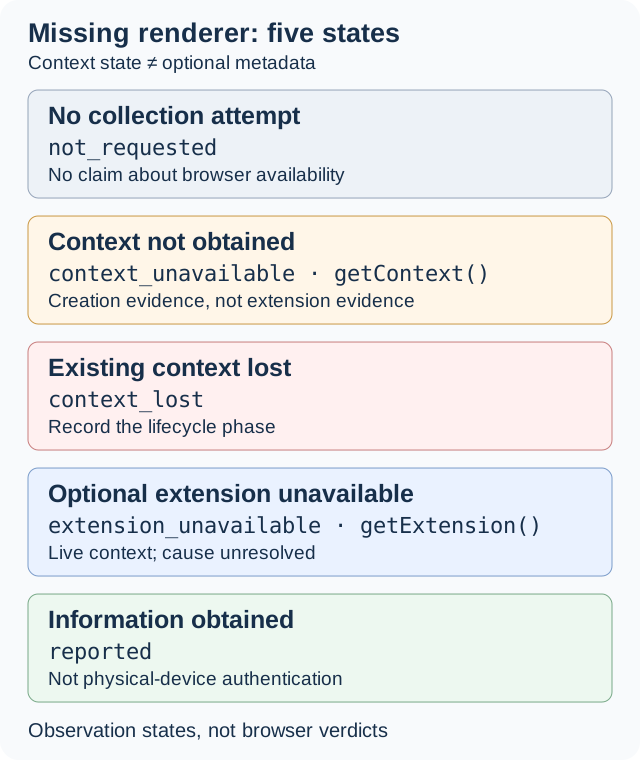
Context state and optional metadata availability belong in separate fields. Neither field identifies the reason for a missing renderer value.
Renderer absence has several meanings
The extension is not the drawing context
The Khronos extension specification separates the ordinary renderer and vendor parameters from additional unmasked diagnostic information. An application can have a WebGL context without receiving the optional extension object. Its drawing workflow and its access to more detailed graphics metadata are therefore separate questions.
The distinction changes a support decision. A chart that already displays its values has a different problem from a chart that never obtained a drawing context. Asking the first user to replace a working browser because a renderer label is missing confuses diagnostic convenience with the feature the user wanted. The absence of WEBGL_debug_renderer_info is not enough to make that decision.
The broader WebGL fingerprinting analysis covers what renderer information can disclose alongside other graphics surfaces. Missing-value diagnosis has a narrower concern: whether an observation was attempted, at which stage it ran, and what that stage could establish. It does not require collecting rendering output or assembling a device signature. The separate WEBGL_debug_renderer_info privacy analysis traces the optional extension-to-parameter branch. For a CreepJS-specific reading of WebGL context and capability signals in a public report, see the CreepJS WebGL report analysis.
A null result belongs to one call
MDN documents getExtension() as returning an extension object or null when the requested name does not match an available extension. That return value belongs to the requested extension in the current context. It does not contain a browser-policy explanation, a physical-GPU inventory or an authentication result.
getContext() has another scope. The canvas reference documents null when the context identifier is unsupported or the canvas has already been assigned a different context mode. A collector that writes the same blank value for this result and for an unavailable extension loses information about which operation was possible.
An exception creates a third distinction. If application code fails before it records an extension result, the collector did not establish extension_unavailable. The exception may concern its own assumptions, stale state or another operation. Preserve that as an application collection failure outside the renderer-value field instead of converting every failure into a claim about browser privacy.
Five states preserve the diagnostic boundary
The following five-state vocabulary is a proposed design for owned-application support records. It is not a transcript from BotBrowser, a measured distribution or a list of outputs every browser produces. Each row names the minimum observation required before the application assigns that state.
| Record state | Minimum observation | What remains unresolved | Application action |
|---|---|---|---|
not_requested | The application did not attempt renderer-information collection | Whether a context or extension would be available | Leave the diagnostic field absent and continue the task |
context_unavailable | The requested drawing context was not obtained | The reason context creation failed | Check creation evidence and the visible fallback |
context_lost | The existing context is known to be lost at the observation phase | The cause of the loss and recovery outcome | Follow the application's recovery path |
extension_unavailable | A live context was available, but the requested optional extension was not | Whether implementation support or policy explains the absence | Continue without the optional renderer label |
reported | The requested diagnostic information was obtained | Physical-device identity, user identity and future availability | Use only the information needed for the support question |
Unrequested is not unavailable
The not_requested state prevents a common analytics error: treating every empty field as a failed request. An application may omit optional graphics diagnostics by design, defer them until a user requests support, or stop collection after the user withdraws consent. None of those paths demonstrates that a browser withheld a value.
The record should describe what the application actually did. If a release removes renderer collection, comparing raw empty-string totals with an older release can make a deliberate reduction look like a browser regression. Include the collection policy version in an authorized support record when that distinction is needed; do not silently interpret a missing field using the older collector's behavior.
The five states do not cover every application error. A rejected support export, a cancelled user action or an exception before context inspection belongs in another outcome field. Assigning context_lost requires lifecycle evidence. Assigning reported requires a completed information request. A default branch that labels every unknown path as extension_unavailable would recreate the original ambiguity.
Missing is not the same as an empty reported string
An extension result, a renderer value and the serialized support record are different objects. If a serializer removes a property or replaces a value with an empty string, the exported document may no longer preserve the collection result. Debug that transformation before drawing conclusions about WEBGL_debug_renderer_info itself.
Keep reported separate from a validation decision about the value's shape. The schema can reject a malformed support record without claiming the browser refused access. Likewise, a user interface that suppresses a renderer label for space should not rewrite the underlying observation as an unavailable extension. These are application transformations, not measurements of another browser layer.
Privacy settings and application failures need different evidence
A documented privacy example is not a universal explanation
MDN's extension reference describes availability as dependent on browser privacy settings and specifically notes that Firefox disables the extension when privacy.resistFingerprinting is enabled. That is a documented example of a policy affecting exposure. It is not a rule that every missing renderer value proves that setting, or any equivalent setting, was enabled.
The reverse implication fails too. A reported renderer value does not establish that every browser privacy control is off. The observation concerns one information surface in one context. Privacy protection includes decisions about other data, collection purposes and retention, none of which is resolved by a successful getExtension() request.
An owned-browser support session can corroborate a policy explanation with the relevant configuration, browser documentation and a comparison whose collection phase is held constant. A normal website often lacks that evidence. Its accurate description is then extension_unavailable, with the cause left unresolved. Asking users to disable privacy protection merely to fill an optional diagnostic field is not an application requirement.
Creation failures need creation evidence
The webglcontextcreationerror reference describes an event for an unsuccessful context-creation attempt. Its statusMessage may contain platform-dependent information. That evidence concerns creation; it is not interchangeable with an unavailable optional extension on a context that already exists.
Do not assume every creation failure supplies the same message or even a message suitable for central telemetry. A platform-dependent string may be absent or contain detail that the support task does not need. Preserve a bounded local diagnostic only when the user chooses that support path. The routine product record can stay at context_unavailable plus the user-visible fallback result.
An application should also identify its own canvas usage. The getContext() documentation's different-context-mode case matters when code has already requested another drawing mode from that canvas. Calling that result a privacy restriction would assign a browser-policy cause to an application precondition. Check ownership and initialization order before changing a user's browser configuration.
Comparisons need a context and a collection phase
Loss happens after a context exists
The webglcontextlost event concerns a drawing buffer the browser reports as lost. isContextLost() provides a context-state check. These describe lifecycle state, not a reliable explanation of the event's cause and not a persistent property of the user's device.
A value recorded before loss and a missing value recorded while the application is handling loss are not comparable observations. The browser, device and application release can be unchanged while the collection phase differs. Mark the phase explicitly if support work depends on that difference. Without it, an analytics dashboard can mistake an interruption for a stable change in graphics-information exposure.
Restoration introduces another boundary. MDN documents that resources created before context loss are no longer valid after restoration and must be recreated. A successfully restored drawing path does not validate an extension object or a cached diagnostic result retained by the application's earlier code. Reconcile application state before comparing a later observation with an earlier one.
The software-rendering and privacy guide covers drawing fallback and resource recovery in more detail. A missing renderer field does not select a software-rendering diagnosis. The field may be absent while drawing succeeds, or present before a later failure; record the task result instead of inferring it from the metadata.
Comparison cases for an owned application
The following cases describe a proposed acceptance plan, not executed results. Keep the application fixture and user-visible task fixed. Change only the condition the row names, and report an unresolved cause when the available evidence cannot distinguish alternatives.
| Controlled case | Distinction the record must preserve | Acceptance question |
|---|---|---|
| Renderer collection is not requested | not_requested is not an extension failure | Does the visualization remain usable without collecting the label? |
| The requested context is not obtained | context_unavailable is not an extension result | Does the alternate view preserve the user's task? |
| Optional information is unavailable on a live context | Metadata exposure is separate from drawing readiness | Does collection finish without treating the user as a failed device? |
| Context loss occurs during the task | Collection phase differs from initial readiness | Does the support record retain the loss state rather than reuse a stale label? |
| The application resumes after restoration | New resources and earlier observations have different lifetimes | Does a later record describe the current phase and task outcome? |
These comparisons do not establish a device's uniqueness or a third party's detection decision. They establish whether the application records its own control flow accurately. A support test can therefore pass even when the renderer label remains absent, provided the absence is classified correctly and the product's declared fallback works.
A support record can avoid collecting hardware identity
Store the distinction before storing the string
A support question such as “did optional metadata disappear after this application release?” usually needs the collection state and release identity first. It does not automatically require raw UNMASKED_RENDERER_WEBGL values from every visitor. Add a field only when it answers the incident's stated question, and keep it out of routine analytics when it does not.
The record fields below are a design recommendation. They are not standard WebGL return values and do not imply that BotBrowser automatically emits this schema. Separate application-owned labels from browser-returned data so that later readers do not mistake a collector enum for a browser API result.
| Support field | Purpose | Collection boundary |
|---|---|---|
| Application release | Identify which collector and visualization code ran | Use the application's release label, not a person identifier |
| Collection phase | Distinguish initialization, active use and recovery | Record only the phase needed for the incident |
| Renderer-information state | Preserve one of the five observation states | Do not infer an unobserved cause |
| Task outcome | Distinguish usable visualization, alternate view and interrupted task | Keep it independent of renderer metadata |
| Diagnostic consent | State whether the user chose an additional support export | Do not convert an omitted export into a browser refusal |
A change in the proportion of not_requested records may be explained by collection policy, while an increase in context_unavailable records calls for creation-path investigation. Those are hypotheses to verify against application releases and support evidence. Neither category supplies a rule for classifying visitors.
Keep detailed diagnostics separate from routine events
When a specific graphics incident does require a renderer string, make the collection purpose and export boundary clear. A user can choose a bounded support attachment without consenting to permanent hardware-linked telemetry. Keep that attachment separate from account identifiers unless the support request actually needs the association.
Retention and access rules also matter. A short-lived incident record has a different purpose from a durable browser fingerprint. Do not reuse the raw renderer field as a stable account key, claim it authenticates a physical machine, or treat its disappearance as evidence that the user changed devices. The observation's scope is smaller than those conclusions.
Schema changes need the same discipline. If an older collector used blank strings and a newer collector uses not_requested, historical records do not suddenly acquire the newer distinction. Mark their state as unresolved at migration rather than assigning a cause after the fact. A dashboard can show an unknown historical category without inventing observations the old code never preserved.
BotBrowser scope and acceptance questions
The BotBrowser WebGL documentation describes profile-driven graphics output and extension availability. It is the source for those product capabilities. The Khronos extension specification and MDN pages explain WebGL interfaces; they do not document BotBrowser's profile behavior. Keep those attributions separate in technical notes and localized support material.
An authorized BotBrowser comparison should state the declared configuration and the application phase being compared. An absent renderer label alone cannot confirm that the intended profile loaded, that a particular graphics mode was selected, or that the host changed. The acceptance cases require observations from the owned application's environment before any result can be assigned.
The acceptance boundary is the product's behavior with optional information absent. A visualization that can complete its task should continue. A creation failure should reach an alternate view. A context-loss path should preserve task state and distinguish later observations from earlier ones. None of those requirements needs a promise about identical graphics output across hosts or a private detector's conclusion.
FAQ
Does a missing renderer mean WebGL is disabled?
No. An unavailable WEBGL_debug_renderer_info object and an unavailable drawing context are different observations. Establish which call was attempted and whether the application had a live context. If those facts were not recorded, the old empty field cannot establish either state retrospectively.
Can an empty field identify a particular privacy setting?
Not by itself. Browser documentation can identify policies that affect extension exposure, but a missing field does not identify which policy applied. Corroborate the explanation in an authorized environment or retain extension_unavailable without a causal label. The unavailable field does not establish a person's intent.
Must support collect a renderer string to diagnose a blank chart?
Not as the first step. A blank chart may concern context creation, application resources, lifecycle handling or data. Start with the task outcome and the relevant context state. A raw UNMASKED_RENDERER_WEBGL string is an additional diagnostic input, not a substitute for evidence about the failed task.
Sources
- Khronos: WEBGL_debug_renderer_info specification
- MDN: WEBGL_debug_renderer_info
- MDN: WebGLRenderingContext.getExtension()
- MDN: HTMLCanvasElement.getContext()
- MDN: WebGLRenderingContext.isContextLost()
- MDN: webglcontextcreationerror event
- MDN: webglcontextlost event
- MDN: webglcontextrestored event
- BotBrowser: WebGL documentation
Practical conclusion
Preserve the difference between not_requested, context_unavailable, context_lost, extension_unavailable and reported. Establish the application attempt and collection phase before assigning any explanation to a missing renderer field. Keep task success independent of optional diagnostic metadata, and collect detailed graphics information only when an explicit support question requires it.
This article is part of the guide: What Is a Browser Fingerprint?
Related Articles
WEBGL_debug_renderer_info: Privacy and Renderer Boundaries
FingerprintBrowserLeaks WebGL Report: Collection and Missing States
FingerprintWebGL Software Rendering, Capability Fallbacks, and Privacy
FingerprintCreepJS WebGL Report: Contexts and Capability Signals
Fingerprintwebgl_debug_renderer_info: What Your GPU Reveals to Pages
FingerprintWebGL Capabilities and Privacy: A Practical Application Guide
Take BotBrowser from research to production
The guides cover the model first, then move into cross-platform validation, isolated contexts, and scale-ready browser deployment.