WEBGL_debug_renderer_info: Privacy and Renderer Boundaries
Trace optional WebGL renderer disclosure from extension lookup to getParameter without treating a renderer string as device identity.
BotBrowser Team
Want the structured docs for Fingerprint?
This article lives in the editorial library. For step-by-step setup, reference material, and ongoing updates, jump into the docs section.
WEBGL_debug_renderer_info is an optional diagnostic extension. It can expose vendor and renderer strings through getParameter(), but it is not a device identity API. The useful question is which operation succeeded, which operation returned null, and what the application actually needed.
BotBrowser documents profile-level WebGL controls. That product documentation does not turn a missing extension into proof of a setting, and a reported renderer does not prove a physical GPU or a person. The distinction matters when a detector, support tool, or privacy review reads the same browser surface.
TL;DR
getExtension('WEBGL_debug_renderer_info')is a separate step from creating a WebGL context.- The extension defines
UNMASKED_VENDOR_WEBGLandUNMASKED_RENDERER_WEBGL; their values are observations, not identities. null, an exception, an empty serialized field, and a reported string describe different application states.- A missing value does not identify a privacy preference, browser family, graphics backend, or automation decision.
- Record the collection phase and task outcome before retaining a raw renderer value.
Contents
- The extension is optional
- Lookup and parameter calls are different evidence
- A renderer string has a narrow meaning
- A redacted comparison record
- BotBrowser scope and limits
- Practical conclusion
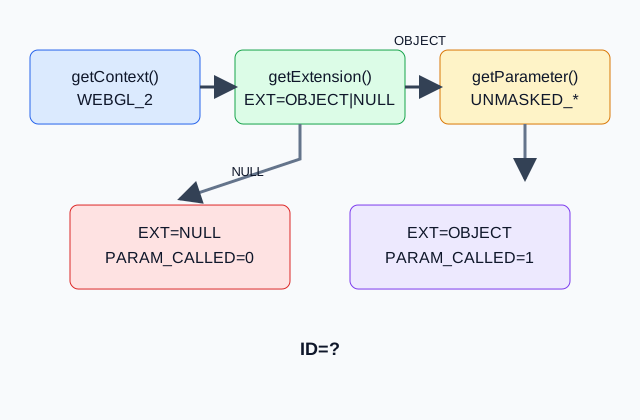
The flow keeps API observations separate from interpretations about privacy or identity.
The extension is optional
The Khronos specification defines extra diagnostic constants for WebGL. It does not replace ordinary context creation. An application can obtain a working WebGLRenderingContext and still receive no extension object. Conversely, a failed context creation means the application never reached the extension lookup.
The MDN extension reference describes the two constants and notes that exposure can depend on browser privacy policy. That is a documented example, not a universal explanation for every missing value. A support record should preserve the observed branch and leave the cause unresolved when no policy evidence exists.
The distinction prevents a common detector mistake. A renderer field omitted by design is not the same as a browser refusing an extension. A page that never asks for the field cannot report extension_unavailable; it can only report not_requested.
Lookup and parameter calls are different evidence
getExtension() returns an extension object or null when the requested name is unavailable in the current context. The result answers one question: whether this context exposed that optional interface at that moment.
getParameter() answers another question after an object exists. With the extension constants, the application may request vendor or renderer information. A thrown exception, an invalid constant, or a serializer that drops the property belongs to a separate failure field. Converting all of those outcomes into an empty string erases the evidence needed to debug the collector.
Use a small state vocabulary for an owned application:
| State | Required observation | What it does not prove |
|---|---|---|
not_requested | No extension lookup was attempted | Whether the context or extension would be available |
context_unavailable | getContext() did not return a usable context | Why creation failed |
extension_unavailable | A live context returned null from getExtension() | Which policy or implementation caused the absence |
parameter_missing | Extension existed but the parameter was absent or rejected | A privacy setting or graphics failure |
reported | A parameter value was returned and recorded | Physical hardware, person or bot identity |
These are application record labels, not additional WebGL return values. They make a later comparison falsifiable: the reviewer can ask whether the named operation actually ran.
A renderer string has a narrow meaning
The returned value is a string exposed by one API surface in one context. For WEBGL_debug_renderer_info, the concrete boundary is its two parameter constants, not a device registry. It may be useful for a support incident, a compatibility comparison, or a privacy review. It is not a proof that a particular physical GPU is installed, because software layers can report shared names and multiple environments can expose the same value. It is also not a person identifier or a bot verdict.
Do not reverse the implication. A reported value does not prove that all privacy controls are disabled. A missing value does not prove that a privacy control is enabled. The WebGL fingerprinting analysis covers broader combination risks; this article limits the claim to the optional extension branch. The renderer missing-value analysis covers context lifecycle states; it is the right companion when the context itself is failing.
For a controlled support comparison, hold the canvas, context type, browser release and collection phase constant. Change one declared condition, record the operation result, and redact the raw string unless the incident requires it. A result table that only says “renderer blank” cannot distinguish a deliberate omission from a failed lookup.
A redacted comparison record
The following record is a proposed application artifact, not a BotBrowser runtime result:
{
  "applicationRelease": "support-ui-14",
  "context": "webgl2",
  "extensionLookup": "reported",
  "parameters": {
    "UNMASKED_VENDOR_WEBGL": "redacted",
    "UNMASKED_RENDERER_WEBGL": "redacted"
  },
  "taskOutcome": "visualization-complete",
  "collectionPhase": "after-context-create",
  "rawValueRetention": "not-retained"
}
The artifact says which branch ran and whether the user-visible task completed. It does not claim a device match. If the extension lookup returns null, keep the same task outcome field and change only the observation state. If context creation fails, record that earlier phase instead of pretending the extension was checked.
The distinction is especially important for anti-bot analysis. A detector can combine many signals, but one renderer string cannot establish the detector's decision. A privacy review should ask what was collected, why it was collected, and how long it is retained rather than treating a convenient label as a verdict.
Reading the two constants without overreach
The extension registry gives the constants names, but it does not prescribe an analytics schema. An owned application should therefore capture the operation that produced a field. For example, UNMASKED_VENDOR_WEBGL and UNMASKED_RENDERER_WEBGL can be stored as two separate keys under one reported state. If only one call succeeds, do not manufacture a second value from the first.
The distinction also applies when the application uses WebGL 1 and WebGL 2. A successful getContext('webgl2') call does not prove that getContext('webgl') would return the same object or expose the same extension. Record the requested context name, the actual context result, and the extension lookup separately. The MDN getContext reference describes context-mode conflicts; that application precondition is different from an extension policy.
An incident record can use a compact matrix:
| Context request | Context result | Extension lookup | Parameter result | Safe interpretation |
|---|---|---|---|---|
webgl | object | object | both strings | Optional metadata was returned for this phase |
webgl | object | null | not attempted | Extension was unavailable; cause is unresolved |
webgl2 | null | not attempted | not attempted | Context creation failed before extension evidence |
webgl2 | object | object | one exception | Parameter collection failed; do not classify the extension as absent |
webgl | object | object | empty serialized field | Inspect serialization; the API result is not known to be empty |
The fifth row is easy to miss in production. A JSON serializer can omit undefined, a redaction layer can replace a value with "", and a UI adapter can display a placeholder. Those transformations happen after the WebGL call. Preserve an internal state field before applying a display or retention policy. The state is often more useful for a support decision than the raw string.
Collection phase changes the comparison
Timing belongs in the record because a context can change state. The context-lost event documentation describes a lifecycle interruption, while isContextLost() reports a state check. Neither call says that an extension was permanently unavailable.
Use phase labels that belong to the application, such as after-context-create, after-context-restore, and fallback-render. A value obtained before loss should not be compared with a missing value during loss as if both were stable browser properties. After restoration, resources may need to be recreated; a cached renderer field may also be stale for the application's current phase.
The same discipline helps anti-bot research. A detector report taken after a failed canvas initialization is not equivalent to a report taken after a completed extension lookup. If a study compares the two, it has changed both the browser-visible signal and the application state. Record the fixture, context request and phase before comparing labels. Do not claim that a detector saw a specific value unless the record contains that value and its source operation.
Redaction can preserve the useful fact
Raw renderer strings are often unnecessary for a support question. A support team may only need to know whether the extension was queried, whether each constant returned a string, and whether the chart or fallback completed. The following fields preserve those facts without creating a durable hardware-linked identifier:
| Field | Example | Reason to keep it |
|---|---|---|
contextRequest | webgl2 | Reconstructs the requested API boundary |
extensionState | reported | Distinguishes lookup from context creation |
vendorShape | string | Confirms the value type without the value |
rendererShape | string | Confirms the second call's type |
taskOutcome | fallback-visible | Separates user impact from diagnostics |
phase | after-context-create | Prevents lifecycle mixing |
retention | redacted-after-validation | Makes the privacy decision auditable |
If an incident genuinely requires the raw value, attach it to a bounded support case with a stated purpose and expiry. Do not reuse it as an account key, a device login factor, or a permanent anti-bot label. A value can be useful for reproducing one rendering issue while remaining unsuitable for cross-site linkage.
What a source review can and cannot establish
The Khronos source establishes the names and parameter contract. MDN explains browser-facing method behavior and gives examples of availability constraints. Neither source establishes how a particular site combines the string with canvas pixels, fonts, timing, or network signals. That combination belongs to the site's own code and must be reviewed separately.
A falsifiable review worksheet
Before changing a collector, write the expected branch for each operation. The worksheet below turns a vague “renderer changed” report into checks that can be repeated without collecting an identity. It uses the requested context name, not a guessed browser or host description.
| Check | Input held constant | Observable output | Interpretation boundary |
|---|---|---|---|
| Context request | Canvas element and requested name | object or null | Creation readiness only |
| Extension lookup | Same context and exact extension string | object or null | Optional interface availability only |
| Vendor parameter | Same extension object | string, exception or missing field | One diagnostic value only |
| Renderer parameter | Same extension object | string, exception or missing field | Another diagnostic value only |
| Serialization | Same in-memory record | key retained, redacted or omitted | Application transformation only |
| User task | Same chart or fallback | completed, fallback or interrupted | Product outcome, not identity |
Run the rows in order and retain the operation name in the evidence. If the second row is null, rows three and four are not executed; marking their fields “empty” would imply a measurement that did not happen. If serialization removes a key, keep the pre-serialization state in a short-lived diagnostic record and label the exported representation as redacted. If the chart completes while the optional fields are absent, the task outcome remains successful.
This worksheet also constrains comparisons between an ordinary browser and an automation environment. Compare the same context request, the same extension name, and the same collection phase. A difference in a profile control may explain a different API value, but the API value itself does not explain the profile setting. Keep the direction of evidence explicit: a declared configuration can be compared with an observed branch; an observed branch cannot authenticate the configuration.
Likewise, the BotBrowser WebGL page establishes product documentation about profile controls. It does not make a third-party detector predictable. A review should quote the product page for the capability, quote the web specification for the API, and label any application record as a proposed schema. Mixing those attributions is how a support note turns a narrow observation into an unsupported product promise.
For a useful comparison, store the requested context and phase beside each operation result rather than storing one final renderer field. A record might show webgl2: object, extension: null, and chart: completed; that is enough to explain why no renderer value was available while preserving the user outcome. If the extension exists but one parameter throws, keep separate results for vendor and renderer. Do not convert an unexecuted call into missing, because that label confuses an unavailable API with a collection step that never ran. These distinctions also make retention review practical: a support case can keep state, type and phase while dropping the raw strings after the incident is resolved.
For a reproducible source review, pin the URL and retrieval date, record the exact method name, and write the negative case. For getExtension(), the negative case is null; for context creation, it can be null or an application error; for parameter access, it can be an exception or a value that the serializer later redacts. A review that only records the successful path cannot explain a missing field. Keep the worksheet beside the release identifier, context name and retention decision so a later reviewer can reproduce the branch without collecting a person-level identifier.
BotBrowser scope and limits
The BotBrowser WebGL documentation is the source for product-level profile controls and graphics information. Khronos and MDN define the web API; they do not document BotBrowser profile behavior. Keep those attributions separate in reports and translations.
An authorized comparison can verify that an application records the extension branch consistently under a declared profile. It cannot infer a private third-party classifier, guarantee a renderer value on every host, or convert an absent value into proof of automation. The product boundary is the same whether the observed value is present or absent: record the browser-visible surface, then state what remains unknown.
FAQ
Does null mean WebGL is disabled?
No. getExtension() returning null concerns one optional extension. Context creation and drawing readiness are separate checks.
Does a renderer string identify a GPU?
No. It is a reported API value. Shared software layers, virtualization and policy choices can produce the same value or omit it.
Should routine analytics retain the raw string?
Not automatically. Keep the state, collection phase and task outcome; retain the raw value only for a stated support need and a bounded retention period.
Sources
- Khronos: WEBGL_debug_renderer_info
- MDN: WEBGL_debug_renderer_info
- MDN: getExtension()
- MDN: getParameter()
- BotBrowser: WebGL
Practical conclusion
Treat WEBGL_debug_renderer_info as an optional observation path. Record context creation, extension lookup, parameter access and task outcome separately. A missing value needs its own evidence, and a reported value needs a narrow interpretation. That discipline keeps anti-bot analysis and privacy support factual without turning a renderer string into an identity claim.
This article is part of the guide: What Is a Browser Fingerprint?
Related Articles
WebGL Renderer Missing: Privacy or Context State?
FingerprintBrowserLeaks WebGL Report: Collection and Missing States
Fingerprintwebgl_debug_renderer_info: What Your GPU Reveals to Pages
FingerprintWebGL Software Rendering, Capability Fallbacks, and Privacy
FingerprintCreepJS WebGL Report: Contexts and Capability Signals
FingerprintWebGPU Fingerprinting: The Next Generation of GPU Tracking
Take BotBrowser from research to production
The guides cover the model first, then move into cross-platform validation, isolated contexts, and scale-ready browser deployment.