Privacy-Preserving Browser Validation Methods
Use public browser standards, minimal observations, and explicit limits to validate privacy-sensitive browser behavior.
BotBrowser Team
Want the structured docs for Identity?
This article lives in the editorial library. For step-by-step setup, reference material, and ongoing updates, jump into the docs section.
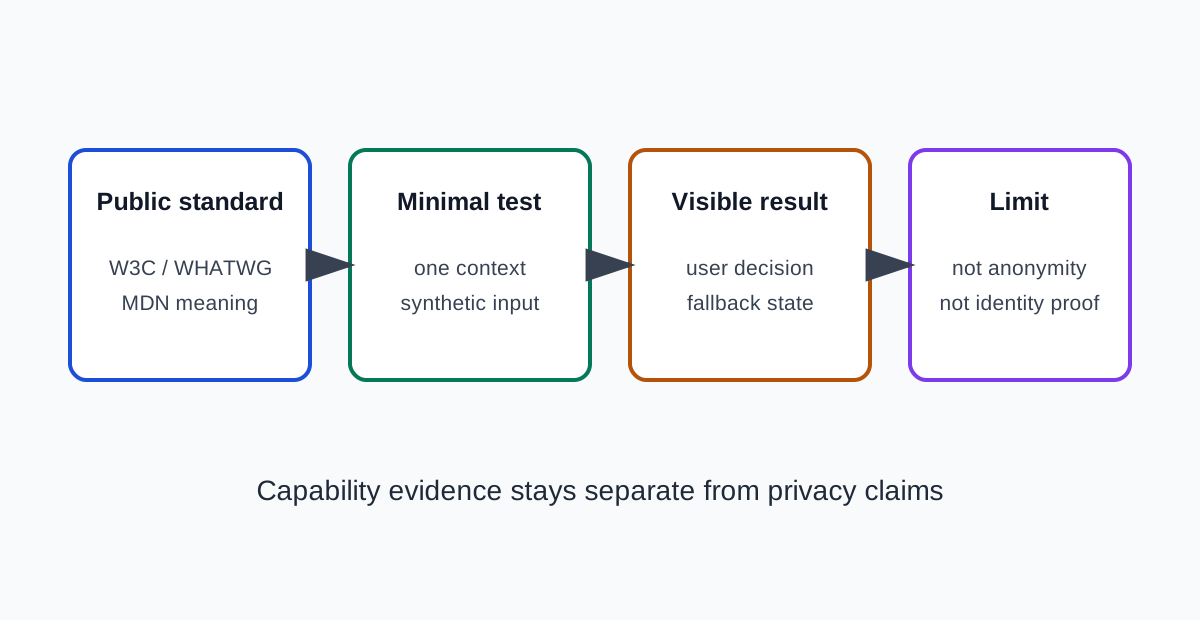
BotBrowser can repeat an authorized browser observation in a declared profile and context. It cannot prove anonymity, identify a person, control what a visited site retains, or replace a privacy review. Privacy-preserving validation starts with a public browser definition, a narrow user-facing decision, and an explicit statement of what the observation cannot establish.
Start with a public definition
Use WHATWG, W3C, or MDN to define the browser surface before collecting a value. A standard explains required behavior and permitted variation. MDN adds API purpose, compatibility notes, and examples. Neither source says that one property identifies a person or proves that a browser is private.
Write the question in user terms: should an application choose a fallback, show a permission message, or keep a feature enabled? Then name the relevant surface and the boundary of the answer. A value can affect compatibility while being shared by many users. A reduced or absent value can reflect a permission, policy, or unsupported operation rather than complete privacy.
Read modality carefully. “May,” “must,” permission-dependent behavior, empty results, and implementation-defined choices are evidence. Preserve uncertainty when the source leaves room for variation. Record the source URL and retrieval date so a later reviewer can distinguish a browser change from a standards change.
Minimize the observation
Use one controlled page, one declared browser release, one profile family, one route, and one visible assertion. Collect only the surface needed for the decision. Do not inventory unrelated hardware, account data, credentials, private destinations, or stable identifiers. Synthetic input keeps the fixture useful without carrying customer content into a public record.
Define the expected result before running the page. It might be “the permission message is visible,” “the fallback table is available,” or “the feature remains usable after a reduced value.” A visible assertion is easier to audit than a private log. If server evidence is required, govern it separately and label it outside the browser observation.
Compare one meaningful dimension at a time: browser release, profile, locale, permission state, host class, or route. When several dimensions change, report a comparison rather than a cause. A repeated observation shows repeatability in the tested context; it does not show universal behavior or uniqueness.
Separate signal, purpose, and identity
Browser-visible describes what the page can observe in a declared context. Site-visible describes what the application or server receives after the request crosses the browser boundary. Person-identifying is a stronger claim requiring evidence about correlation, retention, and access outside the page.
Canvas, WebGL, language, timezone, screen geometry, permissions, storage, and timing can affect compatibility or privacy. Treat them as separate signal families with separate purposes. A page may need a graphics capability for a chart without needing a device profile. A locale may select a translation without identifying a person. A permission result may guide a fallback without proving that all tracking is blocked.
Keep a signal inventory focused on the application decision. Record what was needed, what was observed, what was excluded, and when the result expires.
Make the result visible and reversible
Keep a user-facing state for pass, unavailable, denied, failed, and inconclusive outcomes. “Not observed” differs from “does not exist.” If a permission prompt is denied, preserve the task with a documented fallback. If a capability is missing, explain the supported alternative. If a value is reduced, do not silently treat it as a complete privacy control.
Design the fixture so a reviewer can repeat it without private state. Keep the input schema and page revision explicit. Add a cancellation path and a cleanup action. Delete temporary values after the decision, and define retention for screenshots, error details, and test records. A small fixture is easier to inspect and less likely to create a new privacy risk.
Review evidence with its limits
| Evidence | Supports | Does not support |
|---|---|---|
| Public definition and source date | A shared meaning for the API | A claim about a person |
| Repeated value in one context | Context consistency | Universal browser behavior |
| Variation across declared contexts | A difference to investigate | A cause without more evidence |
| Missing or reduced value | A limitation or fallback path | Complete anonymity |
Keep the conclusion proportional. “The selected profile returned the documented hint and the application chose its fallback” is useful. “The fingerprint is hidden” or “the browser is untraceable” is not supported by that observation. State exclusions such as server retention, account correlation, network observation, extensions, unrelated origins, and untested platforms.
When observations differ, report the difference before proposing a cause. A permission, locale, browser release, profile, host, or application revision can change the result. Restore the accepted baseline, repeat the same page assertion, and record the changed input. This is a review discipline, not a detector or evasion recipe.
BotBrowser capability and limitation
BotBrowser can provide a repeatable browser context, profile boundary, and visible assertion for an authorized validation. It helps teams compare the same browser observation across declared configurations. It does not decide whether a collection purpose is lawful, control a site’s server records, identify a person, or prove that a value is unique or anonymous.
Keep BotBrowser evidence separate from server logs and product decisions. A profile boundary can make a test repeatable without making a person anonymous. A proxy can change network context without deleting site records. When a server-side fact is unknown, label it unknown instead of filling the gap with a browser result.
Record the question, decision, public source, source date, browser release, profile family, locale, route, permission state, expected result, visible assertion, observed state, exclusions, retention rule, owner, and review trigger. Keep private destinations, credentials, account names, raw captures, and session identifiers out of the article.
Re-run the narrow test after a browser major, profile refresh, permission-policy change, route change, application revision, or standards update. An expired observation is a prompt to refresh evidence, not proof that the old result was false. State what remains untested, including mobile, another graphics backend, another origin, or server retention.
- Link a current WHATWG, W3C, or MDN definition.
- Name the user-facing decision and the minimum observation.
- Keep synthetic input, visible assertions, and cleanup explicit.
- Separate browser-visible, site-visible, and person-identifying claims.
- Record variation and exclusions beside the result.
- State BotBrowser capability and limitation independently.
- Set an owner and a refresh trigger.
The method is also useful when a team changes a browser release or a profile package. Start with the accepted row, repeat the same page assertion, and record the visible result before evaluating a candidate. If the accepted row no longer completes, pause the comparison and repair the baseline. This prevents a changed application, host image, permission policy, and browser release from being treated as one unexplained privacy result. Keep the application revision beside the browser revision because a page change can alter which surface is read, when it is read, and how its value is presented. Keep the route and storage policy visible because a returning session can expose state that a clean session does not. A privacy review should say whether the page is intended to run with a clean state, a returning state, or either state. It should also say whether the visible assertion is a capability check, a fallback check, a user-choice check, or a data-retention check. These are different purposes and should not be collapsed into one pass label. When a result is inconclusive, preserve that status and explain the next safe observation. Do not fill uncertainty with a stronger claim. A reader should be able to tell whether the missing evidence belongs to the browser, the application, the server, or the governance owner. This ownership map is especially important when a browser feature is permission-gated or origin-scoped. The page may know that a read was blocked, while the product owner must decide whether to show a fallback and the privacy owner must decide whether the attempted read was necessary. A standards citation can support the browser boundary, but it cannot answer those product and governance questions. Use a short release note to link the observation, the decision, and the review trigger. Avoid copying raw values into a public article when a state description is enough. “Reduced value returned and table fallback shown” is often more useful than a literal number. It is also less likely to become a new identifier in the documentation itself. The same principle applies to screenshots: keep a public illustration generic and store any diagnostic capture under the appropriate access and retention policy. Reviewers can assess the article from its source links, its visible assertion, and its stated limitation without receiving private browsing material. Finally, distinguish a method from a guarantee. A method tells a team how to ask a narrow question and preserve uncertainty. A guarantee claims that every context, host, browser, and site will behave the same way. Public standards and a controlled observation can support the method; they cannot justify the guarantee without much broader evidence.
Keep examples small enough that a reader can understand the decision without collecting a personal profile. Describe the browser state in ordinary terms, explain which part of the page was visible, and name the next action when the observation is incomplete. This keeps the method useful for engineers and privacy reviewers while avoiding claims that the page can prove more than it actually measured.
Related reading: Privacy claims, evidence, and product comparison and Cross-surface browser privacy.
A durable validation method also explains how the application behaves when the browser returns less information than expected. A permission can be denied, a feature can be unavailable in the current context, a value can be deliberately coarse, or a browser can choose an implementation-defined result. These are different states for the application even when they look similar in a log. Give each state a visible outcome and a recovery path. A report can show a summary table when a chart cannot read its preferred capability. A sign-in flow can keep a person on the same step when a browser mediation prompt is cancelled. A measurement page can stop after the minimum decision instead of continuing to read unrelated properties. These choices reduce both collection and confusion. They also make a privacy review useful to product owners who do not need to inspect browser internals. The page should state what it knows, what it does not know, and what the user can do next. If a value is unavailable, avoid wording that implies the device has no such property. If a value is present, avoid wording that implies it belongs to one person. If a browser returns a different result after a release update, record the changed release and rerun the same visible assertion before changing other inputs. If the same result returns under a second declared context, describe it as repeatability for those contexts. Do not turn a small sample into a population claim. A standards-led method keeps the sample boundary visible because the boundary is part of the result. This is especially important for browser privacy work: a page observation can be technically correct and still be insufficient for a statement about tracking, retention, or anonymity. The owner of the browser fixture should therefore be different from the owner of a server-retention decision when those responsibilities belong to different teams. The worksheet can link them without combining them. It can say that a browser value was visible, that a server record was not assessed, and that a product decision remains pending. That sentence is more actionable than a broad label such as private or identifiable. Use the same discipline for permissions. A permission prompt is a user control, not a fingerprint guarantee. A denial may preserve privacy for one operation while leaving other browser surfaces available. A grant may be required for a legitimate task while still requiring data minimization. Document the purpose, the user choice, the fallback, and the retention rule. Do not infer a person's identity or intent from the choice. Use the same discipline for storage. A clean context can limit local state for a test, but it does not erase server records, account associations, network observations, or copies already exported by the application. A returning context can be required for a user journey without being a security boundary between operating-system users. State the storage scope and the stronger isolation boundary separately. Use the same discipline for graphics and timing. A rendering difference can affect a chart or animation without proving a distinct device. A timing observation can explain a performance regression without proving a tracking identifier. Keep capability, performance, and privacy columns separate in the review record. The application can then decide whether to change a fallback, change a release, or change a collection purpose. A public article should not require readers to reproduce a private account flow. A synthetic route with a visible assertion is enough to show the reasoning. When a route cannot be public, describe its purpose and state the missing evidence. Do not paste a full URL, session token, response body, or customer screenshot into the article. Redaction is part of the method, not an afterthought. A source citation also needs a scope note. Link the exact standard or MDN page that defines the surface, then state whether the observation concerns availability, value shape, permission behavior, fallback, or visible completion. Avoid citing a general privacy page as if it proved a specific browser behavior. Avoid citing a product page as if it were independent standards evidence. BotBrowser documentation can establish a documented capability boundary for an authorized context; it cannot settle a standards interpretation or a site's retention practice. When readers compare browsers, keep the comparison question narrow. Ask whether the same owned journey completes, whether a documented fallback appears, or whether a permission state is handled consistently. Do not rank products from one property or present a clean local result as proof of human identity. A comparison becomes more useful when it records what was not compared: another release, another host, another origin, another permission policy, or another server. The refresh trigger should be explicit. Revisit after a browser major, a profile package change, an application release, a policy change, a route change, or a standards revision. If none of these changed, an old result can still expire when its purpose or retention policy changes. The review owner should be able to pause use of the result, request a new run, or mark it superseded. This ownership keeps a public statement honest over time. It also avoids a common failure mode in privacy writing, where a narrow technical observation is copied into a broad product claim. A bounded article is clearer: it names the source, the context, the user decision, the visible result, the exclusions, and the next review condition. Readers can then apply the method to a new browser surface without collecting more than the decision requires.
The same record should make the stopping point explicit. Once the visible assertion answers the product question, stop reading additional browser properties unless a separately approved question requires them. If the assertion cannot answer the question, record the missing capability or permission state and route the issue to the application owner. Do not compensate for an incomplete observation by widening the fixture, combining unrelated signals, or retaining raw values for later speculation. A short review entry can name the declared context, the observed state, the fallback, the excluded surfaces, and the next review date. This gives engineering, privacy, and support teams a common handoff while preserving the distinction between browser evidence and organizational decisions. It also makes later deletion practical because the record contains states and reasons rather than unnecessary data.
Sources
W3C Privacy Principles, WHATWG HTML, MDN Web Docs, and BotBrowser advanced features.
Related Articles
Take BotBrowser from research to production
The guides cover the model first, then move into cross-platform validation, isolated contexts, and scale-ready browser deployment.