IPv6 Address Selection for Browser Applications
How operating systems and browsers choose between IPv6 and IPv4, how to design availability fallbacks, and where privacy boundaries apply.
Want the structured docs for Network?
This article lives in the editorial library. For step-by-step setup, reference material, and ongoing updates, jump into the docs section.
Dual-stack applications may have both IPv6 and IPv4 paths available. The browser usually does not choose an address by itself from a list that an application can inspect. Name resolution returns endpoint candidates, while the operating system networking stack and browser connection logic decide which usable path to try. That separation matters for reliability and privacy: an address choice is a connection detail, not proof of a person's location or identity.
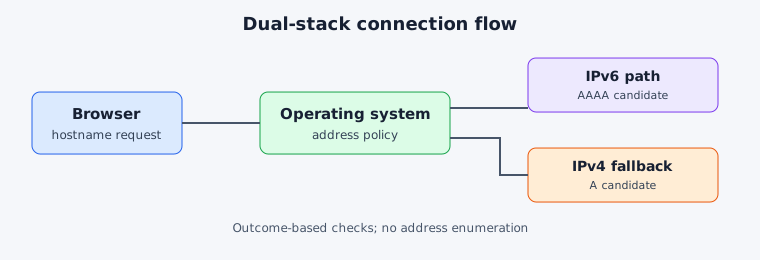
What participates in address selection
An application normally supplies a hostname, not a literal address. DNS can return AAAA records for IPv6 and A records for IPv4. The operating system applies its address-selection policy, including destination and source address suitability, while the browser manages connection attempts and protocol details. RFC 6724 describes default IPv6/IPv4 selection policy; implementations and local policy can differ. Modern connection strategies can try more than one family with a small delay. RFC 8305 describes a Happy Eyeballs approach that reduces user-visible delay when one family is reachable but the other is not. The exact delay, ordering, caching, and transport behavior belong to the implementation. Do not treat one observed choice as a stable browser property.
Availability is a runtime condition
IPv6 support can be present in a host configuration while a particular network, resolver, firewall, tunnel, or destination path is unavailable. Conversely, a working IPv6 path can appear only after a network change. An application should therefore measure the outcome of its own request rather than enumerate interfaces or collect candidate addresses. Keep the baseline workflow independent of one address family: 1. Use normal hostnames and secure transport. 2. Give the browser and operating system time to select a usable path. 3. Handle timeout, connection refusal, and name-resolution errors with one bounded retry or an equivalent user-visible recovery. 4. Preserve entered state and required content while an optional request retries. An IPv4 retry is an implementation concern for the networking stack, not a signal that the user changed identity. Avoid hard-coding a family or assuming that IPv6 is always faster, safer, or available.
Browser and operating-system boundaries
The browser can choose when to open a connection, reuse a connection, or report a network error. The operating system owns interfaces, routing policy, source-address selection, and much of DNS resolution. A proxy, VPN, enterprise policy, or content security boundary can add another hop. A page should not infer which layer made a decision from ordinary success or failure. For application code, feature detection means checking whether the requested operation succeeds. There is no portable web API that grants a page a complete inventory of local IPv6 addresses or routing tables, and exposing such an inventory would create unnecessary privacy risk. Build health checks around service reachability and user-visible outcomes instead.
Privacy boundaries
IP addresses are connection data that can be personal data in context. Do not log raw
IPv6 addresses in analytics merely to explain whether a request used IPv6. Prefer a short-lived outcome such as
connection-ok, timeout, or fallback-used, with a retention window and access control appropriate to the incident.
Aggregate operational metrics by policy and release rather than turning address-family observations into a long-lived
browser profile. Do not use address selection to infer nationality, residence, identity, or device class. Do not publish
address-enumeration scripts, timing thresholds, or route-specific workarounds. A successful IPv6 request says only that
one path worked for one request under one network condition.
Testing a dual-stack workflow
Test behavior at
controlled endpoints that you operate. Cover an IPv6-only success, an IPv4-only success, both families available, a
stalled first family, and a name with no usable address. Assert that the page preserves content, gives an understandable
recovery action, and does not expose raw candidates to logs. Repeat after browser, operating-system, DNS, proxy, or
network-policy changes; address ordering and transport support can change without an application code change. Avoid
using a single public endpoint as a universal compatibility proof. Results depend on the local network, resolver,
firewall, proxy, and destination. Document the tested environment and the product fallback, not a promise that every
browser or network chooses the same family. A practical request lifecycle It helps to describe a request without
pretending that the page controls every layer. A user activates a link or a form submits. The browser resolves the host
name according to its configured resolver and security policy. The operating system evaluates available source and
destination addresses, then the connection implementation starts the transport handshake. A proxy or VPN may terminate
one leg and create another. Finally, the browser reports a response, a protocol error, or a timeout to the page. Each
stage has a different owner. Application code owns the meaning of a successful response and the recovery shown after a
failure. The browser owns connection scheduling and reuse. The operating system owns interfaces, routes, and
source-address policy. Network administrators own firewall, tunnel, and resolver policy. Keeping these responsibilities
separate prevents a page from making unsupported claims such as “the browser always prefers IPv6” or “an IPv4 result
proves that IPv6 is disabled.” For a critical action, model the request as a small state machine: ready, loading,
complete, and recoverable-error. A timeout should move to the error state with an actionable retry, while an
optional enhancement can be skipped without blocking the primary task. If the browser retries internally, the page
should not start a second uncontrolled request merely because it cannot see that internal attempt. Use an application
timeout only when the product needs a clear user-facing boundary, and document that boundary as a product behavior
rather than a detector signal. DNS answers are not a route inventory An AAAA or A record is an answer for a name at
a point in time. It is not a guarantee that the address is reachable from the current network, nor is it a complete
inventory of all possible paths. DNS caching, split-horizon resolvers, service configuration, and policy can change
which records a client receives. A page should not expose the records it received to a third party just to classify a
session. When a service has separate IPv6 and IPv4 endpoints, keep their application contract equivalent. They should
enforce the same authentication and authorization rules, return the same semantic response, and emit comparable
accessibility states. Do not make the IPv6 endpoint a diagnostic back door or use the IPv4 endpoint to avoid a policy
decision. A family-specific hostname can be useful for an operator-owned health check, but it should remain an
operational control with documented access and retention. Connection pooling makes address observations especially easy
to misread. A later request may reuse an existing connection whose family was selected earlier, while a new origin or a
resumed connection may choose differently. Redirects, subresources, service workers, and HTTP/2 or HTTP/3 sessions add
more opportunities for different connection lifecycles. The visible page result still represents the product operation,
not a stable label for the browser. Designing an accessible fallback Fallback behavior is part of the feature, not
an error-page afterthought. Keep the primary heading, form values, keyboard focus, and status message available while an
optional request waits. State what happened in user terms: “The connection did not respond. Retry” is more useful than
exposing an address family or a resolver error that the person cannot act on. A retry should be explicit, bounded, and
safe to repeat; it should not submit a payment, create a duplicate record, or discard a draft. For a required document,
render the shell and explanatory text from the initial response whenever possible. For optional media, show a stable
placeholder with an equivalent text alternative. If a family-specific path fails, do not remove content that was already
loaded from the other path. Preserve the current route and let the user continue with the available representation.
Assistive technology should receive a status update through the ordinary accessible status mechanism, and focus should
move only when the workflow requires it. Avoid asking a person to choose IPv6 or IPv4. Most users cannot verify that
choice, and the platform has information that a page does not. A product setting such as “use reduced media” or “retry
on another connection” describes an understandable outcome. It is different from exposing a low-level route switch that
may break other requests or conflict with enterprise policy. Proxies, VPNs, and managed networks An enterprise
proxy, VPN, or secure gateway can change the path after the operating system has made a local decision. A browser may
connect to a proxy over IPv6 while the proxy reaches the origin over IPv4, or the reverse. This is normal for layered
networking. The application should test the service behavior it needs and avoid claiming that the origin saw the same
address family as the client. Managed environments can disable a family, rewrite DNS, require a tunnel, or block direct
connections. Those controls are outside the page and should be respected. If a deployment requires a particular network
capability, document it as an environment prerequisite and provide a clear failure mode. Do not instruct users to weaken
certificate validation, ignore a proxy policy, or alter routes to make a single test pass. For support, collect the
smallest reproducible evidence: browser release, operating-system family, approximate time, request outcome, and the
controlled endpoint used. A short-lived request identifier can link logs without storing a raw address. Restrict access
to detailed network logs, redact them before sharing, and delete temporary diagnostics when the incident closes. This
keeps troubleshooting useful without creating an address history for every session. Measuring reliability without
profiling Useful metrics describe a workflow: time to first useful content, completion rate, bounded retry rate, and
recovery after a connection error. Segmenting by a coarse deployment policy or browser release may help find a
regression. Storing every AAAA/A answer, local interface, or raw IPv6 address rarely improves that decision and
increases privacy risk. Where operational law or policy requires network logging, define a purpose, retention period,
access owner, and deletion path before enabling it. Do not compare IPv6 and IPv4 as if they were controlled experiments
when the network, resolver, destination, and connection pool also changed. A fair test uses the same application build,
controlled endpoints, representative networks, and a documented time window. Report uncertainty and missing
observations. An absence of an IPv6 success does not prove that the browser lacks IPv6 support; it may indicate a local
route or destination problem. If a service wants to optimize content after a failure, use an application policy such as
retry-later or reduced-transfer. Keep that policy short-lived and explain material changes before downloading more
data. Never use an address-family result as a hidden account attribute or a cross-session identifier. The same person
can use different networks during the same day, and the same network can produce different paths as conditions change.
Release and regression review Review dual-stack behavior when changing browser versions, operating-system images,
DNS providers, proxy settings, transport protocols, or CDN configuration. A release test should exercise a
representative journey, not just a synthetic socket check. Verify navigation, authentication, an API request, a media or
download path, and recovery after an interrupted request. Confirm that security headers, certificate validation,
authorization, and content semantics remain the same on both families. Keep the test artifacts free of unnecessary
addresses. Store the endpoint name, test policy, coarse result, and timestamps needed to reproduce the run. If a
diagnostic capture must include network details, keep it in the restricted incident record and remove it from public
tickets or screenshots. A release is ready when the workflow remains usable under the tested conditions and the
documented fallback still works; it is not ready merely because one endpoint answered over IPv6. The same discipline
applies to client libraries and automation. A test runner may execute on a host with different routes from the
production browser, and a headless run may use a different proxy or resolver policy. Record those differences. Do not
turn a successful local run into a universal browser guarantee, and do not add page code solely to discover which family
was used. FAQ Can a page force IPv6? Ordinary web content should not force a local address family. The platform
and managed network policy decide how to connect. If a product needs an IPv6-only health check, keep it on an
operator-owned endpoint and treat failure as a deployment signal, not a user identity signal. Does an IPv4 fallback
mean IPv6 is broken? No. The fallback can result from a temporary route, resolver, firewall, destination, or
connection-pool condition. Compare controlled outcomes across representative networks before changing a product
requirement. Should analytics record whether IPv6 was used? Usually a coarse outcome is enough. Record a short-lived
policy result such as fallback-used only when it answers a documented reliability question. Avoid raw addresses and
detailed candidate lists, and do not retain the result as a profile attribute. Is IPv6 availability a browser
fingerprint? A network outcome can contribute context when combined with other signals, but it is not a reliable
identity proof. Treat it as sensitive operational data, minimize collection, and never publish an enumeration or
classification recipe. What should happen when both families fail? Keep the primary page state, explain that the
request could not complete, and offer a bounded retry or an offline-safe alternative. Preserve drafts and accessible
controls. Do not silently loop or discard the task. Working with changing networks Laptops and phones can move
between wired, wireless, cellular, and managed networks while a page remains open. A connection established over IPv6
may continue until it closes, while a later request chooses IPv4. Network changes can invalidate DNS caches, suspend a
tunnel, or make a destination temporarily unavailable. Treat each request outcome as local evidence for that request. Do
not rewrite an account setting or browser profile because one connection used a different family. Long-running pages
should handle an aborted fetch, a service-worker update, a resumed tab, and a user returning from offline mode. Keep
retry controls visible when relevant, remove stale listeners when a component is destroyed, and avoid duplicate work
after a resume. For uploads, make the operation resumable or clearly restartable; for forms, preserve values and
validation messages. These safeguards improve reliability regardless of the next address family. When a page opens
several origins, each origin can have a different DNS answer, proxy route, and connection pool. Do not infer one global
address-family state from a single resource. Coordinate only a product policy users can understand, such as pausing
optional downloads while offline. Required requests should retain their own authorization and error handling, and a
failed optional origin should not make the whole document unusable. Network errors can also come from application
configuration. A certificate mismatch, expired credential, origin policy, or server overload should not be relabeled as
an IPv6 problem. Use the browser error surface and restricted server logs to distinguish these cases. The public
interface can still show one clear recovery message while operators investigate the detailed cause.
Operating checklist
- Keep hostnames and secure transport as the application contract.
- Let the platform select addresses; do not enumerate interfaces from page code.
- Make failure recovery bounded, accessible, and independent of identity decisions.
- Record coarse outcomes with minimal retention; protect raw connection data when it is operationally necessary.
- Re-test representative dual-stack journeys after infrastructure or browser changes.
Keep this policy independent from account identity and user classification.
An IPv4 fallback is a bounded availability action, not a change to the browser identity.
Sources
- [RFC 6724: Default
Address Selection for IPv6](https://www.rfc-editor.org/rfc/rfc6724) - RFC 8305: Happy Eyeballs Version 2 - MDN: IPv6 - W3C: Network Error Logging Related reading: DNS leak prevention and IPv4 and IPv6 proxy consistency.
Related Articles
Take BotBrowser from research to production
The guides cover the model first, then move into cross-platform validation, isolated contexts, and scale-ready browser deployment.