Privacy Review for Web Measurement Projects
Review purpose, minimum data, user choice, retention, and evidence boundaries before a Web measurement project begins.
BotBrowser Team
Want the structured docs for Identity?
This article lives in the editorial library. For step-by-step setup, reference material, and ongoing updates, jump into the docs section.
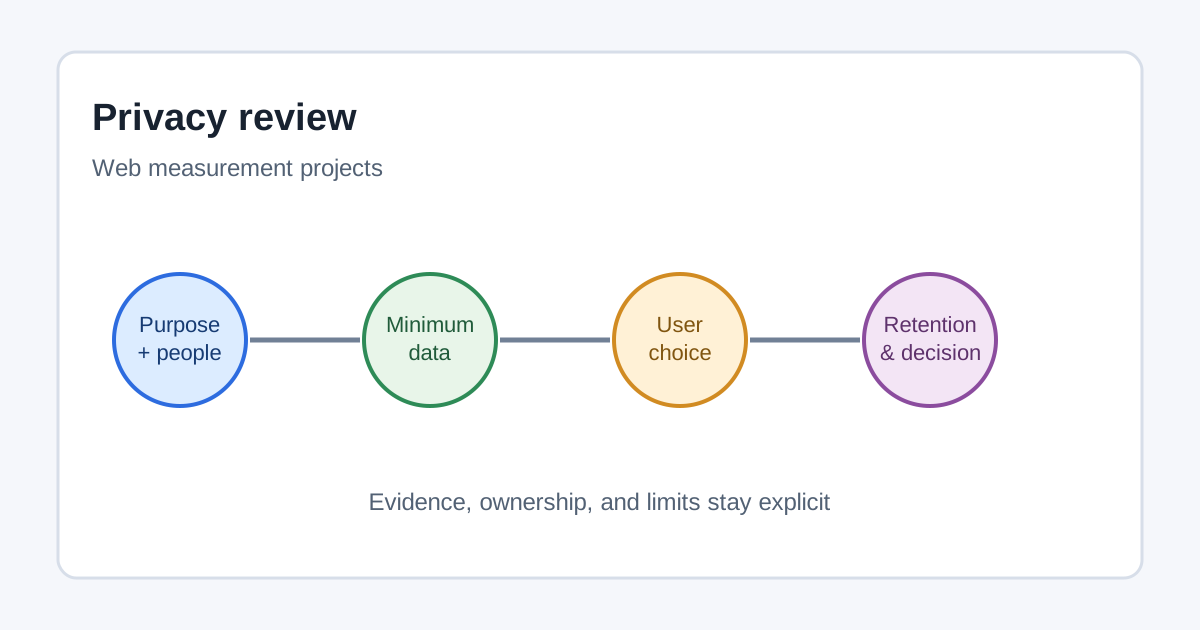
A measurement project should explain what it needs before it starts collecting. A useful privacy review connects the project purpose to the smallest decision-relevant data, the people affected, the choices they receive, the retention period, and the evidence that will be produced. It is design evidence, not legal advice or a promise that risk is zero.
Define purpose and participants
Write the question in one sentence: what decision will the measurement support, and when will the project stop? Avoid purposes such as “collect everything for future analysis.” Name the page or journey, the authorized owner, the audience for results, and the success condition. If the purpose cannot be stated clearly, pause collection.
List the participants that matter: user, browser, site, account provider, measurement service, support team, and managed device or network. They do not receive the same information. A browser context can repeat a declared journey, while a site or account may apply its own records and policies. Do not infer that a separate profile makes a person anonymous.
Minimize signals and identify user choice
For every proposed field, record why it is needed, who can see it, and what happens if it is absent. Prefer aggregates, coarse categories, and event counts over raw URLs, page text, identifiers, or exact timestamps when those details do not change the decision. Do not collect credentials, tokens, customer content, or hardware signals merely because they are available.
Explain choices before collection. State whether participation is optional, what declining changes, and how a person can withdraw or request deletion through the project owner. A measurement control must not quietly become persistent tracking or cross-site recognition. Keep consent, authorization, and technical feasibility as separate questions.
Set retention, access, and deletion
Give raw events and derived reports separate retention periods. Name the owner who can approve access, the reason for each audience, and the deletion or aggregation trigger. Troubleshooting artifacts should be redacted and short-lived. A longer period needs a current purpose, not a hope that the data may be useful later.
Copyable privacy review worksheet
Project and owner:
Decision this measurement supports:
Authorized journey and participants:
Proposed fields | purpose | minimum form | access:
User choice and decline consequence:
Raw retention | aggregate retention | deletion trigger:
Redaction and security review:
BotBrowser fixture and visible assertion:
Decision: approve | narrow | pause | reject | unknown:
Next action, owner, and stop condition:
Review date:
Decision table
| Evidence | Decision | Bounded next action | Do not claim |
|---|---|---|---|
| Purpose, minimum fields, choice, access, and deletion are explicit | Approve | Run the authorized fixture and review the first aggregate | That the project is legally compliant everywhere |
| A field lacks a decision-relevant purpose | Narrow | Remove it or replace it with a coarser aggregate | That availability makes collection justified |
| Choice, authorization, or owner is unclear | Pause | Resolve the missing control before collection | That silence is consent |
| The project depends on identity inference or covert tracking | Reject | Redesign around an authorized, non-identifying question | That a profile or proxy makes it acceptable |
| Evidence conflicts or retention is unknown | Unknown | Assign one owner and a stop condition | That one clean test proves privacy |
BotBrowser capability and limitation
BotBrowser controlled contexts can repeat an authorized declared measurement journey while keeping browser-side setup explicit. That can help compare visible outcomes and validate a fixture. BotBrowser does not decide whether a project is lawful, infer consent, identify people, control what sites retain, or certify production access and deletion. Keep browser receipts separate from server logs and business conclusions.
Review again when the purpose, participant, browser release, site dependency, account, data field, or retention policy changes. Sources: W3C Privacy Principles, RFC 6973, and BotBrowser advanced features.
Connect measurement to a decision
A measurement is useful when a named owner can act on its result. Start with the decision, then work backwards to the smallest observation that can support it. For example, a team may need to know whether a sign-in form remains usable after a browser release, whether a consent control is visible on a supported route, or whether a documented checkout journey reaches its confirmation page. Those questions do not require a permanent record of every page visited. They require a bounded fixture, a defined observation, and an owner who can interpret the result.
Write the expected result before running the fixture. Include the route, locale, browser release, profile class, account state, and the visible assertion that will count as evidence. A statement such as “the confirmation heading is visible after the authorized test order” is more useful than “the page worked.” It also makes it easier to remove fields that do not affect the decision. If a field is not used by the assertion, challenge its presence.
Measurement can support product quality, accessibility checks, reliability work, or privacy controls. Keep those purposes separate when they require different data or audiences. A reliability event may need a timestamp and error class; an accessibility review may need a screenshot with personal content masked; a privacy control may need only an aggregate count. Combining them into one unrestricted stream makes access and retention harder to justify.
Map data flows before collection
Draw the path from the person and browser to the site, measurement runner, storage location, report, and deletion process. Mark where data is created, transformed, copied, viewed, and destroyed. Include redirects, account providers, proxy services, observability tools, support exports, and temporary files. A browser profile is one part of this flow, not a substitute for mapping it.
Record the trust boundary at each handoff. A controlled browser can provide a repeatable local context, but the visited site can still log requests, account activity, IP information, and its own identifiers. A measurement service can receive screenshots or event summaries even when the browser profile stays local. State these boundaries in the review so readers do not mistake a browser-side setting for a site-wide privacy guarantee.
Use a data inventory with four columns: field, source, purpose, and disposition. Disposition should say keep, aggregate, redact, or discard, together with the trigger. This simple record exposes accidental duplication. For example, a full URL may already reveal a customer identifier that a separate event field repeats. Removing one copy reduces exposure without changing the decision.
Design user choice that can be understood
Choice is meaningful only when a person can understand the activity and its consequence. Describe what the measurement observes, how long it lasts, who receives the result, and whether declining affects the service. Keep an operational authorization for a test account distinct from a person’s consent for product analytics. A team may be authorized to test a controlled account while still being required to minimize records and respect the site’s rules.
Avoid dark patterns in measurement controls. Do not hide a decline path, require unrelated data to proceed, or reuse a one-time review permission as indefinite tracking. If the project cannot offer a choice because it is a strictly authorized internal fixture, record that scope and prevent the fixture from being used with ordinary customer sessions. The control should match the audience and the purpose.
Provide a withdrawal path that works in practice. Identify the owner, the request channel, the data classes covered, and the expected response. Test deletion on a sample record before the project expands. A deletion statement without an owner, lookup key, and completion signal is not an operational control.
Keep raw and derived evidence distinct
Raw browser events are usually more revealing than an aggregate report. They may contain routes, query parameters, referrers, timing, error text, or account state. Keep them in a restricted location with a short retention period. Derive the smallest report that answers the decision, then delete or irreversibly aggregate the raw material when the approved trigger fires.
Screenshots need the same discipline. Capture only named checkpoints, mask account details, and avoid screenshots when a text assertion is sufficient. Store a run identifier for traceability instead of copying secrets into a ticket. If support needs to reproduce a failure, create a redacted fixture with synthetic content rather than exporting the original session.
Retention should be measurable. Say “delete raw events after 14 days unless an incident owner records an exception” rather than “keep briefly.” Set a separate expiry for reports, access grants, temporary downloads, and backups where the project can control them. Review exceptions at a fixed date; an exception that never expires becomes the default.
Review technical boundaries with BotBrowser
BotBrowser is useful when a team needs a controlled, repeatable browser context for an authorized journey. A local profile, explicit launcher settings, and a visible assertion can make a comparison reproducible across a release. This supports test evidence such as “the same consent dialog remained visible under the approved profile and browser pair.” It does not turn an observation into a legal conclusion.
Keep the fixture narrow. Use an approved account, synthetic or permitted content, and a route list that matches the review. Do not use BotBrowser to ignore a site’s access controls, infer a person’s identity, override consent, or collect information outside the declared purpose. A proxy or separate profile can change the browser context, but it does not authorize a site action or erase server-side records.
Separate four results in the report: browser setup, visible product outcome, server-side evidence supplied by the owner, and the decision. BotBrowser can help with the first two. The application owner or service operator must establish the third. The review owner records the fourth. This division prevents a clean browser run from being presented as proof that retention, consent, or deletion worked everywhere.
Handle uncertainty and change
Privacy reviews should be able to say unknown. If a data recipient is not documented, a retention job has not been tested, or a route behaves differently from the approved fixture, mark the result unknown and assign an owner. Do not convert missing evidence into a pass. A bounded stop condition is more useful than a confident guess.
Re-review after changes to browser release, profile package, site route, account, proxy, event schema, consent copy, storage system, or retention policy. Start with the affected assertion and one stable control. Keep the prior accepted record so that a change can be compared without rewriting history. If several inputs changed together, state that the result is combined and do not attribute it to one input without evidence.
Internal reading path
See Browser storage model: cookies, localStorage, and IndexedDB, Browser tracking protection settings explained, and Automation consistency.
The review should also describe the people who will operate the measurement. A developer may prepare the fixture, a privacy owner may approve the fields, a support engineer may inspect a failure, and a product owner may accept the decision. Give each role the narrowest access it needs. Do not grant a whole project team access to raw events when most members only need an aggregate. Record temporary access and remove it when the troubleshooting task ends.
Consider the ordinary failure paths. A page may redirect to an account provider, a consent dialog may appear in a different language, a test account may be locked, or a third-party dependency may time out. Decide in advance what evidence is necessary for each case. A failed redirect might need a route and status class, while a locked test account may need only an operational ticket. Avoid saving full response bodies or copied pages when a short failure code answers the question.
The same discipline applies to identifiers. A run identifier can connect a browser receipt to a report without being a customer identifier. If a stable identifier is needed for a limited comparison, document its scope, owner, and expiry. Do not reuse a measurement identifier for promotion, account matching, or an unrelated research question. Reuse changes the purpose and should trigger a new review.
When a project uses a managed network or proxy, include that dependency in the boundary record. The network operator may see destinations or connection metadata even when the browser does not expose a particular signal to page scripts. A proxy can help reproduce an approved environment, but it does not erase network records or authorize access to a third-party service. The review should state which party is responsible for those records and how long they remain available.
Make the first run deliberately small. Start with one authorized route, one synthetic account, one browser and profile pair, and one visible assertion. Review the resulting record with the owner before adding more fields or journeys. This staged approach catches unclear purpose early and gives the team a concrete deletion test. Expansion should be based on a documented decision, not on the fact that the runner can technically expose another signal.
Treat derived metrics as data with their own risks. A low-volume aggregate, a rare error combination, or a report split by a narrow account group can reveal a person even after raw events are removed. Set minimum group sizes where appropriate, suppress outliers, and limit report audiences. Explain the aggregation rule in the review so a reader can understand what the report does and does not reveal.
Document the review date and the next trigger. A review is current only for the purpose, route, account, browser release, profile, schema, audience, and retention plan it names. When any of those inputs changes, open a new review or record a scoped update. Keep the old decision available for audit, but do not let it silently approve the changed project.
Finally, make the stop condition visible to the person running the fixture. The run should stop after the named assertion, after the approved number of events, or when an unexpected account or content appears. A runner that continues collecting because a page is interesting has left the approved scope. A short stop condition protects the project, the site, and the people whose data might otherwise enter the record.
For a practical handoff, attach the worksheet to the run record and include the approval owner, fixture version, and expected deletion date. A reviewer should be able to tell which fields were observed without opening raw customer material. When a run is repeated, compare the approved assertion and the disposition of each field before comparing screenshots. This keeps a visual difference from becoming an excuse to widen collection.
Before expanding a measurement, ask the owner to review the first run as a small, reversible change. Confirm that the route, account, browser release, profile class, and visible assertion still match the worksheet. Record which fields were actually emitted, which were discarded, and whether the deletion trigger fired. This checkpoint catches accidental collection while the sample is still easy to inspect.
Make operational ownership explicit when a result crosses teams. The person who runs a fixture may not be the person who approves retention, handles a deletion request, or interprets a product decision. Name those roles in the run record and give each only the evidence needed for the task. A clear handoff prevents browser output from being treated as an unreviewed data feed.
The review can be lightweight for a small internal test and more formal for a customer-facing program, but the core questions remain stable: why is the measurement needed, what is the minimum useful data, who chooses or authorizes it, who can access it, when is it deleted, and what can BotBrowser actually demonstrate? Recording those answers makes a narrow project easier to maintain and easier to stop.
Keep the final approval readable: one owner, one scope, one retention trigger, and one next review date. A concise record helps the next operator repeat the same boundary without guessing.
Final checklist: confirm the approved route, account, visible assertion, field disposition, access owner, and deletion date before every repeat run.
Sources
Related Articles
Take BotBrowser from research to production
The guides cover the model first, then move into cross-platform validation, isolated contexts, and scale-ready browser deployment.