HTTP/3 and QUIC Browser Compatibility Basics
Learn how HTTP/3 uses QUIC, how browsers negotiate and fall back, and how to review compatibility without assuming one network path is universal.
Want the structured docs for Network?
This article lives in the editorial library. For step-by-step setup, reference material, and ongoing updates, jump into the docs section.
HTTP/3 is the version of HTTP that runs over QUIC. QUIC supplies encrypted, multiplexed transport over UDP, while HTTP/3 defines how requests and responses use that transport. A compatible browser and origin can use HTTP/3, but the browser still chooses a protocol that works for the destination and the current network. When QUIC is unavailable, a browser can continue with HTTP/2 over a different transport when policy allows. HTTP/3 support therefore improves the set of possible paths; it is not a promise that every request will use one.
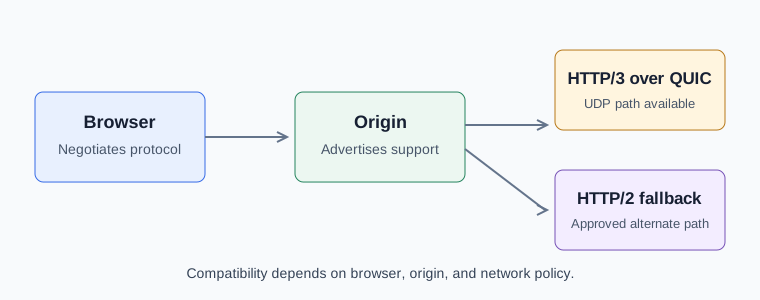
HTTP/3 and QUIC have different jobs
HTTP/3 is specified in RFC 9114. It maps HTTP concepts such as methods, headers, streams, and status codes onto QUIC. RFC 9000 defines QUIC's connection, stream, loss-recovery, and security behavior. Keeping these roles separate makes compatibility reviews clearer: a browser may implement HTTP/3 correctly while a route, firewall, or destination prevents QUIC from being used.
QUIC uses UDP, but it is not the same as sending an arbitrary UDP application packet. The browser and server perform a protocol handshake, negotiate versions and transport parameters, and protect application data with encryption. A page cannot replace that negotiation with JavaScript, and a successful HTTPS navigation does not reveal which HTTP version carried every subrequest.
The distinction is also useful when reading operational logs. HTTP/3 names the request protocol; QUIC names the transport that carries its streams. A connection can carry many independent request streams, so loss affecting one stream does not necessarily look like a failed connection to the page. HTTP semantics remain familiar: the application still receives responses, status codes, headers, and bodies. What changes is the transport behavior underneath those semantics.
QUIC includes its own version negotiation and connection identifiers. Those identifiers help a connection survive some changes in the network path, but they do not give a website control over the path or guarantee uninterrupted service. A NAT rebinding, a firewall timeout, or a provider policy can still make a connection fail. Treat the connection identifier as protocol state, not as a stable user or network identity.
Encryption covers QUIC packets and the HTTP/3 data they carry, subject to the normal TLS certificate and endpoint trust decisions. HTTP/3 does not remove the need to validate certificates, protect credentials, or review where a proxy terminates a connection. It also does not hide the fact that a client is connecting to a destination from every network observer. Protocol encryption and privacy policy answer different questions.
HTTP/3's stream model can improve application behavior under loss, but an application should not assume a fixed latency improvement. Congestion, server scheduling, request size, cache state, and the path between the browser and origin all matter. A release review should measure the customer journey rather than promise a particular percentage improvement from the protocol name alone.
How browsers negotiate and fall back
The browser learns about an origin's available protocols through the browser's network implementation and signals such as an HTTP Alt-Svc advertisement. It may try HTTP/3 for a later connection, reuse an existing connection, or continue with HTTP/2. The exact timing, cache lifetime, racing strategy, and preference order are implementation details. MDN's HTTP/3 overview is useful background, but it is not a promise of identical behavior across browser releases.
Treat fallback as an availability rule. A page should preserve its task when HTTP/3 is not selected: render the response, keep form state, and show a bounded retry when a required request fails. Do not open a second uncontrolled request merely because application code cannot see the browser's internal protocol attempts. If HTTP/3 is a hard requirement for a particular service, make that requirement explicit in the deployment contract and fail with an understandable recovery path.
The first request and later requests can follow different decisions. A browser may have no cached indication that an origin supports HTTP/3, use HTTP/2 for the first visit, then learn a later preference from an Alt-Svc response. The cache can expire, the profile can be replaced, or the network can change between visits. A warm connection can also be reused after the environment changes. These lifecycle details are why one page load is not a complete compatibility test.
Protocol selection is scoped to an origin and connection. A page can load its document over HTTP/2 while a different origin for an image, font, API, or analytics request uses HTTP/3. Redirects can move the request to another origin with a different policy. Service workers and connection pools add more lifecycle state. Test the requests that matter to the application and avoid describing the entire page with one protocol label.
When a request fails, distinguish a transport failure from an HTTP response. A timeout before a response, a refused connection, and an HTTP 503 are different application inputs. The page can show the same accessible recovery action when appropriate, but an operator should retain a short category that points to the right owner. Do not expose packet details, raw addresses, or credentials in a user-facing error just to prove that a fallback occurred.
An acceptable fallback is part of product design. A document or form may continue over HTTP/2 without changing its meaning. A real-time feature may require a UDP-capable route and should explain that the feature is unavailable when that route cannot be established. An optional enhancement can be skipped while the primary task remains available. Decide these cases before rollout so a timeout does not silently become an unapproved direct connection.
Browser updates can change the order in which alternatives are tried, the lifetime of a protocol advertisement, or the conditions under which a connection is reused. The application contract should therefore describe outcomes and recovery, not internal timers. If support staff need to compare two releases, record the browser major and the profile package, then run the same journey under both.
Middleboxes change the result
Firewalls, enterprise gateways, NAT behavior, proxies, and endpoint policy can all affect UDP reachability. A network can permit ordinary HTTPS while blocking or shaping QUIC. A proxy may support an HTTPS tunnel but not the UDP operation needed by an HTTP/3 path. The destination may also prefer HTTP/2 or disable HTTP/3 temporarily. These are separate compatibility facts, not evidence that the browser is inconsistent.
Use controlled endpoints that you own when testing. Record the browser release, profile, host environment, route policy, destination capability, and user-visible result. Test an HTTP/3 success, an HTTP/2 fallback, a blocked UDP path, and a destination that does not advertise HTTP/3. Keep packet captures, credentials, and destination histories in the organization's controlled systems; public compatibility guidance does not need them.
Start by separating the legs of the connection. The browser may connect to a proxy over one transport while the proxy connects to the origin over another. A corporate gateway can terminate TLS, forward an HTTPS tunnel, or apply a policy that disables UDP. A load balancer can advertise HTTP/3 on one hostname while a neighbouring hostname serves only HTTP/2. Record the endpoint and route policy used by the test so an observed fallback is not attributed to the wrong layer.
UDP reachability is more than an open port. NAT mappings can expire during an idle period, firewalls can apply an idle timeout, and a network can allow small datagrams while dropping larger ones. QUIC path validation and packet-size discovery respond to these conditions, but a browser cannot repair every middlebox. An application that keeps a long-lived connection should have a reconnect state and should not treat a reconnect as a new user session without checking its own state rules.
Proxies need an explicit contract. An HTTP proxy can carry ordinary requests and an HTTPS CONNECT tunnel without carrying QUIC packets. A SOCKS5 service may offer UDP relay, but that capability and its policy are separate from HTTP/3 support. A QUIC-aware proxy can still have account, region, concurrency, or endpoint limits. Do not infer support from a scheme string or a provider product name; ask which operations are supported for the account and endpoint that will run the workflow.
TLS and certificate checks remain visible at the endpoint that terminates TLS. If a managed gateway inspects traffic, its trust configuration and certificate policy become part of the deployment boundary. A browser warning is not a reason to disable validation. Instead, classify the failure as a trust or policy issue, restore the approved certificate path, and then repeat the HTTP/3 journey. This keeps transport troubleshooting from weakening connection security.
Observability should be deliberately small. A release record can hold the browser major, profile family, host class, route name, destination category, protocol outcome, and recovery action. A short request identifier can connect browser and service logs without retaining full URLs, packet captures, or raw addresses. Retain detailed traces only in the controlled system and for the shortest period that supports the incident review.
Middlebox compatibility can vary by location and time. Test the region and account tier that production uses, and repeat the check after a provider, firewall, browser, or profile change. A successful check at one office does not certify every remote worker or network. The correct public statement is that the documented combination was tested under stated conditions, not that HTTP/3 works everywhere.
Review a browser release safely
Compare the same application journey before and after a browser or network change. Confirm that the browser starts with the intended profile, reaches the expected page state, and follows the documented fallback when QUIC is unavailable. Measure the outcome that matters to the application rather than treating an observed protocol label as a quality score.
BotBrowser supports proxy routing configured per browser context, which lets a team repeat an approved route policy while reviewing an HTTP/3 journey. It cannot force an origin to negotiate HTTP/3 or control every middlebox, provider route, or protocol choice. The browser may use HTTP/2 or fail according to the configured policy, so keep an approved fallback and a visible recovery action in the release record. For context-level routing boundaries, see per-context proxy guidance; for broader release checks, see browser release validation and QUIC proxy routing.
Use a context-level policy when separate workflows in one browser process have different approved routes. Create the context, apply the route before opening the first page, and record the route name beside the context owner. This lets a reviewer tell whether a fallback belongs to the browser, the selected route, or the destination. It does not turn a context setting into a guarantee about the origin's protocol choice.
For a repeatable release review, keep five facts together: the browser release, the matching profile package, the host and display environment, the network policy, and the application journey. Change one of those inputs at a time when possible. If a candidate fails, restore the last accepted pair first, confirm the journey, and then investigate the changed input. A broad change to browser, proxy, profile, and application at once leaves no reliable baseline.
The test matrix can be small and still useful. Include a cold first visit, a warm revisit, an HTTP/3-capable origin, an HTTP/2-only origin, a controlled UDP block, and the expected user-visible recovery. For each row, record success or bounded failure, not a guessed protocol from a page title. Repeat the rows after a browser major update or a route-provider change. Keep an approved fallback available throughout the test window.
Support guidance should tell an operator what to do next. An invalid proxy credential, a provider that lacks the required operation, an origin that does not advertise HTTP/3, and a blocked UDP path have different owners. A short category and route name are usually enough to route the case. Avoid printing a proxy URL, secret, full destination history, or raw packet data in a ticket.
The same discipline applies to performance claims. Compare first usable page, API completion, media readiness, or download completion under the same profile, host, region, and application build. Keep the accepted route available while a candidate is measured. If a result changes, restore the accepted configuration before changing another variable. This makes the result actionable without turning protocol behavior into a fingerprint or a universal promise.
Before promotion, ask whether the application needs HTTP/3 specifically or only a reliable secure request. If HTTP/2 satisfies the workflow, document it as the normal fallback. If a feature genuinely requires a UDP-capable path, define a visible unavailable state and an approved recovery. The release record should answer which outcome is accepted, which route was tested, and who owns the next action when QUIC cannot be used.
A compact compatibility checklist.
Start with the application requirement. If the product needs an encrypted request and a responsive page, HTTP/2 may already satisfy the requirement when it travels through the approved route. If the product depends on a QUIC-specific property, name that property and define what the user sees when it is missing. Avoid making “HTTP/3 enabled” a goal without explaining the customer outcome it is meant to improve.
Confirm the origin side independently. The service must be configured to accept HTTP/3 and advertise it through the mechanism used by the browser. A DNS record, a successful TCP connection, or a page that loads over HTTPS is not evidence that the origin accepted HTTP/3. Use a controlled endpoint or a service-owned report that identifies the protocol outcome without exposing customer content.
Confirm the path side next. Check whether the host, firewall, enterprise gateway, proxy, NAT, and provider account allow the QUIC traffic required by the journey. Keep the test route and the production route equivalent in the dimensions that matter: endpoint, region, account tier, authentication policy, and concurrency class. A test through an unrestricted home connection does not qualify a managed production route.
Confirm the browser side last. Record the browser major, profile package, operating-system family, and display or headless mode. Repeat a cold visit and a warm visit because protocol advertisements and connection reuse can produce different first-request behavior. Keep the acceptance statement at the level of the workflow: “the document and form completed” is stronger evidence than “the page looked normal.”
When a row fails, use the narrowest corrective action. A missing origin advertisement belongs with the service owner. A blocked UDP path belongs with the network owner. A proxy capability mismatch belongs with the provider or deployment owner. A browser or profile regression belongs with release validation. Do not weaken certificate validation, ignore a route policy, or force a direct connection to make the row pass.
Document the expected fallback in plain language. For example, a content page can continue over HTTP/2, while an optional live feature can be marked unavailable and retried after the route recovers. Include the retry limit, the state that must be preserved, and the person or team that owns the next review. This turns a protocol difference into an ordinary recovery path that support can explain.
Finally, set a recheck trigger. Repeat the matrix after a browser major upgrade, a profile package change, a proxy-provider migration, a firewall policy change, a region change, or a material origin configuration change. Do not treat a past success as a permanent guarantee. The useful compatibility statement is always tied to a named release, route, destination, and test outcome.
Sources
Related Articles
Take BotBrowser from research to production
The guides cover the model first, then move into cross-platform validation, isolated contexts, and scale-ready browser deployment.