How to Scrape Amazon: Product Data and Browser Limits
Amazon product data needs an approved source, the right variant and offer context. Compare the current official API with authorized page observations and browser inputs.
BotBrowser Team
Want the structured docs for Deployment?
This article lives in the editorial library. For step-by-step setup, reference material, and ongoing updates, jump into the docs section.
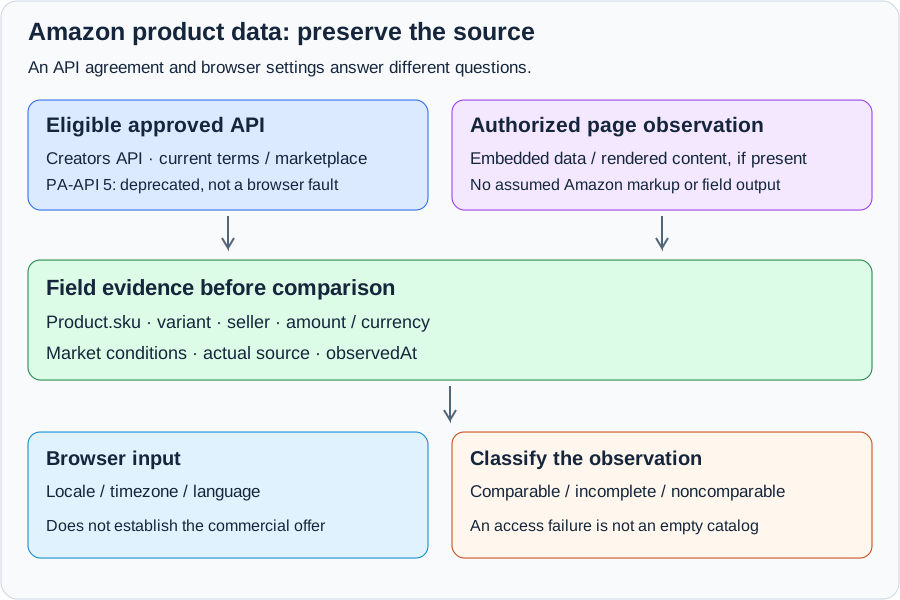
How to scrape Amazon depends first on which product data an application is permitted to use and through which source. The current official catalog route for eligible affiliate integrations is the Creators API, not the retired PA-API 5 endpoint. A browser may support an authorized page observation, but its configuration does not establish a seller's price, a selected variant or permission to collect either. BotBrowser controls browser configuration inputs; it does not supply Amazon catalog data or replace an applicable API agreement. Product identity, offer conditions and observation provenance need separate evidence before any collected value becomes a comparison.
TL;DR
- Start with the current official API and its eligibility, marketplace and license conditions. PA-API 5 is deprecated.
- Distinguish product identity and variations from the particular seller offer being compared.
- Embedded data and rendered text are different observations. Neither is guaranteed to exist or agree on an arbitrary Amazon page.
- Record a field's actual source and applicable context instead of assigning browser settings as commercial facts.
- Treat missing, changed and noncomparable values separately; a challenged response is not an empty product catalog.
Contents
- Choose the current official route
- Map fields to evidence rather than assumed stability
- Separate embedded data from rendered content
- Keep market and seller context with the offer
- Classify drift before changing the parser
- Decide when a browser observation adds evidence
- Practical conclusion
Choose the current official route
Amazon's Creators API introduction describes programmatic product catalog access for publishers, influencers and affiliate partners. Its listed operations include searching items, retrieving item details, retrieving variations and retrieving browse nodes. That is a starting point for an eligible application's source decision, rather than a reason to build a page collector before checking whether the required data is already available through an approved integration. Specify the actual product fields and use case before selecting a transport.
The official PA-API 5 deprecation notice changes an important assumption in older tutorials. It says the old API is deprecated and is being replaced by Creators API. It also documents an access-denied response from applications continuing to call the old endpoint. An integration that encounters that documented retirement needs an API migration decision, not a different browser profile or repeated page navigation. Keep the called API family and its documented lifecycle in the incident record before diagnosing a browser failure.
Eligibility and permission have a narrower scope than the phrase official API sometimes suggests. The introduction lists enrollment for the target marketplace, sales-related eligibility, API registration and credentials. The license index directs users to the applicable locale's IP license and operating agreement. Review the current requirements for the actual integration; a general product-data need does not establish eligibility. An approved affiliate application is not automatically approval for every analysis, every market or a separate page-collection method.
When the needed source is unavailable or the proposed use is outside its agreement, record that limitation explicitly. Do not silently switch to an undocumented endpoint because a page references it, or treat an API credential as permission to collect unrelated account data. Source selection should produce a concrete decision: the approved API and requested resources, an independently authorized page-observation scope, or no available source. These outcomes are useful inputs to an application even when they do not produce a fresh price. They also prevent obsolete sample code from becoming a production dependency without anyone noticing which service it calls.
Map fields to evidence rather than assumed stability
A field-stability map should state what must remain comparable, not declare that a marketplace field never changes. The schema.org Product reference separates product descriptions from offers and defines SKU as merchant-specific. Those are useful interpretation boundaries, but they do not establish Amazon's current page markup. Record the actual source of a product identifier and its marketplace scope. A matching title or SKU string is insufficient evidence that observations describe the same variant across sellers or sources.
| Field group | Evidence to retain | Comparison boundary |
|---|---|---|
| Product and variant | Identifier from the approved source and the selected variation context | A product family is not necessarily one purchasable variant |
| Seller and offer | Seller and conditions actually associated with the observation | The same product can have different offers |
| Amount and currency | Both values from the same applicable offer context | A number alone cannot establish a comparable price |
| Availability | The source's actual availability statement and its scope | A failed observation is not proof of stock status |
| Market conditions | Marketplace and any relevant conditions established by the source | Browser locale is not a delivery or tax condition |
| Provenance and time | Source type, observation time and collection outcome | A batch completion time is not the time of every offer |
Each row is a collector-owned requirement, not a claim that the API or a retail page always supplies every field. The Creators API introduction distinguishes item details from variations through separate operations. Preserve that distinction in the application's product model instead of flattening all related items into one price. If the intended variant cannot be established, keep the candidate out of a comparison requiring that variant. Do not fill the gap with the first amount found in a response.
The price-monitoring pipeline design owns scheduling and publication across sources. A marketplace-specific field map sits before that publication decision: it records why a given observation represents the intended product and offer. Preserve the source reference and the matching rule rather than merely copying the final display string. A later reviewer should be able to distinguish a genuine offer change from a source change, a different variant or a parser that began reading another part of the same response. None of those alternatives should be hidden behind a single field called latest price.
Separate embedded data from rendered content
An HTML response can contain executable scripts, non-executable data blocks and ordinary page content. MDN's script type reference explains that a suitable non-JavaScript MIME type denotes a data block rather than JavaScript to execute. This describes an HTML mechanism. It does not show that a particular Amazon response includes structured product data, nor that such data contains a current seller price. Presence and meaning must be checked in the authorized source actually being observed.
For a permitted saved response, distinguish embedded data available in that response from values visible only after the application renders. A parser operating on the response can inspect the former without running the page. A browser observation may be needed for the latter if the authorized task requires rendered state. Neither method has automatic precedence when the values disagree. Record what each source says, which product and offer it refers to, and when it was observed. A disagreement is a validation question before it is a reason to choose the more convenient number.
The Product reference supplies vocabulary for interpreting a product and an offer, not a selector contract for a retail site. A field named like a standard property can still be absent, incomplete or associated with another item. Likewise, a visible number may be a quantity, a previous amount or another commercial value rather than the selected offer's price. Tie interpretation to the field map and the approved source contract. Avoid generic rules that label every nearby decimal as a current monetary offer.
An authorized fixture should preserve enough evidence to explain that interpretation without retaining a reusable account session. Store a minimal redacted fragment and the relevant product and offer references where the retention agreement permits it. Record source-response and rendered observations separately when both matter. The browser-layer ecommerce discussion separates browser presentation from commercial facts; a successful render does not erase that boundary. If a required value cannot be attributed to the intended offer, mark it incomplete instead of promoting rendering success into data correctness.
Keep market and seller context with the offer
Marketplace selection, browser language and offer conditions are different inputs to a comparison. The Creators API concepts guide names locales, authentication, resource selection and rate limits as integration concepts. An application should use the applicable API contract for marketplace selection and returned fields rather than assuming a browser's preferred language controls them. An API observation and a page observation can also describe different scopes; record those differences before treating the values as competing versions of one fact.
BotBrowser's timezone, locale and language reference describes browser settings and their priorities. With the documented prerequisites, automatic settings derive from the proxy; manual overrides require ENT Tier1. These settings affect browser-reported preferences and internationalization behavior. They are useful configuration inputs for an authorized cross-locale comparison, but they do not establish a seller's chosen currency, a delivery address, tax treatment or inventory eligibility. The browser input and the offer's observed market conditions belong in separate parts of the record.
The seller distinction follows the Product and offer model: product-level identity does not collapse all offers into one. A change of seller can be a real difference in the observation's commercial context rather than a price change for the same offer. Keep applicable seller and variant evidence with the amount. When an essential condition is unavailable, return an incomplete or noncomparable outcome under the application's rule. Do not make browser configuration the default value for a missing marketplace field simply because both use a country or language label.
Comparison also needs a consistent treatment of formatting. A rendered amount may use separators and currency symbols differently from an API representation. Preserve the raw source form where permitted and the parser's interpreted amount and currency as separate values. State the interpretation rule rather than deleting punctuation until the text becomes a number. When the rule cannot resolve the source unambiguously, flag the record for interpretation instead of inventing precision. This is a collector design decision; it is not a claim that a particular marketplace always formats a field in one way.
Classify drift before changing the parser
An apparent extraction failure can describe a missing field, a changed representation, a different product or offer, or loss of the approved source. These require different actions. Layered scraper diagnosis separates transport, HTTP and page execution; the field map adds interpretation after those layers. Retain the first observation that no longer satisfies the contract and compare it with a known accepted observation. A parser exception alone does not establish which layer changed or whether any product data was supplied.
| Observation | Interpretation to investigate | Data action |
|---|---|---|
| Required field absent from an otherwise permitted response | Missing source data or changed representation | Mark incomplete; do not substitute a zero amount |
| Product, variant, seller or relevant market condition differs | A noncomparable offer context | Separate the observation before raising a price-change event |
| Approved API reports its documented retirement | Integration lifecycle change | Follow the current supported API decision, not browser retries |
| Response becomes a challenge or access refusal | The expected source contract is no longer satisfied | Stop dependent extraction and retain the bounded incident outcome |
The retirement row is grounded in the current PA-API deprecation notice; it should not be generalized into an explanation for every forbidden response. The specific endpoint and documented response matter. A page failure, an expired credential and a retired API are different incidents even if they share a broad HTTP category. Use the actual response evidence and the relevant official integration documentation rather than assigning the same recovery action from status alone.
For an authorized parser change, retain the old interpretation rule, the proposed new rule and a minimal fixture demonstrating the difference. The price-monitoring observation contract treats the schema version as the collector's version, not the site's internal version. Record which parser produced each accepted value. Reprocessing history may be a deliberate application operation, but it must not silently relabel old observations as freshly collected facts. Keep failed refreshes separate from the last accepted record, and do not delete a valid history merely because the latest request supplied no usable offer.
Decide when a browser observation adds evidence
Use a browser when the approved task actually needs page state unavailable in the approved response or feed. Examples include checking an authorized interface's displayed formatting or verifying which permitted variation is selected in an owned saved fixture. These are bounded observation questions, not a general requirement to automate the retail site. The Creators API introduction provides the current official catalog route to assess first. A browser is not an alternative eligibility mechanism for that API.
The BotBrowser geographic settings reference makes the browser inputs inspectable. Record the intended profile, locale, timezone and language configuration alongside actual observations without calling configuration a proof of successful loading or merchant identity. A permitted fixture can establish that the harness applies and records those inputs. It cannot establish that Amazon would supply the desired offer, accept the session or permit another collection method. Keep that distinction in the acceptance criterion for the browser work itself.
Access scope remains independent of how readable a response is. RFC 9309 explicitly states that robots rules are not access authorization. An allowed crawler path does not replace the relevant agreement, and an API license does not automatically authorize a separate page-collection scope. Stop at an access refusal rather than changing accounts, routes or client state to continue. Where permission or a required field is unavailable, return the limitation to the requesting application instead of claiming the browser can resolve it.
The practical browser decision therefore has a concrete output: the approved question that rendering answers, the source and field it observes, and the condition that makes the result usable. If the same approved data is already available through the integration contract, another browser run may add cost without adding evidence. If only a rendered observation answers the question, preserve its context and time. Choose the smallest approved observation that resolves the field question, while leaving unsupported product, seller and market assumptions unknown.
FAQ
Is PA-API 5 still the route to recommend for a new integration?
No. Its current official documentation states that it is deprecated and replaced by Creators API. Check the current integration and eligibility documentation.
Does structured product vocabulary prove Amazon serves that markup?
No. A vocabulary describes meanings. Only the authorized response can establish whether particular markup and fields were present for that observation.
Does changing browser locale establish a marketplace price?
No. It changes browser inputs. Marketplace, seller, currency and applicable offer conditions need their own evidence from the approved source.
Can a failed observation be stored as an out-of-stock product?
Not on that basis alone. Keep failure and missing data distinct from an availability statement actually supplied by the permitted source.
Sources
- Amazon: Creators API introduction
- Amazon: PA-API 5 deprecation notice
- Amazon: Creators API license index
- Amazon: Creators API concepts
- MDN: script type
- Schema.org: Product
- BotBrowser: Timezone, locale and language
- RFC 9309: Robots Exclusion Protocol
Practical conclusion
Choose Amazon product-data sources through the current supported API and the actual permission scope. For any authorized page observation, preserve product variant, seller, amount, currency, market conditions and provenance rather than assuming stable fields. BotBrowser can supply declared browser inputs, while the approved source must supply the commercial facts. Missing data, noncomparable offers and access failures need distinct outcomes before a record reaches a price comparison.
This article is part of the guide: Browser Deployment and Release: Operations Map
Related Articles
Competitor Price Monitoring: Browser Pipeline Design
DeploymentScraping Indeed Jobs: Fields, Pagination and Duplicates
DeploymentZillow Scraping: Listing IDs, Prices and Status History
DeploymentGoogle Maps Scraping: Places API or Rendered Listings?
DeploymentScraping Shopify: Storefront API, Ajax or Browser?
DeploymentJob Posting Scraping: Titles, Reposts and Closure
Run the same check in BotBrowser
Load a profile, keep the signals you just read about consistent inside the browser, and confirm the result on your own machine before a rollout.