How to Evaluate Browser Privacy Claims with Public Evidence
Define browser privacy claims precisely, compare products fairly, and communicate evidence limits without inferring identity or anonymity.
BotBrowser Team
Want the structured docs for Documentation?
This article lives in the editorial library. For step-by-step setup, reference material, and ongoing updates, jump into the docs section.
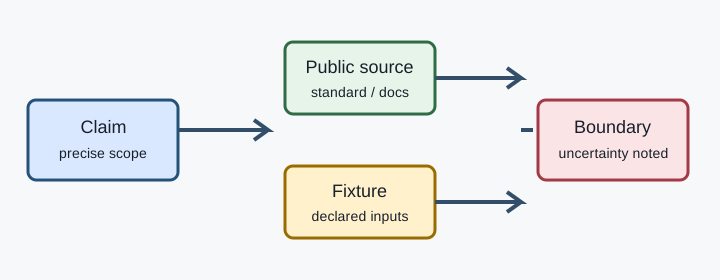
BotBrowser can run an authorized, repeatable comparison fixture in controlled contexts and record declared profile consistency. It cannot prove anonymity, control a website's server-side collection, or replace standards evidence. That boundary is the starting point for evaluating any browser privacy claim. A product page may say that a setting reduces exposure, limits storage, or separates contexts. Each statement needs a precise subject, an observable condition, a public source, and a limit that says what the evidence does not establish.
Define the claim precisely
Rewrite broad language into a testable sentence. “Private” is not a measurable result by itself. “This setting prevents every site from learning who operates the browser” is also too broad because sites can make their own observations and the browser cannot control every server. A useful claim names the surface and boundary: “In a fresh authorized context, site data from origin A is not available to origin B after the documented clearing step.” That wording can be checked against a standard, a browser document, and an owned fixture without assigning an identity to a person.
Use the W3C Privacy Principles to ask which parties observe data, what purpose the observation serves, and whether collection is necessary and proportionate. RFC 6973 provides vocabulary for privacy considerations, including identifiers, linkability, detectability, and secondary use. These sources help frame the question; they do not certify a vendor or prove a deployment outcome. MDN privacy and security documentation and official browser documentation add implementation context, such as storage partitioning, permission controls, or tracking protection settings.
Map claims to public evidence
Create an evidence map before comparing products. For each claim, record its exact wording, affected party, public source, browser or origin condition, fixture assertion, and unresolved limitation. A source should support the clause you quote, not merely mention the same topic. If a document describes a control, do not promote it to a promise about all websites. If a standard defines a privacy consideration, do not present it as proof that a product implements every mitigation.
| Claim layer | Evidence to use | What it can show | What it cannot show |
|---|---|---|---|
| Standard principle | W3C Privacy Principles or RFC 6973 | Terms, actors, purposes, and risk vocabulary | A product's implementation or deployment result |
| Browser behavior | MDN or official browser documentation | Declared controls, conditions, and caveats | Every origin's server behavior or a person's identity |
| Controlled fixture | An owned synthetic page and declared context | One reproducible observation under named inputs | Universal anonymity or production traffic behavior |
| Product operation | Authorized comparison record | Whether the declared setup matched the fixture | That an unrelated customer or site sees the same result |
Keep source revision dates and browser versions in the record. When a claim changes from “isolates storage” to “prevents tracking,” stop and rewrite it. The second statement covers more actors and requires stronger evidence than a storage test can provide.
Compare products without turning privacy into a score
Use the same synthetic journey, origin set, permissions, release, viewport, locale, network assumptions, and success definition for each comparison. Change one variable at a time. A comparison can show that two declared setups expose different observable behavior; it cannot rank a product as universally private or infer what a named website will conclude. Report “observed under these conditions,” “conditional on this policy,” or “not tested” instead of assigning a privacy score with hidden weights.
The fixture should test the claim's boundary. For storage, create a synthetic value at origin A, navigate to origin B, and assert only the permitted visibility result. For a permission claim, request a synthetic capability after explicit user intent and record granted, denied, or unavailable. For a context-isolation claim, run the same page in two authorized contexts and compare only the owned test value. Do not collect real account data, third-party identifiers, full browser inventories, or server logs that the claim does not require.
Communicate uncertainty and limits
Every result needs a scope sentence. Name the browser release, operating context, origin, permission state, fixture revision, and visible observation. Then name the missing evidence: another browser, an embedded frame, a managed policy, a server-side practice, assistive technology, or a different release. “Not observed” is not the same as “impossible.” “The browser did not expose this value in the fixture” is not proof that no site can obtain related information through another channel.
Avoid identity and anonymity inference. A stable test result does not identify a person, and an isolated context does not make a user anonymous. Do not use privacy language to justify fingerprint collection or covert measurement. Retain the minimum normalized state, source link, declared conditions, visible result, and next review date. If a service owner needs server evidence, request an authorized test endpoint and document that it is a separate application boundary.
BotBrowser capability and limitation
BotBrowser supports controlled browser contexts, authorized profile consistency checks, and repeatable comparison fixtures. Those capabilities help a team hold inputs steady while checking a declared browser or context condition. The test owner should record the fixture URL, synthetic values, release, context assumptions, observed state, and cleanup result.
BotBrowser does not prove anonymity, prevent a website from collecting data on its server, decide whether a privacy purpose is necessary, or replace W3C, IETF, MDN, and official browser evidence. It does not make a conditional observation universal, and a profile-consistency result is not a statement about a person's identity or every site. Keep product operation evidence beside, not above, the public source and the explicit limitation.
Publish a bounded comparison record
End with a compact record: claim, source clause, declared setup, fixture assertion, observed result, uncertainty, owner, and review date. Include a clear decision such as “supports this narrow claim under the named conditions,” “requires a documented prerequisite,” or “evidence is insufficient.” A reader should be able to reproduce the comparison without private data and understand what remains unknown.
Sources
- W3C Privacy Principles
- RFC 6973 Privacy Considerations
- MDN Privacy and security
- BotBrowser advanced features
For a practical comparison, pair this method with the browser comparison methodology article. For privacy boundaries across browser surfaces, see cross-surface browser privacy. These links are complementary: one explains controlled product journeys, while the other explains why a browser observation should not be treated as a personal identity signal.
A claim worksheet.
Use a worksheet with one row per sentence in a product page or support answer. Copy the sentence exactly, then identify the actor, action, condition, and result. “Private” has no useful condition by itself. “The default setting partitions site storage by top-level site in the documented browser context” is narrower and can be compared with official documentation. Add a source clause and a fixture assertion. If no source supports a word, remove it or mark it as an internal hypothesis rather than a public fact.
The worksheet should identify the affected party. A browser control may reduce what one origin can read while leaving the site's own server collection unchanged. A profile boundary may prevent one test context from seeing another context's cookies while leaving network providers, operating-system services, or application logs outside the test. Naming the party avoids treating one local control as if it governed every observer in the data flow.
Choose the right observation.
Choose an observation that matches the claim. If the claim concerns storage, inspect only the synthetic value and documented origin boundary. If it concerns permission, record the prompt state and visible result after explicit user intent. If it concerns profile consistency, compare declared profile inputs and the owned fixture output. Do not add a large browser-signal collection step because it feels thorough. Extra signals create privacy risk and rarely strengthen a narrow claim.
Repeat the observation after a clean setup and after the documented state transition. A clean setup tests the initial boundary; the transition tests whether it survives navigation, restart, or permission change. Keep the test value unique so a later run cannot be confused with an earlier one. Record whether the result came from a fresh context, a reused authorized context, or a staging context.
Read negative results carefully.
If a synthetic page cannot read a value, say that it was not readable from that page under the declared conditions. Do not say that the browser prevents all correlation. If permission was denied, say that the operation was unavailable in that context. Do not say that the browser is private in every mode. If an owned endpoint received no request, say exactly that. Do not generalize to unrelated services.
Negative results can guide a product decision. They may justify a fallback, a changed permission explanation, or a documented prerequisite. They do not justify naming another product unsafe or assigning a user a risk category. Preserve the boundary so a later reviewer can tell whether a release changed browser behavior, the fixture, or the endpoint.
Review product language.
Before publication, ask a reviewer who did not write the claim to mark absolute words such as always, never, anonymous, invisible, safe, blocked, and guaranteed. Replace them with a condition or remove them. Ask another reviewer to read only the limitation and explain what remains outside the test. If the missing evidence cannot be named, the limitation is too vague. This catches overclaiming that a spelling or link checker cannot see.
Keep the comparison constructive. The goal is not to produce a winner; it is to help a reader decide which narrow claim is supported by which evidence. A conditional or unknown result can still be useful. Publishing an unknown state prevents an unverified promise and gives engineering a clear next experiment.
Retention and re-review.
Set a retention period that matches the decision's lifetime. A release note may need a source revision and visible result for the supported release window, while a temporary fixture log may be deleted after triage. Avoid retaining raw values when a normalized state answers the question. At re-review, confirm that source links, browser release, context assumptions, and the endpoint still represent the claim. If any changed, create a new record instead of silently editing the old result.
The same method applies when a team compares a privacy setting, a browser configuration, and an application design. Start by drawing the data flow in plain language. A page may send a request to its own service, receive a response from a content delivery network, ask a browser permission, and store a value in a local origin partition. Each step has a different observer and a different evidence source. Browser documentation can describe the local storage boundary, while a service document describes its own retention. Neither source establishes what an unrelated service does. List the observer beside the claim instead of using one word such as “privacy” for the whole flow. This helps support teams explain the narrow local behavior, the server-side boundary, and the next control the reader can choose without claiming every service behaves the same way.
Use a fixed vocabulary for evidence status. “Documented” means a public source states the behavior or requirement. “Observed” means the owned fixture saw it under declared inputs. “Conditional” means an explicit prerequisite was present. “Unknown” means the available evidence cannot answer the question. “Out of scope” means the question concerns an observer or service the test does not control. This prevents a design goal from being confused with a measured result. It also allows reviewers to compare different surfaces without forcing them into a single privacy score.
A useful comparison includes a stop rule. Stop when the fixture answers the declared question, when a required prerequisite is absent, or when the next step would collect data unrelated to the claim. Do not expand a storage test into a renderer inventory because the first result was inconclusive. Do not add real accounts because a synthetic page did not reproduce service behavior. Escalate an unanswered question to the relevant service owner and record that the browser fixture ended at its boundary. A stop rule reduces privacy risk and interpretation drift, and makes the comparison easier to rerun after a browser update.
When communicating results to non-specialists, put the condition next to the conclusion. “The value was isolated in a fresh context served from HTTPS” is more useful than “the browser is isolated.” “Permission was denied and the page kept its fallback” is more useful than “the feature is private.” Avoid unexplained labels such as fingerprint or anonymous unless the text defines the exact surface and evidence boundary. A reader should be able to tell whether a result concerns local state, a browser prompt, a network request, or a service record. Concise condition and result text can also be announced clearly by assistive technology without exposing test values.
Preserve disagreement in the record. Two reviewers may interpret a principle differently, or a fixture may conflict with documentation. Keep both the source clause and observed result, identify the unresolved question, and assign an owner. Do not silently choose the more favorable interpretation. A later browser release, policy change, or service update may resolve the disagreement, and the old record will explain why the claim was conditional. Evidence literacy is not about making every answer positive; it is about making each answer traceable, bounded, and honest.
The comparison record should also state what the reader can do next. If the evidence supports a narrow storage boundary, link to the documented setting and explain how to verify it with a synthetic value. If the evidence is conditional on a secure context, name that prerequisite before the reader changes a deployment. If a result is unknown because the service endpoint is outside the fixture, say which service owner can answer it and which browser observation is still useful. A next action turns uncertainty into a safe decision without pretending that the missing evidence has been collected.
Keep examples deliberately ordinary. Use a test note, a synthetic preference, or a sample origin that contains no account information. Show the reader how to reset the test state and how to tell a clean result from a stale value. If the example needs a permission, make the user action explicit and provide an alternative when it is denied. If the example uses two contexts, label them by test purpose rather than by a guessed user or customer. These details make a comparison reproducible while keeping the demonstration within the stated privacy boundary.
When a product team receives a broad request such as “prove that this browser protects privacy,” answer with a sequence of smaller questions. Which data surface is in scope? Which observer is being considered? What public document defines the expected control? Which owned fixture can observe it? What condition makes the result valid? What remains outside the test? This sequence is more useful than a yes-or-no answer because it identifies the decision that evidence can actually support. It also gives reviewers a stable way to update the article when standards or browser behavior change.
Related Articles
Take BotBrowser from research to production
The guides cover the model first, then move into cross-platform validation, isolated contexts, and scale-ready browser deployment.