Scraping CAPTCHA: Diagnose a Challenge Mid-Run
A CAPTCHA appearing during scraping needs a request timeline, not a guessed bot score. Separate route, browser-session and workload changes before approved recovery.
BotBrowser Team
Want the structured docs for Network?
This article lives in the editorial library. For step-by-step setup, reference material, and ongoing updates, jump into the docs section.
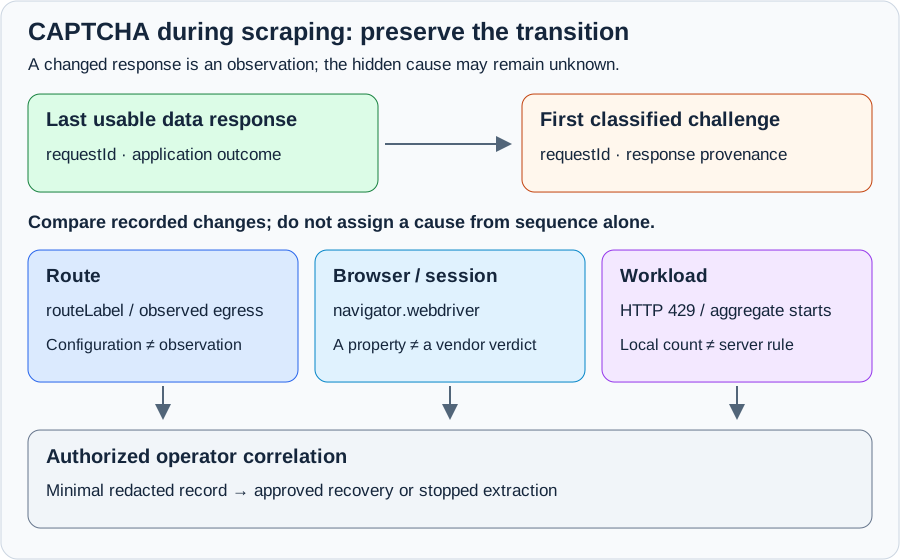
A CAPTCHA appearing halfway through scraping changes the job's observable result; it does not identify the cause of that change. A route update, a new browser context and a different workload can coincide with the first challenge. BotBrowser documents profile-backed browser controls and proxy configuration, but it does not grant access, identify a site's private rule or guarantee a challenge-free run. For an authorized job, preserve the transition from the last usable application response to the first challenge, stop dependent extraction and ask the operator to correlate the actual requests.
TL;DR
- A challenge is a response classification, not proof that a particular browser signal changed.
- Compare the exact requests around the transition; a previous successful page is not permission for every later operation.
- Investigate route, browser-session and workload changes as possible explanations, not an exhaustive list of causes.
- HTTP
429documents a rate-related refusal; a generic403or HTML challenge does not identify the rule that produced it. - Keep a minimal redacted incident record, respect the existing workload budget and resume only through the site's approved recovery path.
Contents
- A challenge is a transition, not a cause
- Three investigation paths and their observables
- Reconstruct the interval between data and a challenge
- Interpret a workload decision without guessing a safe rate
- Keep a minimal incident record
- Browser configuration and the stop condition
- Practical conclusion
A challenge is a transition, not a cause
Cloudflare's WAF concepts separate detection from mitigation. Detection supplies information; configured mitigation can block, challenge or throttle requests. The reference also describes multiple rule families and their execution order. A client-visible challenge is therefore evidence of an action at the observed boundary, not a complete explanation of the detection inputs or policy that selected it.
Start by classifying the document that actually arrived. The Cloudflare and DataDome response discussion distinguishes a documented challenge marker from a generic refusal and separates server-integration decisions from client responses. An unexpected HTML page may instead be a login document, an application error or a response from an intermediary. Retain an unknown classification when no specific marker or authorized operator record is available.
Locate the last response that satisfied the application's declared data contract and the first response that did not. HTTP 200 alone is not that contract: a successful status with a login document does not contain the expected catalogue data. Likewise, a JSON parser exception describes a downstream processing failure; it does not establish that the site's schema changed. Stop the dependent parser before it publishes empty output or deletes previously collected records.
The layered blocked-scraper diagnosis separates DNS, TLS, HTTP and page execution. Keep those distinctions in the transition record. If the request never obtained an HTTP response, a screenshot of an older challenge does not explain the current network failure. Tie each observation to the operation that produced it rather than assigning one verdict to the entire browser tab.
Do not treat the earlier usable response as a continuing access certificate. Account authorization, application routes and operator policy can differ across requests. A task that was approved for one resource is not automatically approved for a redirected destination or another account's data. Classification tells the collection pipeline what it received; permission still comes from the site's agreed access method and scope.
Three investigation paths and their observables
Use the following paths to organize evidence around the transition. They are candidate explanations, not three proven or exhaustive causes. A site rule can change while the client remains unchanged, and an application authorization problem can resemble a protection response. More than one job variable may also have changed before the first observed challenge.
| Investigation path | Observable worth retaining | Alternative explanation | Authorized operator check |
|---|---|---|---|
| Network route | A redacted route label and any independently verified change in egress for the matching request | Different application route, stale route record or an unrelated server rule | Correlate the exact request with permitted edge and origin records |
| Browser or session | Context/process creation, intended profile configuration and application-session transition | Expired authorization or another request using a different context | Compare the approved launch contract and the application's session record |
| Workload | Aggregate requests started and in flight within the job's own accounting interval | Another worker, account or route sharing the operator's counting key | Compare the matching operator rule and its actual counting scope |
For routing, distinguish configuration from observation. BotBrowser's proxy reference documents the --proxy-server input and requires a supplied proxy service. A configured endpoint is not an observed exit address for every request. Provider-side changes and requests already in flight can complicate attribution. Record the route information actually available for the failed transaction instead of borrowing a current exit check for an earlier request.
For browser state, MDN's navigator.webdriver reference describes a cooperative signal that a user agent is controlled by WebDriver. That property is not a complete vendor verdict. A changed value can be a useful configuration observation on an owned fixture, but it cannot identify why an external site challenged a request. Do not turn a property mismatch into a claimed vendor root cause without applicable operator evidence.
For workload, preserve counts as job observations with their counting boundaries. A local counter may count navigations but omit image requests, retries, redirects or other workers. Conversely, a server rule may count only requests matching a particular expression. The job counter and the operator's counter need not describe the same set. A challenge appearing after a certain number of pages is a sequence observation, not proof of a public safe page allowance.
Reconstruct the interval between data and a challenge
Begin with request identity and time, not the order in which log lines arrived. With concurrent work, a later response can belong to an earlier request. Keep request-start and response-observation times distinct where both are available. Name the clock basis so that a client timestamp is not silently treated as the operator's server time. If clocks are not synchronized, preserve that uncertainty rather than forcing an exact causal ordering.
Attach context and task identifiers to the same transaction. A new browser process, a newly created context or a restored application session can occur while another worker is still completing older work. A global label saying that the job uses a given profile does not establish which context sent the challenged request. The useful question is whether the request matched its intended launch and session contract, not whether some other page in the process looked correct.
Retain any approved change record within the interval. A route configuration update has a start and completion boundary; an application login has its own outcome; a workload scheduler can start additional tasks independently. If several changes overlap, record them together and leave the cause unresolved. Reconstructing the interval is not permission to repeat a denied request under a succession of identities to discover which one is accepted.
Check response provenance before correlating identifiers. A cached HTML challenge can remain visible after the job or the operator changed configuration. A screenshot then proves only what was displayed. Mark an observation as cached, freshly fetched or unknown when the instrumentation supports that distinction. Do not associate an old correlation identifier with the current wall-clock time merely because the browser still shows the old document.
Redirects require the same care. Preserve the requested route, final route and permitted redirect history without retaining signed query values. A final HTTP 200 may describe a login page reached after the original request was redirected. If the destination is outside the authorized collection scope, stop rather than following it to finish the trace. A complete diagnostic record should describe the visibility limit instead of silently extending the job's permissions.
Keep the response sample small. Preserve the status, content type and documented marker when available, plus only the permitted body fragment needed for classification. A 403 body can still contain account information or signed URLs. The purpose is to locate an authorized failure and enable operator correlation, not to create a reusable session capture or an unrelated user's browser fingerprint.
Interpret a workload decision without guessing a safe rate
MDN's HTTP status reference describes HTTP 429 as too many requests in a given amount of time. That supports a rate-related classification at the observed boundary. It does not reveal every part of the operator's counting key, the matching expression or the relationship between the client's task counter and the server's measurements. A generic HTTP 403 gives even less information about a particular workload rule.
Cloudflare's rate-limiting reference describes matching requests with an expression and selecting an action when a configured rate limit is reached. Counting characteristics and available features depend on the applicable plan. A challenge can therefore be a configured action, but its appearance alone does not tell the client which rule matched. Ask the authorized operator to inspect the relevant record rather than inventing a request count that ought to be accepted.
The rate and concurrency discussion separates request-start rate from in-flight concurrency. Keep the budget attached to the same authorized application purpose across routes and workers. Starting another browser, changing an address or splitting the job across contexts does not create a new permission or reset the agreed workload allowance. Record the aggregate work that was scheduled, including bounded retries, before diagnosing a difference in browser presentation.
When an operator confirms a workload-policy decision, use its approved recovery instructions. A local pause can reduce new work, but it does not prove that the server's counters have cleared or that a delayed retry will be authorized. Do not keep a worker pool sending dependent requests merely because the challenge body was not valid JSON. Stop new dependent extraction and preserve the already obtained data separately from the incident result.
An unexpected challenge can also coexist with a deployment or integration change. Compare the operator's applicable policy period and the application's release context with the request interval if that information is available. A response sequence alone cannot decide between a new rule and changed client traffic. Missing operator evidence should produce an unresolved cause in the incident record, not an invented rate formula.
Keep a minimal incident record
Use field purpose, observation source and visibility limits to define the record. The table describes what an authorized diagnostic record needs; it is not a fabricated runtime log. Omit secrets and fields outside the agreed scope, and mark required observations as unavailable rather than filling them with guessed values. An absent observation is useful information about what the investigation cannot establish.
| Field | What it establishes | Boundary to retain |
|---|---|---|
requestId | Which transaction each observation describes | A local ID needs an explicit mapping to any operator correlation ID |
startedAt and observedAt | Request-start and response-observation ordering | Clock basis and synchronization limits remain explicit |
taskId and contextId | Which scheduled task and browser context sent the request | A context label is not an account permission or a profile-load receipt |
routeLabel | The intended approved route without credentials | Configuration alone does not establish the request's observed egress |
| HTTP status and content type | The visible response class | A successful status does not establish application-data success |
| Change record | Which approved client changes occurred in the interval | A preceding change is not automatically the cause of the challenge |
| Operator correlation | Applicable rule or integration decision, when supplied | Internal evidence stays unavailable until the authorized operator supplies it |
Separate intended configuration from measured results in the storage schema. For example, a routeLabel belongs to job configuration unless an observation independently establishes its egress. A context's intended profile reference belongs to the launch contract; an unrelated browser value must not be promoted into proof that the complete profile was loaded. This distinction keeps an incident record useful when some checks were never executed.
Keep records for the last usable data response and the first classified challenge without copying all previous page contents. Their relationship matters more than a large undifferentiated dump. Where collection is permitted, retain the smallest classification fragment and the application outcome. Exclude cookies, authorization headers, proxy credentials, signed URLs and account data from shared diagnostics. Operator correlation should use redacted identifiers, not a request to disclose private detection configuration.
The output of the data job should also state whether extraction completed, stopped or remained unresolved. Do not publish an empty price list or remove previous records because an HTML challenge replaced JSON. That is a consumer-side data integrity decision, separate from the vendor's classification. The incident can remain unresolved while previously collected, valid data remains intact under the application's retention rules.
Browser configuration and the stop condition
BotBrowser's automation-consistency reference documents profile-dependent browser behavior and the responsibilities that remain with the automation harness. Its navigator.webdriver control requires a loaded profile; framework-created bindings and when the harness runs its setup are separate concerns. Protected console and runtime CDP paths have the documented ENT Tier1 boundary. These controls describe browser configuration, not a site's private rule or an exemption from its access policy.
Use an owned, authorized application fixture to inspect the configuration that the job intended to use. Keep that fixture's observation separate from the protected site's response record. A local property check can identify a mismatch in the local launch contract; it cannot measure a vendor's hidden score or prove the cause of a later challenge. Fixing an owned configuration defect is therefore a different result from establishing permission to restart collection.
Apply the same separation to networking. A --proxy-server configuration needs a valid supplied service and the applicable destination support. Route settings do not grant access to a service on the site's behalf. Product controls can make a declared configuration inspectable, but they do not eliminate all possible network changes, replace server-side session authorization or promise that a policy decision will change. Leave unavailable route and application observations unknown.
The stop condition should be explicit before the job starts: a classified challenge, an authorization refusal or an unresolved response that cannot satisfy the application's data contract stops the dependent extraction. Preserve the minimal record and use the owner's approved support or data-access route. There is no need to automate a puzzle, replay challenge tokens or change client identity to make that diagnostic outcome useful.
FAQ
Does a CAPTCHA after several pages prove rate limiting?
No. The sequence establishes when the challenge was observed. A matching operator rule or other applicable evidence is needed to attribute the cause; HTTP 429 supports a rate-related classification without revealing the complete counting policy.
Does unchanged browser configuration rule out a challenge?
No. Application authorization, workload and operator policy can change independently of browser properties. A stable client configuration is one observation, not a promise of access.
Can an owned fixture identify the vendor's hidden score?
No. It can record the browser and request behavior visible to that fixture. A private vendor score or decision needs its own applicable authorized evidence.
When should the collection job resume?
Only through the application's approved recovery process after the relevant access or integration condition is resolved. A delay or a fresh browser context does not itself provide permission.
Sources
- Cloudflare: WAF concepts
- MDN: HTTP response status codes
- BotBrowser: Automation consistency
- BotBrowser: Proxy configuration
- MDN: Navigator.webdriver
- Cloudflare: Rate limiting rules
Practical conclusion
Treat a newly appearing CAPTCHA as a request-level transition. Classify the received document, compare the surrounding requests and inspect route, browser-session and workload changes without promoting correlation into cause. Keep secrets out of the incident record, preserve valid collected data and stop dependent extraction. The next step is an approved operator decision, not a guessed score or a promise that a browser setting will remove the challenge.
This article is part of the guide: Proxy Configuration Overview: A Browser Network Decision Map
Related Articles
Scraping Rate Limits: 429, Retry-After and Concurrency
NetworkScraper Blocked? Diagnose DNS, TLS, HTTP and Page Errors
NetworkCloudflare and DataDome: Scraping Response Signals
NetworkProxy Rotation for Web Scraping: Session Boundaries
DeploymentJob Board Scraping: Browser Boundaries
NetworkScraping Cookies: Keep State Across Browser Runs
Run the same check in BotBrowser
Load a profile, keep the signals you just read about consistent inside the browser, and confirm the result on your own machine before a rollout.