Browser Privacy Policy Review Before a Product Release
A standards-led, bounded review for browser data practices, user control, retention, and ownership before shipping.
BotBrowser Team
Want the structured docs for Documentation?
This article lives in the editorial library. For step-by-step setup, reference material, and ongoing updates, jump into the docs section.
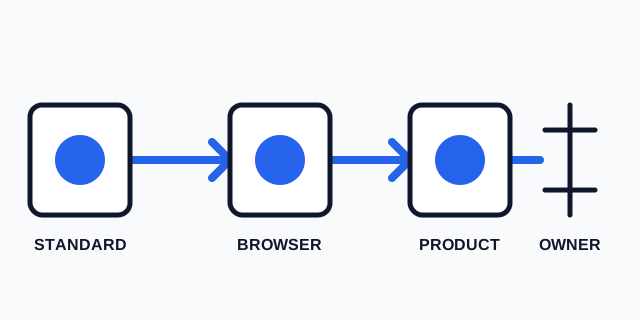
BotBrowser can repeat an authorized journey with a declared browser release, profile, route, and visible assertion. It cannot infer consent, identify people, decide legality, control service retention, prove server-side deletion, or guarantee third-party access. That boundary should be written before a product release review begins.
TL;DR
Review the changed browser data practice, the user control, the retention and access path, and the accountable owner. Use W3C Privacy Principles, RFC 6973, MDN, and official browser documentation to define terms. A controlled browser observation can support one narrow release claim; it cannot prove compliance, anonymity, deletion, or a universal result.
Contents
- Set the release boundary
- Map policy to public evidence
- Use bounded browser evidence
- Practical conclusion
Set the release boundary
Start with the user-visible change: a new permission, storage value, telemetry event, embedded feature, or retention rule. Name the observer and purpose. “The browser is private” is not a reviewable policy statement. “This release stores a synthetic preference in the documented origin scope, gives the user a reset action, and deletes the product record after the stated period” is reviewable because it names behavior and ownership.
Draw the data flow from page to browser, service, support tooling, and deletion process. Mark what the release owns and what belongs to a browser, network provider, or third-party service. Review cross-surface browser privacy when one change crosses several browser surfaces, and compare the release journey with privacy claims and product comparison.
Map policy to public evidence
Use W3C Privacy Principles for actors, purposes, necessity, and proportionality. Use RFC 6973 for privacy vocabulary such as linkability and detectability. Use MDN privacy and security and official browser documentation for implementation conditions, permissions, storage, and tracking controls. These sources explain principles or browser behavior; they do not certify a product release.
| Review item | Evidence and owner | Decision boundary |
|---|---|---|
| Collection purpose | Public policy clause; product owner | Necessary and proportionate, or revise |
| User control | UI copy, permission behavior; accessibility owner | Understandable, operable, and resettable |
| Retention and access | Schedule, deletion owner, service record | Duration and access are explicit |
| Browser behavior | MDN/official docs plus a synthetic fixture; release owner | Observation supports only the named context |
Use bounded browser evidence
Keep a release fixture small: one synthetic value, one route, one declared permission state, and one visible assertion. Record browser release, profile boundary, locale, expected result, observed result, source revision, and review date. Do not collect account content, credentials, customer identifiers, broad hardware inventories, or private operational details. If a server-side fact matters, assign it to the service owner and keep it separate from the browser receipt.
“The value was isolated in this fresh context” is a useful result. “No site can correlate the user” is not. “Deletion was requested” is different from “all copies were deleted.” Mark unknown, conditional, and out-of-scope results instead of filling gaps with a browser observation.
BotBrowser capability boundary
BotBrowser helps hold declared browser inputs steady and repeat an authorized journey. It does not decide consent or legality, control service retention, prove deletion, identify a person, or replace standards and governance evidence. A profile or proxy does not authorize third-party access. Keep browser receipts beside, not above, policy decisions and service records.
Practical conclusion
Ship only the narrow claim the evidence supports. The release record should name the changed behavior, public source clause, user control, retention trigger, owner, fixture result, exclusions, and re-review date. If a prerequisite is missing, postpone the claim or document it as conditional. A bounded review is complete when a later reader can understand what was tested, what remains unknown, and who must revisit it after a browser, policy, or service change.
Review questions for release owners
The first question is whether the change is actually new. A release can alter a browser permission prompt, a default storage scope, a fallback path, a network request, or the length of time a service keeps a receipt. A small code change can therefore change the data flow even when the feature name stays the same. Compare the old and new user journeys in plain language. Identify the point where data is created, read, transmitted, combined, retained, or removed. A reviewer should be able to point to that point without reading private code details.
The second question is whether the purpose is specific. “Improve the experience” is not enough to justify collecting a browser property. State the decision that needs the data and the minimum observation that can support it. A compatibility fallback may need a feature availability result. It may not need an entire device inventory. A support workflow may need a normalized error state. It may not need raw account content. The release record can explain the user benefit and the boundary, while the service record names the owner who confirms the purpose.
The third question is what the user can do. A permission can be denied, a setting can be reset, and a retention period can expire. The product should make those controls understandable and usable with a keyboard, screen reader, and zoomed layout. An accessible control is part of the privacy boundary because a user who cannot reach a reset or rejection path does not have the same practical choice. Test the visible label, status message, focus order, and fallback. Record an unavailable state separately from a denied state; they can require different product responses.
The fourth question is where the browser boundary ends. A page can observe local state, ask for a permission, and send a request. The service can then retain an event, attach it to an account, or share it with another processor. Browser evidence cannot answer those service questions. Assign each question to the owner who controls it. Put the service retention schedule, access roles, deletion receipt, and escalation contact beside the browser result instead of treating a browser screenshot as proof of a complete data lifecycle.
A release worksheet
Use one row for each changed practice. The row should contain a plain-language claim, the affected observer, the purpose, the data category, the user control, the source clause, the synthetic fixture assertion, the retention trigger, the owner, and the re-review condition. Add a status such as documented, observed, conditional, unknown, or out of scope. These labels are deliberately modest. “Documented” means a public source states a behavior or requirement. “Observed” means the owned fixture saw it under named inputs. “Conditional” means a prerequisite was present. “Unknown” means the available evidence cannot answer the question. “Out of scope” means the question belongs to an observer or service the test does not control.
Do not turn the worksheet into a data export. Keep synthetic values short and disposable. Do not place session tokens, customer names, account identifiers, full private URLs, or raw network metadata in a public article. When a route is private, describe its purpose and use an owned synthetic route for the demonstration. When the release depends on a managed browser policy, record the policy class and owner rather than publishing a policy file. This keeps the evidence useful without revealing an operational recipe or a customer environment.
Standards and implementation notes
Read a standard for the meaning and modality of a requirement. “Must,” “should,” “may,” and implementation-defined behavior carry different weight. Read MDN and official browser documentation for compatibility notes, secure-context requirements, permission states, and fallback behavior. Keep the retrieval date or version in the release record. A later source revision may clarify a term without changing the implementation, or a browser release may change the implementation while the normative requirement remains stable. The review should make those possibilities visible instead of silently replacing an old link.
RFC 6973 is useful when a team discusses linkability, detectability, or secondary use, but its vocabulary is not a product verdict. W3C Privacy Principles help identify actors, purposes, necessity, and proportionality, but they do not decide whether a particular release is lawful in every jurisdiction. MDN can explain a web-facing API, but it does not describe the retention practice of an application server. Keep the source beside the clause it supports and write a separate sentence for any product inference.
Bounded comparison after a browser update
After a browser release, rerun the same synthetic journey before changing the policy conclusion. Keep the route, locale, permission state, profile boundary, and assertion stable, and change only the browser version when that is the question. If the visible result changes, report the difference first. Do not guess that a privacy mitigation caused it without an additional source or fixture. A changed fallback may be a compatibility issue rather than a privacy regression. A changed permission state may reflect a managed policy. The record should preserve both the old and new observations and identify the owner of the follow-up.
Use a stop rule. Stop when the fixture answers the declared question, when the prerequisite is absent, or when the next step would collect data unrelated to the release decision. Do not expand a storage check into a broad browser-signal survey because the first result was inconclusive. Do not add real accounts because a synthetic page did not reproduce service behavior. Escalate the unanswered question to the service or policy owner and mark the browser check complete at its boundary.
Communicating the release decision
Put the condition next to the conclusion. “The synthetic preference was isolated in a fresh HTTPS context and the reset control cleared it” is actionable. “The browser protects privacy” is not. Explain what the reader can verify, which control to use, and when the evidence expires. A release decision can be positive, conditional, unknown, or deferred. Each is useful when the evidence and owner are visible. Avoid absolute words such as always, never, invisible, safe, blocked, and guaranteed unless the source and scope truly support them.
The public guidance should be readable without an internal ticket. It can link to public standards, describe a synthetic assertion, and state exclusions. It should not disclose collection recipes, customer information, private routes, credentials, or language intended to circumvent a site's controls. A product team can provide a safe next step such as reviewing a permission explanation, checking a documented reset, or contacting the service owner about retention. That is enough to make the boundary practical without pretending that the browser test governs the entire system.
Re-review triggers
Schedule another review when the browser release, specification wording, permission policy, profile class, route, data purpose, retention period, processor, or deletion workflow changes. Also review when an incident, accessibility finding, or support report shows that the documented user control does not work as expected. Keep the old record and create a new one; do not silently edit a historical observation. The old record explains which source and context supported the previous decision, while the new record explains why the decision changed or stayed the same.
The strongest release review is not the longest test. It is the clearest chain from a user-facing change to a public source, a minimal observation, a named owner, and an explicit limit. That chain gives product, privacy, accessibility, and service teams a shared decision without converting a browser receipt into a promise about identity or every third party.
Keep the decision easy to revisit. Store the source links, browser version, fixture name, expected assertion, and owner with the release record, and note when each item was checked. A later browser update may change a permission prompt or storage behavior without changing the product purpose. Repeating the same small journey makes that difference visible. If the result changes, show the old and new observations side by side and ask the service or policy owner to interpret the consequence. This gives customers a clear explanation of what changed, what remains controlled by the product, and what still depends on the browser or another service.
For customers, the useful outcome is a plain answer about their next action. They should be able to see why a permission is requested, decline it without losing an unrelated feature, and find the reset or deletion control later. A privacy notice should name the data category and retention period in language that matches the screen. When a browser setting changes, the product can explain the affected feature and offer a documented fallback. It should not ask the customer to provide a real account for a browser-only check. These details turn a narrow technical observation into a practical, respectful release experience.
The final review should also check defaults and recovery. A default that changes silently can alter the data flow for every new user, while an opt-in control gives the user a clear moment to choose. Verify the first-run explanation, the rejection path, and the reset path after a restart. Verify that a denied permission does not cause repeated prompts or a hidden retry. These checks are small, visible, and useful to both product and privacy owners.
Review the policy and interface as one experience. The policy should name the category, purpose, retention period, access roles, and contact route. The interface should state the immediate choice in plain language and make the current state visible. A long policy cannot repair an unclear prompt, and a concise prompt cannot promise a deletion outcome that the service has not confirmed. Keep the browser condition beside the browser statement and the service condition beside the service statement.
Accessibility is part of the privacy decision. Confirm that status updates are announced, keyboard focus remains visible, color is not the only state signal, and reset controls have meaningful names. Test a denied and unavailable permission separately because the fallback may differ. Record the assistive-technology setup and known variation, without implying that one setup covers every device or browser.
When the evidence is incomplete, preserve that state. An unknown retention period should create a service-owner task, not a broader browser claim. An unavailable fixture should create a compatibility question, not a conclusion that the feature is unsafe. If documentation and observation disagree, keep both records, identify the owner, and state what would resolve the disagreement. This makes the release decision auditable and prevents a temporary assumption from becoming a permanent promise.
Use a short handoff that any reviewer can read: what changed, what was observed, which public source supports the interpretation, what was not tested, and when to review again. The handoff can point to a documented setting or a synthetic reset check. It should never require a customer profile, a session secret, or an undisclosed operational route. Public reproducibility means that the reasoning and safe assertion are visible; it does not mean publishing private data.
The review also benefits from a change log. Record the browser release, policy revision, fixture revision, owner, and decision status. When a new release changes the result, compare the old and new observations under the same route and permission state before changing the policy text. A difference can be a compatibility change, a managed policy, or a source clarification. Report the difference first and assign a follow-up rather than guessing at a cause.
Sources
Related Articles
Take BotBrowser from research to production
The guides cover the model first, then move into cross-platform validation, isolated contexts, and scale-ready browser deployment.